- In the final hours of the 2026 session, Governor Gavin Newsom signed bills expanding virtual power plants, legalizing plug-in balcony solar, and easing solar development on farmland — while vetoing AB 1813, the legislature’s latest attempt at a workable community solar program.
- The veto keeps California — the state that pioneered rooftop solar — without a scalable way for renters and shaded homes to subscribe to local shared solar.
- Industry groups cheered the VPP measures but say the community solar veto leans on outdated cost assumptions, citing analyses that put the savings from a real program at $4.6–$6.5 billion over 20 years.
California’s 2026 legislative session ended with a split screen for clean energy. In the final hours of September 30, outgoing Governor Gavin Newsom signed bills expanding virtual power plants and plug-in solar — then vetoed AB 1813, the latest attempt at a viable community solar program, pv magazine USA reported.
Newsom acted on 1,160 bills during the session, signing dozens and vetoing a few in the closing hours. The energy bills that survived his pen — and the one that didn’t — together tell the story of a state trying to squeeze more out of the grid it already has, while still deadlocking on who gets to share in the solar boom.
The wins: virtual power plants get a real pathway
The centerpiece signings were SB 905 and SB 913, both authored by Senator Josh Becker, which pv magazine USA describes as an aggressive push to lower utility bills by calling on coordinated networks of customer-owned batteries, smart thermostats and EVs instead of building expensive new grid infrastructure.
SB 905 establishes a grid utilization metric for the distribution and transmission grids, requiring the state’s largest utilities to track and report how full their wires run — and giving the California Public Utilities Commission (CPUC) a pathway to set mandatory utilization targets. Many circuits sit well below capacity most of the year and only fill up for a few hours annually; the metric lets regulators push utilities to serve more load on existing wires through flexibility rather than costly expansion.
SB 913 directs the CPUC to establish a valuation methodology for virtual power plants made up of customer-sited batteries that export to the grid during periods of stress. That matters because fleets of customer devices have historically been shut out of California’s Resource Adequacy market — the mechanism that pays resources to guarantee grid reliability — receiving credit only for reducing an individual home’s consumption. Regulators now have until June 30, 2028, to finalize rules giving VPPs a clear route to compete alongside conventional gas power plants.
“Customer batteries are already moving electricity usage away from the hours that are most expensive for utilities, but these new laws will take that to another level by operating batteries as a network that can more precisely target the hours when utility costs spike,” said Brad Heavner, executive director of the California Solar and Storage Association. “Resources installed on garages and campuses can provide energy cheaper than building new power lines to faraway power plants.”
The Solar Energy Industries Association welcomed the signings. “SB 913 will modernize rules to allow aggregated distributed energy resources to help stabilize the grid and lower electricity prices at times of peak demand,” said Stephanie Doyle, SEIA’s California state affairs director, in a statement.
Plug-in solar, recycling, farmland and transmission
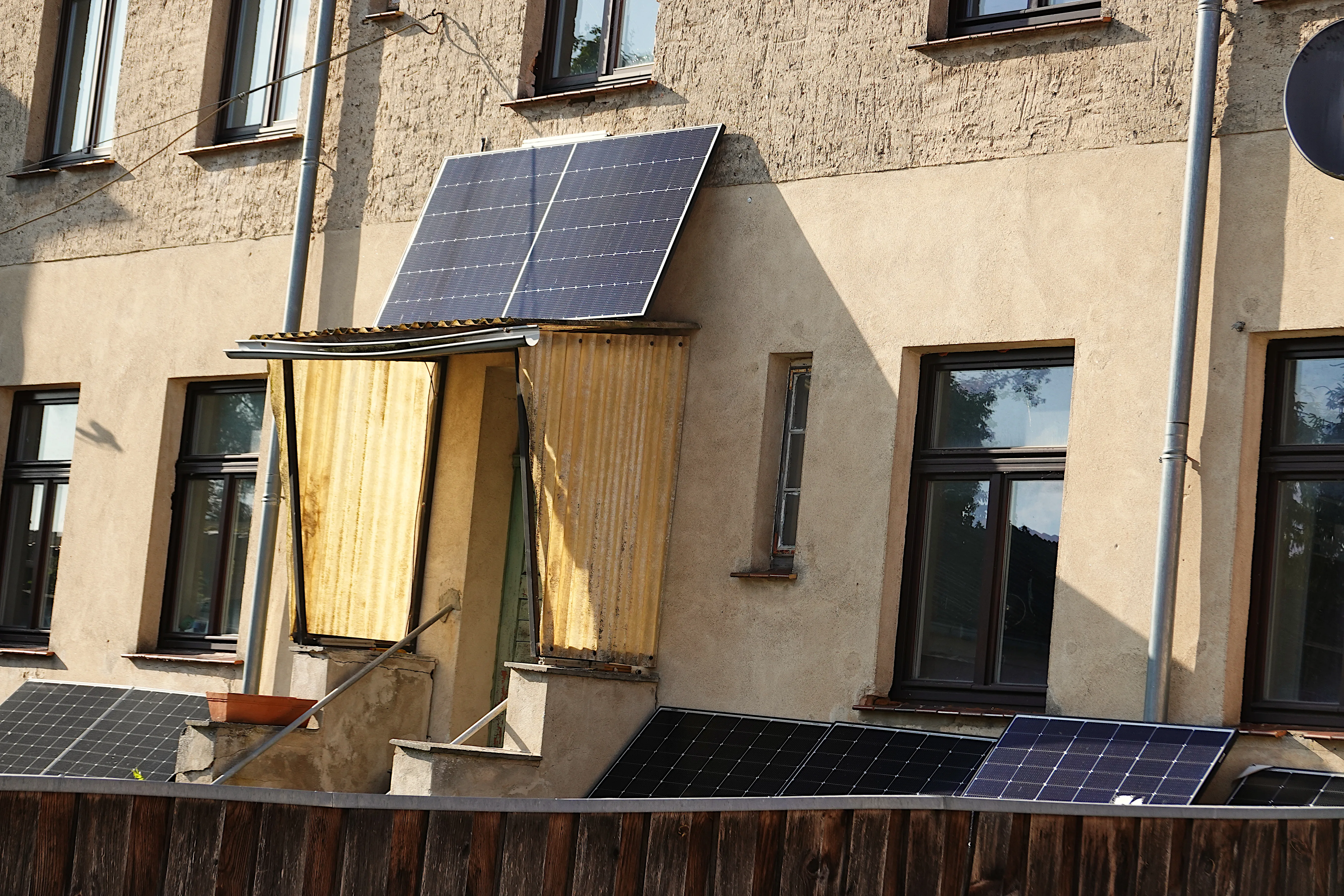
Also signed were measures legalizing balcony (plug-and-play) solar: small systems of up to 1,200 watts AC that residents can install without utility interconnection, provided they are UL-certified and shut down automatically during outages. Energy-Storage.News reports the provisions remove utility barriers for renters — significant in a state where roughly 14 million rental units, about 40% of households, could benefit. California joins states including Utah, Colorado, Maryland and Virginia; Germany leads globally with more than one million balcony installations as of June 2025, according to BSW Solar.
Three more signed bills filled out the package: AB 864 directs the Department of Toxic Substances Control to evaluate federal hazardous-material reclamation standards for recycling decommissioned solar panels; AB 1156 amends the Williamson Act so farmers can convert distressed agricultural land into solar facilities; and AB 2493 requires the CPUC to establish a transmission development monitor by October 1, 2027.
One notable absence from the win column: Newsom blocked continued funding for the Demand Side Grid Support program, California’s existing VPP initiative, which enrolled over 1 GW of customer battery capacity in 2025, including systems from Sunrun and Tesla. Participants will shift to the CPUC’s Emergency Load Reduction Program, a five-year pilot — a move Energy-Storage.News notes some see as a missed opportunity, since it rewards demand reduction only during emergencies rather than in normal operations.
The veto: community solar blocked again
AB 1813 — the Community Renewable Energy Program Act of 2026, authored by Assemblymember Chris Ward — would have created a statewide community solar framework letting residents subscribe to local, shared solar projects and receive credits directly on their utility bills, no roof required. It would have directed the CPUC to evaluate community solar facilities, particularly those paired with battery storage, as load-modifying resources rather than wholesale generators, unlocking credits based on the CPUC’s avoided cost calculator.
The bill capped individual projects at 5 MW of generation plus 5 MW of storage and total program capacity at 4 GW or seven years of enrollment, and required the California Energy Commission to assess load-modifying potential by December 2027. It passed both houses and reached Newsom’s desk on September 14 — the latest attempt after the CPUC finalized what advocates called an “unworkable” community solar program under 2022’s AB 2316, also authored by Ward.
Newsom called the bill “structurally flawed,” writing that it “would effectively require an administratively set price for the generation of power that exceeds the value that generation provides to the grid.” His veto message added that the independent Public Advocates Office estimated the bill could cost ratepayers an additional $1.5 billion annually, “without delivering reliable, high-performance capacity to the grid at the times we need it.”
Industry advocates pushed back hard. “Governor Newsom’s veto of AB 1813 is a missed opportunity for California ratepayers, low-income households, and the state’s renewable energy economy,” said Aaron Halimi, founder and CEO of community solar developer Renewable Properties. He argued the veto relies on outdated cost assumptions, while an Aurora Energy Research analysis found AB 1813 could have saved California ratepayers $6.5 billion in total system costs over 20 years versus utility-scale alternatives. An August study from UCLA’s California Center for Sustainable Communities argued the CPUC’s framework — which compensates community solar only at wholesale rates — makes projects financially unviable while refusing to apply the tools that would reveal their value, estimating $4.6 billion in potential savings over 20 years.
“We are disappointed to see Governor Newsom continue to prevent the Golden State from establishing a viable, scalable community solar,” said SEIA’s Doyle, adding that the industry looks forward to working with legislators and the next governor on a program “that Californians want and deserve.”
Why it matters
California is living a paradox: the state that built the US rooftop solar market has some of the nation’s highest electricity bills, and the two facts are increasingly tangled in the same policy fights. The VPP and grid-utilization bills attack the cost problem from the infrastructure side — if customer batteries and smarter use of existing wires can defer transmission spending, everyone’s bills benefit. The community solar veto, by contrast, keeps solar closed to the renters, apartment dwellers and shaded-home owners who make up most of the state.
The political calendar adds stakes. Newsom is outgoing, and implementation of the signed bills will fall to the CPUC and the next governor — CALSSA’s Heavner made exactly that point: “Gov. Newsom has done his part. Implementation of the bill at the CPUC under the next governor will determine whether customers see lower bills.” Community solar advocates get another cycle to regroup; whether a fourth attempt fares better than the third remains to be seen.
What to watch next
Watch the CPUC’s VPP valuation rulemaking first — the June 2028 deadline is the real test of whether aggregated home batteries can earn reliability payments on par with gas peakers. Then watch the transmission monitor, due October 2027, for data on whether utilities are building on schedule. And on community solar, watch Sacramento: with a new governor and legislature, the issue that AB 1813 couldn’t close will almost certainly be back.