- ARRAY Technologies (NASDAQ: ARRY) opened a $50+ million, 216,000-square-foot manufacturing facility in Albuquerque, New Mexico, roughly triple the size of its previous local site.
- The plant will support about 300 jobs and lets ARRAY bring tracker-component production in-house, with torque tubes and structural fasteners qualifying for Section 45X credits worth 87¢/kg and $2.28/kg respectively.
- ARRAY ranks third globally among tracker makers behind Nextpower (Nextracker) and Trina Tracker in Wood Mackenzie’s H1 2025 rankings. The new plant is a bid to close that gap on bankability as well as cost.
The company celebrated the opening with a ribbon-cutting ceremony on September 9, marking a tripling of hometown output for solar tracker production.
The facility spans 216,000 square feet, roughly triple the size of ARRAY’s previous Albuquerque site, and will support approximately 300 jobs across production, assembly, design, engineering, customer service, and other functions. Founded and headquartered in Albuquerque for more than 35 years, ARRAY has grown into a global solar technology company with more than 100 GW of tracker deployments worldwide.
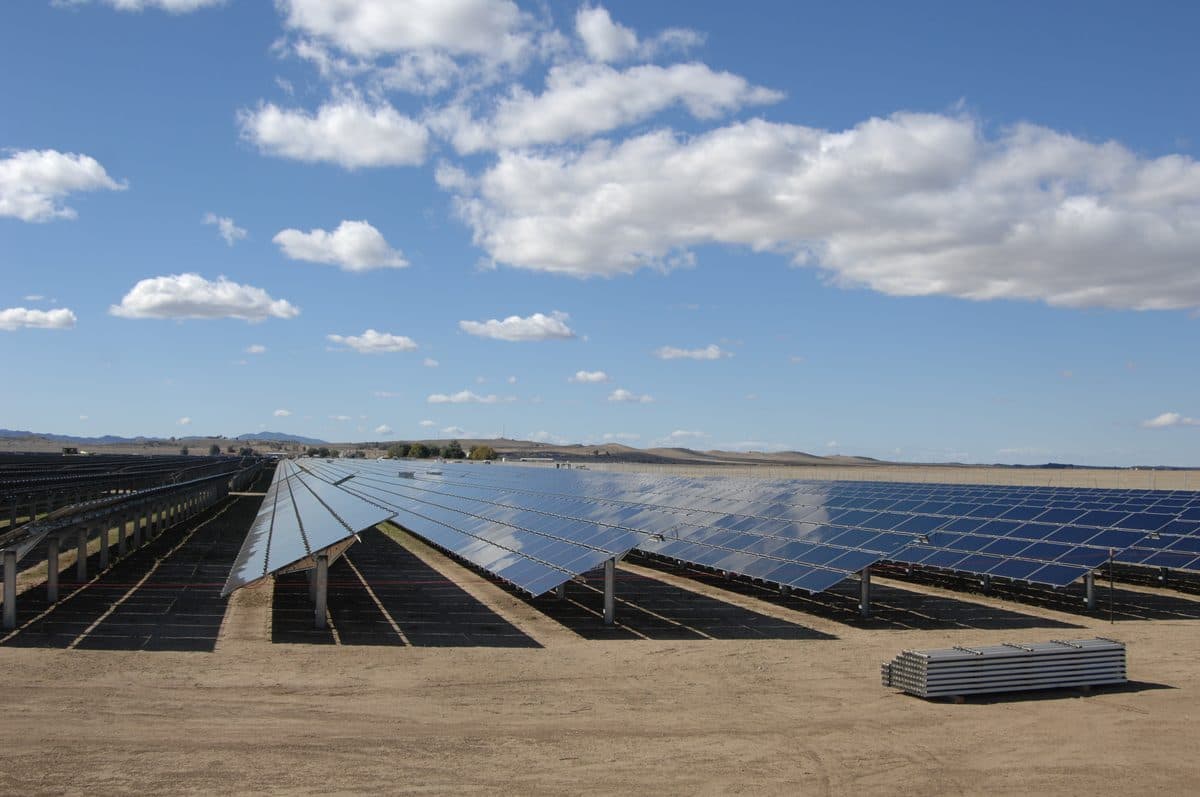
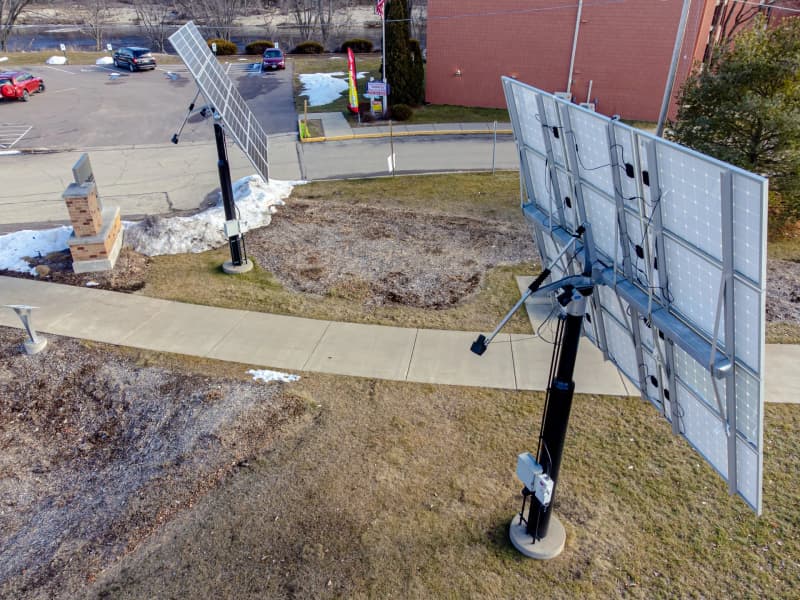
Trackers, the motorized steel structures that tilt solar panels to follow the sun, are the quiet workhorses of utility-scale solar. A tracker can boost a plant’s energy yield by 10 to 25 percent compared with fixed mounts, and the hardware is essentially industrial steel fabrication: heavy, bulky, and expensive to ship. That makes it a natural candidate for domestic manufacturing, and ARRAY’s new plant leans into exactly that logic.
Third place, and what it costs
ARRAY is not the company to beat in this market; it is the company chasing. In Wood Mackenzie’s global PV tracker manufacturer rankings for the first half of 2025, Nextpower (the renamed Nextracker) took the top spot, Chinese manufacturer Trina Tracker came second, and ARRAY placed third among 24 evaluated manufacturers across five countries. Notably, Wood Mackenzie’s methodology weights ESG and supply-chain resilience at 30%, the largest single factor, ahead of shipment volume. That is precisely the contest ARRAY is trying to enter: not who ships the most steel, but who can document the cleanest, most bankable bill of materials.
The Albuquerque plant is the physical expression of that strategy. Tracker contracts are won on bankability as much as on price: lenders and tax-equity investors want supply chains that will not be disrupted by trade cases or component shortages. Owning the factory floor, rather than renting capacity from third-party fabricators, gives ARRAY tighter control over quality, lead times, and the documentation trail that underpins domestic-content claims.
Vertical integration, with a tax credit attached
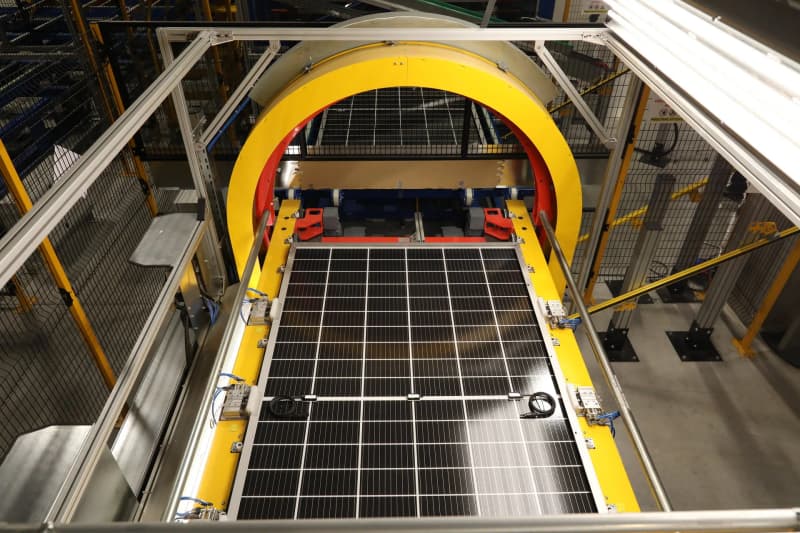
Built around lean manufacturing principles, the facility lets ARRAY bring production in-house for components it has historically sourced from outside suppliers. That matters for two reasons: control over supply chains and delivery times, and eligibility for the Section 45X Advanced Manufacturing Production Tax Credit. Under the Treasury’s final rules, tracker components carry specific credit values: torque tubes earn 87 cents per kilogram, and structural fasteners earn $2.28 per kilogram. For a product that is essentially fabricated steel sold by weight, those per-kilo credits translate directly into lower cost of goods sold, a structural margin advantage over imported equivalents that compounds across every project.
The credits are not permanent: the full rate applies to components sold through 2029, then phases down to 75% in 2030, 50% in 2031, and 25% in 2032. ARRAY’s timing (bringing domestic tracker capacity online now) captures the maximum-credit window.
| Item | Value |
|---|---|
| Torque tubes | 87¢/kg |
| Structural fasteners | $2.28/kg |
| Credit rate, components sold through 2029 | 100% |
| 2030 | 75% |
| 2031 | 50% |
| 2032 | 25% |
CEO Kevin Hostetler framed the investment as a long-term bet on American manufacturing, saying the expansion strengthens the company’s supply chain and creates skilled career opportunities in Albuquerque, where the company was founded more than 35 years ago.
The jobs are the kind that don’t require a college degree to start: the company cited openings including stamping press operators, tooling and die technicians, and process engineers. The LEED-certified building is designed to support current production needs while leaving room for future growth across the company’s broader portfolio.
Public money, private risk
The facility came together through a public-private partnership: $2.5 million from New Mexico’s Local Economic Development Act (LEDA) job-creation fund, plus $250,000 each in LEDA funding from the city of Albuquerque and Bernalillo County, and partial property-tax abatement through an Industrial Revenue Bond. Against a $50+ million project, the public contribution is modest, roughly 6%, which cuts both ways: taxpayers are not heavily exposed, but the subsidy alone did not make the project pencil out. The 45X credits, not the LEDA grants, are the financial engine here.
Trackers vs modules: where domestic content wins
Most headlines about U.S. solar manufacturing focus on modules, and there have been plenty lately, from SEG Solar’s new HJT production line in Tomball, Texas, to TOYO’s $240 million in binding U.S. module supply agreements announced the same month, and utility-scale demand keeps absorbing the output (see Mitsui’s 150 MW Texas solar farm, now live). But trackers are where a different dynamic plays out. Unlike cells and wafers, tracker components are steel-intensive and freight-sensitive, which means domestic production has a structural cost argument even before subsidies.
ARRAY’s move is also a bet on what its utility-scale customers are being asked to prove. With foreign-entity-of-concern sourcing rules tightening on clean-energy tax credits and domestic-content adders worth real money, developers increasingly need to document where their equipment comes from. A vertically integrated U.S. tracker supply chain, eligible for 45X credits that directly lower the cost of goods sold, gives ARRAY something its offshore-dependent competitors can’t easily match: a paper trail.
The demand question, answered with data
The obvious risk in building factory capacity is overbuild: what if the projects don’t materialize? The data here is genuinely mixed, and worth stating plainly.
On the bullish side, the pipeline is enormous. According to the SEIA/Wood Mackenzie Solar Market Insight Q2 2026 report, developers safe-harbored between 216 and 240 GWdc of utility-scale projects ahead of the July 2026 deadline, and Wood Mackenzie senior analyst Caitlin Connelly notes that this pipeline underpins the near-term market even after accounting for attrition. Globally, the buildout is even larger (see our 2026 solar installations forecast). Q2 2026 installations rebounded 45% year-on-year to 11.4 GWdc, with utility-scale up 61%. For a tracker maker, that is a deep order book.
A sense-of-scale check: ARRAY has deployed more than 100 GW of trackers over its 35-year history. The U.S. installed 11.4 GWdc of solar in a single quarter (Q2 2026), an annualized run rate near 45 GWdc, or almost half of ARRAY’s lifetime total in one year. The market no longer needs convincing that trackers sell; it needs suppliers who can document domestic content, hold lead times and survive the 45X phase-down. That is the competitive set the Albuquerque plant was designed for.
On the cautious side, SEIA and Wood Mackenzie now expect U.S. solar capacity additions to stay essentially flat from 2026 through 2031, a doubling of the fleet over five years, but stagnation in annual additions after years of growth. Interconnection queues remain clogged, interest rates are keeping project financing expensive, and residential solar just posted its weakest quarter in five years. ARRAY is adding capacity into a market that is large but no longer accelerating.
That context reframes the Albuquerque bet. This is not a capacity play for a booming market; it is a share play for a maturing one. With growth slowing, tracker contracts will be fought over bankability, domestic content, and documented supply chains rather than sheer volume. That is exactly the fight a vertically integrated, 45X-eligible U.S. factory is built to win. Whether it is enough to move ARRAY past Trina Tracker into second place globally is the question the next two years of order books will answer.