
- Net metering is a billing rule, not a subsidy. It credits rooftop solar owners for surplus electricity they export to the grid, usually offsetting the power they draw at night or on cloudy days.
- Utilities and solar owners disagree on the price. Utilities say retail-rate credits let solar owners dodge fixed grid costs; solar advocates say exported solar reduces peak demand and grid strain.
- California rewrote the rules in 2023. Its “NEM 3.0” cut the average export credit from about 30¢ to about 8¢ per kWh — the largest cut of its kind in U.S. history.
How net metering actually works
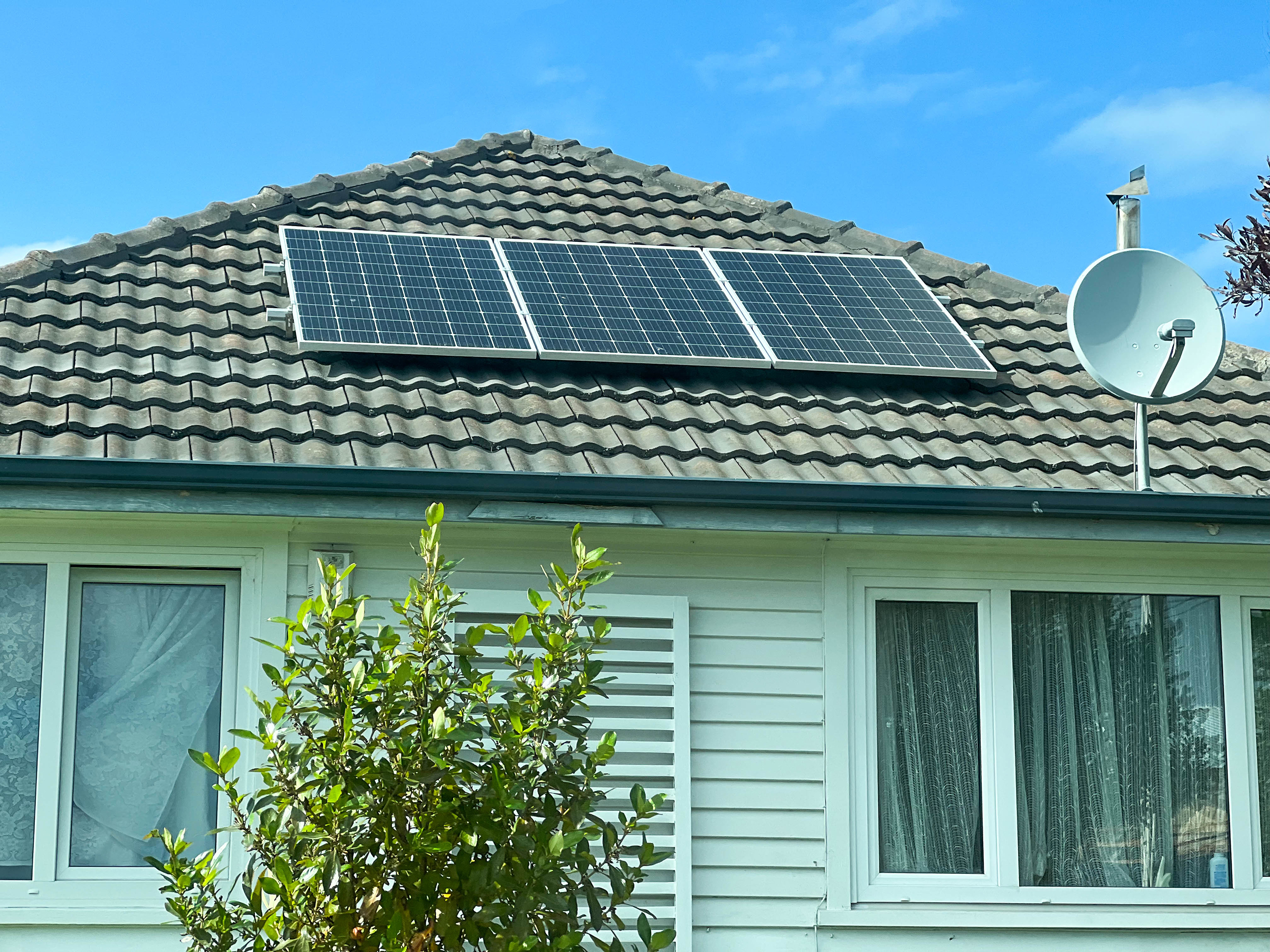
Solar panels produce the most electricity in the middle of the day — often more than the home beneath them is using. Without net metering, that surplus power would have nowhere useful to go. With it, the excess flows into the grid and the owner’s electricity meter effectively runs backward, banking credits that offset the power the household draws later, such as at night.
The Solar Energy Industries Association (SEIA) defines it plainly:
“Net metering is a billing mechanism that credits solar energy system owners for the electricity they add to the grid. … Customers are only billed for their ‘net’ energy use.” — SEIA
Technically this is handled by a bi-directional meter, which records electricity flowing both into the house and back out to the grid. At the end of each billing cycle, the utility nets the two numbers. If you imported more than you exported, you pay for the difference. If you exported more, the credit usually rolls over to the next month.

What happens to a big surplus at the end of the year depends on local rules. In some states, excess credits simply roll over month to month; in others, any unused balance at year-end is paid out at the lower wholesale rate rather than the retail rate, or expires. On average, only 20 to 40 percent of a solar array’s output ever goes to the grid at all, according to SEIA.
Who sets the rules: it’s the states, not Washington
There is no national net metering law in the United States. Each state — and often each utility — writes its own version. According to SEIA, 34 states plus Washington, D.C. and Puerto Rico have mandatory net metering rules in place, catalogued in the Database of State Incentives for Renewables and Efficiency (DSIRE).
That patchwork is in constant flux. A 2025 review by the NC Clean Energy Technology Center found that about one-third of U.S. states are either offering alternatives to traditional net metering or making significant revisions to it, as reported by pv magazine USA. The trend is away from the original one-to-one deal and toward more granular alternatives:
- Net billing: exports are credited at a separate, usually lower, rate instead of the retail price. Virginia’s proposed successor program, for instance, would use 30-minute netting intervals and compensate excess generation based on prices from distributed-solar power purchase bids.
- Shorter netting intervals: two Nevada utilities have filed to move from monthly netting to 15-minute netting for systems under 25 kW, which sharply reduces how much daytime surplus can cancel out evening imports.
- Avoided-cost credits: Arizona regulators have been reviewing an “avoided cost proxy” credit rate — essentially paying solar owners what the utility would otherwise spend generating or buying that power — with a 10 percent annual cap on changes.
Why utilities and solar owners fight about it
The original version of net metering, often called NEM 1.0, credited every exported kilowatt-hour at the full retail electricity rate — the same price the customer pays per kWh. Solar owners love this arrangement, because it makes the grid act like a free battery: export at noon, draw back at night, and pay only the difference.
The utility argument is that retail rates bundle two things together: the cost of generating electricity and the fixed costs of running the grid — poles, wires, substations, maintenance crews. A net-metered customer who zeroes out their bill with solar credits still relies on that grid every night, the argument goes, but stops contributing to its upkeep. Utilities call this a cost shift: the fixed costs don’t disappear, they get pushed onto customers without solar. The Arizona Corporation Commission has explicitly cited the cost-shift argument in its deliberations.
The solar industry’s counterargument is that exported solar power has real value utilities don’t acknowledge. SEIA notes that net metering creates a smoother demand curve, lets utilities better manage peak loads, and — because generation happens near the point of consumption — reduces strain on distribution systems and avoids losses from long-distance transmission. Cost-benefit studies of distributed solar in various states have found that rooftop solar can defer expensive grid upgrades. In the industry’s view, the “free battery” framing ignores what the grid actually receives in return.
Both sides have a point: it’s a disagreement about the true value of a kilowatt-hour injected into the grid at noon on a sunny day. That value genuinely differs from place to place and hour to hour — and that observation is what eventually blew up the system in California.
California’s NEM 3.0: the flashpoint that changed everything
In December 2022, the California Public Utilities Commission (CPUC) unanimously approved a new net billing tariff — universally known as NEM 3.0 — that took effect on April 15, 2023. It slashed the average rate credited for exported rooftop solar from about $0.30 per kWh to about $0.08 per kWh, a cut of roughly 75 percent, according to pv magazine USA. It was the largest cut to rooftop solar export payments in U.S. history, in a state that represented roughly half of the nation’s residential solar market.
The logic behind the cut was the mismatch described above. Under the old one-to-one credit, Californians were exporting enormous volumes of midday solar — deepening the famous “duck curve,” where net grid demand plunges at midday and spikes at sunset — and being paid full retail price for power the grid barely needed at that hour. NEM 3.0 replaced the flat credit with time-varying export rates tied to the wholesale value of electricity: industry estimates put the average around 5 cents per kWh, with midday exports worth as little as 2 to 4 cents — while evening exports during a September peak window can pay as much as $3 per kWh.
The solar industry’s reaction was furious. Ken Cook, president of the Environmental Working Group, said: “What the CPUC did today is a disgrace and a disservice not only to Californians, but to the nation.” Roger Lin, an energy justice attorney at the Center for Biological Diversity, said: “California regulators just rammed through a plan to make rooftop solar more expensive as the climate crisis spirals out of control.”
The economics for new California solar customers genuinely changed, and the fight didn’t end in 2023: in 2025, a state bill (AB 942) proposed moving even customers grandfathered into the old rates onto the cheaper NEM 3.0 structure — a move pv magazine USA reported would raise a typical solar customer’s bill by about $63 a month.
What this means if you’re thinking about rooftop solar
Net metering is usually the single biggest factor in whether rooftop solar pays for itself — and the rules where you live are what matter, not the national debate. Three practical takeaways:
- Look up your state and utility. The DSIRE database catalogs net metering rules state by state. Rates, netting intervals, and rollover rules vary enormously, and a third of states are actively revising them.
- Batteries change the math. Where export credits are low — as under California’s NEM 3.0 — storing midday solar and using it in the evening is worth far more than exporting it. Industry analyses suggest the NEM 3.0 structure strongly rewards pairing solar with home batteries.
- Grandfathering matters. When states revise their rules, existing customers are often locked into the old rates for a decade or more. In a market where the rules can change, the timing of your installation can be worth real money.
Net metering began as a simple idea — spin the meter backward — and grew into one of the most consequential energy policies in America. Whatever form it takes next, the underlying question isn’t going away: what is a rooftop kilowatt-hour actually worth, and who gets to decide?