- New Mexico’s $20 million Local Solar Access Fund has cut energy costs by an average of 53 per cent at public buildings, overwhelmingly in rural communities.
- 31 of the 34 grants approved so far (91 per cent) serve rural areas — comfortably above the 60 per cent minimum written into state law.
- With $18 million of the $20 million already awarded in project grants, the fund shows how temporary fossil-fuel revenue can be redirected into local clean energy.
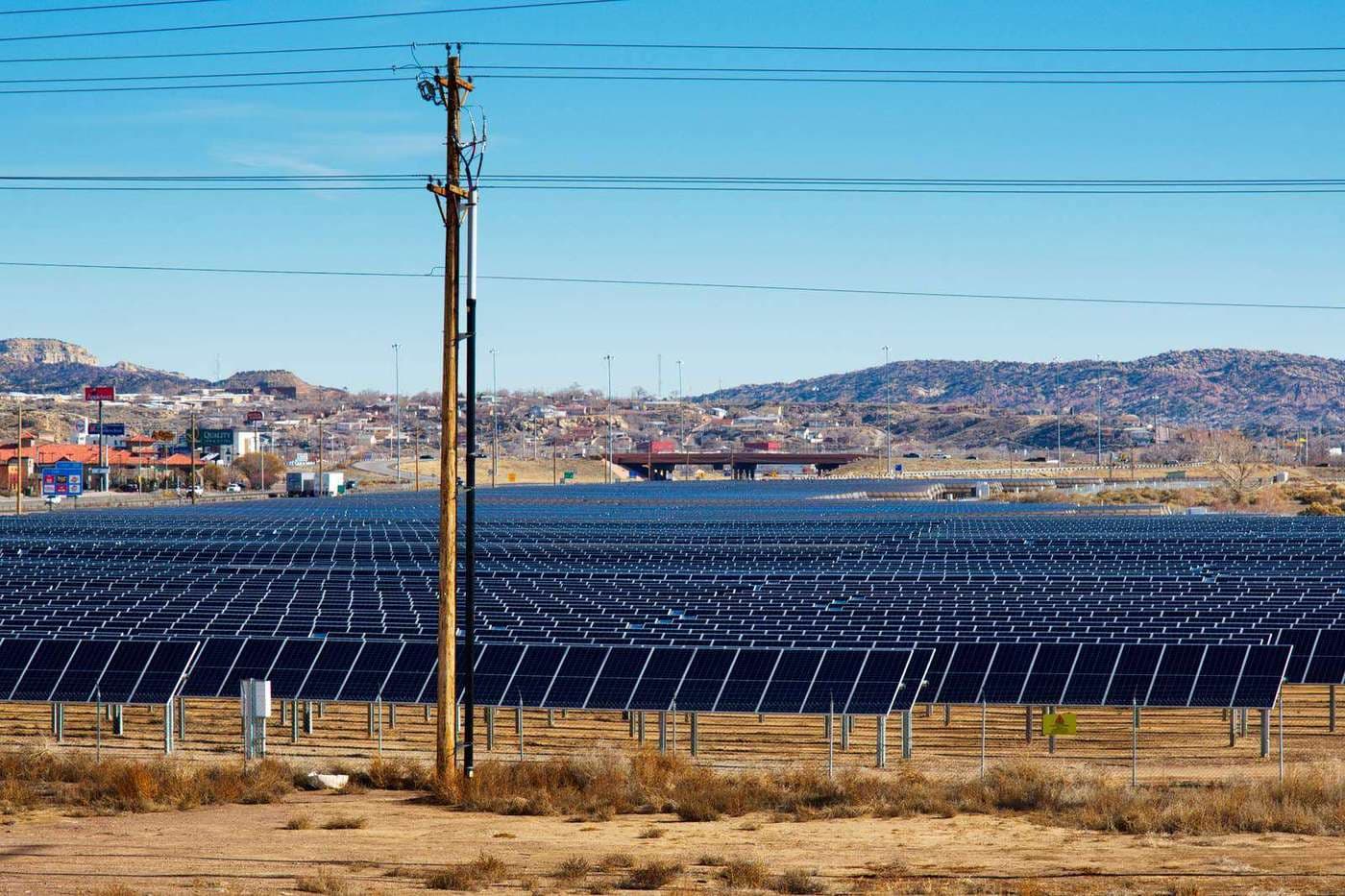
New Mexico solar grants are delivering some of the most striking savings numbers in American community solar. Testifying on 6 October before the interim Finance Authority Oversight Committee, programme chief John Brooks of the New Mexico Finance Authority said solar projects at public buildings have cut energy costs by an average of 53 per cent for predominantly rural communities. According to Source New Mexico’s report on the hearing, 34 grants have been approved to date under the $20 million Local Solar Access Fund, and 31 of them — 91 per cent — serve rural areas, far above the 60 per cent legal floor set by the legislature.
The figures put hard data behind a policy experiment that is being watched well beyond the state’s borders: a fund created from temporary oil-and-gas revenue surpluses, channelled into solar and battery storage on the schools, libraries, fire stations and water systems of New Mexico’s smaller communities.
New Mexico solar grants: what the latest numbers show
The fund has moved quickly. In September 2026, 21 project grants totalling $18 million were awarded, with a maximum of $1 million per project. Three months earlier, in June 2026, 13 technical assistance grants totalling $650,000 went out — each worth up to $50,000, with 92 per cent going to rural applicants to help them plan and design projects before construction begins.
That two-track design matters. Small municipalities and tribal governments often lack the engineering staff to develop a bankable solar project on their own; the technical assistance grants bridge that gap, and the pipeline of 34 approved grants suggests the approach is working. The fund’s structure was laid out when it was established — pv magazine USA covered the fund’s creation in April 2025 — and the early results reported by Brooks show the model delivering ahead of expectations.
Who qualifies for the solar access fund
Eligibility is aimed squarely at public institutions rather than individual homeowners. Counties, municipalities, school districts and tribal governments can apply, and grants cover solar panels plus battery storage installed on schools, libraries, fire stations and water and wastewater infrastructure.
The inclusion of water and wastewater infrastructure is a detail worth pausing on. In rural New Mexico, water pumping and treatment are among the most electricity-intensive — and expensive — municipal operations. Shaving the power bill of a water system frees up money in the local budget for everything from road maintenance to emergency services. Adding storage alongside solar also gives these critical facilities a measure of backup power when the grid fails, a resilience benefit that community solar paired with batteries has demonstrated in other states.
For readers new to the underlying technology, our guide explains how solar panels convert sunlight into electricity and why pairing them with storage transforms a daytime-only resource into round-the-clock capacity.
Oil revenue repurposed: how the fund was created
The Local Solar Access Fund was created by House Bill 128, passed by the New Mexico legislature in 2025, and capitalised from temporary surpluses in oil-and-gas revenue. The funding source is as important as the spending: rather than drawing on general taxation or utility ratepayer funds, the state redirected a slice of boom-time fossil-fuel income into permanent local energy infrastructure.
That design gives the fund a political durability that many clean-energy incentives lack. Fossil-fuel revenues are cyclical, but the projects they are financing — arrays on schools and water plants with 25-year operating lives — keep producing savings long after the wells are capped. It is a model that other resource-rich states could copy without touching their operating budgets, and it explains why the programme page at Public Power New Mexico has attracted attention from policymakers elsewhere.
Why it matters
These numbers are worth putting in context. National Renewable Energy Laboratory research, summarised by CleanTechnica’s analysis of low- and moderate-income community solar, finds that the average US residential community solar subscription saves subscribers about 10 per cent on their electricity costs over the life of the subscription. New Mexico’s public-building projects are reporting 53 per cent — more than five times that benchmark.
The comparison is not perfectly like-for-like: subscription savings reflect bill credits flowing to individual households, while New Mexico’s 53 per cent figure reflects whole-facility energy cost reductions on public buildings, where high daytime consumption and onsite generation align especially well. But the gap is large enough to make the point clearly: community solar in rural areas, deployed directly on the buildings that consume the power, can deliver savings far beyond what typical subscription models achieve.
The second data point is deployment pace. $18 million of the $20 million fund has already been awarded in project grants — 90 per cent committed within roughly a year of the fund becoming operational. That is a strikingly fast absorption rate for a state grant programme, and it suggests demand from local governments far exceeds what one year’s fossil-fuel surplus could provide.
Large solar projects elsewhere in the US show the same logic at bigger scales — from utility-scale arrays like DTE’s Cold Creek project in Michigan to major commercial installations such as the 12MW solar carport at Six Flags Magic Mountain. New Mexico’s contribution is to show that the economics work just as well at the scale of a county fire station or a school district in a town of a few thousand people.
What happens next
With the bulk of the project-grant funding committed, attention shifts to construction, commissioning and the longer-term question of whether the 53 per cent savings figure holds once all 34 projects are operational. The rural skew of the awards — 91 per cent against a 60 per cent legal minimum — also sets a precedent that future rounds will be measured against.
For now, the fund stands as a proof of scale: community solar plus storage, targeted at the public buildings of small and rural communities, delivering some of the steepest energy cost reductions reported anywhere in the US — and paid for by yesterday’s fossil-fuel revenues.