
- Perovskite solar cells degrade when exposed to heat, moisture, and light — the same conditions every solar panel faces daily — making stability the single biggest barrier to commercialization.
- Recent breakthroughs are closing the gap: encapsulated modules now pass the IEC 61215 damp-heat test, with some retaining 95% of efficiency after 1,500+ hours of brutal 85°C/85% humidity exposure.
- The industry target is a 25-year warranty to match silicon, but no perovskite product has more than a few years of real-world field data — bankability, not physics, is now the binding constraint.
Perovskite solar cells have a durability problem. The same crystal structure that makes them so good at converting sunlight into electricity — cheap to make, easy to tune, astonishingly efficient — also makes them fragile. Heat breaks them down. Moisture dissolves them. Ultraviolet light ages them. And a solar panel that cannot survive twenty years on a rooftop is a laboratory curiosity, not a product.
This is the central tension in the most exciting solar technology of the decade. Lab efficiencies keep climbing — LONGi hit 35.5% on a perovskite-silicon tandem in July 2026 — but every efficiency record lands with the same asterisk: can it last? For an industry built on 25-year warranties and 30-year project finance, the answer matters more than the efficiency number.
Why perovskites fall apart
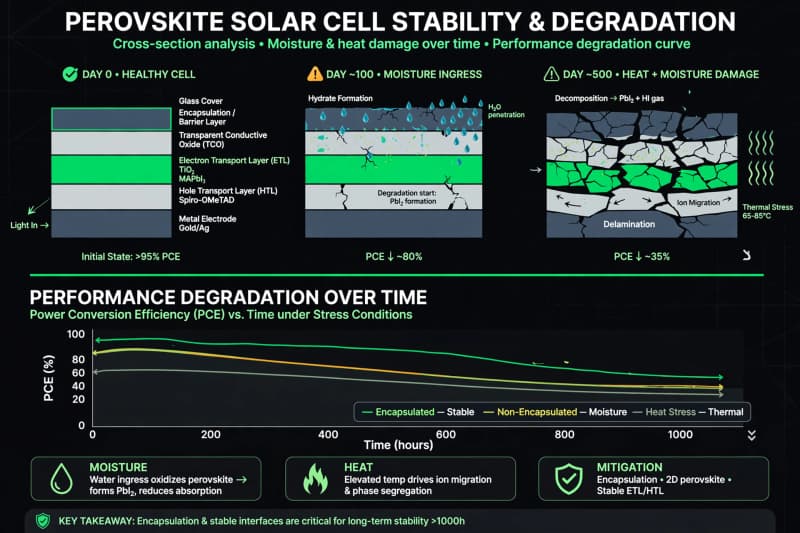
To understand the stability challenge, it helps to know what a perovskite actually is. The name refers to a crystal structure — ABX3 — typically built from lead, iodine, and an organic molecule like methylammonium. That organic component is the weak link. At temperatures a rooftop panel routinely reaches (65–85°C on a hot day), the organic molecules start to migrate and decompose. Water vapor accelerates the process dramatically: unprotected perovskite films can visibly degrade in hours in humid air.
There are four main degradation pathways researchers track. Thermal degradation breaks down the crystal at elevated temperatures. Moisture ingress dissolves the perovskite layer, particularly at grain boundaries. Light-induced degradation — including UV — creates defects that trap charge carriers and sap efficiency. And ion migration, where charged atoms drift under the panel’s own electric field, slowly rearranges the material from the inside.
Silicon shrugs off all of this. A silicon cell is a slab of ultra-pure crystal with no volatile components, which is why manufacturers confidently warranty panels for 25 to 30 years. Perovskites must earn that same trust from scratch.
The testing gauntlet
The solar industry measures durability against IEC 61215, the international standard for crystalline silicon module qualification. The headline test is damp heat: 1,000 hours at 85°C and 85% relative humidity. There is also thermal cycling (200 cycles from -40°C to 85°C), UV preconditioning, and mechanical load testing.
Passing these tests was unthinkable for perovskites five years ago. Now it is happening. Chinese researchers reported meter-scale perovskite modules using a lead-carboxylate passivation layer that lost only 2% of initial efficiency after 1,300 hours of damp-heat exposure — compared with 39% loss for modules using a conventional passivator. The same modules retained 96% of efficiency after 2,200 hours of maximum-power-point operation and 95% after UV aging, according to pv magazine.
Separate work on co-crystal engineering produced cells retaining over 95% efficiency after 5,000 hours of light soaking and over 91% after 5,000 hours at 85°C, with modules up to 48 cm² exceeding IEC commercial requirements, as reported by pv magazine. These are not incremental gains — 5,000 hours of continuous stress testing is roughly seven months of nonstop punishment.
Where the field stands in 2026
The honest summary: perovskite stability has moved from “fundamentally broken” to “plausibly solvable,” but the evidence is still mostly accelerated lab testing, not decades of rooftop data. Encapsulated tandem modules from GCL and UtmoLight have achieved IEC certification. Oxford PV, the furthest along commercially, ships modules with a 10-year warranty and targets 20 years by 2027 — still short of silicon’s 25-year standard.
Lead-free variants face an even steeper climb. Tin-based perovskites, the leading lead-free alternative, oxidize rapidly in air. A University of Toledo team recently claimed the most air-stable tin perovskite cell to date — 16.19% efficiency, retaining 95% after 1,600 hours in dry air — but that is still far below lead-based performance, per pv magazine.
Why it matters
Here is the data comparison that frames the whole debate. A utility-scale solar project is financed on 25- to 30-year cash flows, and lenders discount anything they cannot model. Silicon’s degradation rate — about 0.5% per year, backed by billions of installed modules — is bankable. Perovskite’s best accelerated-test results suggest comparable degradation is achievable, but accelerated tests are not field data, and financiers know the difference.
This creates a paradox: perovskite tandems could cut the levelized cost of solar electricity by generating 20–30% more energy from the same panel area, yet the first commercial projects must be financed as higher-risk pilots — with warranty escrows and performance bonds — precisely because the technology is new. The cost advantage only materializes at scale, and scale requires the bankability that only time can provide.
The realistic timeline, based on where testing stands: niche and early-adopter deployments through 2027, broader commercial availability as 20-year field data accumulates toward 2028–2029. Anyone promising 25-year perovskite warranties today is selling a projection, not a measurement. For more on how the efficiency story and the durability story fit together, see our coverage of perovskite-silicon tandem healing treatments pushing past 30% efficiency.
Frequently asked questions
How long do perovskite solar panels last?
There is no proven field lifespan yet. The best accelerated lab tests suggest 10–20 year durability is achievable, and Oxford PV currently warranties its tandem modules for 10 years. Silicon panels are warranted for 25+ years with decades of field data backing it.
What causes perovskite solar cells to degrade?
Four main factors: heat (breaks down the organic components), moisture (dissolves the crystal), UV light (creates efficiency-sapping defects), and ion migration (charged atoms drifting under the electric field). Encapsulation and chemical passivation are the main defenses.
Have perovskite modules passed industry durability tests?
Yes — several have now passed IEC 61215 damp-heat and related stress tests, including modules from GCL and Chinese research groups. But passing accelerated lab tests is not the same as demonstrating 25 years in the field, which no perovskite product has yet done.
AI illustration · Joule Post