
- Oxford PV is the only company shipping perovskite-silicon tandem modules commercially today — 24.5% efficiency panels delivered to a US utility customer in September 2024, with volume manufacturing targeted for 2027.
- Hanwha Qcells hit 28.6% on a full M10-size tandem cell using mass-production processes, positioning it for pilot-to-mass production in 2027 — the most credible near-term scale-up in the West.
- Chinese giants LONGi, Trina, and GCL are pursuing parallel tracks: LONGi holds the 35.5% lab record but has no mass-production plan, while GCL targets silicon cost parity at 3 GW of tandem production.
The perovskite solar industry in 2026 looks nothing like it did three years ago. The conversation has shifted from “will this ever leave the lab?” to “who is actually building it?” — and the answer is a surprisingly diverse mix of startups, legacy giants, and licensing plays, spread across the UK, Germany, the US, Korea, and China.
But “building it” covers a wide range of realities, from genuine commercial shipments to PowerPoint roadmaps. This is a field guide to who is actually making perovskite solar — and how seriously to take each claim.
Oxford PV: first across the line
Oxford PV, the UK-founded company manufacturing in Brandenburg an der Havel, Germany, remains the furthest along. In September 2024 it made the first commercial shipment of perovskite-on-silicon tandem modules — 24.5% efficiency, 72-cell format — to a US utility customer. Its current Centaur tandem series runs at roughly 25% module efficiency, with a 26% product planned, delivering up to 20% more energy from the same panel area than standard silicon, according to MarketsNXT.
Oxford PV’s strategy is notable for its dual track: manufacturing its own modules while licensing its technology — over 400 granted perovskite patents — to others. It licensed to Trinasolar for manufacturing in China (April 2025) and to First Solar for the US market, an ARM-style IP model that could put Oxford PV technology into far more panels than its own factories could ever produce.
The caveat: as of early 2026 the company still described its output as pilot products, targeting mass production in 2027 and a 20-year product lifetime — up from the current 10-year warranty.
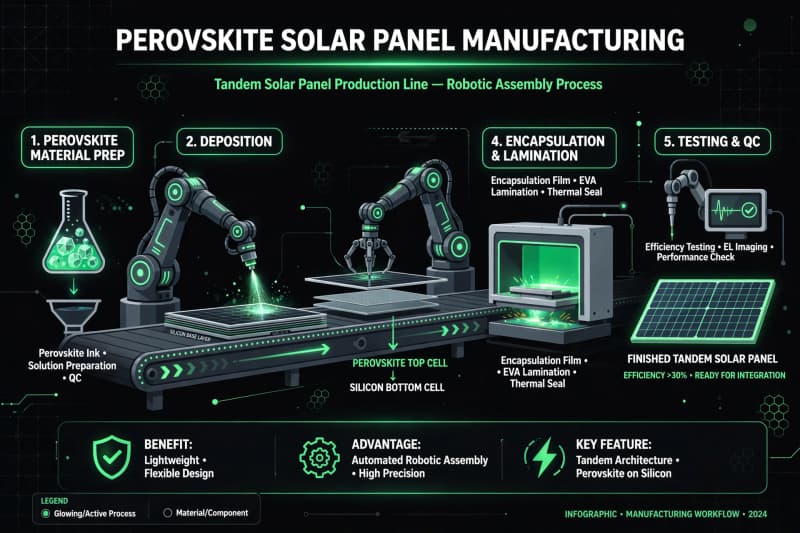
Hanwha Qcells: the Western scale bet
South Korea’s Hanwha Qcells may be the most important near-term player for Western markets. In December 2024 it achieved 28.6% efficiency on a full M10-size tandem cell (330.56 cm²) — significant because M10 is a standard mass-production wafer format, not a postage-stamp lab device. The company is moving from pilot toward mass production in 2027, backed by its US manufacturing footprint, which matters enormously for projects seeking domestic-content incentives.
Qcells has also cleared IEC/UL certification milestones, addressing the bankability question that haunts every perovskite newcomer. For utility buyers who need warrantied, certified product from a balance-sheet-strong supplier, Qcells is currently the most credible Western option after Oxford PV.
The Chinese giants: LONGi, Trina, GCL
China’s solar majors are pursuing perovskites aggressively but on different timelines. LONGi holds the world efficiency records — 35.5% certified by ESTI in July 2026, improving on its own 34.85% NREL-certified record from April 2025 — yet stated in June 2026 that it has no active mass-production plan for tandems, per pv magazine. LONGi is playing a long game: perfect the technology, then deploy at overwhelming scale.
GCL Optoelectronic is the most production-focused of the Chinese players, expanding rigid tandem manufacturing with large-format IEC certification and targeting silicon cost parity at 3 GW of production, according to Mordor Intelligence. Trinasolar, meanwhile, took the licensing route via its Oxford PV deal — a tacit admission that buying proven IP can be faster than in-house R&D.
JinkoSolar also runs a commercial-track tandem development program, and Microquanta operates a 100 MW perovskite line aimed at BIPV and utility markets.
US startups: Caelux, CubicPV, Swift Solar
The US has a cluster of earlier-stage players. Caelux, backed by BP, announced a 5-year, 3 GW partnership with Solx in April 2026 for production in Aguadilla, Puerto Rico, targeting commercial US volumes by 2027 at 28% module efficiency. Its asset-light model — applying perovskite coatings to existing silicon lines — avoids the capital intensity of greenfield fabs.
CubicPV supplies high-performance silicon wafers optimized for tandem integration, positioning upstream of the perovskite deposition step. Swift Solar focuses on lightweight flexible tandems (22%+) for aerospace and portable applications — a niche where perovskite’s weight advantage matters more than absolute cost per watt.
Why it matters
Here is the comparison that cuts through the hype. Fewer than 10 companies worldwide are operating or commissioning GW-class perovskite production lines as of mid-2026, per Mordor Intelligence — against a global silicon module industry shipping over 500 GW a year. Perovskites are roughly 1% of solar manufacturing capacity. Every “mass production” announcement in this space should be read against that denominator.
The strategic split is what matters for buyers and investors. Oxford PV and Qcells are selling certified, warrantied product today at 24–28% module efficiency — real, but at a premium and in limited volumes. LONGi and GCL are building the capacity to flood the market once the technology is proven — but have not committed to timelines. Caelux-style partnerships try to bridge the gap with asset-light models.
For anyone evaluating perovskite purchases in 2026: ask for IEC 61215/61730 certification documents, not press releases; ask about the warranty escrow behind the 10-year guarantee; and compare the quoted $/W against the 20% energy-yield premium the efficiency gain actually delivers. The technology’s future is bright — but procurement should be done with eyes open. For the efficiency milestones driving this manufacturing race, see our coverage of perovskite-silicon tandems breaking 30% with healing treatments.
Frequently asked questions
Which company makes perovskite solar panels I can buy?
Oxford PV is the only company shipping commercial perovskite-silicon tandem modules today (24.5% efficiency, utility-scale). Hanwha Qcells is closest to mass production, targeting 2027. No perovskite panels are widely available through residential installers yet.
Are Chinese perovskite panels available?
Not for general purchase. LONGi holds the efficiency records but has no mass-production plan; GCL is building toward 3 GW of tandem capacity; Trinasolar licensed Oxford PV’s technology for the Chinese market. Expect Chinese tandem products from 2027–2028.
Should I wait for perovskite panels before installing solar?
Probably not. Waiting 2–3 years for a 10–20% efficiency gain costs more in lost electricity savings than the gain is worth for most homeowners. Perovskite tandems will matter most first in utility-scale projects where the yield premium compounds over gigawatts.
AI illustration · Joule Post