
- Perovskite-silicon tandems have hit 35.5% lab efficiency — far above silicon’s 26.8% record and within striking distance of the ~43% theoretical tandem limit — while commercial silicon modules sit at 20–24%.
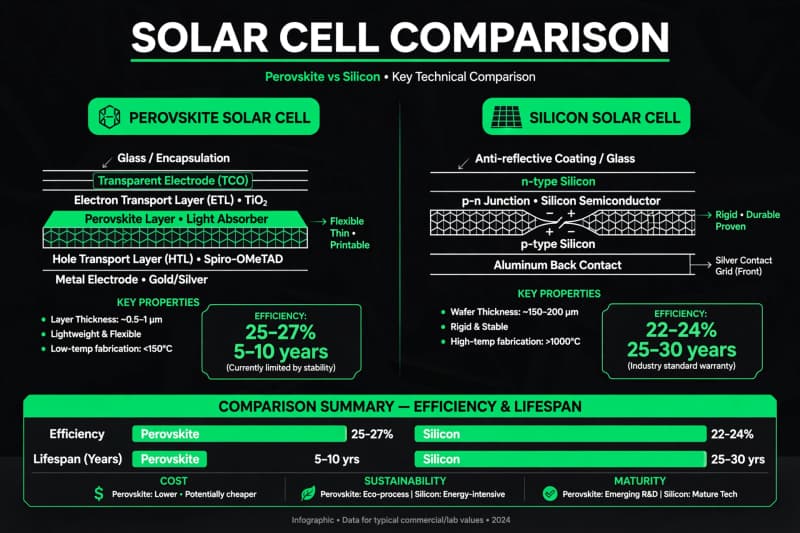
- Perovskites win on manufacturing cost potential: solution-based, low-temperature fabrication versus silicon’s energy-intensive purification — but lose decisively on proven lifespan, 25+ years versus unproven.
- The likely future is not replacement but combination: perovskite-on-silicon tandems that capture the strengths of both, already shipping from Oxford PV at 24.5% module efficiency.
Every few years, a new solar technology arrives trailing claims that it will kill silicon. Perovskites have been making that claim for a decade — and unlike most challengers, the numbers increasingly back it up. But the full picture is more nuanced than either the hype or the skepticism suggests.
This is an honest, data-driven comparison of perovskite and silicon solar across the dimensions that actually determine what gets installed: efficiency, cost, lifespan, and manufacturability.
Efficiency: perovskite’s clearest win
Start with the physics. A single-junction silicon cell has a practical efficiency ceiling around 29.4% — and LONGi’s 26.8% heterojunction record is already at 96% of that limit. Silicon has, in effect, nearly run out of room. Future gains will be slivers, not strides.
Perovskites escape this ceiling by stacking. A perovskite-silicon tandem layers a wide-bandgap perovskite top cell over a silicon bottom cell, each absorbing different parts of the solar spectrum. The result: LONGi’s 35.5% certified tandem record (July 2026, ESTI-certified), up from 34.85% in April 2025, per pv magazine. The theoretical limit for tandems is around 43% — meaning the technology is at roughly 80% of its ceiling, with real headroom left.
In commercial products the gap is narrower but still meaningful: Oxford PV’s shipping tandem modules at 24.5% versus 22–23.5% for mainstream TOPCon silicon and ~24.8% for premium back-contact panels. That 1–2 percentage point advantage translates to up to 20% more energy from the same roof area — significant at utility scale.
Cost: perovskite’s promise, silicon’s reality
Perovskites should be cheap to make. The active layer is deposited from solution at low temperatures — printable, in principle, like newspaper — versus silicon’s energy-intensive purification (1,400°C+ furnaces), ingot growth, and wafer sawing. Manufacturing cost projections for tandem modules at 25–30% efficiency run $0.29–$0.42/W, potentially undercutting silicon, according to industry analysis.
But “should be” is doing heavy lifting. Silicon’s costs are real, measured, and bankable — the product of two decades of brutal scale-up that drove module prices below $0.10/W. Perovskite’s cost projections assume manufacturing yields, throughput, and material utilization that have not been demonstrated at gigawatt scale. Early tandem modules command a 10–50% price premium per watt over silicon, with pricing by negotiation rather than published price lists.
The honest cost comparison: silicon wins today on actual $/W and $/kWh. Perovskites could win tomorrow on $/kWh if durability matches — because a 30%-efficient panel generates proportionally more lifetime energy from the same balance-of-system costs (racking, inverters, labor, land).
Lifespan: silicon’s unassailable moat
This is where the comparison is most lopsided. Silicon modules degrade at roughly 0.5% per year, backed by billions of fielded modules and 25- to 30-year warranties that insurers and lenders accept without blinking. It is the most bankable durability record in energy technology.
Perovskites have no equivalent. The best accelerated-test results — 95%+ retention after thousands of hours of damp heat, thermal cycling, and UV — are promising but are not field data. Oxford PV’s commercial modules carry a 10-year warranty, targeting 20 years by 2027. No perovskite product has a decade of rooftop history, let alone two and a half.
For project finance, this gap is everything. A utility solar farm is a 30-year financial instrument; the panel is the collateral. Until perovskites accumulate real-world degradation curves, they will be financed as higher-risk assets regardless of lab results.
Why it matters
Here is the comparison that should guide decisions. On a pure physics scorecard, perovskite tandems already beat silicon: 35.5% vs 26.8% lab records, 43% vs 29.4% theoretical limits, cheaper manufacturing physics. On a commercial scorecard, silicon still dominates: 500+ GW annual manufacturing versus under 10 GW of perovskite pilot lines, 25-year warranties versus 10, $0.10/W versus negotiated premiums.
The investment implication: perovskites are not a silicon replacement bet — they are a silicon enhancement bet. The winning architecture layers perovskite onto silicon, capturing the efficiency gain while leaning on silicon’s proven bottom cell for part of the durability story. That is why every serious manufacturer — Oxford PV, Qcells, LONGi, GCL — is pursuing tandems rather than pure perovskite modules for mainstream power applications.
For homeowners in 2026: buy silicon. The math is unambiguous — waiting years for tandems costs more in lost savings than the efficiency gain returns. For utilities and developers: start qualifying tandem suppliers now, because the 2027–2029 window is when bankable 20-year products are expected to arrive, and early mover advantage in procurement will matter. Our main coverage tracks how healing treatments pushed tandem efficiency past 30% — the durability story is the other half of that breakthrough.
Frequently asked questions
Are perovskite solar panels better than silicon?
On lab efficiency and manufacturing simplicity, yes. On proven lifespan, bankability, and current cost, silicon still wins decisively. The most likely outcome is perovskite-silicon tandems combining both strengths.
How much more efficient are perovskite tandems than silicon panels?
Lab records: 35.5% (tandem) vs 26.8% (silicon) — a 32% relative advantage. Commercial products: ~24.5% (Oxford PV tandem) vs 22–23.5% (mainstream silicon) — roughly 5–10% more energy in practice today.
Will perovskites replace silicon solar panels?
Unlikely as a pure replacement. The industry consensus is that perovskites will enhance silicon in tandem architectures. Silicon’s manufacturing scale (500+ GW/year) and 25-year track record cannot be replicated quickly, so tandems — not pure perovskites — are the commercial path.
AI illustration · Joule Post