
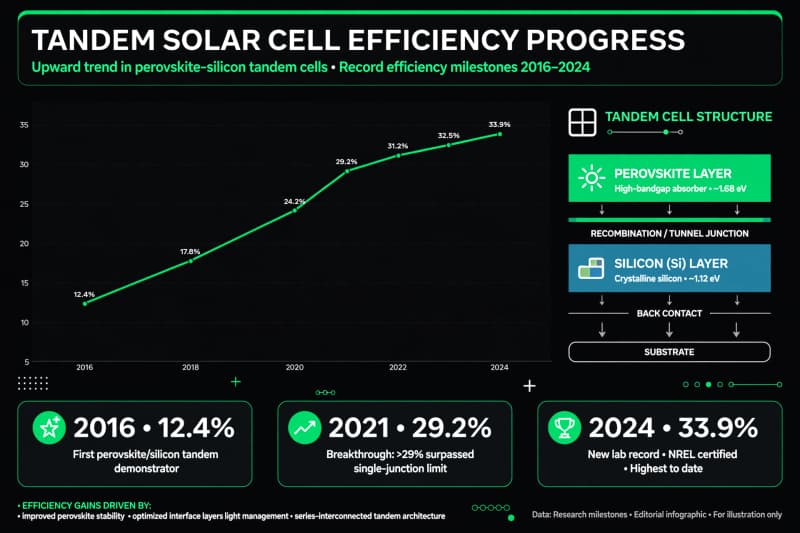
- LONGi’s 35.5% perovskite-silicon tandem cell (ESTI-certified, July 2026) is the current world record — the fifth record in its streak from 31.8% in 2023.
- The record has climbed roughly one percentage point per year since 2023, but each gain is harder-won: the tandem theoretical limit of ~43% means the easy gains are behind us.
- Lab records and commercial reality are diverging: the record cell’s area was not disclosed, while the largest high-efficiency tandem (33% on 260.9 cm²) shows how much efficiency is lost scaling up.
Solar efficiency records used to be sleepy affairs — a tenth of a percent here, a press release there. Perovskite tandems have turned the record chase into the most exciting race in photovoltaics, with the world record falling five times in three years and the 40% barrier now visible on the horizon.
But records can mislead as easily as they inspire. Here is what the numbers actually mean — and what they don’t.
The record timeline
LONGi has owned this race. Its certified perovskite-silicon tandem results read like a staircase: 31.8% in 2023, 33.9% later that year, 34.6% in 2024, 34.85% in April 2025 (NREL-certified), and 35.5% in July 2026 (ESTI-certified), as documented by pv magazine. Each result was independently certified — NREL or the European Solar Test Installation — which matters because uncertified “hero cells” have a long history in this field.
The pace — roughly a percentage point per year — looks sustainable until you consider the physics. The Shockley-Queisser limit for a single-junction cell is 33.7%; tandems escape it by stacking junctions, with a theoretical ceiling around 43% for the perovskite-silicon pairing. At 35.5%, the record sits at about 82% of the theoretical maximum. The remaining 7–8 points will be far harder than the last 7–8, requiring near-perfect light management, minimal recombination losses, and exquisite interface engineering.
What the record doesn’t tell you
Three caveats that rarely make the headlines. First, LONGi did not disclose the active area of the 35.5% cell. Record cells are typically fractions of a square centimeter — “postage stamps” — where edge effects are negligible and uniformity is easy. Scaling to commercial sizes bleeds efficiency: LONGi’s own 260.9 cm² tandem (June 2025, NREL-certified) managed 33%, a full 2.5 points below the small-area record, because coating uniformity and electrical losses compound with area.
Second, the record is a cell, not a module. Module-level records lag cell records by 5+ points — the best tandem modules are around 29.4% on 1.7 m², and shipping commercial modules (Oxford PV) are at 24.5%. Every interconnection, busbar, and glass cover exacts its toll.
Third, LONGi itself said in June 2026 that it has no active mass-production plan for tandem cells. The record is a research milestone, not a product announcement — a demonstration of what the physics allows, not what factories will ship next quarter.
How high can they go?
The credible near-term trajectory: 36–37% lab records by 2027–2028 as interface passivation and wide-bandgap perovskite quality improve. The 40% mark — psychologically huge, the point where tandems would convert nearly half of incident sunlight — is plausible by the early 2030s but requires breakthroughs in light trapping and possibly three-junction architectures.
The more important race is the module record and the large-area cell record, because those predict commercial reality. Watch for 30%+ commercial modules and 34%+ on 200+ cm² cells — those are the milestones that would signal tandems are ready to challenge silicon’s cost-per-kWh dominance rather than just its physics textbooks. NREL’s Best Research-Cell Efficiency Chart, updated continuously, remains the authoritative scoreboard — any record claim not on that chart should be treated with skepticism until independently certified.
Why it matters
Here is the data comparison that puts the record in perspective. Silicon’s lab record (26.8%) took decades to grind out and sits at 96% of its practical ceiling — future silicon gains will be measured in tenths of a percent. Perovskite tandems gained nearly 4 points in three years and sit at 82% of their ceiling. The rate of improvement is the story: tandems are on a steeper curve, earlier in their development, with more headroom.
But the commercial translation rate is what determines energy impact. It took silicon roughly a decade to move lab records into mass-produced modules at ~90% of record efficiency. Tandems are attempting the same journey with an added handicap — the perovskite layer’s durability is still being proven. If the industry can compress that timeline to 5–7 years (2028–2031 for 30%+ bankable modules), tandems will reshape solar economics. If durability stalls, the records will remain beautiful physics experiments.
The record to watch is not the next 35.x% announcement — it is the first 30% module with a 20-year warranty. That is when the race stops being about physics and starts being about power grids. Our main coverage examines the healing-treatment breakthrough that pushed tandems past 30% — the efficiency foundation these records are built on.
Frequently asked questions
What is the highest efficiency solar cell in 2026?
LONGi’s perovskite-silicon tandem at 35.5%, certified by the European Solar Test Installation in July 2026. The highest single-junction silicon cell is 26.8%, also held by LONGi.
What is the theoretical maximum efficiency for tandem solar cells?
Around 43% for perovskite-silicon tandems, versus 33.7% (Shockley-Queisser limit) for any single-junction cell. Triple-junction designs could theoretically exceed 45%, but remain lab curiosities.
When will 30%+ efficient solar panels be available to buy?
Lab modules have reached 29.4%. Commercial 30%+ modules with bankable warranties are likely 2028–2031, contingent on solving perovskite durability at scale. Oxford PV’s 24.5% tandem modules are the most efficient shipping product today.
AI illustration · Joule Post