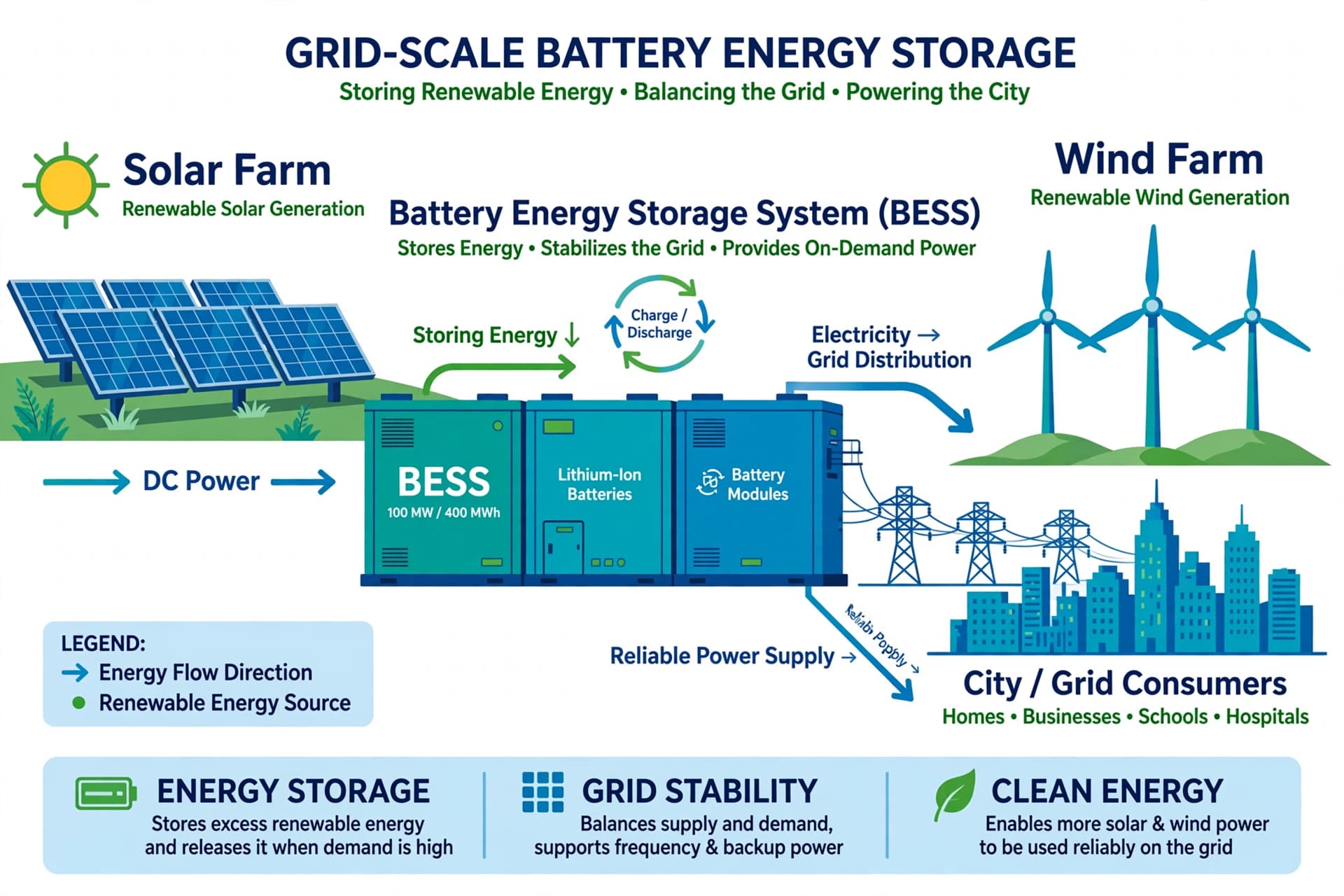
- Grid batteries store surplus electricity as chemical energy and release it hours later, letting solar and wind power cover demand after sunset.
- Lithium iron phosphate (LFP) dominates new projects, but sodium-ion and flow batteries are moving from pilots to gigawatt-hour scale.
- Stationary battery pack prices fell to a record $70/kWh in 2025, making 2-to-4-hour storage cheaper than gas peakers in several markets.
Battery energy storage: A system that converts electricity into chemical energy, stores it inside rechargeable cells, and converts it back into electricity when the grid needs it. Grid-scale installations range from a few megawatts to gigawatts in size and typically discharge for two to eight hours, shifting renewable power from when it is generated to when it is actually consumed.
Solar panels produce the most power in the middle of the day. Wind turbines spin hardest when weather systems move through, often at night. Electricity demand, meanwhile, peaks in the early evening — right when solar output collapses. This mismatch, sometimes called the “duck curve,” is the central problem of a renewable grid, and batteries are the most direct answer to it.
Over the past decade, grid batteries have gone from a curiosity to a mainstream grid asset. In 2017, Tesla’s Hornsdale Power Reserve in South Australia made global headlines at 100 megawatts — people called it absurdly large. Less than a decade later, single projects store a hundred times that much energy. This guide explains how these systems work, which chemistries matter, what they cost in 2026, and why they have become one of the fastest-scaling pieces of energy infrastructure in history.
How grid batteries work
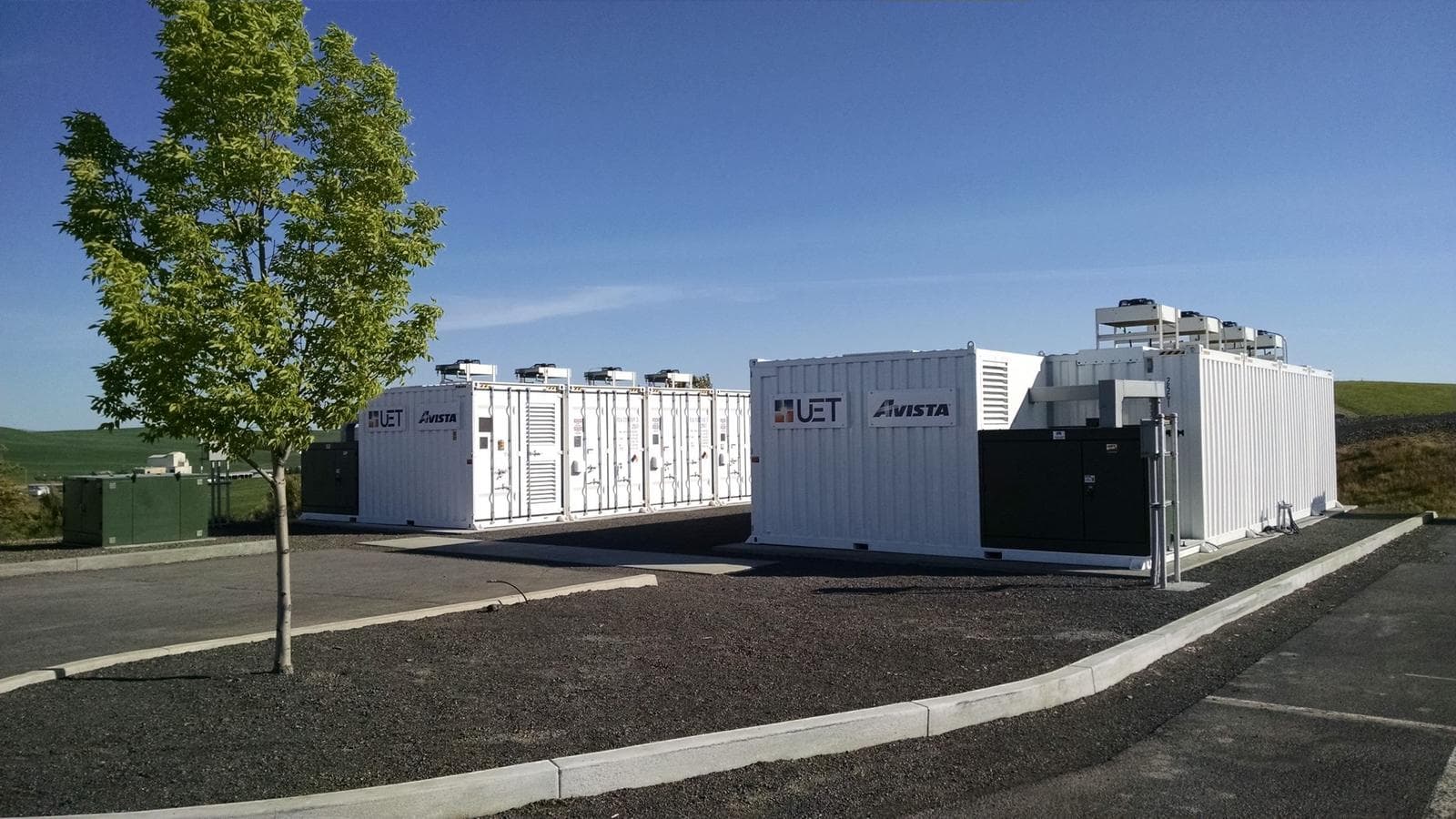
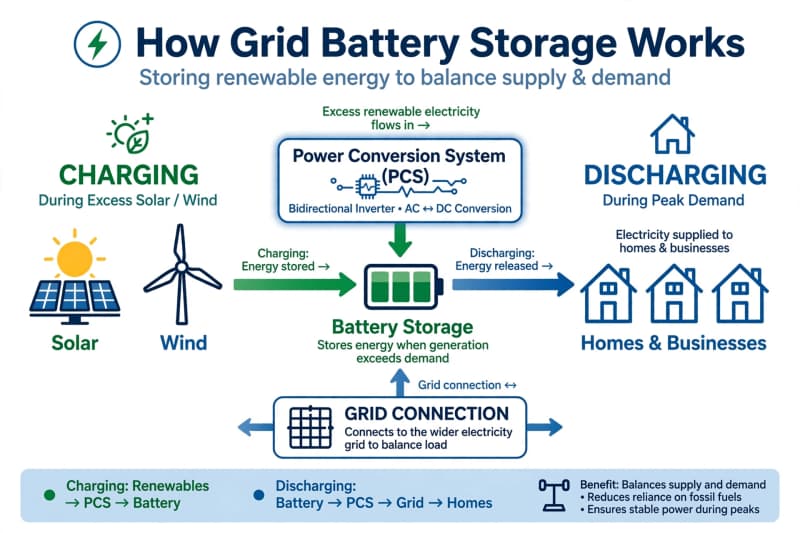
A grid-scale battery installation — usually called a battery energy storage system, or BESS — is simpler in concept than it looks. The grid runs on alternating current (AC). Batteries store direct current (DC). Everything in between is conversion and control.
Here is the path electricity takes. During charging, AC power from the grid or from a co-located solar farm flows through a transformer and into a power conversion system (PCS), essentially a large bidirectional inverter that turns AC into DC. That DC charges racks of battery modules, each containing hundreds of individual cells wired together. A battery management system (BMS) monitors every cell’s voltage, temperature, and state of charge, keeping them balanced and shutting things down if anything drifts out of safe limits.
When the grid needs power — say, at 7 p.m. when solar fades and air conditioners are still running — the process reverses. The BMS releases DC from the cells, the PCS inverts it back to AC, the transformer steps the voltage up to grid level, and the energy flows out onto the transmission network. An energy management system (EMS), essentially the site’s brain, decides exactly when to charge and discharge based on price signals, grid operator instructions, or a contract with a utility.
The whole round trip is not perfectly efficient. A lithium-ion system returns roughly 85 to 95 percent of the energy put into it; the rest is lost as heat in the cells, inverter, and transformer. Operators factor this into their economics the same way a warehouse factors in spoilage.
What makes batteries different from every other grid resource is speed. A gas turbine takes minutes to ramp up. A battery can go from idle to full output in milliseconds. That is why the first grid batteries earned their keep providing frequency regulation — tiny, constant corrections that keep the grid at exactly 50 or 60 hertz — before the economics of longer-duration storage caught up.
Capacity vs. power: megawatts are not megawatt-hours
The single most misunderstood thing about battery storage is the difference between power and energy. They are measured in different units, and both matter.
Power, measured in megawatts (MW), is how fast the battery can deliver electricity — the size of the pipe. Energy, measured in megawatt-hours (MWh), is how much electricity it can deliver in total — the size of the tank. A 100 MW / 400 MWh battery can output 100 megawatts at once and sustain that for four hours before running empty.
Divide energy by power and you get duration: the number of hours a battery can discharge at full power. Duration is how the industry sorts projects into categories, because it determines what job the battery does:
- Under 1 hour — frequency regulation and grid stabilization. The original battery business, now a small slice of new builds.
- 2 to 4 hours — the workhorse category. Stores midday solar and discharges through the evening peak. The large majority of projects built through 2025 sit here.
- 6 to 12 hours — emerging long-duration territory. Covers overnight demand or multi-day weather lulls when paired with renewables.
- 100+ hours — multi-day storage for extended cloudy or windless stretches. Still largely in pilot and early commercial stages.
When you read that a project is “the world’s largest battery,” check which number the headline uses. Power records and energy records are different things, and the energy number — the MWh — is usually the more meaningful one for the grid.
Battery chemistries: lithium-ion vs. the alternatives
Almost every grid battery operating today is lithium-ion. But “lithium-ion” is a family, not a single chemistry, and two challengers are now reaching serious scale.
Lithium-ion: LFP and NMC
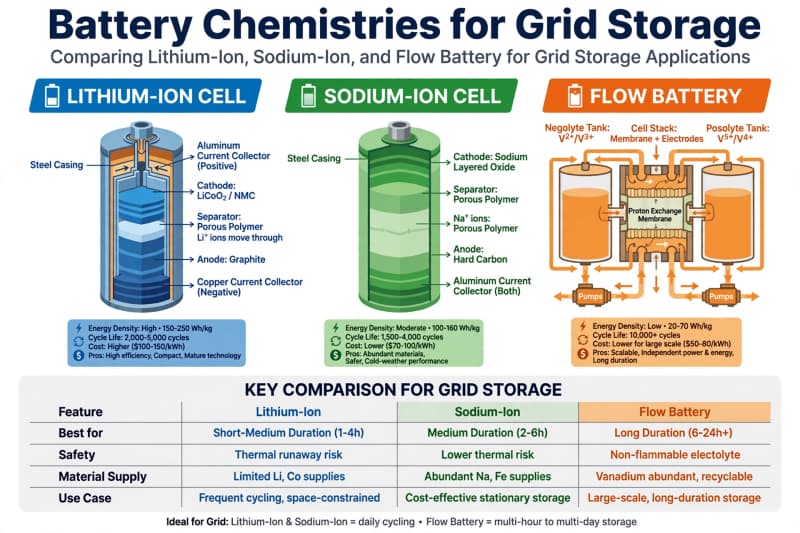
Two lithium-ion chemistries matter for the grid. Lithium iron phosphate (LFP) has steadily taken over new stationary projects because it is cheaper, tolerates heat better, and cycles longer than its rival. The trade-off is lower energy density — an LFP cell holds less energy per kilogram — but for a container sitting in a field, weight barely matters.
Nickel manganese cobalt (NMC) packs more energy into less space, which is why it dominated early electric vehicles and the first wave of grid projects. For stationary storage, its higher cost and shorter cycle life have steadily pushed it aside; most new grid batteries ordered today are LFP.
At grid scale, lithium-ion cells typically deliver 3,000 to 7,000 full charge-discharge cycles before their capacity degrades to the point of needing replacement or augmentation — roughly 10 to 15 years of daily cycling. Round-trip efficiency sits in the 85 to 95 percent range.
Sodium-ion: the 2026 arrival
Sodium-ion batteries work on the same principle as lithium-ion but shuttle sodium ions instead of lithium. Sodium is roughly a thousand times more abundant in the Earth’s crust than lithium, and the chemistry avoids nickel and cobalt entirely — which makes it potentially cheaper and less exposed to metal price swings.
For years sodium-ion was a lab curiosity with too-low energy density. That changed when CATL, the world’s largest battery maker, began mass production of its Naxtra sodium-ion line in December 2025 at around 175 watt-hours per kilogram — close to LFP territory — and then signed a 60 GWh supply deal with storage integrator HyperStrong in April 2026, the largest sodium-ion contract to date. Total global sodium-ion shipments reached roughly 9 GWh in 2025, more than double the year before.
The chemistry’s strengths map neatly onto grid storage: lower material costs, strong performance in extreme heat and cold, and a good safety profile. Its weakness is the same as ever — lower energy density than lithium-ion — which matters little for stationary containers. Expect sodium-ion to take a growing share of the stationary market through the rest of the decade, particularly where cost matters more than footprint.
Flow batteries: tanks instead of cells
Vanadium redox flow batteries store energy not in solid electrodes but in liquid electrolytes held in external tanks. To store more energy, you build bigger tanks — power and energy scale independently, which is elegant for long durations. The electrolyte does not degrade the way solid electrodes do, giving cycle lives above 20,000 cycles, and it can be reused or regenerated at end of life.
The catch is efficiency and cost. Round-trip efficiency runs 65 to 75 percent, noticeably below lithium-ion, and the vanadium electrolyte accounts for roughly half the system cost — with some 80 percent of global vanadium supply concentrated in China and Russia, prices have swung between $8 and $30 per pound historically.
China has pushed the technology furthest: the Dalian project connected a 100 MW / 400 MWh first phase in 2022 with plans to double to 800 MWh, and a 175 MW / 700 MWh system in Xinjiang came online in 2024. Flow batteries remain a niche, but for 6-to-12-hour applications they are lithium-ion’s most credible rival.
Others worth knowing
Iron-air batteries, pioneered by Form Energy, target the hardest problem: multi-day storage. By essentially “rusting” iron pellets to store energy and reversing the reaction to release it, they promise durations around 100 hours at very low cost — but round-trip efficiency is modest and the technology is still in early commercial deployment. Lead-acid, the oldest rechargeable chemistry, still appears in small backup systems but its short cycle life (hundreds to low thousands of cycles) rules it out of serious grid duty.
| Chemistry | Energy density | Cycle life | Round-trip efficiency | Best grid use |
|---|---|---|---|---|
| LFP (lithium iron phosphate) | ~140–160 Wh/kg | 3,000–7,000 cycles | 85–95% | 2–4 h energy shifting; the current default |
| NMC (nickel manganese cobalt) | ~200–260 Wh/kg | 2,000–4,000 cycles | 85–95% | Legacy installs; space-constrained sites |
| Sodium-ion | ~150–175 Wh/kg | 5,000–10,000 cycles | ~80–90% | Cost-sensitive stationary storage; extreme climates |
| Vanadium redox flow | ~25 Wh/kg (system) | 20,000+ cycles | 65–75% | 6–12 h long-duration applications |
| Iron-air | Low | Thousands of cycles | ~50–60% | 100-hour multi-day storage (early commercial) |
| Lead-acid | ~30–50 Wh/kg | 500–1,500 cycles | 70–85% | Small backup only |
Cost trends: the 2026 picture
Battery prices have fallen almost every year since 2010, with one exception in 2022 when metal prices spiked. The latest BloombergNEF survey, published in December 2025, puts the global average lithium-ion pack price at a record low of $108 per kilowatt-hour — down 8 percent from 2024 and 93 percent below 2010 levels.
The more striking number for the grid: packs built specifically for stationary storage fell to $70/kWh in 2025, a 45 percent drop in a single year, making stationary storage the cheapest lithium-ion segment for the first time. Across all applications, LFP packs averaged $81/kWh versus $128/kWh for NMC.
Turnkey system prices — the full installed cost including inverters, transformers, and construction — tell the same story with a geographic twist. BNEF found global averages of $124/kWh for 2-hour systems and $110/kWh for 4-hour systems in 2025. China, with its manufacturing overcapacity and fierce domestic competition, averaged just $73/kWh, against $177/kWh in Europe and $219/kWh in the US.
Notably, this happened even as lithium and cobalt prices rose in 2025 on supply concerns. Manufacturers absorbed the shock through the shift to LFP, long-term contracts, and hedging — a sign of how much cost reduction now comes from manufacturing scale and competition rather than raw materials alone.
The practical consequence: in several markets, a 4-hour battery is now cheaper than building a new gas peaker plant to cover evening demand — a crossover that would have sounded fanciful five years ago.
Major projects in 2026
The scale of individual projects has grown roughly a hundredfold in under a decade. A short tour of the landmarks:
- Edwards & Sanborn, California — 875 MW of solar paired with 3,287 MWh of storage, fully online since January 2024. The largest single solar-plus-storage project in the US.
- Moss Landing, California — Vistra’s facility reached 750 MW / 3,000 MWh, making it the largest standalone battery site in the world — until a fire in January 2025 damaged the facility and put a planned 1,500 MW / 6,000 MWh expansion on hold pending cleanup and review.
- Darden Clean Energy Project, California — a 1,150 MW solar farm paired with 4,600 MWh of batteries in Fresno County, set to take the operational crown when complete.
- Saudi Arabia — connected 7,800 MWh of storage and tendered a further 12,500 MWh, part of one of the world’s most aggressive storage buildouts.
- Chile — 11,000 MWh under construction, designed to carry the country’s abundant solar power deep into the night.
- China — projects at 6,000 MWh scale alongside the world’s largest flow-battery installations, including Dalian’s vanadium system scaling toward 200 MW / 800 MWh.
The pattern is consistent: the record keeps moving to whoever pairs the cheapest solar resource with the cheapest batteries. A decade ago the entire global fleet added less in a year than a single 2026 project stores.
Why it matters: the numbers behind the buildout
Batteries are not just getting cheaper — they are changing what the grid can do. Consider California, the world’s most advanced battery grid. The state’s battery fleet now routinely discharges several gigawatts during the evening ramp, directly displacing gas-fired generation that used to cover those hours. What was a rounding error in 2020 is now one of the largest dispatchable resources on the California grid.
The economics driving this are straightforward. A gas peaker plant — built to run only a few hundred hours a year during demand spikes — is expensive per unit of energy precisely because it sits idle most of the time. A 4-hour battery charged on cheap midday solar undercuts it on cost in markets where solar is abundant, and the battery can additionally earn revenue from frequency regulation, capacity payments, and price arbitrage the rest of the time. One asset, several income streams; a gas peaker has one.
There is also a speed argument that rarely makes headlines. Permitting and building a gas plant takes years; a battery project can go from contract to operation in 12 to 18 months. When data center demand or an extreme heatwave strains the grid, batteries are the fastest new capacity money can buy. Analysts now attribute a meaningful share of recent storage demand growth to AI data centers — the global fleet is adding on the order of 350 GWh per year.
None of this means batteries solve everything. They shift energy across hours, not seasons; a windless week in winter still needs other answers. But for the daily rhythm of solar-rich grids — charge at noon, discharge at seven — they are now the cheapest tool available.
Frequently asked questions
How long do grid batteries last?
A lithium-ion grid battery typically delivers 3,000 to 7,000 full cycles — roughly 10 to 15 years of daily use — before its capacity fades to around 70 to 80 percent of original. Operators often “augment” sites by adding fresh racks partway through life rather than replacing everything at once. Flow batteries last far longer, exceeding 20,000 cycles, because their liquid electrolyte does not degrade the way solid electrodes do.
Are grid-scale batteries safe?
Modern grid batteries, overwhelmingly LFP chemistry, are thermally stable and far less fire-prone than the nickel-based cells in early projects. Fires still happen — the January 2025 blaze at Moss Landing in California damaged one of the world’s largest sites — which is why standards like NFPA 855 mandate spacing, fire suppression, and thermal monitoring. The industry’s safety record has improved markedly as LFP displaced older chemistries and codes tightened.
What happens to batteries at the end of their life?
Lithium-ion batteries are recyclable: hydrometallurgical processes recover lithium, nickel, cobalt, and other metals for new cells, and a growing recycling industry now handles grid-scale volumes. Many retired EV and grid batteries also get a second life in less demanding stationary applications before recycling. Vanadium flow battery electrolyte is especially circular — it can be reprocessed and reused indefinitely.
Can batteries keep the lights on all night?
Today’s dominant 2-to-4-hour batteries cover the evening peak but not a full night, let alone a windless week. That is why duration matters: 8-to-12-hour systems and emerging 100-hour iron-air batteries target longer gaps. In practice, grids combine batteries with other resources — wind that blows at night, hydro, geothermal, and firm low-carbon generation — rather than relying on storage alone.
Why build batteries instead of just more power lines?
They solve different problems. Transmission moves power across distance; storage moves it across time. A new power line does nothing for solar power at 8 p.m. — the sun has set everywhere in the region. Batteries also deploy in 12 to 18 months versus many years for major transmission, and they can sit exactly where congestion is worst. Most grid plans call for both.