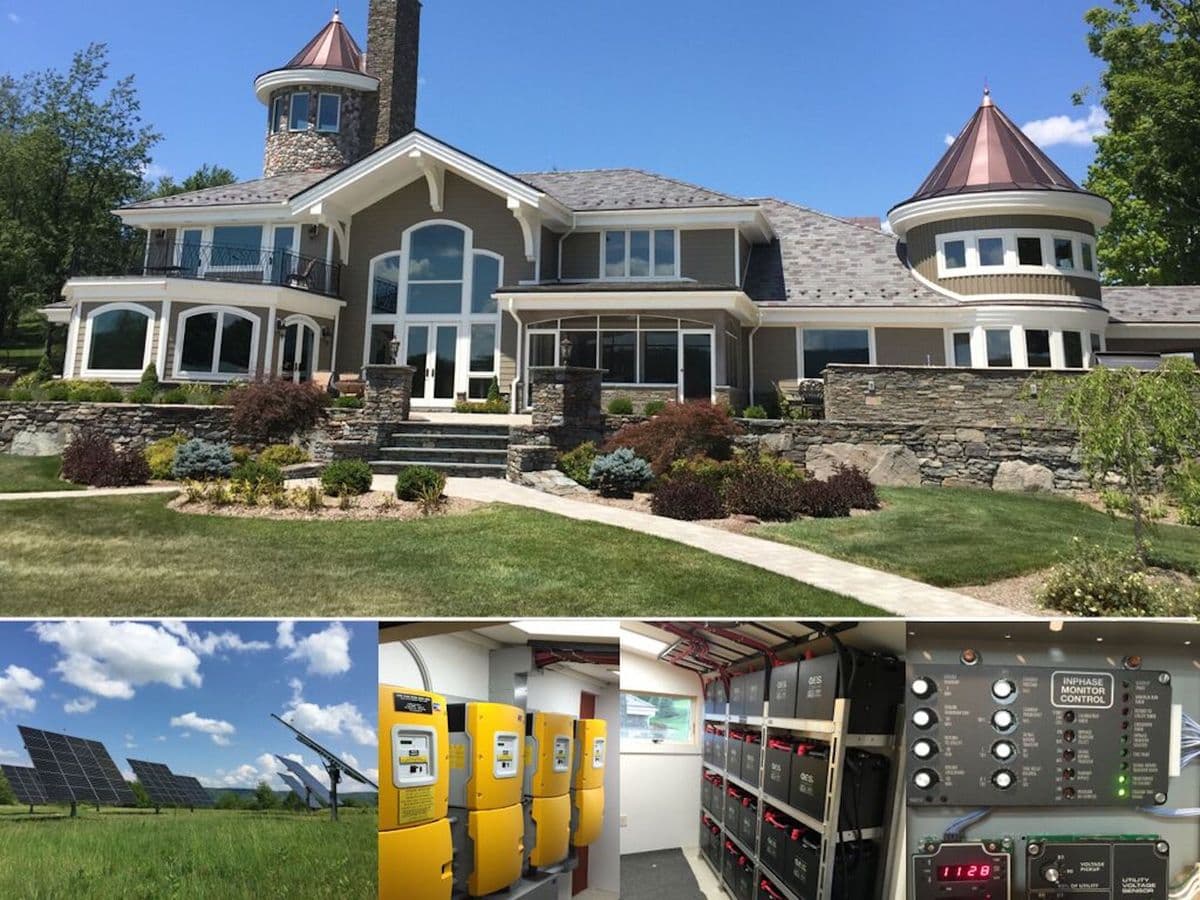
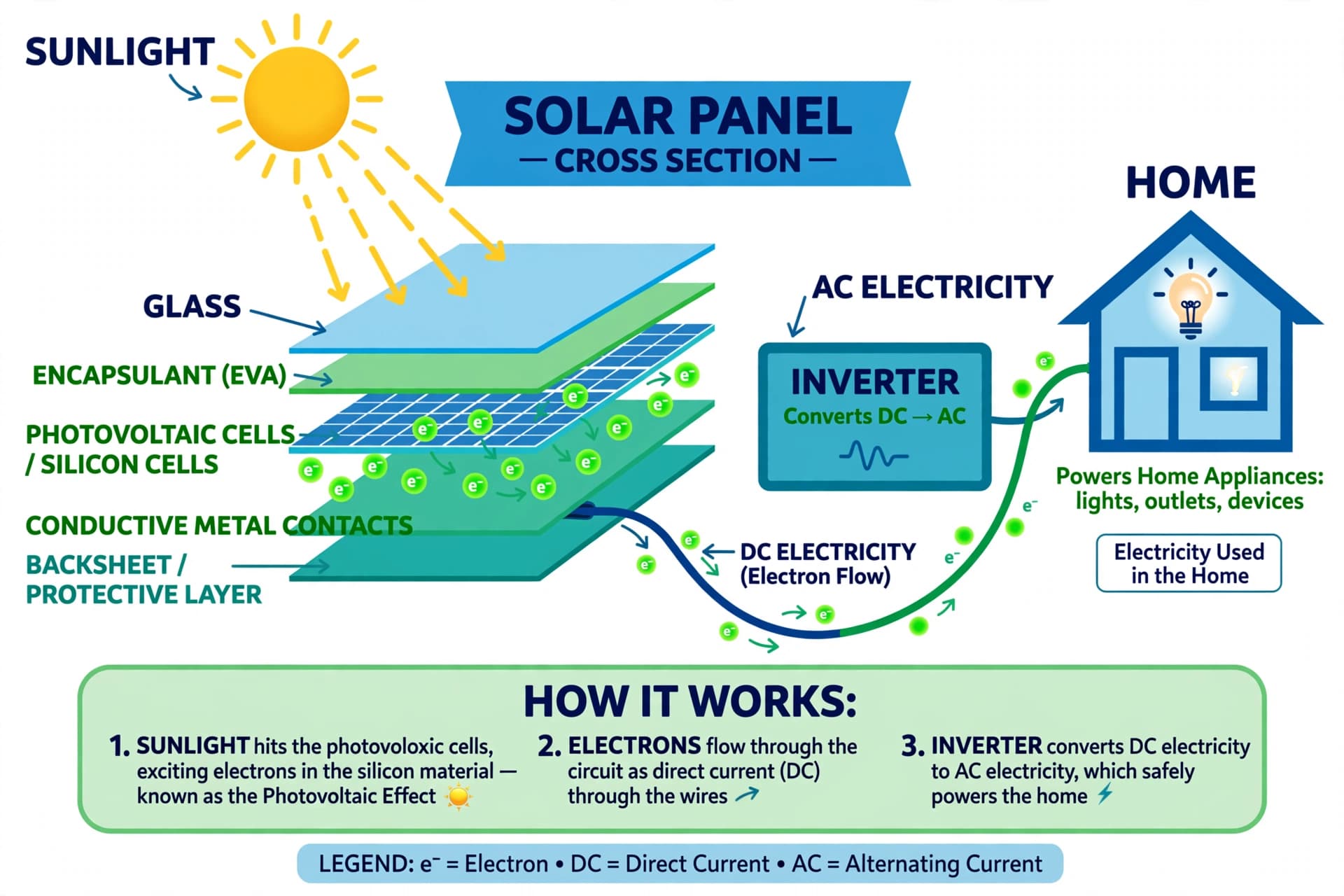
- Solar panels convert sunlight into electricity through the photovoltaic effect: photons knock electrons loose in silicon cells, creating a flow of direct current.
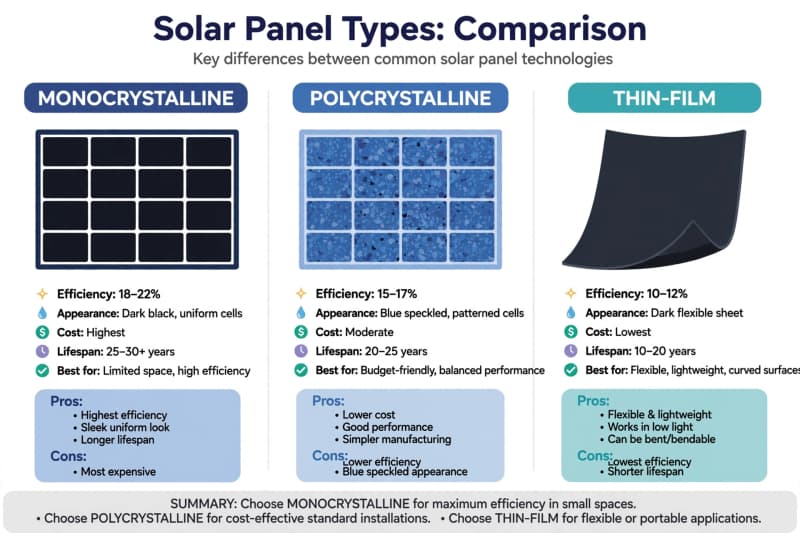
- Monocrystalline panels lead residential efficiency at 20–24%; polycrystalline costs less but runs 15–20%; thin-film is cheapest and most flexible at 10–13%.
- A typical US residential system costs roughly $2.50–$3.50 per watt before incentives in 2026, pays for itself in 6–10 years, and needs little more than occasional cleaning.
Solar panels: flat assemblies of photovoltaic cells, usually made from silicon, that convert sunlight directly into electricity. When photons strike the cells, they dislodge electrons and generate direct current, which an inverter then converts into the alternating current used by homes and the grid.
A solar panel looks deceptively simple — a dark sheet of glass in an aluminum frame. But inside that rectangle is one of the most consequential technologies of the energy transition: a device with no moving parts that turns daylight into electricity, silently, for 25 to 30 years. Understanding how solar panels work matters whether you are considering them for your roof, evaluating them as an investment, or simply trying to make sense of the fastest-growing energy source in history.
This guide walks through the full picture: the physics inside the cell, the three main panel types and how they compare, what efficiency ratings actually mean, what a system costs in 2026, how installation works, what maintenance involves, and why the technology keeps getting cheaper. No engineering degree required.
How the Photovoltaic Effect Works
Every solar panel runs on the photovoltaic effect, a phenomenon first observed in 1839 by the French physicist Edmond Becquerel. He noticed that certain materials produced an electric current when exposed to light. It took more than a century — and the space race, which needed power sources for satellites — before the effect became practical. Bell Labs built the first modern silicon solar cell in 1954, converting about 6% of incoming sunlight into electricity. Today’s commercial panels do four times better.
From sunlight to direct current
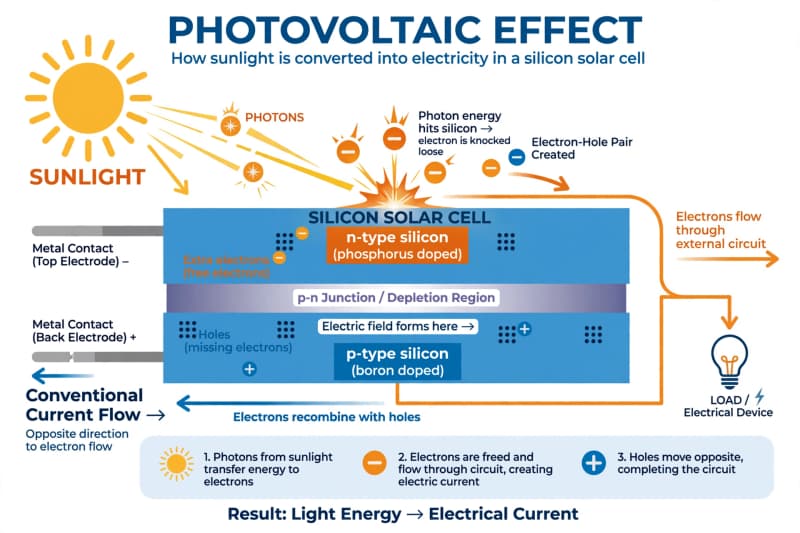
A solar cell is essentially a sandwich of two layers of silicon, each treated with different impurities — a process called doping. The top layer is doped with phosphorus, giving it extra electrons (n-type, for negative). The bottom layer is doped with boron, giving it extra “holes” where electrons could sit (p-type, for positive). Where the two layers meet, an electric field forms, like an invisible slope that electrons want to roll down.
When a photon of sunlight strikes the cell with enough energy, it knocks an electron loose from its silicon atom. The electric field at the junction immediately sweeps that freed electron toward the n-type layer and the hole toward the p-type layer. Metal contacts on the top and bottom of the cell collect these charges, and the result is a flow of electrons through an external circuit — direct current (DC) electricity.
A single cell produces only about half a volt, roughly the same as a AA battery, and a few watts of power. That is why cells are wired together in series inside a panel: a standard residential panel contains 60 or 72 cells, producing 30 to 40 volts and 400 to 450 watts. Wire dozens of panels together and you have a rooftop array capable of powering a home.
From DC to AC: the inverter’s job
There is a catch. Solar cells produce direct current, but homes, appliances, and the electricity grid run on alternating current (AC) — the kind where the flow reverses direction dozens of times per second. Something has to translate.
That something is the inverter. Every solar installation includes one, and it is the second most important component after the panels themselves. The inverter takes the DC electricity from the panels and converts it into AC at the correct voltage and frequency for your home (120/240 volts at 60 Hz in the US, 230 volts at 50 Hz in much of the rest of the world). Modern inverters do far more than convert: they track the maximum power point of the array as sunlight conditions change, monitor each panel’s output, shut the system down safely during grid outages, and report performance to a phone app.
There are two main architectures. A string inverter connects to a whole row of panels at once — cheaper, but one shaded or dirty panel drags down the entire string. Microinverters, mounted behind each individual panel, let every panel operate independently. They cost more upfront but squeeze out 5 to 15% more energy in real-world conditions with partial shading, and they make it easy to see exactly which panel is underperforming.
Types of Solar Panels
Not all solar panels are built the same way. Three technologies dominate the market, each with distinct tradeoffs in efficiency, cost, appearance, and durability. A fourth — perovskite — is moving from laboratory to factory and could reshuffle the ranking within a few years.
Monocrystalline: the efficiency leader
Monocrystalline panels are made from single-crystal silicon ingots, grown slowly from a seed crystal in a process that resembles pulling taffy. The ingot is sliced into thin wafers, each one a perfect crystal lattice. That uniformity is the point: electrons flow through a single crystal with minimal resistance, which is why mono panels convert 20 to 24% of sunlight into electricity — the highest efficiency of any mainstream technology.
You can spot a monocrystalline panel by its uniform dark appearance, usually black or deep blue, with cells that have clipped corners (the wafers are cut from cylindrical ingots). They also perform better than alternatives in low light and high heat, and they degrade more slowly — typically losing about 0.3 to 0.5% of output per year. The tradeoff is cost: growing single crystals is energy-intensive, so mono panels carry the highest price per watt, though the gap has narrowed sharply as manufacturing scaled.
For residential rooftops, where space is limited and every square meter counts, monocrystalline is the default choice in 2026. When a roof can only fit 15 panels, the difference between 400-watt and 350-watt panels is the difference between covering your electricity bill and falling short.
Polycrystalline: the budget workhorse
Polycrystalline panels skip the slow crystal-growing step. Instead, molten silicon is simply poured into a mold and allowed to cool, forming many small crystals. The process is faster and cheaper, and for years poly panels dominated on price. Their efficiency runs 15 to 20% — respectable, but meaningfully behind mono.
Visually, polycrystalline cells have a distinctive speckled blue appearance, like shattered glass frozen mid-break. Each crystal grain reflects light slightly differently. They also tend to lose efficiency faster in high temperatures and degrade a bit quicker over time.
The price advantage that once defined polycrystalline has largely evaporated. As monocrystalline manufacturing scaled up through the 2010s and 2020s, its cost fell faster, and by the mid-2020s most manufacturers had shifted their lines to mono. Polycrystalline remains available and perfectly functional, but it is increasingly a legacy product — worth considering only if you find a genuinely good deal and have plenty of roof space.
Thin-film: flexible and cheap, but hungry for space
Thin-film panels take a completely different approach. Instead of slicing wafers from silicon ingots, manufacturers deposit a microscopically thin layer of photovoltaic material — cadmium telluride, copper indium gallium selenide (CIGS), or amorphous silicon — directly onto glass, metal, or plastic. The active layer can be a hundred times thinner than a silicon wafer.
The result is a panel that is lightweight, flexible enough to curve, and cheap to manufacture at scale. Efficiency is the weak point: 10 to 13% for most commercial thin-film, meaning you need roughly twice the area to match the output of monocrystalline. They also degrade faster in the first years, though the rate stabilizes.
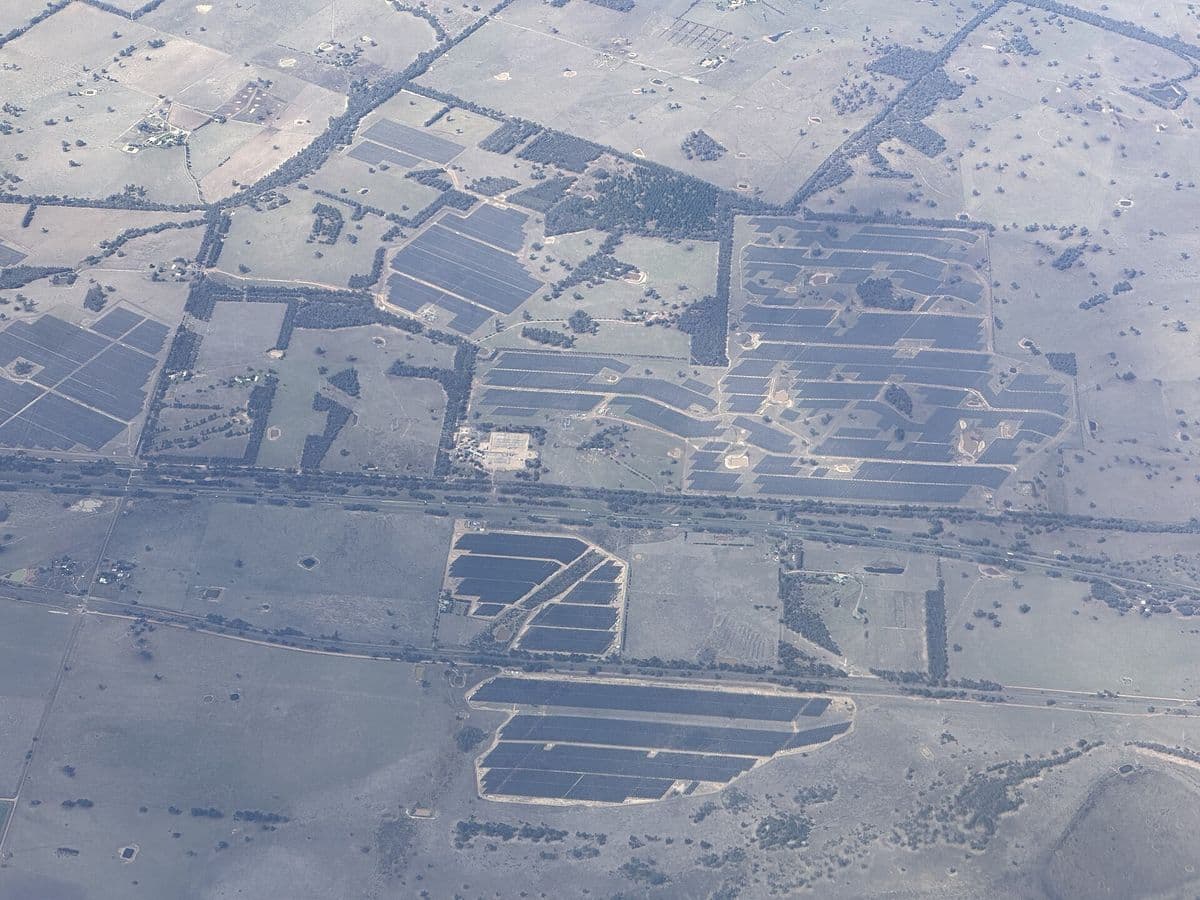
Where thin-film wins is utility-scale solar farms, where land is cheap and installation cost per watt matters more than efficiency per square meter. The largest thin-film manufacturer, First Solar, has built its business almost entirely on cadmium-telluride panels for big desert installations. For rooftops, thin-film rarely makes sense — unless your roof cannot bear the weight of glass panels, in which case flexible thin-film that bonds directly to the surface can be the only option.
Emerging: perovskite and tandem cells
The technology to watch is perovskite — a class of crystal-structured materials that can be printed from solution like ink, potentially at a fraction of silicon’s manufacturing cost. Lab efficiencies have climbed from under 4% in 2009 to over 26% today, a rate of progress unmatched in the history of photovoltaics. The catch has always been durability: perovskites degrade quickly when exposed to moisture, heat, and ultraviolet light.
The most promising near-term path is the tandem cell: a perovskite layer stacked on top of a conventional silicon cell, each absorbing different parts of the solar spectrum. Tandem cells have exceeded 33% efficiency in the lab, and the first commercial products began shipping in limited volumes in 2024–2025. If manufacturers solve the longevity problem — and billions in R&D funding suggest they are close — tandem cells could deliver a step-change in efficiency without a step-change in cost sometime late this decade.
Solar Panel Types Compared
| Feature | Monocrystalline | Polycrystalline | Thin-film |
|---|---|---|---|
| Efficiency | 20–24% | 15–20% | 10–13% |
| Typical panel wattage (2026) | 400–450 W | 330–400 W | 100–180 W |
| Cost per watt | Highest | Medium | Lowest |
| Appearance | Uniform black/dark blue | Speckled blue | Uniform dark, sometimes flexible |
| Space needed per kW | ~5 m² | ~6 m² | ~9–10 m² |
| Temperature performance | Best | Good | Good (some types excellent) |
| Annual degradation | ~0.3–0.5% | ~0.5–0.8% | ~0.5–1.0% |
| Lifespan | 25–30+ years | 25 years | 20–25 years |
| Best for | Homes, limited roof space | Budget projects with ample space | Utility farms, weight-limited roofs |
Solar Panel Efficiency, Explained
Efficiency is the most quoted — and most misunderstood — solar specification. A panel rated 22% efficient converts 22% of the sunlight hitting it into electricity; the rest becomes heat or reflects away. The rating is measured under standard test conditions: 1,000 watts of light per square meter, a cell temperature of 25°C, and a standardized spectrum. Real rooftops rarely match the lab, but the rating remains the fairest way to compare panels.
What efficiency determines in practice is how much roof you need. A 6-kilowatt system built from 22%-efficient panels needs about 27 square meters. The same system from 17%-efficient panels needs about 35. If your roof is spacious, efficiency matters less and cheaper panels can win on economics. If your roof is small or partially shaded, efficiency is everything.
Two caveats deserve attention. First, efficiency is not the same as total energy production. A 400-watt panel in Arizona will generate far more electricity per year than the identical panel in Seattle, because efficiency describes conversion, not sunshine. Second, efficiency declines slowly over time. Manufacturers guarantee this explicitly: a typical warranty promises at least 90% of original output after 10 years and 80–87% after 25 years. The panels keep working long after the warranty expires — they just produce a bit less.
Temperature deserves a special mention because it surprises people. Solar panels love light but dislike heat. For every degree Celsius above 25°C, a typical panel loses about 0.3 to 0.4% of its output. On a scorching 40°C afternoon, with cells baking at 65°C, a panel can produce 12 to 16% less than its rated wattage. This is one reason desert installations, despite abundant sun, do not always outperform cooler sunny climates as much as you would expect — and why panel datasheets list a temperature coefficient worth checking.
How Much Do Solar Panels Cost in 2026
Solar is the cheapest source of new electricity in most of the world, but “cheap” needs numbers. Here is how residential system costs break down in the United States in 2026, the market with the most transparent pricing data. Costs vary by region, roof complexity, and installer, but the structure is similar everywhere.
Cost per watt: the number that matters
The industry prices residential solar per watt of installed capacity. In 2026, a typical US residential system costs roughly $2.50 to $3.50 per watt before incentives. A 7-kilowatt system — enough for an average American home — therefore runs $17,500 to $24,500 gross. After the 30% federal Investment Tax Credit (scheduled to step down for residential systems after 2025, with current law phasing it to 26% then 22% — check current rules before buying), the net cost drops to roughly $12,250 to $17,150.
For context on how far prices have fallen: the same watt cost about $8–10 in 2010. The decline — roughly 80–90% over 15 years — is driven by cheaper panels (now often under $0.30/watt at wholesale), scaled manufacturing, and competitive installer markets. Soft costs — permitting, labor, customer acquisition, installer margin — now make up more than half the residential price in the US, which is why Germany and Australia, with simpler permitting, install comparable systems for meaningfully less.
What the price includes
The panels themselves are only about a quarter to a third of a residential system’s cost. The rest:
Inverter(s): $1,000–$3,000 depending on string vs. microinverter architecture. Microinverters add roughly $0.20–$0.30/watt but pay back through higher yield and panel-level monitoring.
Racking and mounting: $500–$1,500. The aluminum rails, clamps, and flashing that attach panels to your roof without causing leaks — the part of the job where installer skill matters most.
Balance of system: wiring, conduit, disconnects, monitoring hardware — typically $1,000–$2,000.
Labor and permitting: $3,000–$6,000. This is the most variable line item and the reason to get at least three quotes. Permitting alone can add weeks in some jurisdictions and days in others.
Optional battery: $8,000–$15,000 installed for a typical 10–13.5 kWh home battery. Batteries do not make financial sense everywhere yet, but where utilities charge steep time-of-use rates or outages are common, they increasingly do.
Payback and returns
A system that costs $15,000 net and saves $1,800 a year on electricity pays for itself in just over 8 years, then generates essentially free power for another 17+ years. Across the system’s life, the levelized cost often lands at $0.06–$0.10 per kilowatt-hour — well below typical residential utility rates of $0.15–$0.30/kWh in much of the US, and below grid prices in most sunny countries.
Payback varies enormously with local electricity prices, sunshine, incentives, and net metering rules — the policy that determines what the utility pays you for surplus power you export. Before signing anything, model your specific case: a reputable installer will show year-by-year cash flows, not just a headline payback number. Be skeptical of anyone promising payback under 5 years without batteries or over 12 without a clear explanation of why.
The Installation Process, Step by Step
From signed contract to flipping the switch, a residential installation typically takes one to three months — though the crew is only on your roof for one to three days. The rest is paperwork.
1. Site assessment and design. The installer (or a surveyor) visits your roof, measures it, checks its age and structural condition, notes shading from trees or chimneys, and reviews your electrical panel. Using satellite imagery and shading software, they design the array layout and model expected production. If your roof needs replacing within 5–10 years, do it first — removing and reinstalling panels later costs thousands.
2. Permitting. The installer submits structural and electrical plans to your local authority. Timelines range from days to months depending on the jurisdiction. This is also when the utility interconnection application is filed — the formal request to connect your system to the grid.
3. Equipment ordering. Panels, inverter(s), racking, and balance-of-system components are ordered. Most installers stock standard equipment, so this rarely adds delay.
4. Installation day(s). The crew mounts the racking (drilling into rafters with flashed, waterproof attachments), sets the panels, runs conduit and wiring to the inverter, and wires the inverter into your electrical panel. A typical 7 kW system takes a crew of 3–4 people one to two days. Expect noise, roof traffic, and a brief power shutoff when the system is tied in.
5. Inspection and permission to operate. The local authority inspects the work, and the utility grants formal permission to operate (PTO) — sometimes installing a new bi-directional meter first. Only then can the system be switched on legally. Utilities can take two to eight weeks for this step, and it is the most common source of delay.
6. Monitoring setup. The installer commissions the monitoring app, walks you through it, and confirms every panel is producing. Check the app after the first sunny week: if one panel lags its neighbors significantly, call the installer while the workmanship warranty is fresh.
Maintenance: What Solar Panels Actually Need
Here is the good news that surprises most new owners: solar panels are close to maintenance-free. No moving parts means almost nothing to break. The realistic maintenance list is short.
Cleaning: Dust, pollen, bird droppings, and leaves reduce output — typically 2 to 5% in most climates, more in dusty or arid regions. Rain handles most of it. If you live somewhere with long dry spells, hosing the panels down once or twice a year (early morning, when they are cool) restores the difference. Never use abrasive cleaners or walk on the panels.
Monitoring: This is the real maintenance. Glance at your monitoring app monthly. Panels degrade gradually and together; a single panel dropping sharply signals a fault — a failed bypass diode, a loose connection, or a microinverter issue — worth a warranty call. Most problems announce themselves in the data long before they are visible.
Vegetation: Trees grow. A branch that did not shade your array in 2026 might by 2029. Trim back encroaching growth every year or two; even partial shading on one panel can disproportionately cut a string’s output.
Inverter lifespan: The panels will outlive the inverter. String inverters typically last 10 to 15 years; microinverters 20 to 25. Budget for one inverter replacement during the system’s life — roughly $1,500–$3,000 for a string inverter swap.
Warranties that matter: Panels carry two warranties — a product warranty (typically 12–25 years, covering defects) and a performance warranty (typically 25–30 years, guaranteeing output levels). Premium manufacturers now offer 25–40 year product warranties. Keep your paperwork; warranty claims require proof of purchase and sometimes proof of maintenance.
Why It Matters
Solar panels matter far beyond individual rooftops because of three numbers that together describe the most dramatic cost collapse in energy history.
First: the price of solar electricity has fallen roughly 90% since 2010. In 2010, utility-scale solar cost around $0.40 per kilowatt-hour in sunny regions; by the mid-2020s, new solar farms in good locations were signing power purchase agreements below $0.03/kWh — cheaper than the fuel cost alone of running an existing gas plant. No other energy technology has ever gotten cheaper this fast for this long.
Second: solar is now the largest source of new power capacity being built worldwide. In 2024, the world installed over 550 gigawatts of solar — more than every other generation technology combined. China installs more solar in a typical year than most countries have in total. This is not a niche technology scaling up; it is the mainstream of new power construction.
Third: the learning rate holds. For every doubling of cumulative solar deployment, costs have fallen roughly 20–25% — a relationship that has held for four decades. With deployment still doubling every few years, the economic logic points one direction even before counting the avoided climate damage: every ton of CO₂ not emitted by displacing fossil generation.
To put the rooftop case in concrete terms, compare a $15,000 net-cost 7 kW system against doing nothing. Over 25 years it will generate roughly 175,000 kWh (assuming ~10,000 kWh/year with modest degradation). At a utility rate of $0.18/kWh rising 3% annually, the grid electricity it displaces is worth roughly $40,000–$45,000. The system pays for itself, then keeps paying you — while insulating you from exactly the utility rate increases that make the math better every year.
None of this means solar is right for every roof or every household. Heavy shading, a north-facing roof in the northern hemisphere, very low electricity rates, or a planned move within a few years can all weaken the case. But for a large and growing share of homes, the question has shifted from “does solar make sense?” to “why haven’t we done it yet?”
Frequently Asked Questions
Do solar panels work on cloudy days?
Yes, at reduced output. Panels respond to light, not heat, so they generate electricity whenever it is daylight — typically 10–25% of rated output under heavy cloud, 50–70% under light cloud. Germany, not famous for sunshine, was an early solar leader precisely because diffuse light still produces meaningful power. Snow is a different story: a panel buried under snow produces nothing until it clears, though the dark surface melts light snow quickly.
How long do solar panels last?
The industry standard warranty is 25–30 years, but that is a warranty floor, not a lifespan ceiling. Panels degrade gradually — about 0.3–0.5% per year for quality monocrystalline — so a 25-year-old panel typically still produces 85–90% of its original output. There are documented installations from the 1980s still running. Expect 30+ years of useful life, with the inverter (not the panels) being the component you will likely replace once.
Can solar panels power a whole house?
Usually yes, if the roof is big enough and reasonably oriented. The average US home uses about 10,000–11,000 kWh per year, which a 7–8 kW system covers in most sunny and temperate regions. The binding constraints are roof area, shading, and local net metering rules — not the technology. Homes with very high consumption (electric heating, a pool, multiple EVs) may need to maximize every available square meter or accept covering 70–80% of usage.
What happens to solar panels at night or during a blackout?
At night, panels produce nothing — the system draws from the grid or a battery. During a grid blackout, a standard grid-tied system shuts down automatically, even in sunshine. This anti-islanding protection exists to keep utility workers safe. If blackout resilience matters to you, you need a battery plus an inverter configured for islanding (backup) operation — which lets the home run as its own microgrid until the grid returns.
Are solar panels recyclable?
Increasingly, yes. A panel is mostly glass (about 75%) and aluminum (about 10%), both straightforwardly recyclable, plus silicon, copper, and small amounts of silver and other metals. The challenge has been economics: with most panels still in service, recycling volumes are low and dedicated facilities few. That is changing as early-2000s installations retire — the EU already mandates panel recycling under electronic waste rules, and several US recyclers now recover 90%+ of panel materials. The industry’s waste problem is real but solvable, and tiny compared to the waste streams of fossil fuels.