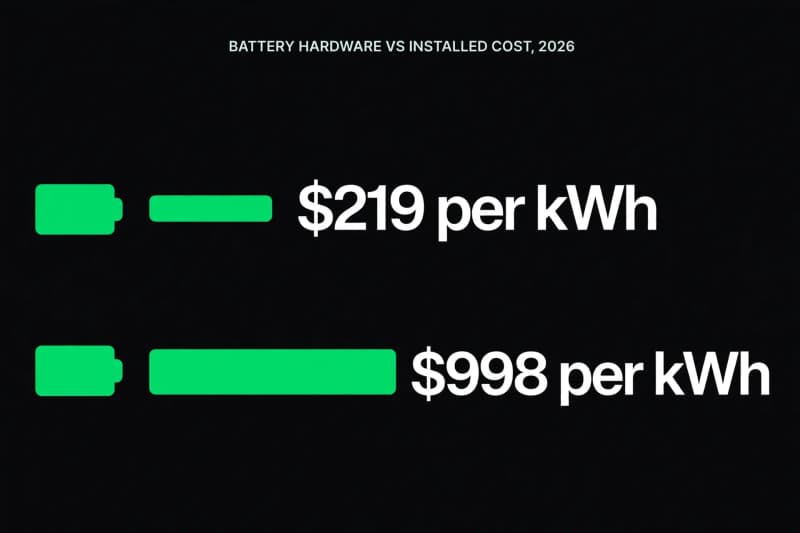
- EG4 PowerPro vs Tesla Powerwall 3 starts with a wide price gap: the PowerPro battery hardware costs about US$219 per kWh, while a Powerwall 3 typically installs for about US$998 per kWh, according to EnergySage marketplace data.
- The gap narrows once the PowerPro gets its inverter and installation. One installer’s published prices put a complete EG4 system at about US$1,156 per kWh installed, against about US$1,074 per kWh for a Powerwall 3.
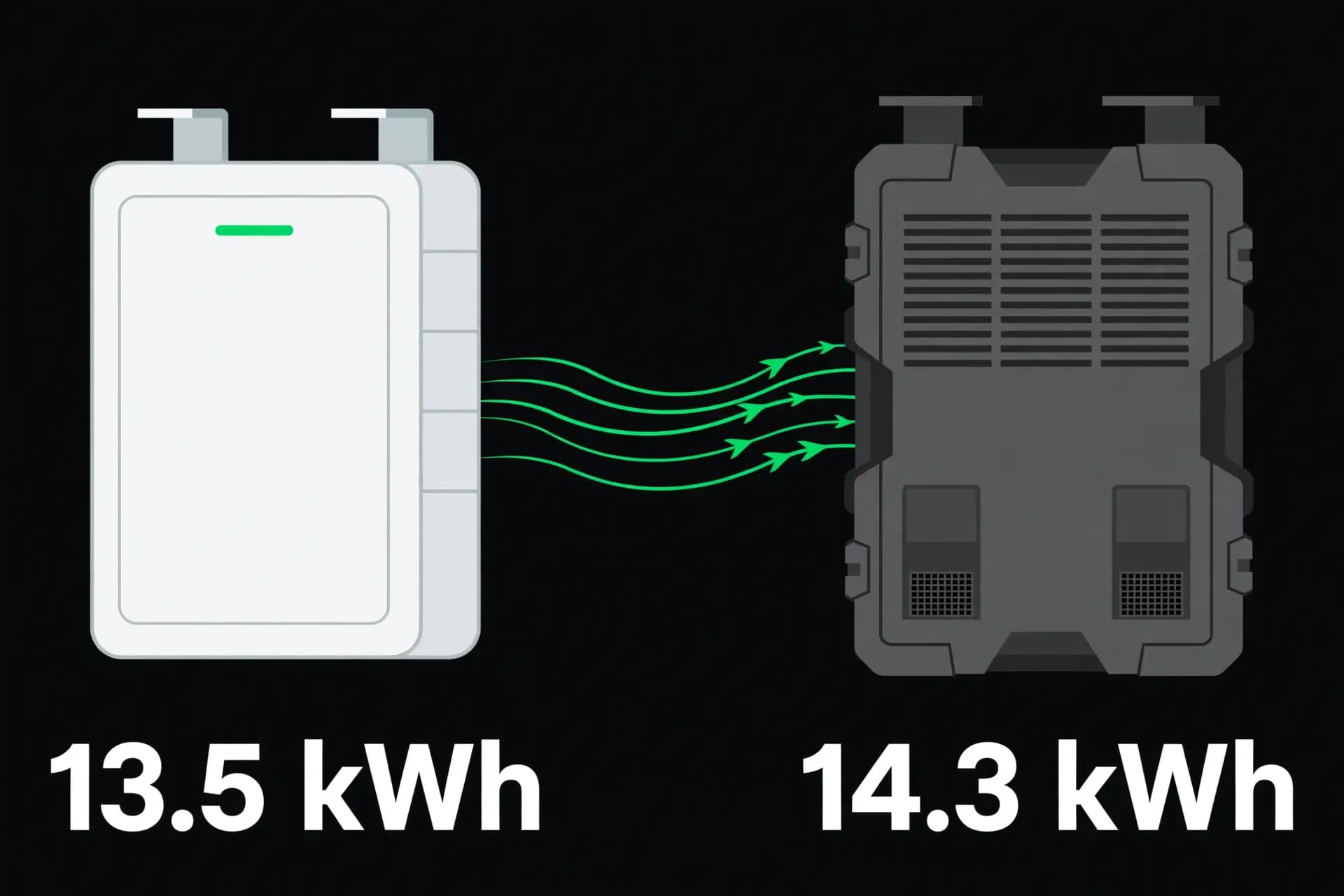
- On paper the PowerPro stores more energy at 14.3 kWh, but the Powerwall 3 delivers more usable energy per unit at 13.5 kWh, and more continuous power from a single box at 11.5 kW.
Home battery: a rechargeable battery installed in a house to store solar power or grid electricity, then discharge it during the evening peak or a power cut. Capacity is measured in kilowatt-hours (kWh), and output in kilowatts (kW). The two numbers answer different questions: kWh is how much energy the battery holds, kW is how fast it can deliver it.
EG4 PowerPro vs Tesla Powerwall 3 is the comparison shoppers ask for most in 2026, and the first numbers they see are misleading. The PowerPro battery lists at a recorded hardware price of about US$3,125 for 14.3 kWh, or roughly US$219 per kWh. A Powerwall 3 typically costs US$13,473 installed for 13.5 kWh, or about US$998 per kWh, according to EnergySage marketplace quotes from May 2026. The PowerPro looks 78% cheaper per kWh. It is not, because the two prices buy different things. The PowerPro is a battery module that needs a separate inverter and a full installation. The Powerwall 3 is a complete system with the inverter built in, sold and installed as one unit. This comparison prices both honestly, side by side, so the gap can be judged on what a buyer actually pays.
Both products sit at the centre of the 2026 home battery market for opposite reasons. Tesla’s Powerwall 3 is the best-selling home battery on the EnergySage Marketplace, holding 61% of marketplace share in the second half of 2025, and EnergySage rates it the best battery overall with a score of 100 out of 100. EG4’s PowerPro is the value challenger that keeps appearing in owner discussions, including a US homeowner preparing for hurricane season who found the Powerwall 3 too costly and larger than needed, then heard EG4 recommended repeatedly on Reddit, as reported by The Cool Down. One installer, BYOP Electric, calls EG4 its most-recommended brand for homeowners who want genuine battery backup without overspending. The question is whether the hardware saving survives the rest of the system.
The spec sheet, side by side
The two units measure capacity differently, and the difference matters. EG4 rates the PowerPro at 14.3 kWh total, from a 51.2-volt, 280-amp-hour lithium iron phosphate (LFP) pack, and recommends an 80% depth of discharge, which leaves about 11.4 kWh of routine usable energy per cycle. Tesla rates the Powerwall 3 at 13.5 kWh AC nominal and lists the same figure as usable capacity, because Tesla manages the state-of-charge window internally. On nameplate capacity the PowerPro is larger. On usable energy per unit the Powerwall 3 is larger, by about 2.1 kWh.
| Specification | EG4 PowerPro WallMount | Tesla Powerwall 3 |
|---|---|---|
| Capacity | 14.3 kWh total, 51.2 V, 280 Ah | 13.5 kWh AC nominal, usable |
| Usable energy per cycle | About 11.4 kWh at 80% depth of discharge | 13.5 kWh |
| Continuous power | About 7.2 kW DC from the battery; 12 kW AC with the EG4 18kPV inverter | 11.5 kW AC from the unit itself |
| Cell chemistry | Lithium iron phosphate (LFP) | Lithium iron phosphate (LFP), per EnergySage |
| Built-in solar inverter | No, needs a separate hybrid inverter | Yes, up to 20 kW DC solar input, 6 MPPTs |
| Round-trip efficiency | Not published as a single figure | 97.5% solar to home, 89% solar to battery to home (CEC weighted) |
| Motor starting | Set by the paired inverter | 185 LRA |
| Outdoor rating | IP65, all-weather, self-heating | Outdoor rated, NEMA 3R enclosure |
| Cycle life | More than 8,000 cycles at 80% depth of discharge | Not published in the datasheet |
| Warranty | 10 years | 10 years, at least 70% capacity retention |
| Certifications | UL1973, UL9540A | UL 9540, UL 9540A, IEEE 1547 |
| Weight | 140 kg (308.6 lb) | 130 kg (287 lb) |
Sources: EG4 PowerPro WallMount All Weather specification sheet; Tesla Powerwall 3 datasheet; EnergySage Powerwall 3 review, updated 15 May 2026. The PowerPro continuous discharge figure of 140 amps is from EG4 specification sheet version 1.2.1, verified against the datasheet in October 2026.
Power is where the two-box EG4 system catches up. The PowerPro battery itself discharges at 140 amps continuous, about 7.2 kW at its 51.2-volt nominal rating, with 200 amps allowed for up to 30 minutes. Paired with EG4’s 18kPV hybrid inverter, rated at 12,000 watts of continuous AC output with 18,000 watts of solar input, the system delivers 12 kW, slightly ahead of the Powerwall 3’s 11.5 kW from a single box. The Powerwall 3 also starts heavy loads, with a 185 LRA motor-start rating that covers central air conditioning. The PowerPro has no motor-start figure of its own, because starting current is set by whichever inverter it is paired with.
US$219 against US$998 per kWh, and why the gap shrinks
The price table shows the same comparison in money. Every figure below is labelled by what it includes, because an unlabelled per-kWh number is how buyers get misled.
| Price | EG4 PowerPro | Tesla Powerwall 3 |
|---|---|---|
| Battery hardware, per kWh | About US$219 (US$3,125 recorded hardware price, 14.3 kWh) | Not sold as hardware alone |
| Typical installed cost, one unit | Not published as a single installed price | US$13,473, about US$998 per kWh (EnergySage, May 2026) |
| Installed range | Varies by inverter and installer | US$11,500 to US$16,500 (published 2026 cost guides) |
| One installer’s complete system | US$18,500 for FlexBoss, GridBOSS and a 16 kWh battery | US$14,500 installed (US$12,500 after a Wattsmart incentive) |
| Expansion cost per kWh | Additional PowerPro units at hardware pricing | US$5,900 hardware per 13.5 kWh expansion pack, about US$437 per kWh |
Sources: EnergySage Powerwall 3 review; BYOP Electric published installed prices; LiveOffTheGrid recorded PowerPro hardware price; Joule Post reporting on Powerwall 3 expansion packs, 5 November 2026.
The BYOP Electric comparison deserves a closer look, because it reverses the headline. That installer’s EG4 system costs US$18,500 for 16 kWh of storage, or about US$1,156 per kWh installed. Its Powerwall 3 costs US$14,500 for 13.5 kWh, or about US$1,074 per kWh installed. At that installer, the EG4 system costs about 8% more per kWh once the inverter, gateway hardware, labour and permitting are included. The PowerPro hardware saving is real, and it is also not the system price. A buyer comparing US$219 against US$998 is comparing a battery against a finished installation.
Two 2026 changes frame every price in this comparison. The 30% federal residential clean energy credit under Section 25D ended on 31 December 2025, so a battery bought and installed in 2026 gets no federal credit, and published 2026 prices are out-of-pocket prices. State and utility incentives still apply in some markets, including the Wattsmart incentive in BYOP Electric’s Powerwall 3 price. Tesla publishes no list price and quotes each system by address, so the EnergySage typical figure is a marketplace average, not a quote. EG4 sells through solar distributors and installers, and its hardware prices move with retailer promotions.
What 8,000 cycles and a 70% promise mean after 10 years
Longevity is the second place the two products report different numbers. EG4 publishes a cycle-life figure: more than 8,000 cycles at 80% depth of discharge, with a rated lifetime throughput of 82.6 MWh. At the recorded hardware price of US$3,125, that throughput works out to about US$0.038 per kWh cycled over the battery’s rated life, by Joule Post arithmetic from the datasheet figures. Tesla publishes no cycle-life figure in the Powerwall 3 datasheet. Its warranty guarantees at least 70% of the 13.5 kWh capacity after 10 years, with no cycle cap for solar self-consumption, time-based control and backup use, according to the warranty terms. Both warranties run 10 years. The difference is what each manufacturer puts in writing: EG4 promises cycles, Tesla promises retained capacity.
The practical consequence is straightforward. A household cycling a battery daily will cross 3,650 cycles in 10 years, well inside the PowerPro’s 8,000-cycle rating, and the Powerwall 3 warranty covers the same period without a cycle limit for the standard uses. Neither warranty is the deciding factor for most buyers. The deciding factors are the installer relationship and the system design. The PowerPro needs a compatible inverter and a design that treats the battery and inverter as separate components. The Powerwall 3 arrives as one box with its inverter, gateway and app already integrated, and it scales to four units for 54 kWh, with expansion packs adding 13.5 kWh each at US$5,900 in hardware. EG4 scales by adding PowerPro units to the same inverter, up to the inverter’s limits, and EG4’s larger XR 60 unit packs 60 kWh at US$342 per kWh in hardware for buyers who want far more storage in one purchase, as Joule Post reported on 13 November 2026.
Which home battery fits which buyer in 2026
The choice comes down to who designs and installs the system. A buyer working with a Tesla Certified Installer, or buying Tesla solar at the same time, gets the simpler path with the Powerwall 3: one box, one app, a published installed price near US$13,473, and 11.5 kW of continuous power that covers a heat pump and the rest of a home’s base load. A buyer with an existing solar array, an off-grid build, or an installer who works with EG4 equipment gets the cheaper hardware with the PowerPro: about US$219 per kWh for the battery itself, an outdoor-rated enclosure with self-heating for cold climates, and a 12 kW inverter pairing that matches the Powerwall 3 on power. The buyer who pays the least per kWh is the one who gets three written quotes for a complete installed system, because the hardware gap and the installed gap point in opposite directions. For the wider market, our battery storage explainer covers how grid batteries work, our home battery cost comparison ranks the wider 2026 field, and our Powerwall 3 expansion pack coverage prices the cost of adding storage later. EG4’s larger unit is covered in our EG4 XR 60 report.
Frequently asked questions
Is EG4 better than Powerwall?
EG4 is better on battery hardware cost per kWh, at about US$219 against the Powerwall 3’s typical US$998 per kWh installed. Tesla is better on simplicity, with the inverter built in, a single app, and a certified installer network. The better buy depends on whether the buyer values low hardware cost or a finished installed system.
How much does a Powerwall 3 cost installed?
EnergySage reports a typical installed cost of US$13,473 before incentives, or about US$998 per kWh, based on quotes on its marketplace in May 2026. Published 2026 cost guides put the range at about US$11,500 to US$16,500 for one unit installed, before incentives. Tesla publishes no list price.
Does the EG4 PowerPro need an inverter?
Yes. The PowerPro is a 48-volt DC battery module and needs a compatible hybrid inverter, such as EG4’s 18kPV, rated at 12 kW of continuous AC output, to convert its stored power into household AC electricity. The inverter and its installation are part of the system cost.
Sources
- EG4 PowerPro WallMount All Weather Battery, Specification Sheet, EG4 Electronics
- Powerwall 3 Specifications, Tesla Energy Library
- Tesla Powerwall 3 Review in 2026, EnergySage, updated 15 May 2026
- Tesla Powerwall vs Enphase, BYOP Electric, installed prices quoted
- US Homeowner Weighs Hurricane Backup Options, Lands on EG4, The Cool Down
- EG4 WallMount All Weather (PowerPro) 48V 280Ah 14.3kWh Specs, LiveOffTheGrid, recorded hardware price US$3,125