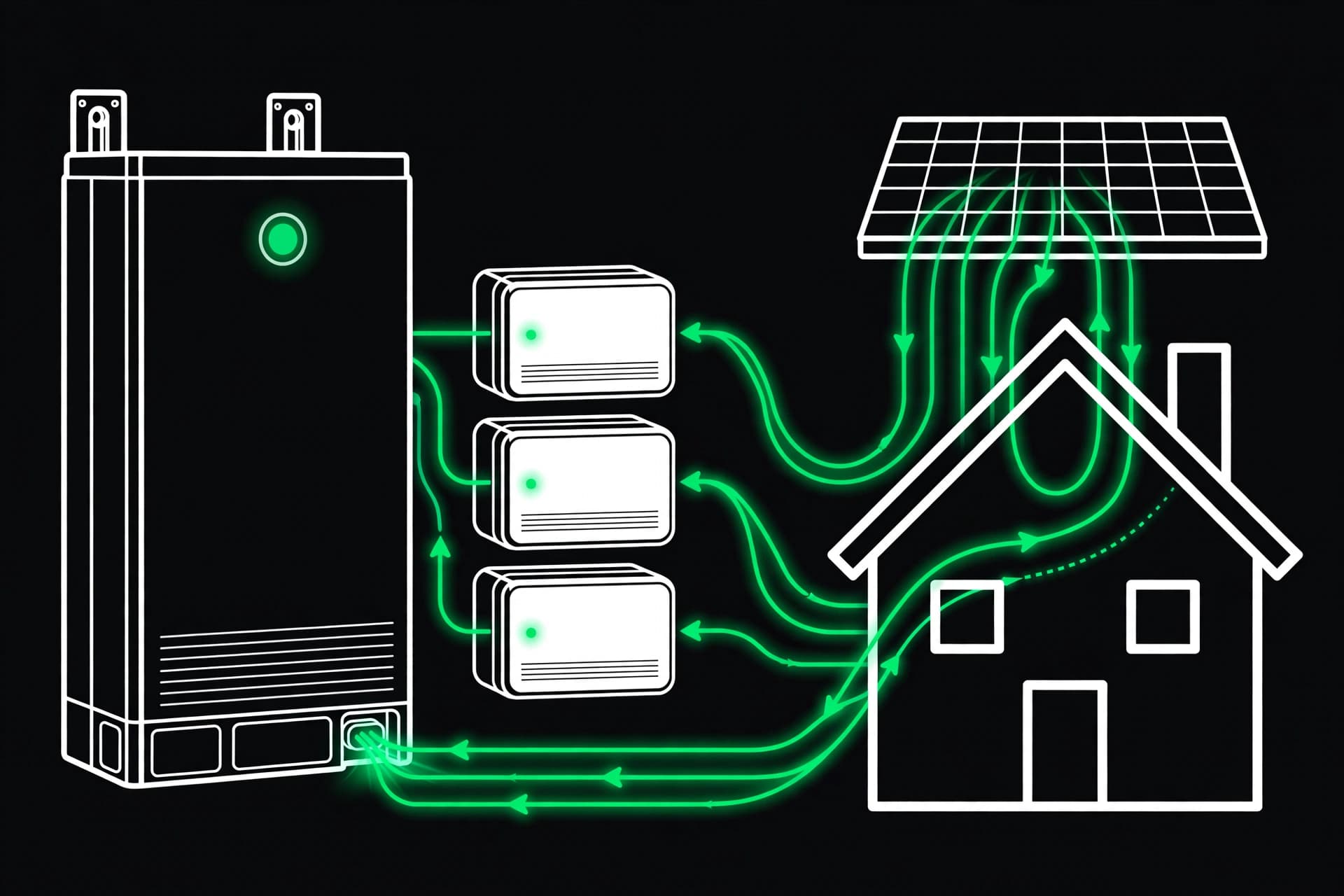
- A Powerwall 3 expansion pack adds stored energy to an existing Powerwall 3 system, and it carries no inverter of its own.
- Tesla lists the expansion hardware at $5,900 in the United States, before installation, according to NRG Clean Power.
- One main unit supports up to three expansion packs, taking total storage to 54 kWh while continuous output stays at 11.5 kW.
Powerwall 3 expansion pack: A DC battery module that adds stored energy to a Powerwall 3 system. It carries no inverter and no solar input, so it extends how long backup lasts for homes that already own the main unit, rather than raising the peak power the system can deliver at once.
Power drawn from the wall during an outage depends on two separate limits, and an expansion pack moves only one of them. The main Powerwall 3 unit converts stored DC energy to AC power for the home, and its inverter sets the ceiling on simultaneous load. An expansion pack stores additional DC energy behind that same inverter, so the house can run for longer at the same power level, and it gains no new ability to start a larger motor or carry a larger combined load.
Tesla’s Powerwall 3 datasheet gives the main unit 13.5 kWh of nominal battery energy and 11.5 kW of maximum continuous AC output on the grid, with output configurable at 5.8 kW, 7.6 kW, 10 kW or 11.5 kW. The same datasheet allows up to four Powerwall 3 units in one system and up to three expansion units, for a maximum total of seven units, with expansion units connected to the leader Powerwall 3. An expansion unit on its own cannot run a home, because it has no inverter, no solar input and no standalone capability.
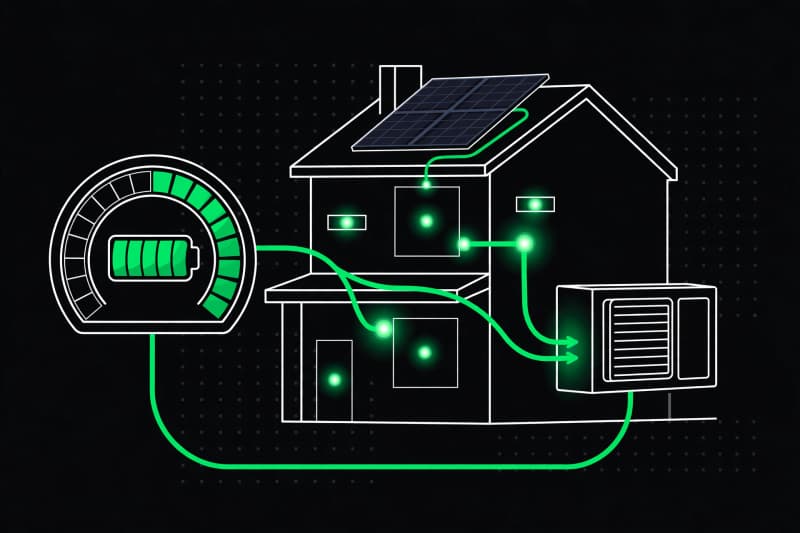
How a Tesla Powerwall 3 expansion pack fits the main unit
The distinction between energy and power decides whether an expansion pack is the right purchase. Energy, measured in kilowatt-hours, sets how long a load can run. Power, measured in kilowatts, sets how much load can run at the same moment. A home that loses grid power for a few hours and needs its lights, refrigerator and internet to keep running faces an energy problem, and extra stored kilowatt-hours solve it directly. A home that trips its battery when a large air conditioner starts faces a power problem, and extra stored kilowatt-hours leave that problem untouched.
Tesla’s datasheet puts the load-start capability of a Powerwall 3 at 185 locked-rotor amps, which is the rating that decides whether a given central air conditioner compressor can start from the battery. Joule Post’s earlier guide on running air conditioning from a home battery explains how that nameplate figure works in practice, and it remains the governing number for motor starts after expansions are added: How a Home Battery Runs Air Conditioning During a Power Outage. An expansion pack adds no locked-rotor capability, so a compressor that could not start before will not start after.
Floor mounting is another practical constraint. Tesla’s installation documentation describes expansion units as floor-mounted packs that stack behind the main Powerwall 3, and the datasheet notes that expansion units must connect to the leader unit in a multi-unit system. A buyer planning three packs needs floor space for three additional cabinets beside the main unit, plus clearances an installer will confirm on site, and a system with several full Powerwall 3 units needs a different expansion layout, because each expansion pack belongs to one leader unit.
Powerwall 3 expansion cost in 2026
Price reporting for expansions splits into hardware prices and installed prices, and the two should never be added together across sources. NRG Clean Power reports that Tesla lists the Powerwall 3 Expansion at $5,900 for hardware in the United States, before installation, and that each unit adds 13.5 kWh while sharing the main unit’s inverter. That hardware figure converts to $437 per kilowatt-hour before any labour, wiring, gateway work or permits, by simple division of $5,900 by 13.5 kWh, as Joule Post arithmetic.
Installed prices for a single main unit give the other side of the comparison. NuWatt Energy reports a typical installed range of $12,000 to $16,200 for one Powerwall 3 in the United States in 2026, including the battery, backup gateway, electrical work and permits, which converts to roughly $889 to $1,200 per kilowatt-hour installed by the same division. EcoFlow reports a $19,000 to $22,500 range for a Powerwall 3 plus one expansion, or 27 kWh in total. Those ranges come from different installers and different scopes, so subtracting one range from another would produce a misleading expansion increment, and the honest reading is simpler: the expansion route keeps the single inverter and gateway, while a second full unit pays for a second inverter and a second set of power electronics.
Outside the United States, the same hardware carries different installed prices and different currencies. SolarLove reports roughly £4,000 to £5,000 fitted per expansion pack in the United Kingdom (British pounds), and a £19,500 to £22,500 fitted total for a main unit plus three expansions. PSC Energy in Australia lists an expansion pack at about A$10,700 before rebate (Australian dollars). Currency symbols alone do not make these figures comparable, because labour rates, rebates and included equipment differ by market, and a buyer should compare quotes inside one market only.
| Configuration | Stored energy | Continuous output | What the buyer pays for |
|---|---|---|---|
| One Powerwall 3 | 13.5 kWh | 11.5 kW | Battery, inverter, solar input and gateway |
| One Powerwall 3 plus one expansion | 27 kWh | 11.5 kW | One extra battery pack, same inverter |
| One Powerwall 3 plus three expansions | 54 kWh | 11.5 kW | Three extra battery packs, same inverter |
| Two full Powerwall 3 units | 27 kWh | 23 kW | A second battery plus a second inverter |
The table shows the core trade in one view. Adding a second full unit doubles both energy and power, which suits a home with a large simultaneous load or a large motor that needs starting current. Adding expansion packs doubles or quadruples energy at the same power, which suits a home whose load is modest but whose outages last long, or a home that wants overnight coverage for a steady load such as a refrigerator, lights and a heat pump running at part load.
How long 54 kWh lasts at real home loads
Simple division gives a useful first estimate for runtime, with a clear caveat: inverter losses, a backup reserve and the battery’s own management reduce usable energy below the nominal figure, so real runtime runs shorter than the arithmetic. At a steady 3 kW load, 54 kWh divides to 18 hours. At 5 kW, the same storage divides to 10.8 hours. At the full 11.5 kW continuous output, it divides to 4.7 hours. A household rarely draws a flat load through an outage, so the practical question is the average load across the night, and a home averaging 1.5 kW overnight would stretch 27 kWh across 18 hours on the same arithmetic.
Charging speed sets a second limit that buyers often miss. Tesla’s datasheet gives a maximum continuous charge current and power of 33.3 A AC, or 8 kW, for a Powerwall 3 with up to three expansion units. Refilling 54 kWh at 8 kW takes 6.75 hours by simple division, before losses, and a solar array feeding the system can only charge as fast as its output and the charge limit allow. A home that drains a large expanded system overnight and expects a full recharge from a small rooftop array the next morning should check the array’s daily output against that charge time, because the battery can store more energy than a modest array can replace in one short winter day.
Sizing guidance from Joule Post’s earlier work helps here. The guide to sizing a home battery for a whole-home outage walks through adding up essential loads and their run times before choosing a capacity: What Size Home Battery Do You Need for a Power Outage?. The guide to running a battery without solar panels covers the same arithmetic from the other side, where grid charging and time-of-use rates set the economics: Is a Home Battery Without Solar Panels Worth It?. Both guides point to the same method: list the loads that must stay on, estimate their average draw, multiply by the outage length to protect, and only then choose between an expansion pack and a second full unit.
When a second full unit beats an expansion pack
Three situations favour a second full Powerwall 3 over expansion packs. A home with two large loads that must run together, such as an electric vehicle charger and an air conditioner, needs the extra 11.5 kW of output that only a second inverter provides. A home whose main unit already struggles to start a large motor needs the extra starting capability of a second unit, since expansion packs add none. A home planning a large solar array also benefits, because each full unit accepts up to 20 kW DC of solar input across six MPPT inputs according to Tesla’s datasheet, while an expansion pack accepts no solar at all.
Three situations favour expansion packs. A home with a modest peak load and long outages needs duration, and expansion packs deliver duration at a lower hardware cost per kilowatt-hour than a second inverter. A home that already owns a Powerwall 3 and wants more overnight coverage avoids paying for a second gateway and second set of power electronics. A home adding storage in stages benefits from the modular design, because packs can be added later as needs change, subject to the three-pack limit per leader unit and to installer confirmation that the existing system supports them.
Retrofit buyers should also check compatibility before ordering. Expansion packs work with Powerwall 3 only, according to Tesla’s documentation, so owners of earlier Powerwall generations cannot add them to an older system. The guide to adding a battery to an existing solar system explains the AC-coupled retrofit route for homes whose inverter setup differs: Add a Home Battery to Your Existing Solar System. For a broader view of how grid-scale and home storage differ in purpose, Joule Post’s storage explainer sets out the roles each plays: Battery Energy Storage Explained.
What the 10-year warranty covers in practice
Tesla’s datasheet gives Powerwall 3 a 10-year warranty, and buyers should read the warranty document itself for the terms that govern an expansion pack, including any throughput or retention conditions that apply to the combined system. Warranty length alone does not guarantee a given capacity at year ten, because lithium iron phosphate chemistry, the chemistry used in Powerwall 3, degrades with cycles and calendar age, and the warranty document states the specific retention or throughput terms that apply. A buyer comparing expansion packs with a second full unit should compare warranty terms for the whole system, beyond the headline year count, and should keep the installer’s written quote, the system design and the warranty document together for any future claim.
Installation scope also affects the final bill in ways a hardware price hides. A straightforward garage-wall install near the main panel costs less than an install with a long cable run, a panel upgrade or a difficult floor location for three stacked packs. The federal residential clean energy credit that once cut battery costs for many United States buyers ended on 31 December 2025, according to NRG Clean Power, so a 2026 buyer should not subtract a 30 percent credit from a quote unless the installer identifies a current programme that applies. State and utility programmes still exist in some areas, and they change often enough that a quote should name the programme, the amount and the eligibility rule in writing.
The expansion maths a buyer should run before ordering
A buyer can run the decision in four steps with numbers from a single installer quote. First, list the loads that must stay on during an outage and their average draw in kilowatts. Second, multiply that average draw by the outage length to protect, in hours, to get the stored energy needed in kilowatt-hours. Third, compare that figure with 13.5 kWh for the existing unit, 27 kWh with one expansion, 40.5 kWh with two and 54 kWh with three. Fourth, check the peak simultaneous load against 11.5 kW, and check the largest motor against the 185 locked-rotor amp rating. If energy is the binding constraint, expansion packs answer it. If power or motor starting is the binding constraint, a second full unit answers it, and no number of expansion packs will change that answer.
The price comparison should use installed quotes for both routes from the same installer, with the same scope, the same gateway work and the same backup panel configuration. Hardware prices from a manufacturer page and installed prices from a local installer measure different things, and mixing them understates the expansion route or overstates the second-unit route depending on which figure is picked. A quote that lists the expansion hardware, the installation labour, the gateway work if any, permits and any panel work separately lets a buyer see exactly where the saving from sharing an inverter lands.
Sources:
- Tesla Powerwall 3 specifications (Tesla Energy Library)
- Tesla Powerwall 3 cost in California (NRG Clean Power)
- How much is a Tesla Powerwall (EcoFlow)
Frequently asked questions
How much does a Tesla Powerwall 3 expansion pack cost?
NRG Clean Power reports Tesla lists the expansion hardware at $5,900 in the United States, before installation. Installed totals vary by installer and scope, and EcoFlow reports $19,000 to $22,500 for a main unit plus one expansion.
How many Powerwall 3 expansions can you add?
One Powerwall 3 supports up to three expansion packs, taking total storage to 54 kWh. Expansion packs must connect to the leader Powerwall 3 in the system.
Does a Powerwall 3 expansion add power output?
It does not. Continuous output stays at 11.5 kW for a single main unit, and the 185 locked-rotor amp motor-start rating stays unchanged. Expansion packs add stored energy only.
Can you add an expansion pack to an older Powerwall?
Tesla’s documentation describes expansion packs as Powerwall 3 equipment, so owners of earlier generations should confirm compatibility with a certified installer before ordering, and should expect a different upgrade route.
Is an expansion pack better than a second Powerwall 3?
It is better for longer runtime at a modest load, because it adds energy at a lower hardware cost per kilowatt-hour. A second full unit is better for a larger simultaneous load, a large motor start or a larger solar array, because it adds a second inverter.