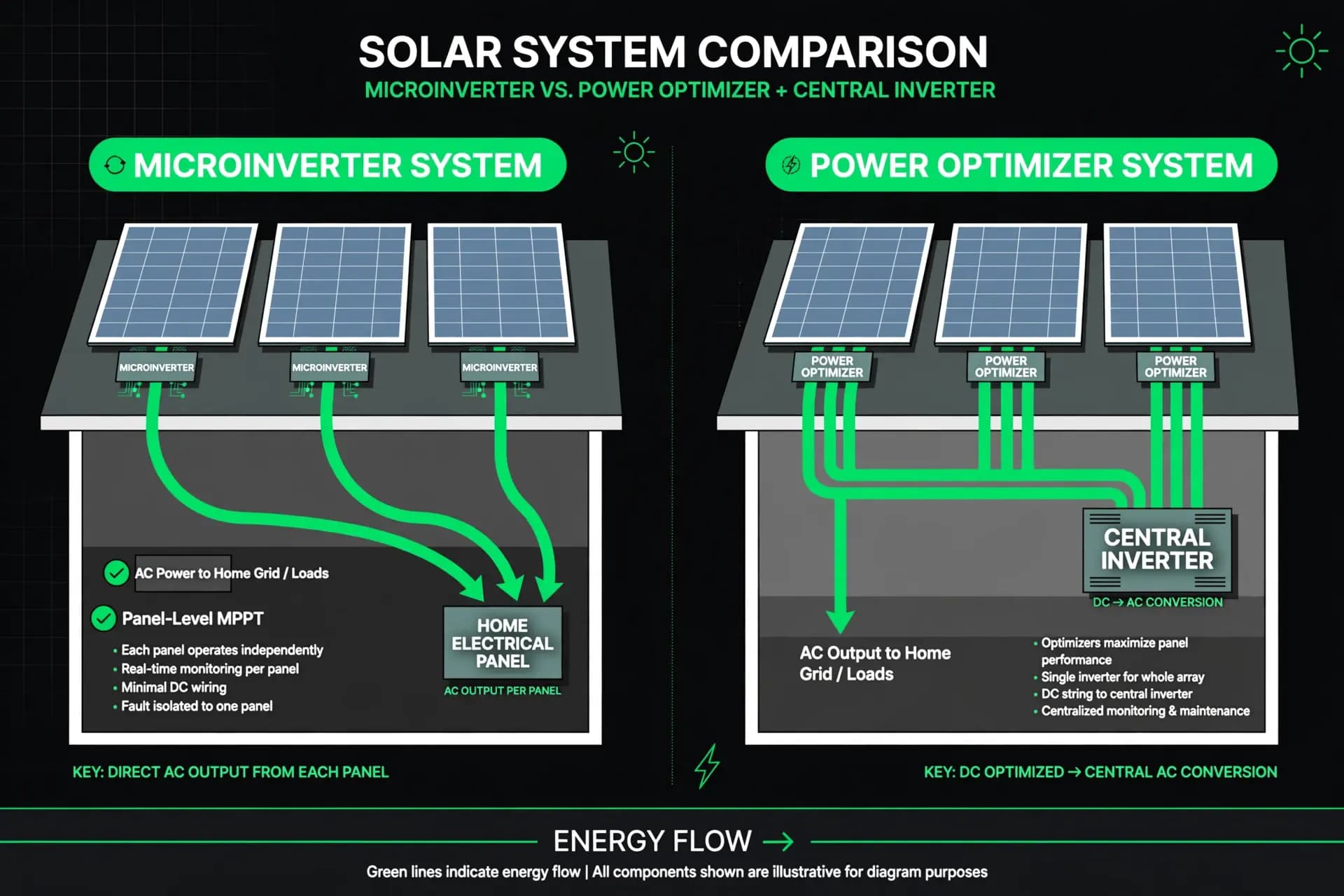
- Enphase and SolarEdge together hold over 90% of the US home solar inverter market, and they represent two different architectures: Enphase’s microinverters convert power behind each panel, while SolarEdge pairs per-panel optimizers with one central inverter.
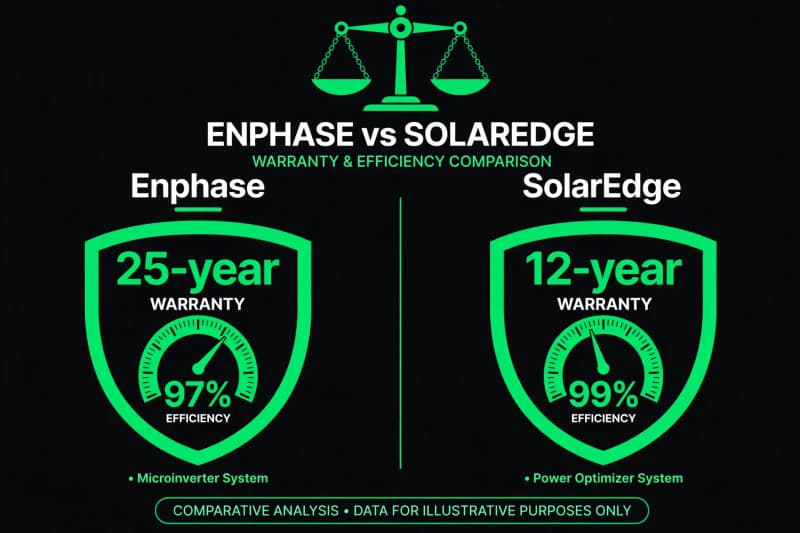
- The core trade-off is warranty length versus failure shape: Enphase microinverters carry a standard 25-year warranty with no single point of failure, while SolarEdge’s central inverter carries a 12-year standard warranty (extendable for a fee), and if it fails, the whole array goes down.
- Cost and efficiency cut the other way: SolarEdge inverter hardware runs roughly $1,000–$2,000 cheaper on a typical 10 kW system, peaks above 99% conversion efficiency, and charges DC-coupled batteries more efficiently, making it the pick for budget-conscious installs designed with storage from day one.
Enphase vs SolarEdge: the choice between the two dominant home solar inverter architectures: Enphase’s microinverters, which convert each panel’s DC power to AC right behind the panel, and SolarEdge’s system of per-panel power optimizers feeding one central string inverter that does the conversion in a single box.
- The two architectures, explained
- Enphase vs SolarEdge head-to-head: the 2026 comparison
- The real trade-off: warranty length vs failure shape
- What $1,000–$2,000 buys: the hardware-cost gap
- Batteries change the answer
- Which roof, which house: the 2026 decision guide
- Year 13 is when the warranty gap bills you
- Frequently asked questions
Enphase vs SolarEdge is the decision hiding inside almost every American rooftop solar quote. The two companies’ equipment appears on the overwhelming majority of US residential installs (SolarReviews puts their combined share above 90% of the home market), and most installation companies can fit either one. That means the choice often falls to the homeowner, who is usually asked to decide between two boxes they have never thought about, on the basis of a line item they barely understand.
The decision is simpler than the jargon makes it sound. It comes down to where the DC-to-AC conversion happens, what breaks when something breaks, how long the manufacturer guarantees the parts, and what you plan to plug in later. Get those four right and the answer mostly picks itself.
Enphase vs SolarEdge: the two architectures, explained
A solar inverter does one essential job: it converts the direct current (DC) electricity your panels produce into the alternating current (AC) your home and the grid use. Enphase and SolarEdge simply do it in different places.
How Enphase microinverters work
Enphase puts a small inverter, a microinverter, behind every panel. Each unit independently finds its panel’s maximum power point (the exact voltage-current mix producing the most power), converts DC to AC on the spot, and reports its output over the AC wiring. According to Enphase’s IQ8-series technical datasheets, California Energy Commission (CEC) weighted efficiency sits between 97% and 97.5% depending on the specific microinverter model. Because every panel operates independently, shade, dirt, or a fault on one panel cannot drag down the rest of the array. The microinverters also handle rapid shutdown, the code-required ability to de-energize the system instantly so utility workers are not exposed to live lines during an outage.
One structural consequence: batteries store DC, so the AC coming off Enphase microinverters must be converted back to DC for storage, then converted again on discharge. Each conversion loses a little energy. The price of the distributed design.
How SolarEdge’s optimizer system works
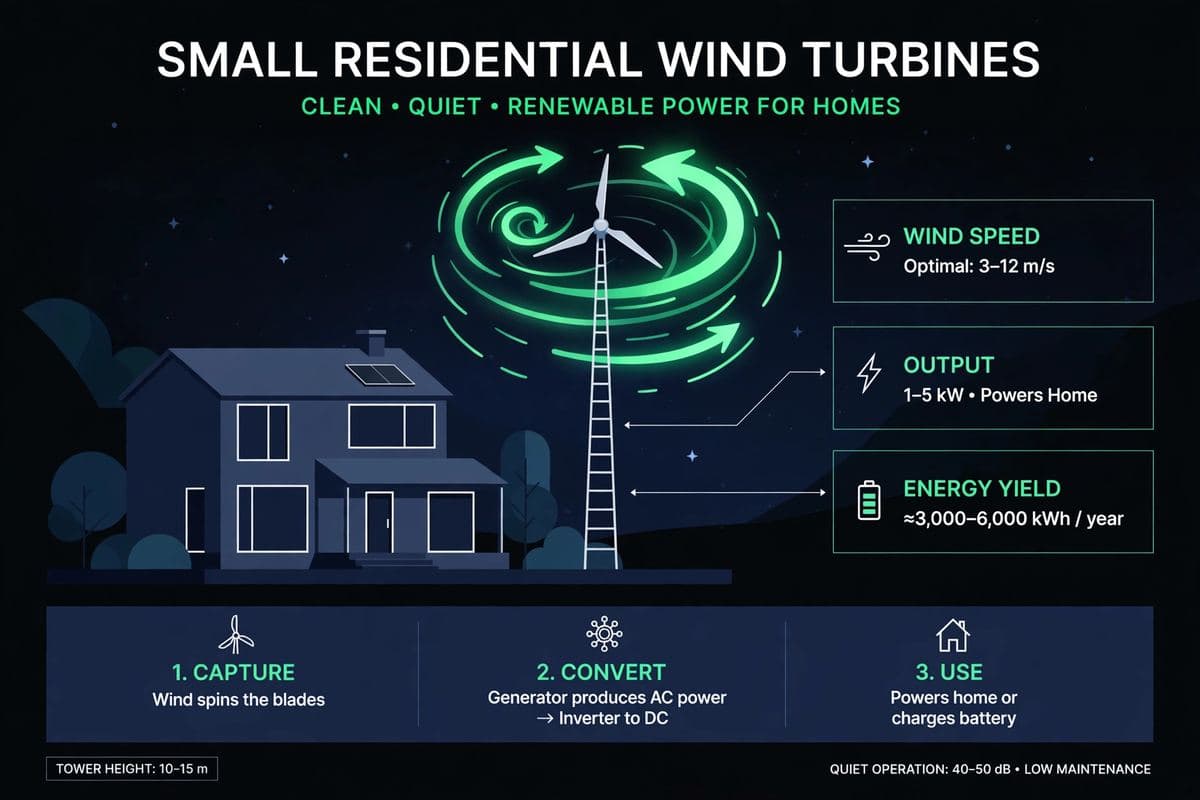
SolarEdge splits the job. Small power optimizers sit behind each panel and handle maximum-power-point tracking, panel-level monitoring, and rapid shutdown. Like microinverters, they isolate each panel’s performance. But they do not convert to AC. Instead, conditioned DC flows to a single central inverter box, usually wall-mounted, which performs the conversion for the whole array at once. SolarEdge’s Home Hub inverter exceeds 99% DC-to-AC conversion efficiency, and because the power stays DC until the central box, it can flow straight into a DC-coupled battery with minimal conversion loss.
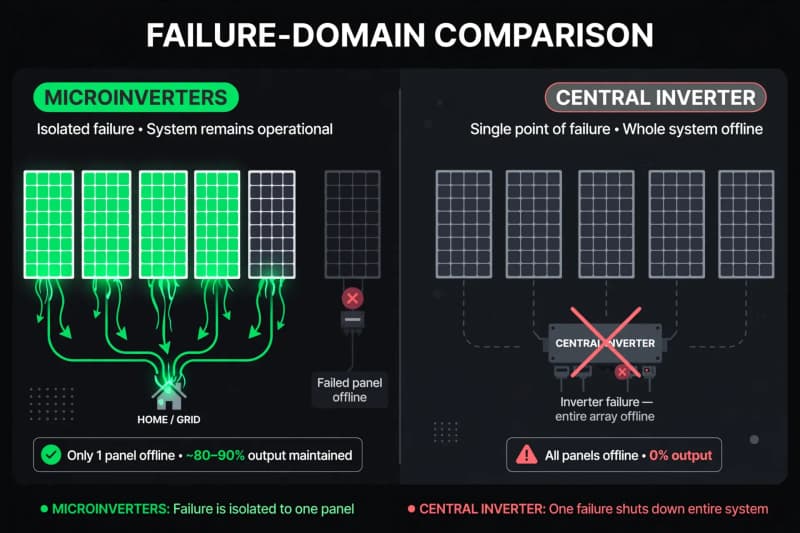
The trade-off is concentration: one box does the work of twenty microinverters, which makes it cheaper and more efficient. It means one failure can silence the entire system.
Enphase vs SolarEdge head-to-head: the 2026 comparison
| Enphase (microinverters) | SolarEdge (optimizers + central inverter) | |
|---|---|---|
| Architecture | DC-to-AC conversion behind each panel | Per-panel optimizers; one central inverter converts |
| Peak efficiency (CEC) | ~97–97.5% | Over 99% (Home Hub inverter) |
| Inverter warranty | 25 years standard | 12 years standard; extendable to 20–25 for a fee |
| Optimizer/microinverter warranty | 25 years | 25 years (power optimizers) |
| Failure shape | One failed unit = one panel down | Central inverter failure = whole array down |
| Battery coupling | AC-coupled (Enphase IQ batteries) | DC-coupled (efficiency edge for storage) |
| Shade handling | Excellent: full per-panel isolation | Good: optimizers manage mismatch per panel |
| Future expansion | Easy: one combiner handles up to 300 microinverters | May require a larger replacement inverter |
| Inverter hardware cost | ~$0.50–$0.70 per DC watt | ~$0.30–$0.45 per DC watt |
Efficiency and warranty specifications compiled from Enphase IQ8 Series and SolarEdge Home Hub official datasheets and limited warranty documentation (Q4 2026) (25-year limited warranty on IQ microinverters); cost-per-watt bands from installer-published Chicago-market figures.
The real trade-off: warranty length vs failure shape
Strip away the spec sheets and the decision is about risk, not efficiency. The efficiency gap between 97% and 99% is real but small, a couple of percent of annual production. The warranty and failure-shape gap is where money and downtime actually live.
Which is more reliable, Enphase or SolarEdge?
The installer community’s verdict leans one way. SolarReviews’ survey of solar installers found that more companies install Enphase, more of them report problems with SolarEdge equipment, and Enphase’s warranty process is easier to navigate. Their bottom line is blunt: “For most solar installations, Enphase microinverters are better.” The logic is the failure shape: if one microinverter fails, you lose a couple of kilowatt-hours a day; if a SolarEdge inverter fails, your whole system goes down until it is serviced.
The warranty asymmetry compounds this. Enphase covers its microinverters for 25 years as standard, essentially the life of the panels. SolarEdge’s central inverter gets 12 years standard, with extensions to 20 or 25 years available for an additional fee. The central inverter is also the component doing the hardest work in the system: it handles the full array’s power through one set of electronics, and industry experience puts typical central-inverter life in the 10–15 year range. A 12-year warranty on a part that often fails at year 13 is a warranty designed to expire on schedule. Price the extension before you compare quotes, because an apples-to-apples 25-year comparison narrows SolarEdge’s cost advantage.
What $1,000–$2,000 buys: the hardware-cost gap
SolarEdge’s genuine advantage is price. Using the installer-published hardware bands: on a 10 kW system, Enphase inverter hardware runs roughly $5,000–$7,000 (10,000 W × $0.50–$0.70), while SolarEdge hardware runs roughly $3,000–$4,500 (10,000 W × $0.30–$0.45). In practice, installed quotes for SolarEdge typically land $1,000–$2,000 below equivalent Enphase systems, and the gap shrinks after labor, which is similar for both.
| Enphase | SolarEdge | |
|---|---|---|
| Hardware cost per DC watt | ~$0.50–$0.70 | ~$0.30–$0.45 |
| Hardware on a 10 kW system | ~$5,000–$7,000 | ~$3,000–$4,500 |
| Typical installed-quote gap | SolarEdge lands $1,000–$2,000 below Enphase; labor is similar for both | |
What does the extra money buy with Enphase? Three things: the 25-year warranty with no extension fee, the distributed failure shape, and easier expansion. A single Enphase combiner can manage up to 300 microinverters, so adding panels later (for an EV, a heat pump, or just more load) is close to plug-and-play, whereas a SolarEdge system may need its central inverter upsized. If you are financing the system, the monthly difference on a $1,500 gap is small; if you are paying cash and your roof is simple and unshaded, SolarEdge’s discount is real money for little practical sacrifice.
One more cost dimension: monitoring. Both systems offer panel-level monitoring, Enphase’s Enlighten and SolarEdge’s platform, so neither leaves you blind to a failing panel. Enphase’s app gets consistently higher marks for owner-friendliness in installer surveys, a small but daily quality-of-life factor over 25 years.
Batteries change the answer: DC-coupled vs AC-coupled
This is where SolarEdge claws back ground. Because SolarEdge’s power stays DC until the central inverter, A DC-coupled battery charges directly from the high-voltage DC bus at roughly 94.5% round-trip efficiency, avoiding the triple DC-AC-DC-AC conversion penalty of AC-coupled architectures (typically ~89-90% round-trip). Enphase’s AC-coupled batteries (like the IQ Battery 5P, which carries a 15-year warranty) must convert AC back to DC for storage and again on discharge, surrendering a few efficiency points on every round trip.
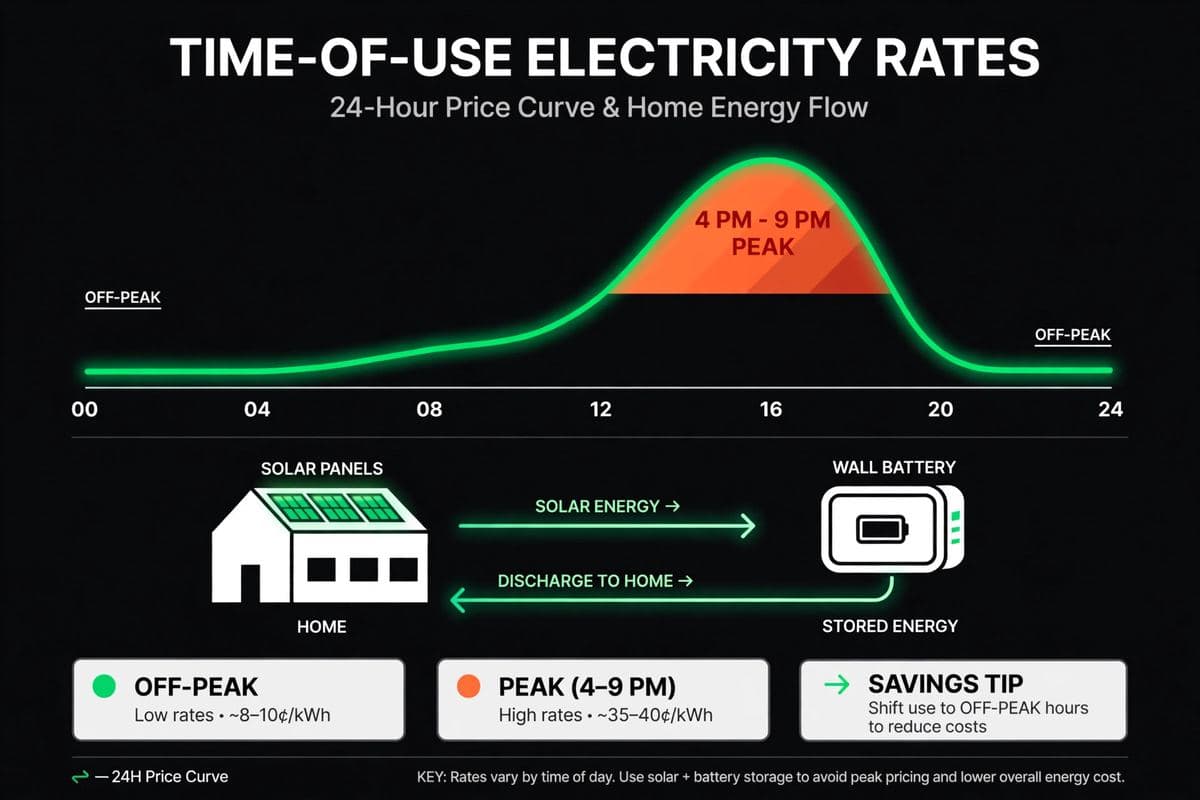
The practical rule: if you are installing solar and a battery together on day one, increasingly the rational move where export credits are weak, SolarEdge’s DC coupling is the more efficient architecture. Our net metering explainer shows why that matters: under California-style net billing, shifting midday surplus into the evening peak is worth far more than exporting it, so every point of storage efficiency is money. If the battery comes later, Enphase’s AC-coupled design retrofits onto the existing system with less friction. For the storage side of the equation, see our battery storage explainer and the 2026 home battery cost breakdown.
Which roof, which house: the 2026 decision guide
Synthesizing the trade-offs into the actual homeowner decision:
- Complex or shaded roof → Enphase. Multiple roof planes, dormers, chimneys, or tree shade: per-panel isolation extracts the most from every panel, and a shaded string drags down less of the array.
- Simple, unshaded, south-facing roof on a budget → SolarEdge. The optimizer already handles mild mismatch; the $1,000–$2,000 savings are real, and the 99% peak efficiency is genuinely the best conversion number in the comparison.
- Battery on day one → SolarEdge. DC coupling’s efficiency edge compounds over thousands of charge cycles.
- Battery later, or panels later → Enphase. AC-coupled storage retrofits cleanly, and expanding the array is trivial up to 300 microinverters per combiner.
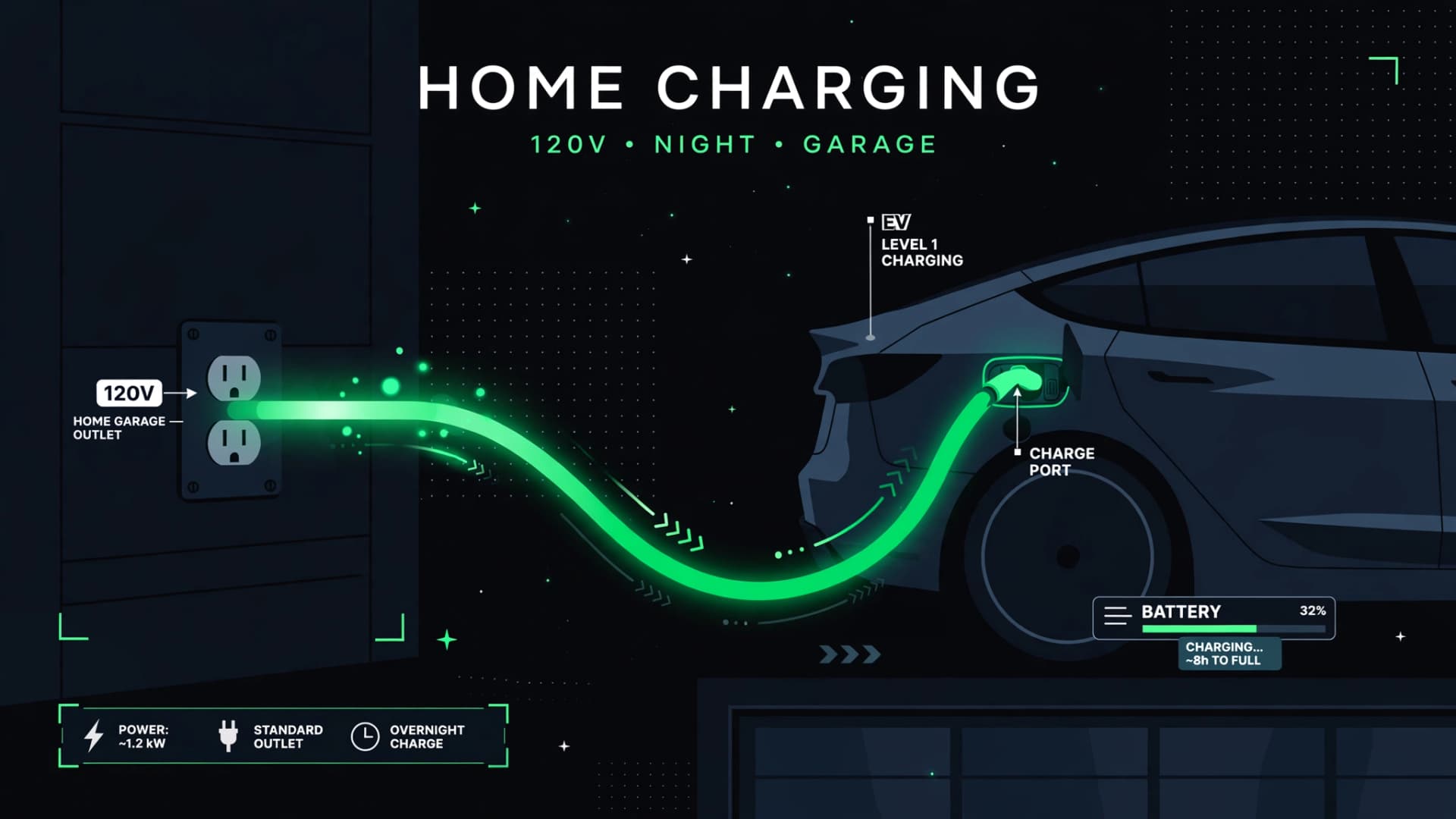
- EV charging on the horizon → Enphase. Because Enphase systems scale on a standard 240V AC branch circuit, adding four to six panels later to offset a new Level 2 EV charger requires only additional microinverters rather than resizing a central string inverter.
- Hands-off for 25 years → Enphase. The standard 25-year warranty with no extension to buy and no single point of failure is the closest thing residential solar has to fit-and-forget.
None of this makes SolarEdge a bad product: installers who recommend it for the right roof are giving sound advice, especially with an experienced crew and a workmanship warranty behind the install. The wrong choice is not picking one brand over the other; it is picking without knowing which trade-off you bought.
Year 13 is when the warranty gap bills you
The economics come down to a warranty asymmetry. Solar panels routinely carry 25-year performance warranties; home batteries are warrantied for 10–15 years. The inverter sits between them. Only one of the two architectures warranties it for the full 25. A SolarEdge owner whose central inverter dies at year 13 faces a replacement bill (hardware plus a service visit) that the Enphase owner never sees, because the microinverters were still under warranty. Price a SolarEdge extended warranty at quote time and the lifetime cost gap shrinks; skip it, and you are self-insuring the highest-failure component in the system.
The market has already voted with its purchase orders: two companies splitting over 90% of US residential share means your installer has deep experience with whichever you choose: ask them which one they service less often, and weight that answer heavily. And since the 30% federal credit ended for 2026 purchases, every dollar of the system is now your dollar; the post-credit solar economics make the inverter choice one of the few remaining levers that moves total cost of ownership. For the full picture of how the panels themselves turn sunlight into power, start with how solar panels work.
Frequently asked questions
Which is more reliable, Enphase or SolarEdge?
Installer surveys favor Enphase: more installers report problems with SolarEdge equipment, Enphase’s warranty process is rated easier, and the distributed design means any single failure costs you one panel’s output instead of the whole array. SolarEdge equipment is not unreliable in absolute terms. But its central inverter is a single point of failure with a shorter standard warranty.
Are microinverters always better than optimizers?
No. Microinverters win on shade-heavy or complex roofs, on warranty length, and on future expansion. Optimizers win on upfront cost and peak conversion efficiency, and the SolarEdge architecture wins clearly when a DC-coupled battery is part of the day-one design. Match the architecture to the roof and the plan, not to a brand loyalty.
Which produces more energy?
On an unshaded roof they are close: SolarEdge’s central inverter peaks above 99% efficiency versus ~96–97% for Enphase microinverters, a small edge. On a shaded or multi-orientation roof, Enphase’s full per-panel isolation typically harvests more in practice, because no panel constrains any other. Real-world production differences are dominated by the roof, not the brand.
Can I add a battery later with either system?
Yes, but Enphase makes it easier. Its AC-coupled batteries integrate with an existing microinverter system with minimal rewiring. SolarEdge batteries pair most efficiently when the solar and storage are designed together as a DC-coupled system, though retrofitting storage onto an older SolarEdge install is possible but less elegant. Decide your storage timeline before you choose.
Should I pay extra to extend the SolarEdge warranty?
If you choose SolarEdge and plan to stay in the home long-term, usually yes. The standard 12-year inverter warranty is the weak link in an otherwise 25-year system, with panels and optimizers covered far longer. An extended warranty converts an unpredictable mid-life replacement bill into a known upfront cost; get the extension price in writing at quote time so you can compare true 25-year costs against Enphase.