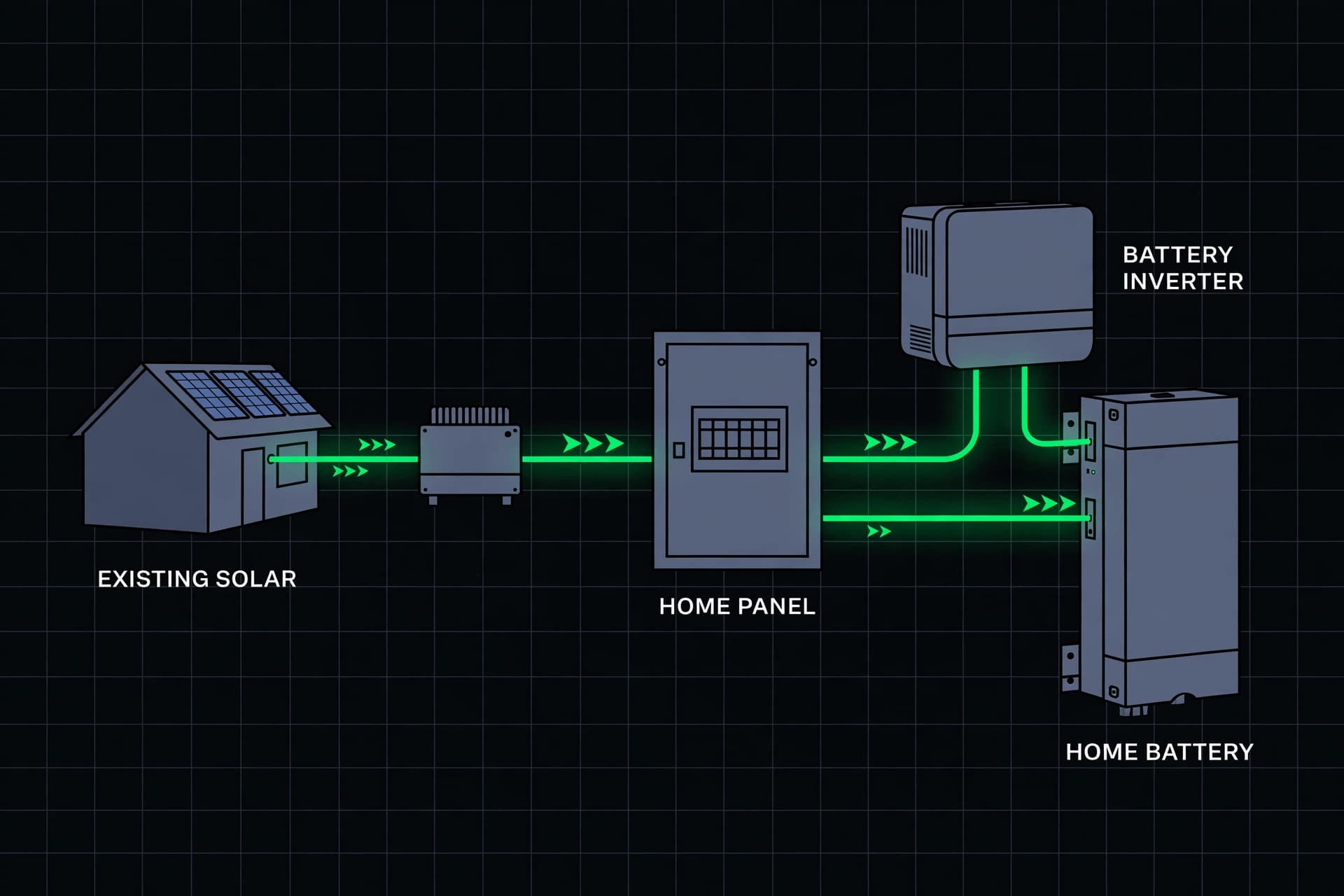
- Yes, you can add a home battery to an existing solar system. The standard path is AC coupling: a battery inverter charges from the AC output of your existing solar inverter.
- Tapping DC wires fails on systems with proprietary optimizers such as SolarEdge. Typical 2026 AC-coupled hardware includes the Tesla Powerwall 3 (13.5 kWh, up to 11.5 kW) and the Enphase IQ Battery 5P (5.0 kWh usable, 3.84 kVA).
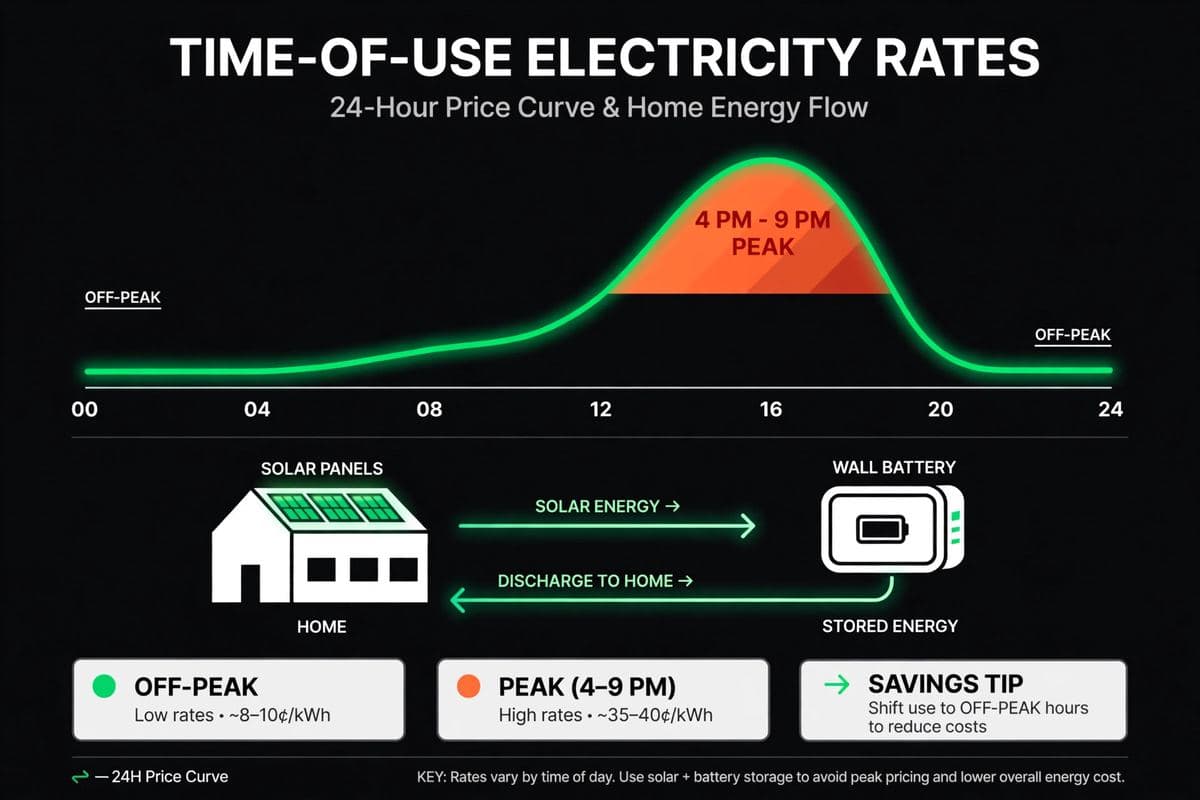
- Under California’s Net Billing tariff, midday exports average about 5 cents per kWh while evening power costs up to 65 cents, so a 10 kWh battery cycled daily returns roughly $900 to $1,100 a year in self-consumption value. The 30% federal residential credit ended for 2026 installations.
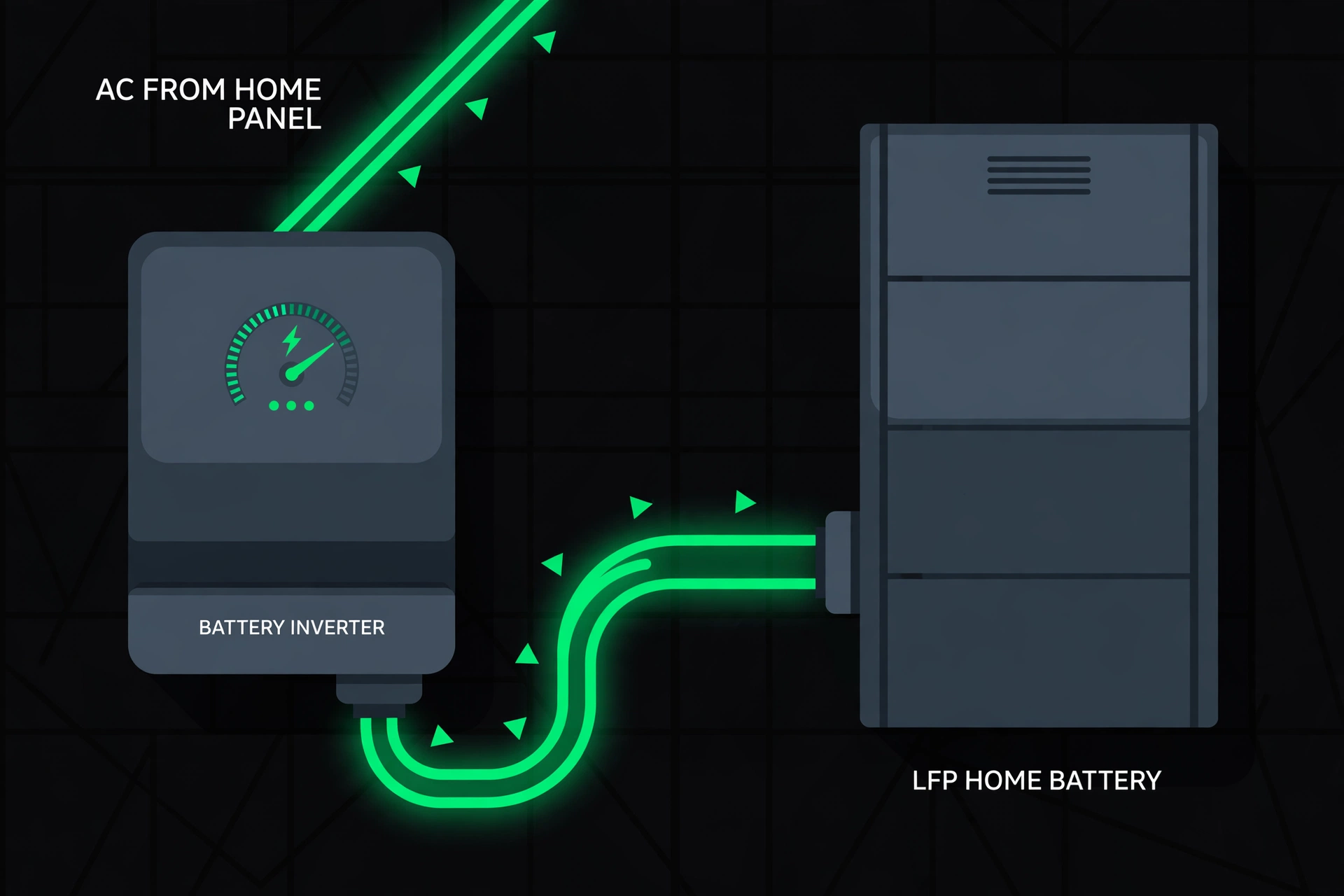
AC coupling: A retrofit method that adds a battery inverter alongside your existing solar inverter. The battery inverter converts your panels’ AC output back to DC to charge the battery, then back to AC when your home needs power. Your original panels and inverter stay untouched.
AC coupling has become the default retrofit as battery attachment surges: Berkeley Lab reports 37% of new US residential solar installations included storage in 2025. The question first surfaced on the DIY Solar Power Forum, where an owner with 72 panels on two SolarEdge inverters asked whether he could tap the DC leads to feed a charge controller. The answer was blunt: SolarEdge optimizers are proprietary, work only with SolarEdge inverters, and provide panel-level monitoring plus code-required rapid shutdown. As one member wrote, “is called AC coupling. You’d add a battery inverter that can charge from AC. This would be able to charge from the AC output of your solar. If set up right it can also provide back up power if the grid goes down.”
Why tapping your DC wires almost never works
Every rooftop system hides an electrical language its inverter speaks. On SolarEdge systems, each panel carries an optimizer that performs MPPT, regulates string voltage, and communicates with the inverter continuously. That communication is the code-required rapid shutdown, and a generic charge controller expects raw panel voltage and knows nothing about the optimizer protocol. Microinverter systems such as Enphase output 240 V AC at each panel, so there is no central DC bus to tap at all. Rewiring older string-inverter systems is technically possible, but it voids warranties and often violates the original permit.
How AC coupling actually works
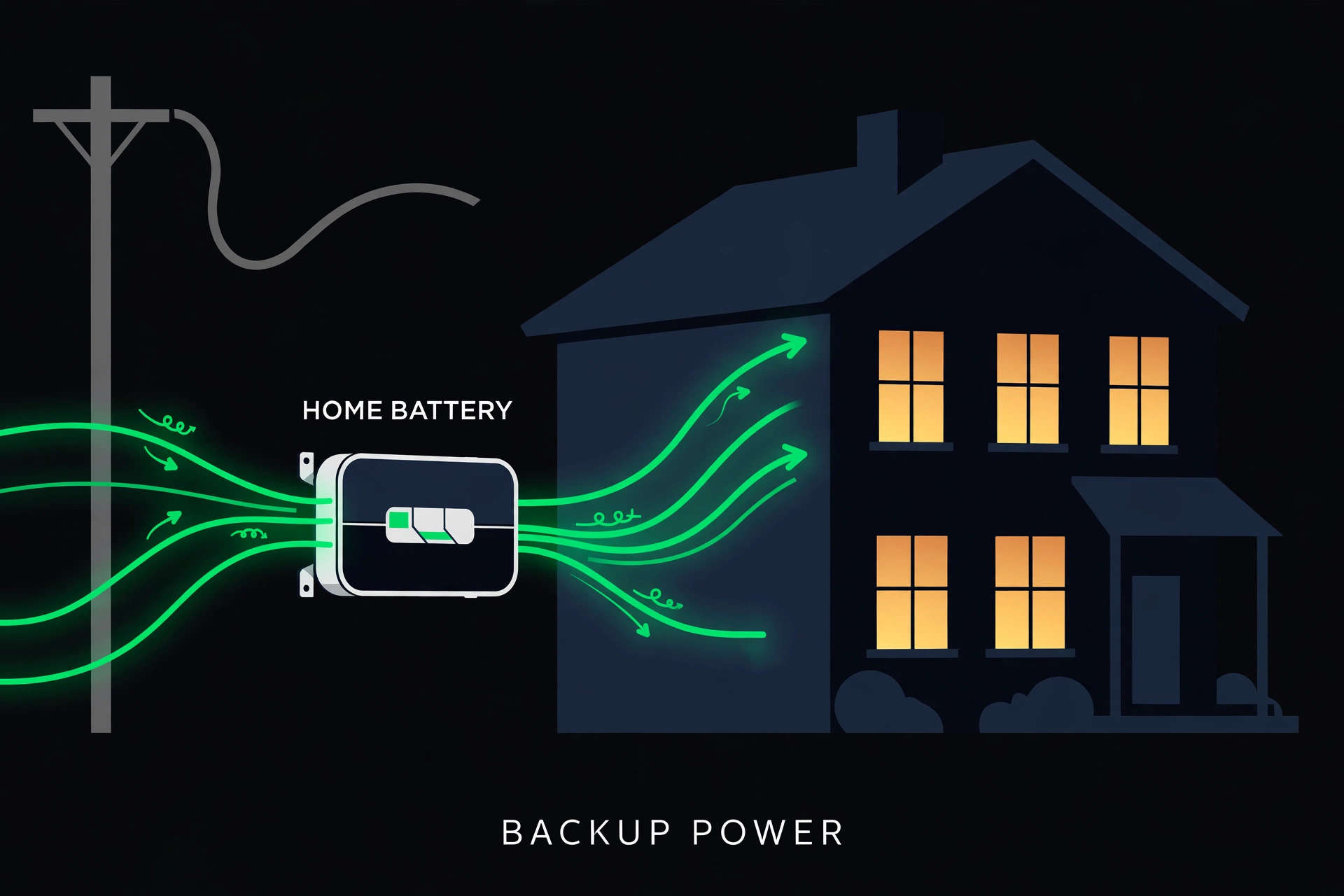
Enphase’s technical brief describes it plainly: the photovoltaic inverter and the battery-based inverter are “coupled” on their AC outputs, both connecting to the same AC bus at your breaker panel. Surplus solar flows through the panel as AC, the battery inverter converts it back to DC, and the battery charges. In the evening, the battery inverter discharges, converting stored DC back to AC for your loads. Your existing inverter never knows the battery exists. A primer on the fundamentals of battery energy storage explains how these conversion stages fit together. Outages need a grid-forming battery inverter and a backup controller that islands your home: the battery inverter creates what Enphase calls “an intentional AC island to which the microinverters can export power”, so your solar inverter restarts and daytime production feeds the home while recharging the battery. When the battery fills, the inverter curtails excess solar through frequency shifting.
What an AC-coupled retrofit actually installs
A retrofit is a half-day to two-day job for a licensed installer. Beyond the battery, expect a battery inverter or an integrated unit; a system controller with an automatic transfer switch; a critical loads panel; and current transformers on your mains and solar feeds. Backup behavior is configurable, not automatic, so the installer must enable the mode you want. Confirm in writing that your equipment supports blackout PV charging before you sign.
The 2026 hardware landscape for retrofits
Home storage in 2026 is an LFP market. Tesla’s Powerwall 3 carries 13.5 kWh of nominal battery energy and up to 11.5 kW of continuous AC output, per Tesla’s published specifications. Enphase’s IQ Battery 5P offers 5.0 kWh of usable capacity per unit with 3.84 kVA continuous output, a 15-year warranty up to 6,000 cycles, and a datasheet note that it is “evaluated to UL 9540A, the highest industry standard for battery safety”. For sizing, warranty, and chemistry detail, see the outage sizing guide, the battery lifespan explainer, and the LFP versus NMC comparison.
| Retrofit path | Existing inverter | Conversion steps | Round-trip efficiency | Example hardware |
|---|---|---|---|---|
| AC-coupled battery | Stays; battery inverter connects at the breaker panel. | Solar DC to AC, then AC to battery DC, then back to AC | About 90% AC round-trip (Enphase IQ Battery 5P datasheet) | Powerwall 3: 13.5 kWh, up to 11.5 kW AC. IQ Battery 5P: 5.0 kWh usable, 3.84 kVA, LFP. |
| DC-coupled hybrid (inverter swap) | Removed; new hybrid handles solar and battery. | Solar DC straight to battery DC; one conversion skipped | About 96% DC round-trip (same datasheet) | DC-coupled hybrid inverters. |
DC coupling wins roughly six points of efficiency by skipping a conversion, but it requires an inverter swap. For a healthy system, the AC-coupled penalty costs a few hundred kilowatt-hours a year, a small fraction of what the battery recovers below.
The 2026 economics: what it costs and what NEM 3.0 did to the math
The 30% Residential Clean Energy Credit no longer applies to 2026 battery installations. The IRS states plainly: “The credit is not available for any property placed in service after December 31, 2025.” Batteries of at least 3 kWh had qualified from 2023.
Start with the hardware adder: Berkeley Lab’s solar-adder analysis put the historical cost of adding storage to residential PV at roughly $700 to $1,300 per kWh of capacity in equipment and integration (earlier vintages; current quotes vary widely), implying $9,500 to $17,500 at the 2025 median of 13.5 kWh. Under California’s Net Billing tariff, in force for applications approved after April 14, 2023, excess solar earns avoided-cost credits the California Solar and Storage Association averages at 4.7 cents for PG&E and SCE and 6.2 cents for SDG&E, while evening time-of-use peaks reach 52.9, 53.9, and 65.3 cents per kWh. The retrofit case is strongest for newer systems on Net Billing. Take a 10 kWh usable battery cycled once a day, 300 days a year. Midday solar that would have exported at 5.5 cents is stored and used in the evening, displacing 40-cent electricity. Gross value per stored kWh is 34.5 cents; at the datasheet’s 90% round-trip efficiency the battery recovers about 31 cents, or $3.10 a day: roughly $930 a year in self-consumption value. Under NEM 2.0, where exports earned around 30 cents, it would have recovered about a dollar a day. Net Billing made the battery roughly three times more valuable. For dispatch tactics, see the time-of-use rates and battery strategy guide.
What the 5-cent export credit means for your existing array
On legacy net metering, the grid is a free one-for-one battery, and storage is mostly outage insurance. Under Net Billing, midday surplus is nearly worthless to export and expensive to buy back, so a battery that eats its own production is doing real financial work.
Frequently asked questions
Can you add a battery to an existing solar system?
Yes. A battery inverter at your breaker panel charges from the AC output of your existing solar inverter. With a backup controller, the system also powers your home during outages and recharges from solar while the grid is down.
Can I tap the DC wires on my SolarEdge inverter to add batteries?
No, not without major surgery. SolarEdge optimizers are proprietary and talk only to SolarEdge inverters, providing panel-level monitoring and rapid shutdown. Installers recommend AC coupling instead, or replacing the inverter with a DC-coupled unit.
Will my solar panels charge the battery during a power outage?
They can, but only if the battery inverter is grid-forming: it creates an AC island, the solar inverter restarts, and daytime production recharges the battery. Confirm this with your installer before signing.
Is a home battery worth it in 2026 now that the 30% federal tax credit has ended?
It depends on your export rates. The federal credit ended for 2026 installations, but where midday exports earn about 5 cents and evening power costs 30 to 65 cents, a 10 kWh battery cycled daily can return roughly $900 to $1,100 a year in self-consumption value.