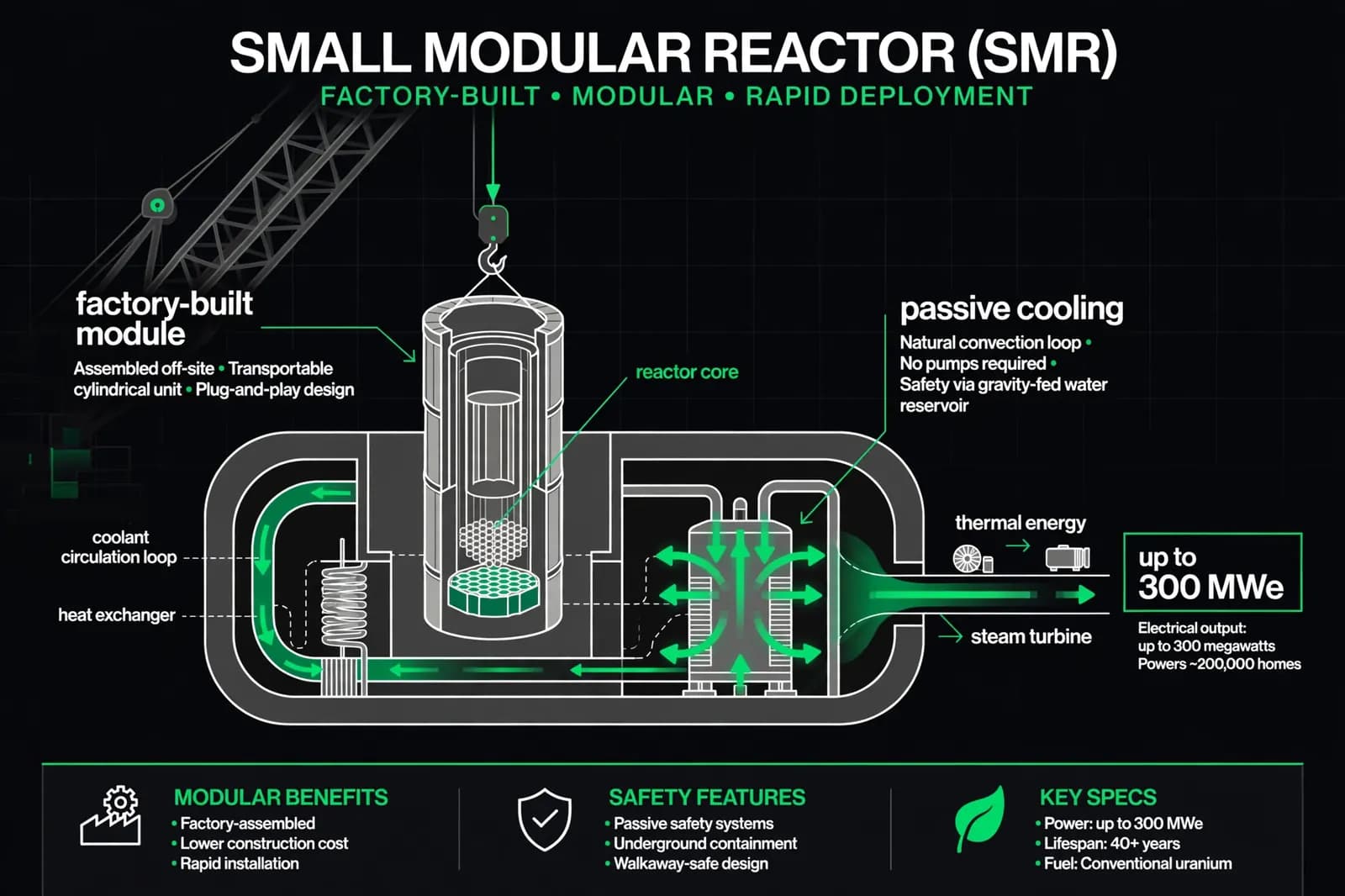
- An SMR is a nuclear reactor sized at 300 megawatts of electricity or less, built from factory-made modules instead of being constructed entirely on site.
- New designs lean on passive safety: cooling driven by gravity and natural circulation, which works without powered pumps or operator action.
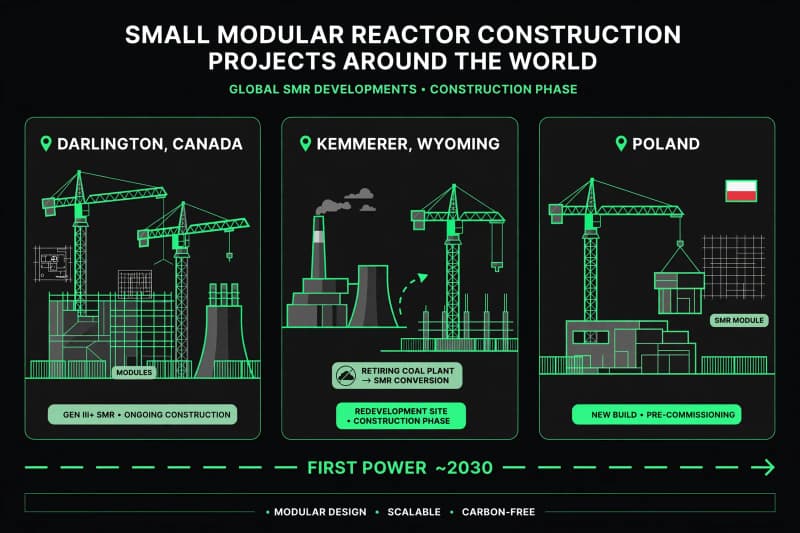
- No Western commercial SMR design is operating yet. Units are under construction in Canada and Wyoming, with first power targeted around 2030.
Small modular reactor: a nuclear reactor that produces up to about 300 megawatts of electricity, roughly a quarter of a conventional plant’s output, built from factory-made modules that are shipped to site and assembled, instead of being designed and constructed entirely on location as a one-off project.
Small modular reactor, explained in plain English: it is a nuclear power station shrunk to roughly a quarter of the usual size and built more like an airliner than a cathedral. The pitch is that smaller, factory-built reactors could be cheaper, quicker to deploy, and easier to place than the gigawatt-scale plants that dominate nuclear power today.
That pitch has drawn billions on three continents, but most of the evidence is still on paper: the leading Western designs have no operating record, and the economics rest on a manufacturing revolution that has not happened yet. This guide covers what SMRs are, how they differ from conventional plants, what passive safety means, and where the projects stand in 2026.
What “small” and “modular” actually mean
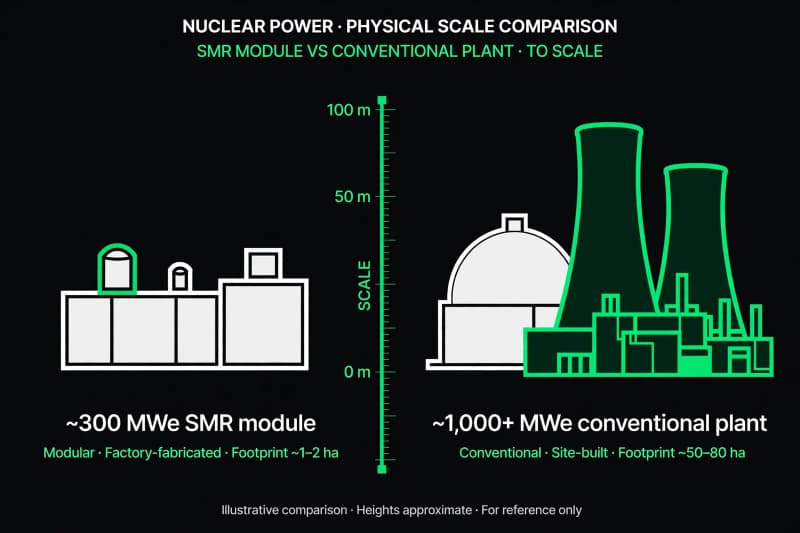
“Small” has a formal definition: the International Atomic Energy Agency defines a small reactor as one producing under 300 megawatts electric (MWe), and the World Nuclear Association describes SMRs as “typically less than 300 MWe.” Most reactors operating today produce 800 to 1,200 MWe, enough for up to a million homes, so an SMR is roughly a quarter to a third the size of a conventional unit.
“Modular” carries two meanings. First, components are fabricated in factories, then shipped to the site for assembly, streamlining construction and improving quality control. Second, capacity can be added incrementally: a utility installs one module now and more later as demand grows, instead of committing to a single giant plant up front. The WNA frames the logic as series production lowering costs “through assembly-line efficiency, shorter installation times, and replicated supply chains, rather than through traditional economies of scale.”
The IAEA contrasts this with large plants, which are often custom-designed for their location, a practice that invites construction delays. Whether the promised savings materialize is the industry’s central open question. The scale of interest is not in doubt: the WNA counts more than 100 SMR designs in development.
How an SMR differs from the nuclear plants you already know
Size changes where a reactor can go. The IAEA notes that a single plant should represent no more than about 10 percent of a grid’s total capacity, which rules large reactors out of small or remote grids. SMRs can slot into existing grids, serve off-grid industrial sites, or replace retiring coal plants on their original footprints.
Operation differs too. The IAEA reports that SMR plants may need refuelling only every 3 to 7 years, compared with every 1 to 2 years for conventional plants, and some designs aim to run up to 30 years without refuelling. Proposed SMR designs are generally simpler, and the US Nuclear Regulatory Commission describes them as a compact, scalable subset of light-water reactors that are potentially safer than the current fleet.
Uses stretch beyond electricity: over 65 percent of SMR designs have potential for high-temperature heat or off-grid applications, per the WNA, including district heating, desalination, industrial processes, and hydrogen production. South Korea is even developing a marine SMR center at Ulsan.
Are SMRs safer? What passive safety really means
The safety case for SMRs rests on passive systems. The IAEA explains that in these designs, “no human intervention or external power or force is required to shut down systems, because passive systems rely on physical phenomena, such as natural circulation, convection, gravity and self-pressurization.” In plain terms: if something goes wrong, physics cools the reactor. Hot water rises on its own, and control rods drop by gravity. No diesel generators, no operators racing to open valves.
Lower power and lower operating pressure add margin: smaller cores hold less heat, which gives passive systems an easier job. The NRC’s wording is careful, calling SMRs “potentially safer,” and that caution is warranted: passive safety is a design claim each design must still prove to regulators.
Small reactors are not a blank page, either. The WNA counts about 110 reactors of 300 MWe or less built to date, with more than 20 currently operating, including Russia’s floating Akademik Lomonosov plant at Pevek. What does not exist yet is an operating record for the new commercial designs being marketed in the West; their safety case is engineered and licensed, not yet demonstrated over decades of service.
The cost argument: factories against economies of scale
Traditional nuclear economics run on economies of scale: build bigger, and the cost per megawatt falls. SMRs invert the logic. A 300 MWe unit will always cost more per megawatt than a 1,100 MWe plant built the same way, so the SMR bet is that building many identical units on an assembly line beats building one big bespoke plant, with factory repetition doing the work that sheer size does for large reactors.
The sceptics have a recent exhibit. NuScale’s VOYGR became the first SMR to receive full NRC design certification in 2023, yet its planned Idaho demonstration with Utah Associated Municipal Power Systems, the Carbon Free Power Project, was cancelled that November after estimated costs climbed from $5.3 billion to $9.2 billion and the target power price rose from $58 to $89 per MWh. Regulatory approval does not guarantee a buildable project.
Both sides claim the lesson. Proponents say first-of-a-kind costs always look terrible and the factory thesis can only be judged once identical units roll off a line; critics reply that nuclear has promised learning curves before. The honest position: the cost claim is a hypothesis awaiting its first real test, now under construction in Canada.
Where the real projects stand in 2026
| Design | Reactor type | Output per module | Status in 2026 |
|---|---|---|---|
| NuScale VOYGR | Integral pressurized water | 77 MWe | NRC design certification 2023, uprated design approved 2025; no US plant under construction; Romania project planned |
| BWRX-300 | Boiling water | 300 MWe | Darlington, Canada under construction since 2025 (target 2030); US construction permit at Clinch River (Sept 2026); Poland, Estonia, Sweden in development |
| Natrium | Sodium-cooled fast reactor with molten-salt storage | 345 MW (500 MWe peak) | Kemmerer, Wyoming under construction since April 2026; NRC construction permit March 2026; target 2030-2031 |
| Xe-100 | High-temperature gas | 80 MWe | Construction permit under NRC review |
| Hermes | Fluoride-salt test reactor | 35 MWt (heat) | Test reactor permitted 2023; demonstration only |
The BWRX-300, from GE Vernova Hitachi, is the furthest along. Construction of the first unit began at Ontario Power Generation’s Darlington site in 2025, targeting commercial operation in 2030. In the US, the Tennessee Valley Authority received an NRC construction permit for a BWRX-300 at Clinch River in September 2026, the first US utility SMR construction project, though an operating license is still required.
Poland is the design’s most ambitious market. ORLEN Synthos Green Energy, the Orlen-Synthos joint venture, applied for European price support covering 14 BWRX-300 units across three sites, with the first at Wloclawek targeted for 2032. In October 2026, ZE PAK and Synthos Green Energy agreed to form a joint venture for six BWRX-300 units at the Patnow coal plant site in central Poland. Estonia’s Fermi Energia selected the BWRX-300 in 2023 for a two-unit plant targeting operation by 2035; Estonia’s parliament passed its Nuclear Energy and Safety Act in June 2026.
TerraPower’s Natrium takes a different path: a 345 MW sodium-cooled fast reactor paired with molten-salt thermal storage, able to push output to 500 MWe at peak demand. It is being built at Kemmerer, Wyoming, on a retiring coal plant site under the US Department of Energy’s Advanced Reactor Demonstration Program. The project received its NRC construction permit in March 2026, the first for a commercial non-water-cooled reactor in more than four decades, and began full construction the following month. The estimated $4 billion project targets completion in 2030 to 2031, though TerraPower rebid its main construction contract in September 2026.
What the CFPP’s $89/MWh price tag means for the SMR promise
The cancelled Idaho project matters more than any rendering. The Carbon Free Power Project’s target price rose from $58 to $89 per MWh, a 53 percent increase before a single foundation was poured. That figure is the closest thing the industry has to a market verdict on first-of-a-kind SMR economics in the West, and it failed the test its own sponsors set.
The comparison that counts is first unit versus tenth unit: SMR economics only work if identical units are built in series, so the decisive figure is the size of the order book, not the cost per megawatt of one reactor. Poland’s 14-unit price-support bid and the multi-unit programs in Canada and the UK are the first attempts at fleet-scale orders. Until those fleets are built, every industry cost claim in either direction is a hypothesis.
The milestones to watch are concrete: Darlington’s progress toward 2030, whether Kemmerer holds its schedule through a contractor transition, and whether any developer converts memoranda into signed, financed orders for identical units. The factory either gets its production run or it does not.
Frequently asked questions
What is a small modular reactor?
It is a nuclear reactor producing up to about 300 megawatts of electricity, built from factory-made modules shipped to the site and assembled. “Small” refers to power output; “modular” refers to factory fabrication and incremental capacity.
How do SMRs differ from regular nuclear plants?
Conventional plants are large (800-1,200 MWe), custom-designed for their sites, and refuelled every 1-2 years. SMRs are a quarter to a third the size, use standardized factory-built modules, deploy incrementally, refuel every 3-7 years, and can serve smaller grids, remote sites, and industrial heat uses that large plants cannot reach.
Are small modular reactors safer?
They aim to be. SMRs rely on passive safety systems that cool the reactor using natural circulation, gravity, and convection, without powered pumps or operator action. Regulators license each design individually, and the new Western designs have no decades-long operating record yet, so “potentially safer” remains the accurate phrasing.
Why are SMRs supposed to be cheaper?
The argument is series production, not size: building many identical units on factory lines cuts costs through repetition, shorter installation, and replicated supply chains, instead of chasing economies of scale with ever-larger bespoke plants. The catch is that this is unproven at commercial scale in the West, and the cancelled US demonstration saw costs rise sharply.