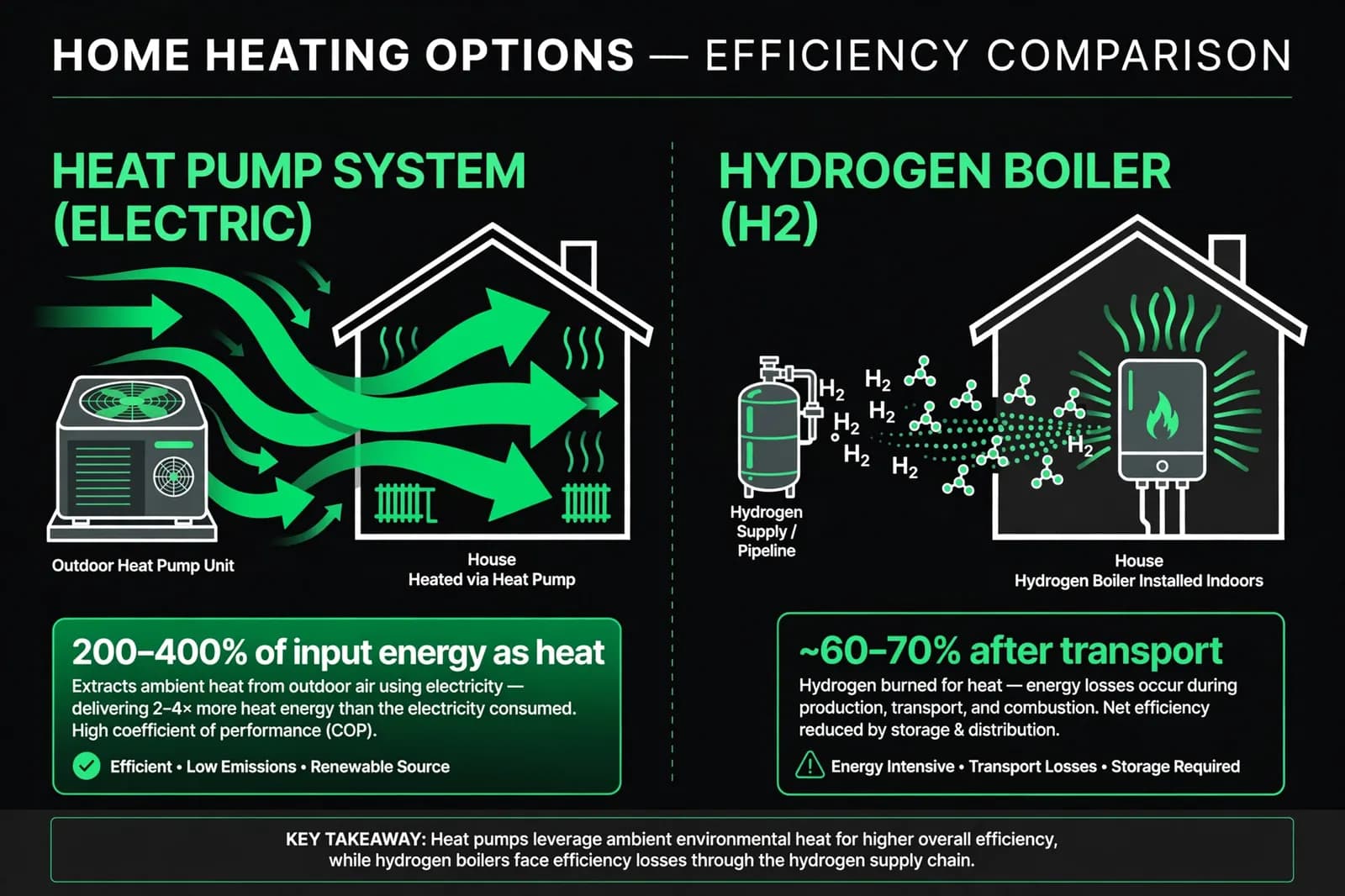
- A heat pump turns one unit of electricity into 2-4 units of heat. Making hydrogen from electricity, moving it, and burning it in a boiler returns only about half a unit.
- Per unit of warmth delivered, hydrogen heating needs roughly four to five times more electricity, and that multiplier flows straight into the fuel bill.
- The UK, which studied the idea more seriously than any other country, cancelled its hydrogen village trials and now treats heat pumps as the primary route, with any hydrogen decision deferred to 2026.
Hydrogen home heating: the idea of warming houses by burning hydrogen gas in a boiler, or blending hydrogen into the natural gas grid, as a way to cut carbon emissions from the boilers and furnaces most homes use today. Proposals range from 100% hydrogen boilers to blends of up to 20% hydrogen in existing pipelines.
Hydrogen home heating sounds like the easiest climate fix ever offered to homeowners. Keep the boiler, keep the pipes, keep the radiators: just change the fuel flowing through them from natural gas to hydrogen, which burns without producing carbon dioxide. Gas companies have marketed “hydrogen-ready” boilers on exactly this promise.
But heating engineers and energy analysts keep reaching the same conclusion: hydrogen is a poor way to heat homes. The problem is not the boiler. It is the chain of conversions between the power station and the radiator, and every step takes its cut. This guide walks through the efficiency math, compares the options, reviews what the UK’s real-world trials found, and explains where hydrogen genuinely earns its place.
Why hydrogen sounds like the easy answer
The appeal starts with the problem’s scale: heating the UK’s 28 million homes accounted for 18 percent of all UK greenhouse gas emissions in 2021, mostly from burning natural gas, according to the National Audit Office. A technology that decarbonized heat without replacing every boiler and pipe would be enormously attractive, which is why the idea won serious political backing.
Hydrogen has genuine advantages as a fuel: it burns without carbon dioxide at the point of use, moves through pipelines, and stores in large volumes, which suits winter-peaking heating demand. Blending up to 20 percent hydrogen into gas networks has been formally consulted on. On paper, it looks like a like-for-like swap.
The catch hides in the phrase “at the point of use.” Almost no hydrogen exists as a ready-made fuel waiting to be burned. It has to be manufactured, and manufacturing it from clean electricity throws away a large fraction of the energy before a single radiator gets warm. A heat pump skips that entire detour.
The efficiency chain, step by step
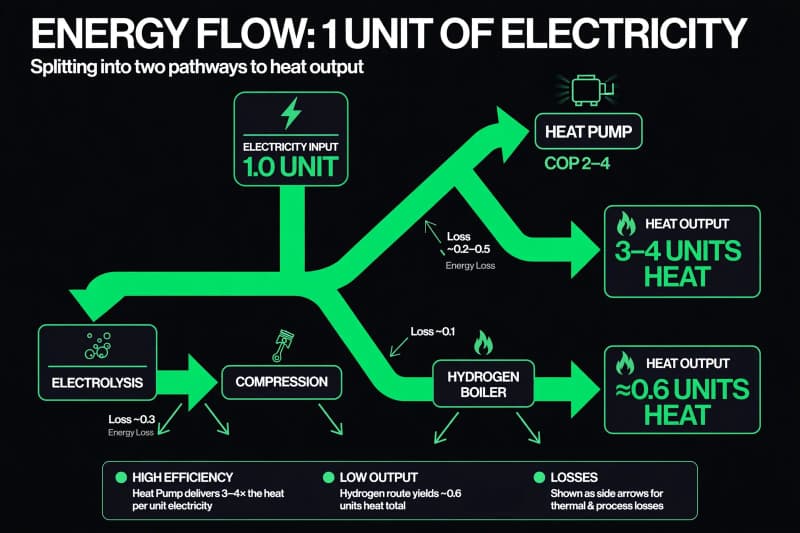
Follow one unit of clean electricity down both paths. The hydrogen path starts with electrolysis, splitting water into hydrogen and oxygen. Alkaline and PEM electrolysers, the two mainstream technologies, have comparable efficiency, though the International Energy Agency notes reported figures vary with design and measurement standards. A reasonable working range is 60 to 80 percent of the electrical energy ending up as hydrogen’s chemical energy.
The hydrogen must then be compressed, transported, and stored, with each handling step taking a cut; assume generously that 90 percent of the energy survives. Finally it is burned in a boiler, and even a good condensing boiler converts only about 90 percent of fuel energy into useful heat. Multiply the chain: 0.70 x 0.90 x 0.90 leaves roughly 0.57 units of heat per unit of electricity, an effective efficiency under 60 percent.
The heat pump path is shorter. A heat pump does not create heat; it moves it, pumping warmth from outside air or ground into the house. Because moving heat takes less energy than making it, a typical unit delivers 2 to 4 units of heat per unit of electricity, and even cold-climate models hold a coefficient of performance around 1.75 to 2.8 at 5°F, far below freezing.
The comparison below puts both routes side by side. Figures are illustrative, using mid-range assumptions, to show the scale of the gap rather than any single product’s specification.
| Heating route | Heat from 1 kWh of electricity | Effective efficiency | Electricity needed vs heat pump |
|---|---|---|---|
| Electric heat pump (COP 3) | 3.0 kWh | 300% | 1x (baseline) |
| Direct electric heating | 1.0 kWh | 100% | 3x |
| Hydrogen boiler (green hydrogen) | ~0.55-0.65 kWh | ~55-65% | ~5x |
| Gas boiler (for reference) | n/a (runs on gas) | ~90% of gas energy | n/a |
The result: per unit of warmth delivered to a living room, the hydrogen route needs roughly four to five times more electricity than a heat pump. That ratio is physics, not pricing, which means it survives every scenario for cheap renewables. A wind farm’s kilowatt-hour used directly in a heat pump warms roughly five times as much living space as the same kilowatt-hour converted to hydrogen first.
What the UK trials actually showed
No country tested hydrogen home heating more seriously than the UK. The government backed a sequence of real-world trials: a neighbourhood trial, then a “hydrogen village” of around 1,800 homes in Redcar supplied by Northern Gas Networks, then a full hydrogen town, with a strategic decision promised for 2026.
The trials kept collapsing. A village trial in Whitby was scrapped in July 2023 after local opposition. The Redcar trial was cancelled in December 2023, with ministers citing a lack of available low-carbon hydrogen supply alongside resident concerns about cost and safety. The hydrogen town pilot was then pushed back: the Department for Energy Security and Net Zero said it would not proceed before 2026, and that the decision would wait for evidence from the smaller Fife neighbourhood trial and similar schemes in Europe.
The policy center of gravity moved meanwhile. In October 2023 the government clarified that heat pumps and heat networks will be the primary low-carbon heating technologies for the next decade. The same month, the National Infrastructure Commission recommended ruling hydrogen out for heating individual buildings entirely, finding no public policy case for it. The blending consultation proposed up to 20 percent hydrogen in gas networks but stated that heat decarbonisation was not its primary purpose.
What a 5-to-1 efficiency gap means for your heating bill
Efficiency ratios sound abstract until they meet a utility bill. Heating is typically the largest single use of energy in a home, so the fuel cost per unit of warmth dominates the bill. If hydrogen heating needs about five times more electricity per unit of heat than a heat pump, then at any given electricity price, the energy cost of staying warm is roughly five times higher. That multiplier does not depend on hydrogen being expensive to produce; it applies even if electrolysis were free to run, because the losses are in the physics of the chain.
The second cost is scarcity. The International Energy Agency reports that of 97 million tonnes of hydrogen produced globally in 2023, less than 1 percent came from low-emissions pathways; RMI puts green hydrogen at around 4 percent of production. Nearly all of today’s hydrogen goes to refining, ammonia, and chemicals. Every tonne of scarce green hydrogen burned in a home boiler is a tonne unavailable to a steel plant or ship with no electric alternative, delivering one-fifth the useful heat a heat pump would have extracted.
This is why analysts describe hydrogen-for-heating as a misallocation rather than just an expensive option. RMI’s framing is blunt: “This is not winner-take-all. The energy transition will be a blend of alternative fuels and electrification.” The blend only works if each technology is assigned to the job it does best. Heating homes is the heat pump’s job; hydrogen’s jobs are elsewhere.
Where hydrogen genuinely earns its place
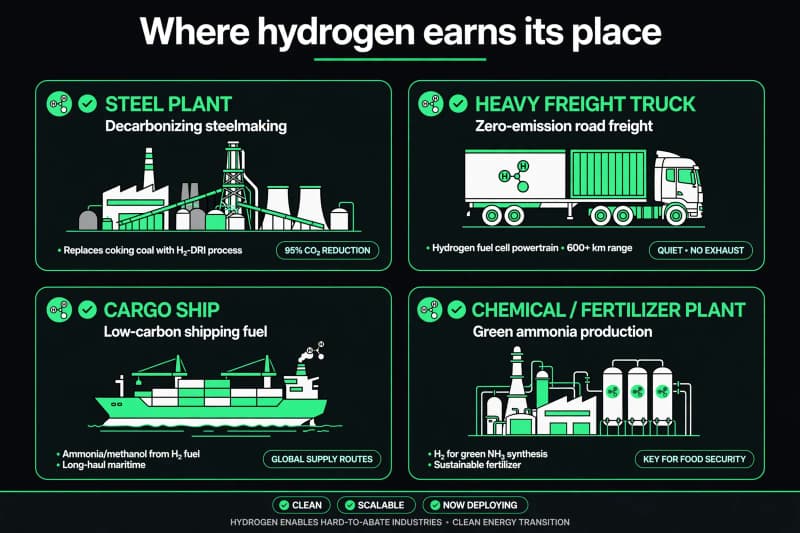
Strip away home heating and hydrogen’s real portfolio comes into focus. It is a chemical feedstock first: the Haber-Bosch process that makes ammonia for fertilizer already consumes vast quantities of hydrogen, all of it currently made from fossil fuels. Greening that supply alone is a giant decarbonization task. Hydrogen can also replace coking coal in steelmaking, fuel heavy transport and shipping, power mining haul trucks, and supply high-temperature industrial heat that electricity struggles to reach.
The investment flowing into those uses dwarfs anything aimed at boilers. Industrial hydrogen hubs are advancing on multiple continents, from the JadeWeser hydrogen project in Germany to EWE and TES’s green hydrogen supply plans at Emden, while deals like Hy24’s acquisition of EDF’s Hynamics hydrogen business show capital consolidating around industrial-scale players. That is where the demand is, because that is where hydrogen has no efficient competitor.
The honest version of the hydrogen story is narrower than the marketing but more durable: a specialized fuel for the corners of the economy that electricity cannot easily reach, including heavy industry, long-haul transport, and chemical feedstocks. Homes, with their moderate temperatures and mature heat-pump technology, are not one of those corners.
Frequently asked questions
Is hydrogen heating realistic for homes?
Technically possible, but economically and energetically punishing. The UK ran the world’s most serious trial program and cancelled its village-scale trials, with the government now treating heat pumps and heat networks as the primary route and deferring any hydrogen decision to 2026. The efficiency gap, roughly five to one against heat pumps, is the fundamental obstacle.
Why is hydrogen not used for home heating?
Because of conversion losses. Turning electricity into hydrogen, moving it, and burning it in a boiler delivers only about half a unit of heat per unit of electricity, while a heat pump delivers 2 to 4 units. That makes hydrogen heat several times more expensive per unit of warmth, and it diverts scarce green hydrogen from industries like steel and shipping that have no electric alternative.
Hydrogen boiler vs heat pump: which is more efficient?
The heat pump, by a wide margin. A heat pump with a coefficient of performance of 3 delivers 300 percent efficiency in effect, three units of heat per unit of electricity. A hydrogen boiler fed by green hydrogen delivers roughly 55 to 65 percent of the original electricity as heat after electrolysis, transport, and combustion losses. There is no boiler design that can close that gap, because the losses happen before the fuel reaches the boiler.
Can green hydrogen replace natural gas for heating?
It can be burned in adapted boilers or blended into gas grids at up to 20 percent, but analysts and the UK’s National Infrastructure Commission see no good case for it. Green hydrogen is scarce, with less than 1 percent of global production from low-emissions pathways, and home heating wastes most of its energy while depriving hard-to-electrify sectors. Electrified heat through heat pumps is the efficient route.