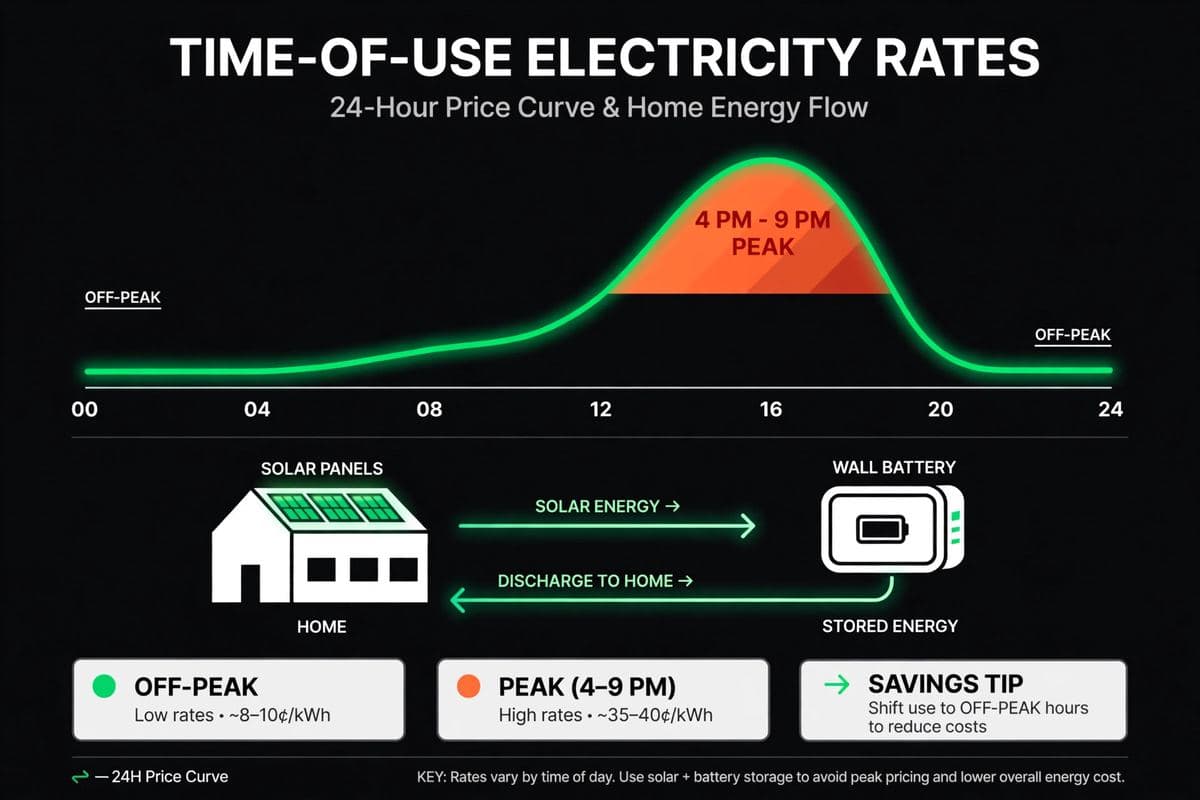
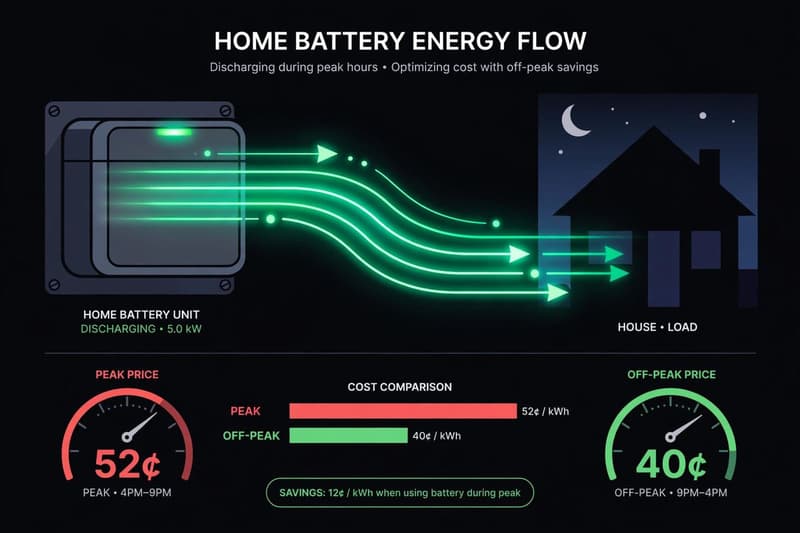
- Time-of-use rates charge different prices by the hour: on PG&E’s E-TOU-C plan, summer electricity costs $0.52 per kWh from 4 to 9 p.m. and $0.40 at all other hours.
- Solar owners have a built-in edge: their panels cover daytime use, and a battery can carry cheap or free solar power into the expensive evening peak.
- The math only works if you actually shift load: our worked example shows a household moving 180 kWh out of the peak window saves about $22 a month in summer, while a battery arbitraging the winter spread can lose money.
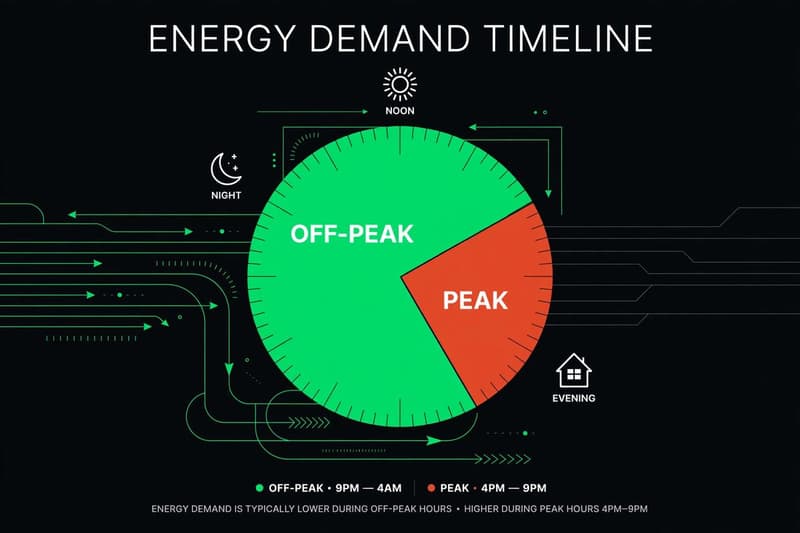
Time-of-use (TOU) rates: a utility pricing plan in which the price of electricity changes with the time of day and day of week. Hours when grid demand is highest, typically 4 p.m. to 9 p.m., are priced as “peak” and cost the most; all other hours are cheaper “off-peak” periods. Running a dryer at noon can cost half what it costs at 7 p.m.
Your electricity bill is no longer just about how much power you use. For a growing share of American households, especially in California, it is about when you use it. Time-of-use rates price every kilowatt-hour according to the clock, and the gap between the cheapest and most expensive hours can exceed 25 cents per kWh. For solar owners, that gap is either a trap or an opportunity, depending on how they play it.
The logic is simple. Grids are most expensive to run in the early evening, when solar output fades just as people come home, cook dinner, and turn on air conditioning. Utilities price that stress into the bill. In most cases, time-of-use plans set peak hours from 4 p.m. to 9 p.m., according to the California Public Utilities Commission’s official rate-plan guidance, and electricity used during peak hours costs more per kWh. The good news: if your home produces its own daytime power and can store some of it, the peak window stops being a penalty and starts being a spread you can trade against.
How time-of-use rates work
Three rate designs dominate US residential billing. The first is the tiered plan: you pay one price up to a monthly baseline allowance, then a higher price for everything above it, regardless of the hour. The second is the classic time-of-use plan with two or three price bands. The third is a hybrid, used by California’s big utilities, that layers a baseline credit on top of time-of-use bands.
PG&E’s residential lineup shows how the pieces fit. The figures below are the utility’s CPUC-filed bundled rates effective March 1, 2026, as compiled from PG&E Schedule E-TOU-C, E-TOU-D, EV2-A and E-ELEC:
| Plan | Peak window | Summer peak / off-peak | Winter peak / off-peak | Notes |
|---|---|---|---|---|
| E-1 (tiered) | None | $0.326 / $0.407 per kWh (tier 1 / tier 2) | Same | Price depends on usage, not time |
| E-TOU-C | 4–9 p.m. daily | $0.52 / $0.40 | $0.40 / $0.37 | 8.14¢/kWh baseline credit within baseline |
| E-TOU-D | 5–8 p.m. weekdays only | $0.48 / $0.34 | $0.39 / $0.35 | Weekends fully off-peak |
| EV2-A | 4–9 p.m. daily | $0.54 / $0.23 | $0.41 / $0.23 | Off-peak midnight–3 p.m.; EV or battery pilot |
E-TOU-C is the default for most PG&E households. Since March 2026, PG&E bills also carry a fixed Base Services Charge of about $24 a month for most households, with per-kWh prices set lower alongside it. The pattern is spreading: California’s investor-owned utilities have been moving residential customers onto time-of-use plans by default, and the US Energy Information Administration now tracks enrollment in time-based rate programs nationally through its Form EIA-861 Dynamic Pricing file, a sign of how mainstream these tariffs have become.
The peak window is the whole game
Five hours, 4 to 9 p.m., decide whether a California solar household saves money or leaves it on the table. That window exists because of the mismatch the industry calls the duck curve: solar floods the grid with cheap power at midday, then disappears just as evening demand ramps. Utilities meet that ramp with their most expensive resources, and time-of-use pricing passes the cost through to whoever is still buying.
For a solar owner without a battery, the peak window is brutal in one specific way. Panels cover midday use, which is already the cheap period, while the expensive evening hours are met by grid imports. Under California’s net billing tariff, which replaced traditional net metering for new systems in 2023, exports earn only a low avoided-cost credit instead of full retail value, so sending surplus midday solar to the grid no longer offsets the evening bill the way it used to. Our NEM 3.0 payback analysis walks through the new math in detail. The short version: under time-of-use rates, self-consumption and storage matter more than export credits.
Three ways solar owners play the spread
There are exactly three levers, and they stack.
1. Shift flexible loads out of the peak
The cheapest lever is behavioral. Dishwashers, laundry, pool pumps, and EV charging move to off-peak hours with a timer or a schedule. A dishwasher cycle draws roughly 1 to 2 kWh; running it at noon on your own solar output instead of 7 p.m. on $0.52 grid power saves 50 to 100 cents a day. It sounds trivial until you multiply by a year of cycles and add an EV. A Level 2 charger pulls 7 to 11 kW, so one hour of peak charging can cost $3.50 to $5.70 on E-TOU-C summer rates, versus about $2.80 to $4.40 off-peak.
2. Dispatch the battery through the peak
The second lever is a home battery programmed to discharge during the peak window instead of exporting or sitting idle. This is the strategy the DIY Solar Forum thread in our research converged on: charge when power is cheap, use the stored power when it is expensive. Our standalone battery analysis and our battery sizing guide cover the hardware side; the rate logic here is what makes the hardware pay. A battery charged from midday solar costs you the export credit you gave up, roughly 8 cents per kWh under net billing, and displaces 52-cent peak imports. That is a 44-cent swing per kWh, several times wider than any grid-arbitrage play.
3. Pick the plan that matches your life
The third lever is the rate plan itself. E-TOU-D’s shorter 5–8 p.m. weekday window with fully off-peak weekends suits households that use most power on weekends. EV2-A’s 23-cent off-peak rate is the widest spread in PG&E’s lineup, built for overnight EV charging, and it is available on a pilot basis to battery and heat-pump households. But a plan with a wider spread also has a sharper peak: pick the plan your actual schedule can honor, not the one with the cheapest headline number.
What a 12-cent spread is actually worth: the worked math
This is where the strategy meets the bill. Take a California household using 900 kWh a month in summer on E-TOU-C, with the tariff figures above. Assume 40 percent of usage falls in the 4–9 p.m. peak before any changes. The arithmetic is illustrative, using the filed rates without the baseline credit, so you can see the shape of the decision:
| Scenario | Peak kWh × $0.52 | Off-peak kWh × $0.40 | Monthly bill |
|---|---|---|---|
| No shifting (360 peak / 540 off-peak) | $187.20 | $216.00 | $403.20 |
| Shift 180 kWh out of peak (180 / 720) | $93.60 | $288.00 | $381.60 |
| Tiered E-1 for comparison (300 kWh @ $0.326, 600 @ $0.407) | usage-based, no time bands | $342.00 | |
Two things stand out. First, shifting half the peak load saves about $22 a month in summer, roughly $130 over a six-month cooling season even before winter’s narrower spread is counted. Second, and less comfortable: the plain tiered plan is cheaper than unshifted time-of-use for this household. Time-of-use is not a discount; it is a bet on your own flexibility. Households that cannot move evening loads, think shift workers, large families cooking at 6 p.m., anyone running medical equipment, can pay more on the default TOU plan than on tiered rates. The CPUC says it plainly: if you can change when you use electricity, you may save on a time-of-use plan. If you cannot, the tiered plan may be the safer pick.
The battery version of the math is more dramatic and more seasonal. A 13.5 kWh home battery cycling once a day, with 90 percent round-trip efficiency, delivers about 12.15 kWh to the house for every 13.5 kWh put in. Buying that charge from the grid at the $0.40 summer off-peak rate costs $5.40; discharging it through the $0.52 peak is worth $6.32. Net: 92 cents a day, or about $112 over the 122-day summer season. In winter the spread collapses to 3 cents ($0.40 peak versus $0.37 off-peak): the same cycle costs $5.00 to charge and returns $4.86, a small daily loss. Pure grid arbitrage on E-TOU-C barely breaks even on an annual basis, which is an honest result worth stating.
The numbers flip when the battery charges from rooftop solar instead of the grid. Midday solar that would have exported at an 8-cent avoided-cost credit now displaces 52-cent peak imports: 12.15 kWh × ($0.52 − $0.08) = $5.35 of daily summer value, or over $650 across the season. That is why installers now size batteries for the 4–9 p.m. window first and backup second. On EV2-A, with its 23-cent off-peak rate, the same battery cycling grid power nets about $3.45 a day in summer, which is why EV households see the fastest battery paybacks of any rate class.
When time-of-use pricing backfires
Everything above is California arithmetic. Outside California, spreads are often a third as wide, and many states still offer flat or tiered rates with no time component at all. On a 5-cent spread, shifting 180 kWh saves $9 a month, not $22, and a battery’s arbitrage value drops below the noise. Time-of-use is a tool, not a virtue: it rewards flexibility and punishes the households least able to provide it, including renters who cannot install timers or batteries and workers with fixed evening schedules.
There is also a policy tension building. As more customers add batteries and shift load, the peak itself moves and flattens, which narrows the spreads that made the shift profitable. California’s default TOU rollout is already several years in, and utilities periodically re-file their tariffs: PG&E’s current schedules took effect March 1, 2026. Treat any rate figure in any guide, including this one, as a snapshot. The strategy, shift what you can, store what you shift, pick the plan that fits, survives every re-filing.
Frequently asked questions
Are time-of-use rates always better than flat rates?
No. Time-of-use plans reward households that can move electricity use out of the peak window. If your heaviest use is locked into weekday evenings, a tiered or flat plan is often cheaper. Compare your actual hourly usage, which most utilities show in your online account, against both structures before switching.
Does time-of-use pricing work without solar?
Yes, but the levers are fewer. Without solar you can still shift loads and, on plans like EV2-A, charge an EV or a battery overnight at 23 cents instead of buying at 52 cents during the peak. A battery without solar is a pure arbitrage play, and as the worked math shows, it only pays where spreads are wide. Our standalone battery guide runs those numbers in full.
What are the cheapest hours to run appliances on PG&E?
On E-TOU-C, every hour outside 4–9 p.m. is off-peak, so late morning and overnight are the cheapest windows. On E-TOU-D, weekdays outside 5–8 p.m. plus all weekend hours are off-peak. On EV2-A, midnight to 3 p.m. is the cheapest period every day.
Can a battery really pay for itself under time-of-use rates?
Charged from the grid alone, a battery on E-TOU-C barely breaks even: the winter spread is too narrow. Charged from rooftop solar, the same battery displaces 52-cent peak power with 8-cent solar, worth over $650 a summer season in our example. The battery pays through avoided peak imports, not through grid arbitrage.
How many solar panels do I need to cover the peak window?
That depends on your evening load and whether you have storage, since panels do not produce during most of the 4–9 p.m. peak. Our 50-state sizing guide computes panel counts from state-level yield data, and pairing it with a battery sized for your evening consumption is what closes the gap.