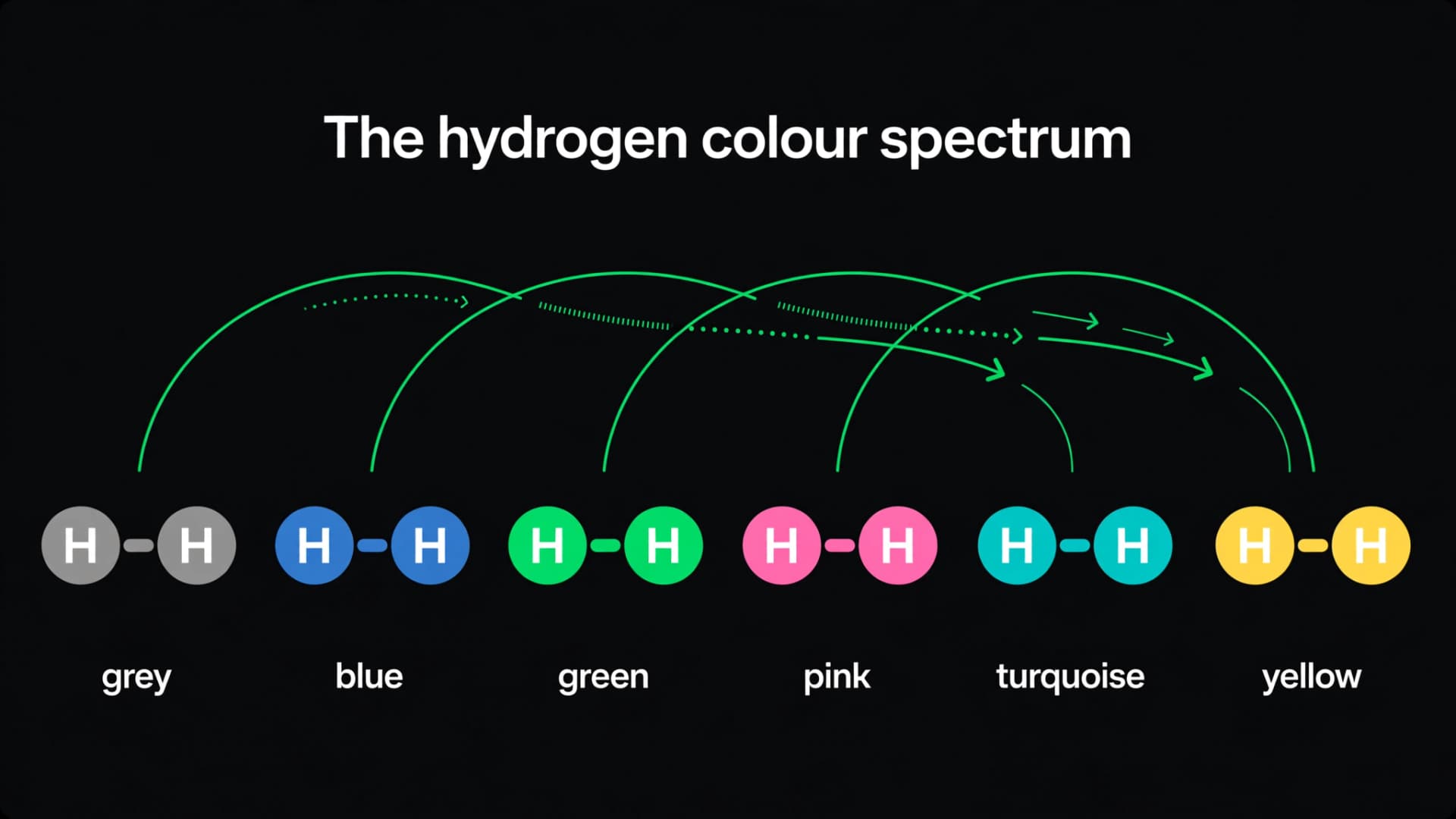
- The grey blue green hydrogen labels describe how hydrogen is made, not the gas itself. Grey hydrogen, from natural gas with the CO2 vented, still dominates global production.
- Grey hydrogen carries 10–14 kg of CO2-equivalent per kilogram of hydrogen over its lifecycle. Blue hydrogen cuts that to 5–8 with today’s capture technology. Green hydrogen from renewable electrolysis scores effectively zero at production.
- Pink, turquoise and yellow describe the electricity source, but regulators measure emissions intensity, not colour: the US clean-hydrogen bar is 4 kg of CO2-equivalent per kilogram of hydrogen.
Clean hydrogen: hydrogen produced with very low lifecycle greenhouse gas emissions, whatever the route used to make it. The US definition behind federal incentives caps it at 4 kilograms of CO2-equivalent per kilogram of hydrogen across the full lifecycle. The colour label does not decide this; the measured emissions do.
News stories about decarbonisation keep invoking grey blue green hydrogen as if the colours were self-explanatory. They are industry shorthand for the production route: how the gas was made, and how much carbon dioxide entered the atmosphere along the way. The hydrogen molecule itself is identical in every case; what changes is the emissions intensity of making it, and the spread is enormous: from effectively zero to more than 20 kilograms of CO2-equivalent per kilogram of hydrogen.
This decoder walks through the seven labels you will meet most often, with emissions data from the International Energy Agency and production shares compiled by RMI.
How the grey blue green hydrogen colour code actually works
The colour code is industry shorthand, not a scientific classification. The US Congressional Research Service notes that the colours of hydrogen are not standardised, and that some pathways have no colour at all. The labels describe the feedstock and energy source used in production, which together determine the emissions intensity of each kilogram made.
That intensity is also what regulators measure. In the United States, the Inflation Reduction Act defines qualified clean hydrogen as hydrogen with lifecycle emissions of no more than 4 kilograms of CO2-equivalent per kilogram of hydrogen, and the Department of Energy’s Clean Hydrogen Production Standard sets the same 4.0 kg target. A colour label cannot tell you whether hydrogen clears that bar. Only a lifecycle number can.
Grey hydrogen: the default that still runs on natural gas
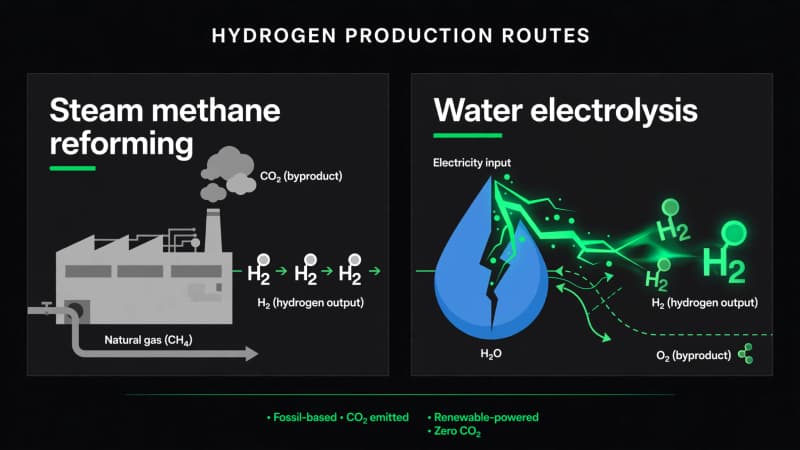
Grey hydrogen is made by steam methane reforming: natural gas reacts with high-temperature steam over a catalyst to release hydrogen, with carbon dioxide as the byproduct. When that CO2 is vented rather than captured, the product is grey (RMI).
The IEA puts the direct emissions of steam methane reforming at around 9 kg of CO2-equivalent per kilogram of hydrogen, rising to 10–14 kg on a lifecycle basis once methane leaks and CO2 from gas extraction and transport are counted, per the International Energy Agency’s analysis of hydrogen emissions intensity. RMI estimates that natural gas accounts for about 48 percent of global hydrogen production and describes the vast majority of today’s hydrogen as grey; US DOE figures cited by the Congressional Research Service put natural gas reforming at 76 percent of global output.
Grey hydrogen costs roughly $1.50 per kilogram, per industry figures compiled by Elsevier. That price is the benchmark every cleaner colour has to beat.
Blue hydrogen: grey with carbon capture attached
So what is blue hydrogen? It starts as grey hydrogen, made from natural gas by steam reforming, with the carbon dioxide captured for storage instead of vented. The label depends entirely on the capture step working.
Retrofitting an existing reformer to capture around 60 percent of its CO2 brings emissions intensity down to 5–8 kg of CO2-equivalent per kilogram of hydrogen. Advanced designs above 90 percent capture could reach 0.8–6 kg, but the IEA notes that no such plants operate yet, and at high capture rates upstream methane leaks dominate what remains.
Two consequences follow. First, nobody should quote 90 percent capture as the norm for blue hydrogen; it describes a future plant, not today’s fleet. Second, typical blue at 5–8 kg misses the US clean-hydrogen bar of 4 kg. Blue costs about $2.50 per kilogram, between grey and green on price, with only a small fraction of global supply.
Green hydrogen: water split with renewable electricity
Green hydrogen electrolysis splits water into hydrogen and oxygen using renewable electricity such as wind or solar power, producing no greenhouse gas emissions in the process. Under the International Partnership for Hydrogen and Fuel Cells in the Economy methodology, renewable electricity carries no associated emissions, so green hydrogen scores 0 kg of CO2-equivalent per kilogram of hydrogen.
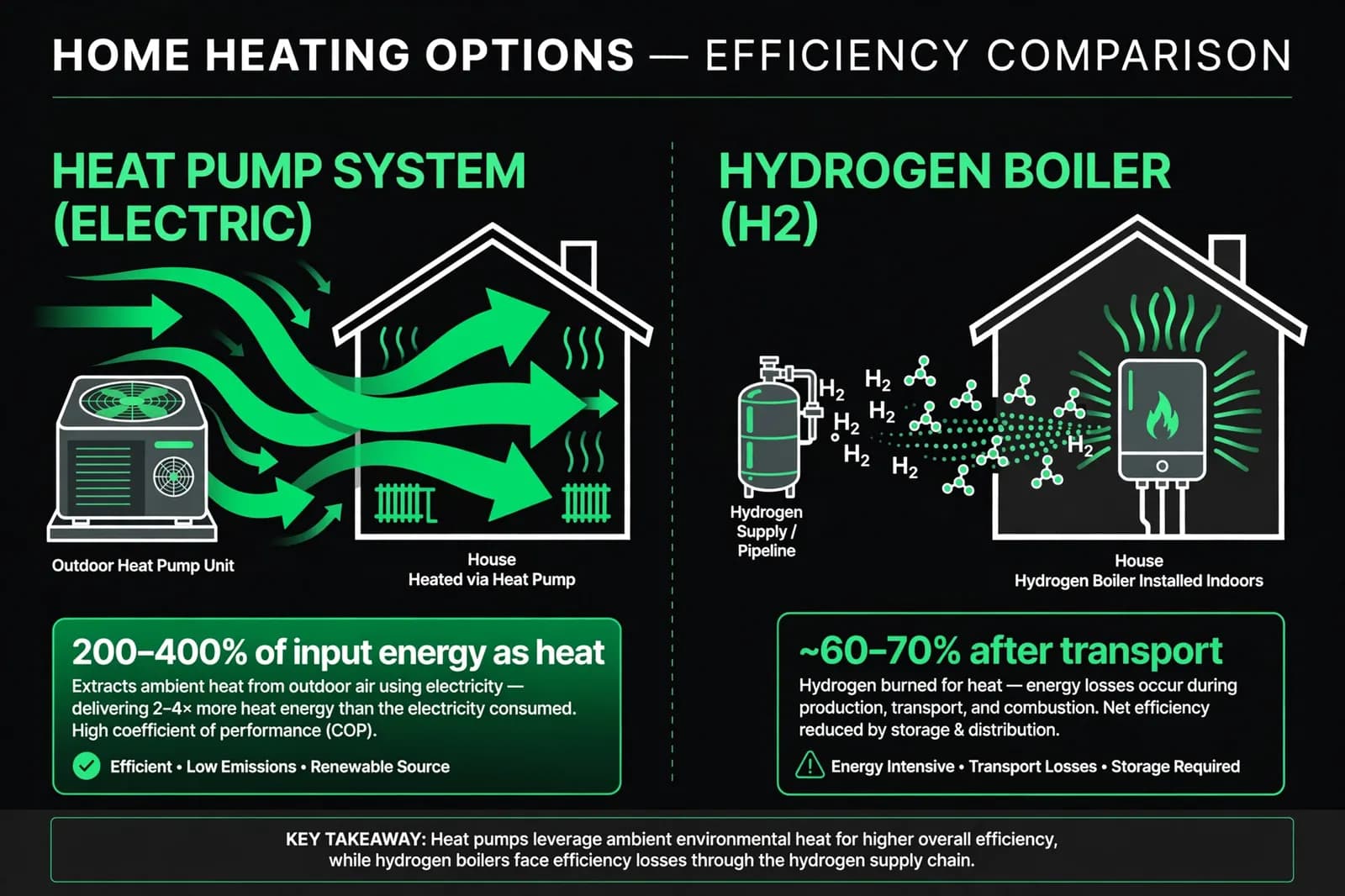
The catch is scale and cost. RMI puts green hydrogen at about 4 percent of global production, and it costs roughly $5 per kilogram today, though Elsevier’s projections see it falling below blue hydrogen before the end of the decade. We have traced the full conversion chain from electrolyser to end use in our comparison of hydrogen boilers and heat pumps for home heating.
The rest of the rainbow: pink, turquoise, yellow, black and brown
Pink hydrogen is nuclear-powered electrolysis: the same water-splitting process as green hydrogen, but the electricity comes from a nuclear plant, making it a low-carbon pathway, though its full lifecycle needs its own assessment.
Turquoise hydrogen uses methane pyrolysis, heating natural gas until it splits into hydrogen and solid carbon instead of CO2. There is no gaseous carbon byproduct at the plant; the climate benefit depends on the heat source and on keeping the solid carbon sequestered.
Yellow hydrogen is electrolysis powered by grid electricity, so its emissions vary greatly with the local grid mix; the IEA warns that grid-connected electrolysers must not drive an increase in fossil-based generation. Black and brown hydrogen, from coal or lignite gasification, sit at the dirty end at 22–26 kg of CO2-equivalent per kilogram of hydrogen, with coal accounting for about 18 percent of global production.
The table below assembles the cited figures into one comparison. Every emissions number comes from the IEA’s lifecycle analysis; production shares are RMI’s accounting via IRENA.
| Colour | Production route | Lifecycle emissions (kg CO2e / kg H2) | Share of today’s production | Source |
|---|---|---|---|---|
| Grey | Natural gas steam methane reforming, CO2 vented | 10–14 | ≈48% (natural gas share) | IEA; RMI |
| Blue | Natural gas reforming with carbon capture and storage | 5–8 (today’s retrofits); 0.8–6 (advanced designs, none operating) | Nascent; a small fraction of supply | IEA |
| Black / brown | Coal or lignite gasification, CO2 vented | 22–26 | ≈18% (coal share) | CRS (IEA data); RMI |
| Green | Electrolysis powered by renewable electricity | ≈0 | ≈4% | IEA; RMI |
| Pink | Electrolysis powered by nuclear electricity | Low at production; lifecycle needs separate assessment | Marginal; not separately reported | Elsevier |
| Turquoise | Methane pyrolysis; solid carbon byproduct | No gaseous CO2 byproduct; depends on heat source | Pilot scale | Elsevier |
| Yellow | Electrolysis powered by grid electricity | Varies greatly with grid mix | Marginal; not separately reported | IEA; Elsevier |
Note: shares reflect RMI’s accounting via IRENA; other methodologies differ.
Why the colour that dominates today is the dirtiest
Against the US clean-hydrogen threshold of 4 kg, the picture is stark. Grey hydrogen at 10–14 kg runs two to three times over the bar, and typical blue hydrogen at 5–8 kg misses it as well. The colours that clear it, green and pink, plus advanced blue designs not yet operating commercially, make up a single-digit share of supply. The market’s colour mix is the inverse of what the climate math requires.
Governments are spending public money to change that mix: green hydrogen costs roughly $5 per kilogram against grey’s $1.50, and buyers will not pay the difference on their own. Germany has committed up to EUR8.7 billion in hydrogen support while China has set a hard end-user price target of 25 yuan per kilogram, about $3.70, as covered in our comparison of Germany’s and China’s hydrogen programmes. Until clean production scales, every hydrogen headline deserves the same question: which colour, and what is its number?
Frequently asked questions
What do green, blue and grey hydrogen mean?
They describe production routes. Grey hydrogen is natural gas reforming with the CO2 vented. Blue hydrogen is the same process with carbon capture added. Green hydrogen is water electrolysis powered by renewables. The gas is identical in all three; the emissions differ enormously.
Is blue hydrogen actually clean?
Usually not by the strictest measures. With today’s retrofit capture rates, blue hydrogen emits 5–8 kg of CO2-equivalent per kilogram of hydrogen, above the US threshold of 4 kg. Advanced designs above 90 percent capture could reach 0.8–6 kg, but no such plants operate yet and upstream methane leaks remain significant.
What is pink hydrogen?
Hydrogen made by electrolysis powered by nuclear electricity. It produces no carbon emissions at the point of generation, making it a low-carbon pathway, though its full lifecycle emissions need separate assessment.
Which hydrogen colour is the cleanest?
Green hydrogen from dedicated renewable electricity scores zero emissions under the IEA’s lifecycle methodology. Pink hydrogen is similarly low. But regulators increasingly ignore the colours: the Congressional Research Service notes they are not standardised, and US policy defines clean hydrogen purely by emissions intensity, capped at 4 kg of CO2-equivalent per kilogram of hydrogen.