- Germany’s energy ministry announced a 10-measure hydrogen package: EUR1.5bn through carbon contracts for difference, inside a draft budget providing up to EUR8.7bn in commitment authorizations for CO2-reduction technologies through 2050.
- The ministry’s stated premise is blunt: hydrogen production costs remain “significantly higher than the willingness to pay of many potential application sectors.”
- Within 72 hours, China launched a hydrogen pilot offering up to 1.6bn yuan (about $238m) per city cluster over four years, targeting end-user hydrogen below 25 yuan/kg by 2030, with clusters that fail annual assessments losing that year’s funding.
Two announcements, 72 hours apart, attack the same problem from opposite directions. On October 20, Germany’s Federal Ministry for Economic Affairs and Energy (BMWE) unveiled a package of 10 measures to accelerate the country’s hydrogen market, including up to EUR8.7bn in funding commitments, as Enerdata reported from the ministry’s October 19 press release. On October 16, China’s industry, finance and planning ministries issued rules for a hydrogen comprehensive-application pilot, reported on October 19, that ties central government money to results and sets a hard price target: end-user hydrogen below 25 yuan per kilogram by 2030, according to sxcoal’s account of the rules.
Germany’s EUR8.7 billion package: subsidizing the cost gap
The BMWE package centers on EUR1.5bn in funding through carbon contracts for difference (CCfDs), agreements that compensate companies for the extra cost of switching to climate-friendly production. Hydrogen projects would also qualify for CCfD support beyond the dedicated hydrogen window. Under the government’s draft, up to EUR8.7bn in commitment authorizations would finance CCfDs for a range of CO2-reduction technologies, including hydrogen, through 2050.
The package’s framing is unusually honest. “The development of the hydrogen market is currently facing major challenges and is being delayed, especially since production costs are still significantly higher than the willingness to pay of many potential application sectors,” the ministry said. Germany is not pretending the economics work; it is proposing to pay the difference for decades.
The 10 measures also reach beyond direct subsidies. The ministry plans incentives to convert 4 GW of power-plant capacity to hydrogen: 2 GW tendered in 2027 with hydrogen use from 2040, and a further 2 GW tendered between 2030 and 2032 with conversion from 2043. On infrastructure, EUR4.2bn in public funding would expand the hydrogen network: more than 500 km of the core pipeline network was operational in 2025, with another 2,200 km under construction. And the package would create a lead market for low-emission steel: under the Offshore Wind Energy Act, offshore wind turbines must use steel produced with renewable or low-carbon hydrogen, a rule designed to pull hydrogen demand into heavy industry.
China’s pilot: a price target, prize money and funding you can lose
China’s approach reads like the mirror image. The Ministry of Industry and Information Technology, the Ministry of Finance and the National Development and Reform Commission jointly issued rules for a hydrogen comprehensive-application pilot that caps central financial rewards at 1.6 billion yuan (about $238m) per city cluster over four years. The money is disbursed “pre-allocation first, settlement later”: some funding arrives upfront to start the work, with the balance settled after completion.
The key clause is the penalty. City clusters that fail annual assessments have that year’s funding suspended, and clusters falling short of their tasks see their quotas cut. This is funding as a prize for performance, not as a cushion for costs.
The pilot’s first batch covers five clusters running for four years: Beijing-Tianjin-Hebei, the Greater Bay Area, Northeast China (including eastern Inner Mongolia) with the Yangtze River Delta, the Xinjiang-Chengdu-Chongqing economic circle, and the Yellow River Jizi Bend-Central Plains region. The 2030 targets are numerical: average end-user hydrogen price in the clusters below 25 yuan/kg, the national fuel-cell vehicle fleet doubled from 2025 levels to 100,000 units, and an application ecosystem built around one general fuel-cell vehicle scenario plus multiple industrial scenarios. A deployment meeting for the Beijing-Tianjin-Hebei cluster, formed by 13 cities and districts across six provinces, was held on October 16, with the cluster prioritizing hydrogen heavy trucks and cold-chain logistics vehicles and building a “six corridors and 11 branches” hydrogen highway network, alongside industrial experiments in hydrogen metallurgy and hydrogen-based chemical feedstock substitution.
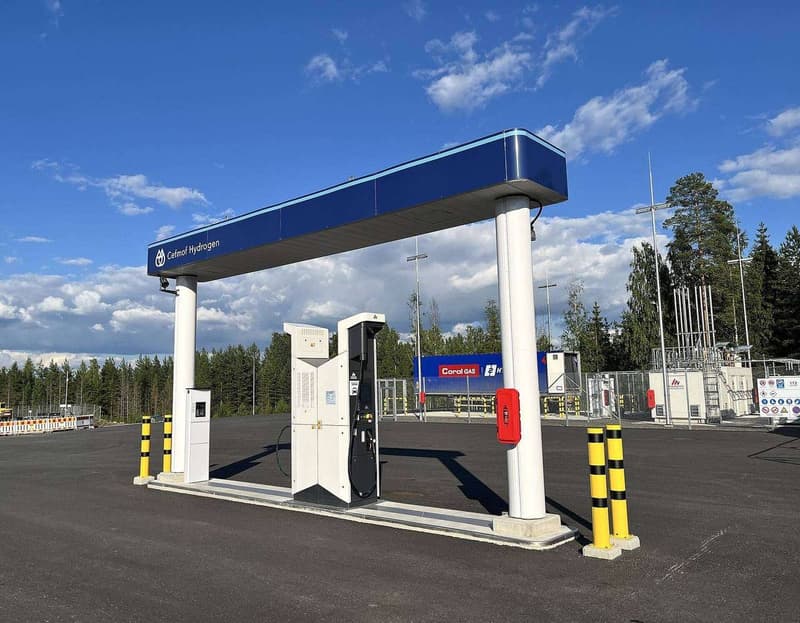
Subsidize the gap or enforce the price: the two programs compared
Our calculation puts the two philosophies in the same frame. Five clusters at 1.6bn yuan each means China’s central rewards could total up to 8bn yuan over four years, roughly $1.19bn at the conversion implied by the official figures. That is the same order of magnitude as Germany’s near-term EUR1.5bn CCfD window, but the structure is the opposite: Germany’s money compensates companies for the cost gap, while China’s money rewards clusters that hit targets and cuts funding for those that fail.
The price arithmetic sharpens the contrast. China’s 25 yuan/kg end-user target translates to about $3.70 per kilogram at current exchange rates. That is a hard, named number against which success or failure can be judged. Germany’s ministry admits costs sit “significantly higher than the willingness to pay” of buyers but names neither the cost nor the acceptable price, proposing instead to fund the difference through 2050.
| Dimension | Germany: 10-measure package | China: comprehensive-application pilot |
|---|---|---|
| Core instrument | Carbon contracts for difference (CCfDs): the state pays the cost gap | Central rewards per city cluster, tied to results |
| Scale | EUR1.5bn CCfD window; up to EUR8.7bn in commitment authorizations to 2050 | Up to 1.6bn yuan per cluster; up to 8bn yuan (about $1.19bn) across five clusters over four years |
| Timeline | Commitments through 2050; 4 GW plant conversion from 2040/2043 | Four-year pilot; 2030 price and fleet targets |
| Price discipline | No target; ministry says costs exceed buyers’ willingness to pay | Hard target: end-user hydrogen below 25 yuan/kg (about $3.70/kg) by 2030 |
| Conditionality | Envelope could grow if bidding demand is strong | Fail the annual assessment, lose that year’s funding; miss tasks, get the quota cut |
| Infrastructure | EUR4.2bn for network expansion; 500+ km live, 2,200 km under construction | “Six corridors and 11 branches” hydrogen highway in Beijing-Tianjin-Hebei; refuelling station buildout |
| Demand pull | Lead market for low-emission steel via the Offshore Wind Energy Act | Fuel-cell fleet doubled to 100,000; hydrogen metallurgy and chemical feedstock pilots |
Why it matters: $3.70 a kilo is the target Germany’s ministry could not name
The week gave the hydrogen debate something it rarely produces: two directly comparable numbers. China’s $3.70/kg target is not a forecast of where costs are; it is a policy requirement imposed on five city clusters, enforced by cutting the funding of those that miss their annual marks. Germany’s EUR8.7bn envelope is a confession that the cost number is too high and the buyer number too low, followed by a commitment to bridge them with public money for a quarter-century.
The contrast runs deeper than budgets. Germany’s instrument, the carbon contract for difference, insulates companies from the cost gap; China’s instrument, performance-tied rewards, insulates taxpayers from failure. One government pays the difference between green hydrogen and what industry will pay; the other sets a price and makes the industry find a way to hit it. No other coverage this week has drawn the two into the same frame, yet the timing, 72 hours apart, makes the comparison unavoidable: the world’s two largest industrial economies are running a controlled experiment in hydrogen policy, and the results will be measurable in yuan per kilogram.
For Germany, the stakes are domestic and concrete. Projects like EWE and Verbund’s 500 MW JadeWeser electrolyser, sited next to cavern storage, show where private capital thinks hydrogen can work: in heavy industry, not home heating. That judgment is consistent with our guide to where hydrogen makes sense in the energy system: heavy industry, not home heating, the same sectors both governments are now targeting with public money.
What to watch next
Two tests will decide which philosophy ages better. In Germany, watch demand for the EUR1.5bn CCfD bidding round: a weak field would suggest the cost gap is larger than even the ministry admits. In China, watch the first round of annual assessments: the pilot’s credibility depends on the government actually suspending funding for clusters that miss. If Beijing follows through, the rest of the world will have to take a $3.70 price target seriously.