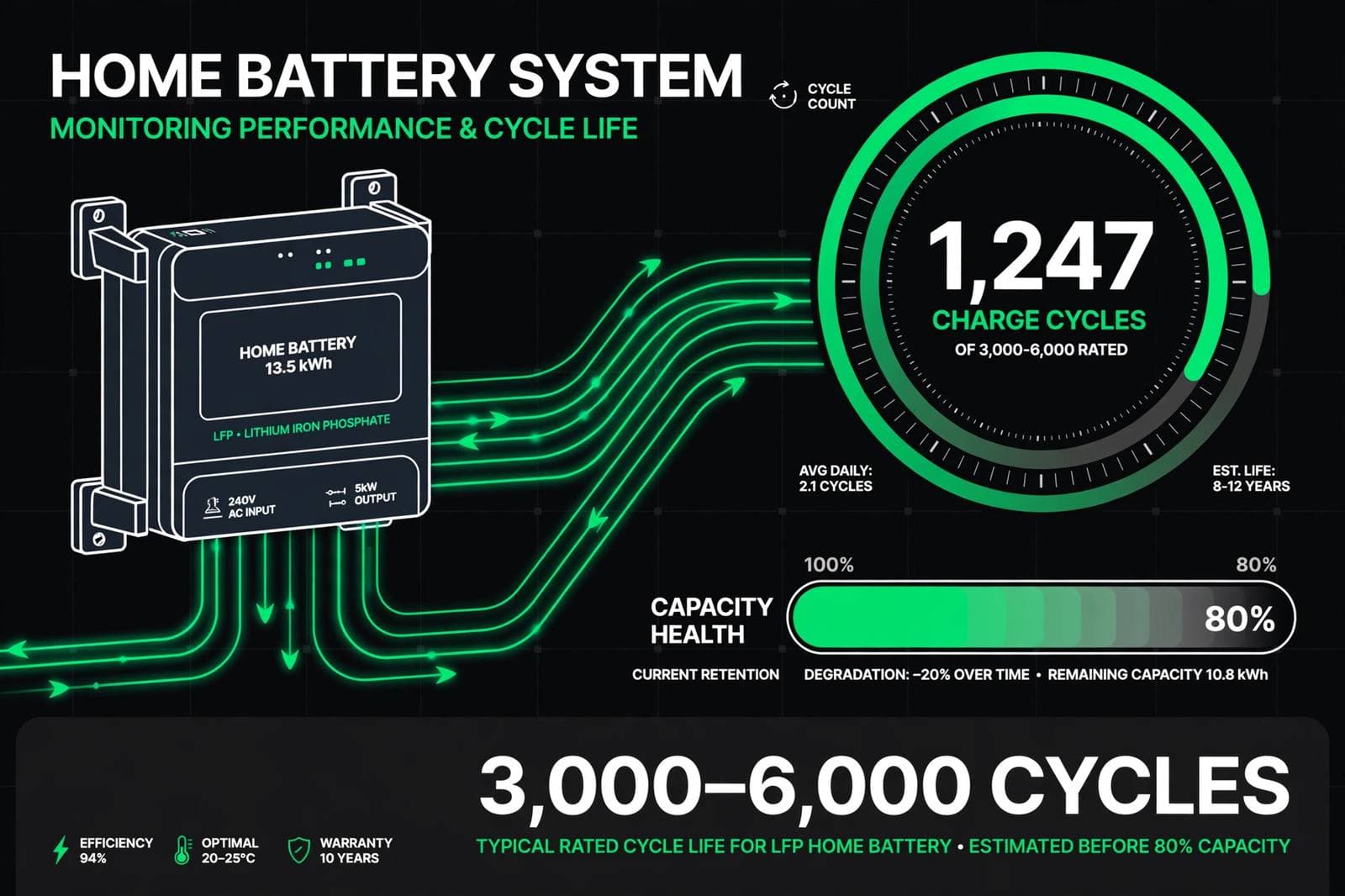
- A lithium iron phosphate home battery is typically rated for 6,000 to 8,000 full cycles before its capacity falls to 80 percent.
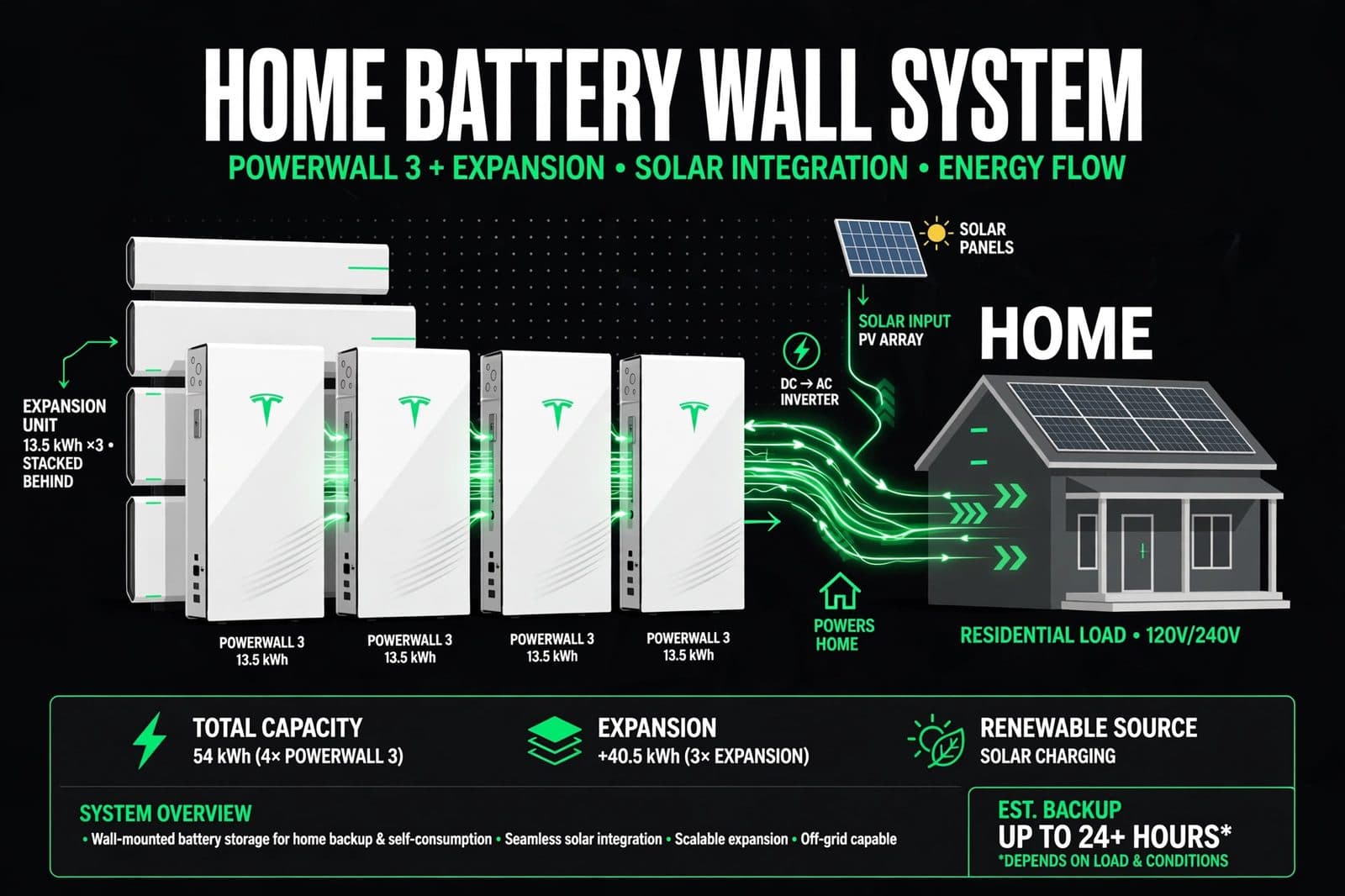
- Four leading batteries answer the cycle question four different ways: Tesla sets no cycle limit for normal home use, Enphase warrants 6,000 cycles, FranklinWH caps total throughput instead, and EG4 rates its cells above 8,000 cycles.
- In practice the warranty term usually expires before the cycle limit is reached, because a home battery in a solar home cycles about once a day.
Home battery cycle life: the count of charge and discharge rounds a home battery survives before the energy it stores drops to the floor its warranty guarantees. It is the second of the two clocks that decide how long a battery lasts, alongside calendar ageing, which wears cells down with time whether they are used or not.
FranklinWH sells one of the most popular home batteries in the United States, and its warranty contains no cycle count. Instead it caps the total energy the battery may deliver at 60 MWh over 15 years. Tesla takes a different route, placing no cycle limit on its Powerwall 3 for ordinary home use. Enphase and EG4 both publish cycle numbers, but one of them is a warranty promise and the other is a design rating. The four structures show the cycle count is not a single comparable number: it is four different kinds of promise, and the buyer’s job is to work out which kind each figure is.
Understanding the answer means separating three things that get blurred in sales material: what a cycle is, what the 80 percent threshold means, and which limit in the warranty actually binds first. This guide works through all three with the manufacturers’ own warranty documents, plus the laboratory study that sets the chemistry benchmark.
- What counts as one cycle
- The 80% line is a warranty definition
- Four batteries, four warranty answers
- LFP cells outlast NMC cells by thousands of cycles
- Two clocks run at once: cycles and calendar
- How the cycle counts convert to years
- What wears a battery out faster
- What to check before you buy
What counts as one cycle
A full cycle means discharging the battery’s full usable capacity and charging it back up again. Two half discharges, 50 percent down and back up twice, add up to one full equivalent cycle. This matters because a home battery rarely runs a neat full cycle each day. On a sunny day it may charge to full by midday, discharge through the evening peak, and recharge the next morning, which is close to one full cycle. On a cloudy winter day it may only move half its capacity, which counts as half a cycle. Manufacturers’ cycle ratings assume full equivalent cycles, so partial use stretches the count.
Depth of discharge sits inside the same definition. A cycle rated at 80 percent depth of discharge, the figure EG4 publishes for its PowerPro, means each counted cycle used 80 percent of the battery’s capacity rather than the full 100 percent. Shallower cycles are gentler on the cells, which is why a rating quoted at 80 percent depth of discharge measures a different workload than one quoted at 100 percent. When two batteries claim different cycle counts, the first check is whether they were measured at the same depth of discharge.
The 80% line is a warranty definition
The 80 percent threshold marks the point where the manufacturer agrees the battery has degraded enough to count as a warranty failure. A battery at 79 percent capacity still stores and delivers power, just less of it: a 13.5 kWh unit holds about 10.7 kWh. The threshold exists because capacity fades gradually from the first day, and the warranty needs a line to draw. Most manufacturers set that line at 70 percent for home batteries, which is more generous to the owner than the 80 percent line used in laboratory cycle-life studies. The distinction matters when comparing a lab figure with a warranty figure: a cell rated for 8,000 cycles to 80 percent would last longer before hitting a 70 percent warranty floor.
Four batteries, four warranty answers
The table below uses the manufacturers’ own warranty documents and datasheets, all current as of November 2026. The differences are the story: the same chemistry, lithium iron phosphate, produces four different warranty structures.
| Battery | Warranty term | Cycle or throughput limit | Capacity floor | Usable capacity |
|---|---|---|---|---|
| Tesla Powerwall 3 | 10 years | Unlimited cycles for solar self-consumption, time-based control and backup; 37.8 MWh throughput cap for other uses such as virtual power plants | 70% at year 10 | 13.5 kWh |
| Enphase IQ Battery 5P | 15 years | 6,000 discharged cycles, whichever comes first | 70% at year 10, 60% at year 15 | 5.0 kWh per unit |
| FranklinWH aPower 2 | 15 years | No cycle count; 60 MWh aggregate throughput, whichever comes first | 70% at end of term | 15 kWh |
| EG4 PowerPro WallMount 14.3 kWh | 10 years, prorated after year 1 | More than 8,000 cycles at 0.5C and 80% depth of discharge; 82.6 MWh rated lifetime production | Not published | 14.3 kWh total |
Tesla’s approach is the most owner-friendly on paper: for the three standard uses, solar self-consumption, time-based control and backup, the warranty places no limit on cycles at all, and the 70 percent floor applies at year 10. The limit appears only when the battery is used for something else, such as enrolment in a virtual power plant, where a 37.8 MWh throughput cap applies instead. That cap equals 2,800 full equivalent cycles of a 13.5 kWh battery, a figure worth knowing before signing up for grid services.
Enphase takes the opposite approach and writes the cycle count into the warranty: 15 years or 6,000 discharged cycles, whichever comes first, with a stepped capacity floor of 70 percent at year 10 and 60 percent at year 15. FranklinWH drops the cycle count entirely and caps total energy instead: 60 MWh through a 15 kWh battery, which works out to 4,000 full equivalent cycles. EG4 publishes the highest cycle rating, more than 8,000 cycles, but as a specification-sheet design rating rather than a warranty guarantee, and it publishes no capacity-retention floor at all. A buyer comparing “8,000 cycles” against “6,000 cycles” is comparing a design rating with a warranty promise, which are different kinds of numbers.
LFP cells outlast NMC cells by thousands of cycles
The chemistry gap behind these ratings comes from laboratory testing. A multi-year study at Sandia National Laboratories cycled commercial lithium-ion cells until they reached 80 percent capacity, varying temperature, depth of discharge and discharge rate. Lithium iron phosphate (LFP) cells lasted 2,500 to 9,000 equivalent full cycles. Nickel manganese cobalt (NMC) cells lasted 200 to 2,500 cycles. Nickel cobalt aluminium (NCA) cells, the chemistry in many older electric cars, lasted 250 to 1,500 cycles.
The ranges are wide because test conditions matter as much as chemistry: heat, deep discharges and fast discharge rates all shorten life. Three caveats belong with the numbers. The study used small 18650-format cells, not the large-format cells in home batteries. The upper LFP values were partly extrapolated, because many LFP cells had not reached 80 percent capacity when the study ended. And the gap narrows when the comparison is made on total energy delivered rather than cycles, because each LFP cell stores less energy than an NMC cell of the same size. Even with those caveats, the ordering is clear, and it is why every battery in the table above uses LFP chemistry. The chemistry comparison in more detail, including safety and cost, is covered in our LFP vs NMC home battery guide.
Two clocks run at once: cycles and calendar
Cycle count is only half the ageing story. A battery also loses capacity with time, even sitting idle on a shelf, through chemical reactions inside the cells that never stop. Manufacturers call this calendar ageing, and it is why warranties carry a year limit alongside any cycle or throughput limit. Whichever limit is hit first ends the coverage.
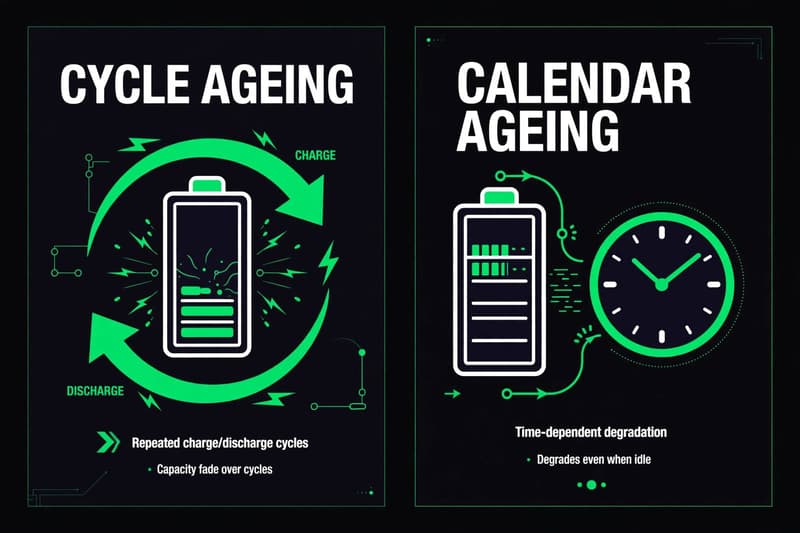
Calendar ageing runs faster in heat. A battery in a hot garage ages faster than the same battery in a cool basement, which is one reason manufacturers specify operating temperature ranges and why installers are told to keep batteries out of direct sun. Cycle ageing and calendar ageing also interact: a battery cycled hard in a hot location loses capacity from both clocks at once, while a battery used gently in a cool spot loses it slowly from both.
How the cycle counts convert to years
The conversion from cycles to years needs one assumption: how often the battery cycles. A home battery paired with solar typically runs about one full equivalent cycle a day, charging on midday solar and discharging in the evening. Some days it cycles less, on cloudy days or when the household uses little power, and backup-only batteries may sit for weeks without a full cycle. Taking one full cycle a day as the working assumption, 365 cycles a year, the warranty figures convert as follows. These are calculations from the published figures.
| Battery | Limit | Years at one cycle a day | Which limit binds first |
|---|---|---|---|
| Tesla Powerwall 3 | Unlimited cycles, 10-year term | No cycle limit | The 10-year term |
| Enphase IQ Battery 5P | 6,000 cycles, 15-year term | 16.4 years of cycles | The 15-year term |
| FranklinWH aPower 2 | 60 MWh throughput, 15-year term | 4,000 cycles, about 11 years | The throughput cap, at one cycle a day |
| EG4 PowerPro | More than 8,000 cycles, 10-year term | 21.9 years of cycles | The 10-year term |
The pattern is the point of the article. For three of the four batteries, the year term or the throughput cap ends the coverage before the cycle rating runs out. Only the FranklinWH cap binds before its term, and only under the one-cycle-a-day assumption: a household cycling less often would hit the 15-year term first instead. A buyer who picks a battery on cycle count alone is buying a number that, in most cases, never gets tested.
Scale helps put the numbers in household terms. The average American home used 10,791 kWh of electricity in 2022, according to the Energy Information Administration, or about 30 kWh a day. A single 13.5 kWh Powerwall 3 holds roughly 45 percent of that daily use, so it covers the evening hours rather than a full day. Sizing the battery to the household’s actual evening load matters more than the cycle rating; our home battery sizing guide works through that calculation, and the cost side is covered in our home battery cost per kWh guide.
What wears a battery out faster
Three factors decide where any single battery lands inside its rated range. Heat is the first: sustained high temperatures accelerate the chemical reactions behind calendar ageing, and the Sandia study found temperature among the strongest predictors of cycle life. Depth of discharge is the second: regularly draining a battery to empty wears it faster than shallow cycling, which is why some manufacturers rate cycles at 80 percent depth of discharge rather than 100 percent. Discharge rate is the third: pulling power out fast, such as running a large air conditioner from a small battery, stresses the cells more than a slow, steady discharge. A battery kept cool, cycled shallowly and discharged gently will outlast the same model run hot, deep and hard.
What to check before you buy
Four questions separate a strong warranty from a weak one. First, is the cycle figure a warranty term or a specification-sheet rating? A warranted number is enforceable; a design rating is a statement of engineering intent. Second, does the warranty cap cycles, total throughput, or neither? Tesla’s unlimited cycles for standard uses and FranklinWH’s 60 MWh cap are opposite answers to the same question. Third, what is the capacity floor, and is it flat or stepped? A 70 percent floor at year 10 is a stronger promise than a 60 percent floor at year 15. Fourth, what voids or shortens the warranty? Tesla, for example, may limit its warranty to four years if the unit is not reliably connected to the internet. The answers to those four questions decide what the warranty is worth. How those warranties play out over the years, rather than the cycles, is covered in our guide to how long home solar batteries last, and the head-to-head value comparison between two of the batteries in the table is in our EG4 PowerPro vs Tesla Powerwall 3 comparison.
Frequently asked questions
How long does a home battery last?
Most lithium iron phosphate home batteries carry a 10 to 15 year warranty and are rated for 6,000 to 8,000 full cycles before capacity falls to 80 percent. In practice the warranty term usually ends first, because a home battery cycles about once a day. Calendar ageing, the slow chemical degradation that happens even when the battery sits idle, runs alongside cycle ageing.
How many cycles does a home battery last?
It depends on the model and the warranty structure. Enphase warrants 6,000 cycles, EG4 rates its PowerPro above 8,000 cycles, FranklinWH caps total throughput at 60 MWh, which equals 4,000 full cycles, and Tesla sets no cycle limit for standard home uses. Laboratory testing of LFP cells found 2,500 to 9,000 cycles to 80 percent capacity.
What does 80% capacity mean for a home battery?
It means the battery stores 80 percent of the energy it held when new. A 13.5 kWh battery at 80 percent holds about 10.8 kWh. The battery still works below 80 percent, but manufacturers use the threshold as the warranty line: dropping below it inside the warranty term counts as a failure.
Do home batteries degrade even if you rarely use them?
Yes. Calendar ageing degrades capacity with time regardless of use, faster in heat. A backup-only battery that rarely cycles still loses capacity year by year, which is why warranties always carry a year limit alongside any cycle or throughput limit.
Is 6,000 cycles enough for a home battery?
Yes, for most households. At one full cycle a day, 6,000 cycles last about 16 years, longer than the 15-year warranty that usually comes with that rating. The cycle count is rarely the binding constraint; the warranty term and the capacity floor matter more.
Sources
- Powerwall Limited Warranty (USA), Rev. 2.6, effective May 6, 2026, Tesla
- Powerwall 3 Datasheet, Tesla
- IQ Battery 5P Datasheet, North America, DSH-00010-4.0, November 2023, Enphase
- Limited Warranty, Storage Systems, IQ Battery 5P (WRTY-00145-1.0), effective May 2, 2026, Enphase
- Franklin Home Power Limited Warranty for End Users, effective August 2025, FranklinWH
- FranklinWH Announces New High-Capacity 15 kWh Home Battery, FranklinWH, September 10, 2024
- PowerPro WallMount All Weather Battery Spec Sheet, Ver. 1.2.1, 2025, EG4 Electronics
- WallMount 280Ah All Weather Battery Warranty, Ver. 1.3, EG4 Electronics
- Preger et al., Degradation of Commercial Lithium-Ion Cells as a Function of Chemistry and Cycling Conditions, Journal of The Electrochemical Society 167, 120532 (2020), Sandia National Laboratories
- How much electricity does an American home use?, U.S. Energy Information Administration