- Twenty-five US reactors at 13 plants now hold licenses to operate for 80 years, after the NRC approved 16 of them in the 18 months to June 2026.
- The original 40-year license term came from economic and antitrust law, and the NRC states that it was never a technical judgment about reactor life.
- Each renewal rests on aging-management programs for the reactor vessel, concrete containment, cables and piping, reviewed under 10 CFR 54.
Subsequent license renewal: the second 20-year extension of a US commercial reactor operating license, taking its authorized life from 60 years to 80 years. The operator must show the NRC, under 10 CFR 54, that aging of safety-significant structures and components will be managed for the extra two decades.
Contents
- The 40-Year Limit Came From Economics and Antitrust Law
- How Nuclear License Renewal to 80 Years Works
- What Aging-Management Programs Inspect, Component by Component
- The 80-Year License Scoreboard, Plant by Plant
- The 2022 Stall and the 2024 Restart of the Review Pipeline
- What 80-Year Licenses Mean for a 94-Reactor Fleet
- What Comes Next for Nine Mile Point, Ginna and the 2027 Queue
- Frequently asked questions
A nuclear license renewal to 80 years is granted on evidence about metal, concrete and cable, rather than on a plant’s operating record. Under 10 CFR 54, the applicant must show the Nuclear Regulatory Commission that the effects of aging on every safety-significant structure and component will be managed for 20 more years. The operating history matters, but the decision turns on inspection data, test specimens and replacement schedules. The review covers the reactor pressure vessel, the concrete containment, electrical cables and piping, each with its own aging-management program.
The idea still surprises people who assume a reactor has a fixed design life. It does not, in the regulatory sense. The Atomic Energy Act caps an initial license at 40 years and allows renewal in 20-year steps, and the NRC’s backgrounder records that economic and antitrust considerations set that number. Some systems and components were engineered on the basis of a 40-year service life, so renewal demands proof that those parts will last, or a plan to replace them. That proof is what sets the practical limit on how long a plant can run.
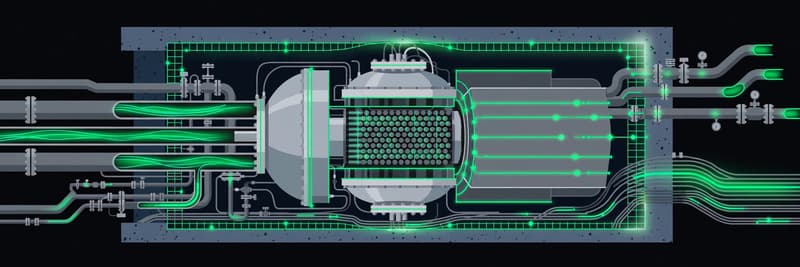
The 40-Year Limit Came From Economics and Antitrust Law
Congress set the 40-year cap when it wrote the Atomic Energy Act in 1954. The NRC’s backgrounder on subsequent license renewal states the point directly: economic and antitrust considerations determined the original term. A 40-year license matched the financing horizon of a large power plant and kept a utility from holding an operating license indefinitely. It was never a finding that steel and concrete fail at 40 years.
That distinction shapes everything that follows. Because the limit was legal rather than physical, the question at renewal is evidence, and the evidence is gathered component by component. The first renewal, from 40 to 60 years, is now routine: the NRC notes that almost every US commercial plant operates under a renewed license. The second renewal, from 60 to 80 years, applies the same framework to older material, longer exposure and a second round of inspections. The regulation that allows it, 10 CFR 54.31(d), states that a renewed license may be subsequently renewed under all applicable requirements. A nuclear plant lifespan, in the US system, is therefore a matter of evidence and economics rather than a fixed engineering number.
The 40-year figure also explains why the fleet is hitting this question all at once. Most US reactors entered service between the late 1960s and 1990, so their 60-year licenses expire across the 2030s and 2040s. An operator that wants to keep a plant running into the 2050s or 2060s must apply years ahead, because the review itself takes one to four years. The queue of applications is the visible result: 13 plants have finished the process, and more are in line behind them.
How Nuclear License Renewal to 80 Years Works
An application for subsequent license renewal runs on two tracks. The safety review, governed by 10 CFR 54, examines the aging-management programs. The environmental review, governed by 10 CFR 51, examines the effects of 20 more years of operation at the site, and the NRC documents it as a plant-specific supplement to the generic environmental impact statement for license renewal, NUREG-1437.
The safety case is built from aging-management programs, known as AMPs. Each AMP covers a specific combination of material, environment and aging effect: carbon steel in borated water, concrete in a marine atmosphere, electrical cable insulation under heat and radiation. The NRC’s guidance for the 60-to-80-year period, published in two documents, NUREG-2191 and NUREG-2192, in July 2017, sets out the AMPs the staff expects to see and the enhancements to programs already in place from the first renewal period.
The review starts with an acceptance check of about 45 days. If the application is complete enough, the NRC dockets it and opens the safety and environmental reviews, with an opportunity for the public to petition for a hearing. The agency’s goal, set out in its backgrounder, is to complete the review within 18 months of docketing, provided there is no hearing and the applicant answers questions promptly. That target was an improvement on an earlier goal of 22 months, and the recent record shows it is reachable: the Hatch review took 12 months and 27 days, from application on May 15, 2025, to issuance on June 11, 2026.
The decision to apply rests with the owner. The NRC’s backgrounder notes that the choice is typically based on the plant’s economics and whether it can meet the requirements. A renewal is worth pursuing when the plant can sell power at a profit for two more decades and the cost of inspections, replacements and the application itself is lower than the alternatives, which are usually retirement or new construction.
What Aging-Management Programs Inspect, Component by Component
The reactor pressure vessel draws the closest attention. Decades of neutron bombardment gradually make its steel more brittle, which matters most during a rapid cooldown, when a brittle vessel is more vulnerable to cracking. Operators track the change with surveillance capsules: small steel samples placed inside the vessel during construction, withdrawn on a schedule and tested for toughness. The results feed the fracture analysis the NRC requires under 10 CFR 50.61, the rule that guards against pressurized thermal shock. If the projections show the vessel staying within limits through 80 years, the program continues. If they do not, the operator must act, and the options are limited and expensive.
Concrete gets its own program. The containment structure and other safety-related concrete are inspected for cracking, spalling and chemical attack, including alkali-silica reaction, a slow swelling reaction between the cement and certain aggregates. Irradiation and temperature add to the load over decades. Inspectors map cracks, measure their growth between outages and compare the findings with acceptance criteria. Concrete cannot be replaced the way a pump can, so the program is built around early detection and repair.
Electrical cables are the quiet problem. Miles of cable run through a plant, and insulation degrades under heat and radiation until it can no longer be relied on. Aging-management programs for cables combine visual inspection, electrical testing and, where the environment is harsh, replacement on a schedule. The NRC’s guidance lists cables among the items that receive specific attention in the 60-to-80-year period, alongside reactor parts, concrete containment structures and piping.
Piping rounds out the set. Corrosion thins pipe walls, fatigue accumulates at welds and vibration points, and flow-accelerated corrosion wears down bends in carbon-steel lines. Programs measure wall thickness at set locations, trend the results and replace sections before they approach minimum thickness. None of this is new technology. The point of subsequent license renewal is that the programs must be shown to work for 20 years longer than they were first designed to cover, and the NRC checks the operating experience behind each one.
The 80-Year License Scoreboard, Plant by Plant
Turkey Point in Florida was first. The NRC issued its subsequent renewed licenses on December 4, 2019, for Units 3 and 4, taking them to July 19, 2052, and April 10, 2053. Peach Bottom followed on March 5, 2020, and Surry on May 4, 2021. By the end of 2024, nine reactors at five plants held 80-year licenses. Then the pace changed: eight more plants, with 16 reactors between them, won approval in the 18 months from January 2025 to June 2026. The full list, from the NRC’s status page for subsequent license renewal applications and the Nuclear Energy Institute’s tracker, is below.
| Plant | Units | Renewal issued | License runs to |
|---|---|---|---|
| Turkey Point, Florida | 3 and 4 | December 4, 2019 | July 19, 2052 (Unit 3); April 10, 2053 (Unit 4) |
| Peach Bottom, Pennsylvania | 2 and 3 | March 5, 2020 | August 8, 2053 (Unit 2); July 2, 2054 (Unit 3) |
| Surry, Virginia | 1 and 2 | May 4, 2021 | May 25, 2052 (Unit 1); January 29, 2053 (Unit 2) |
| North Anna, Virginia | 1 and 2 | August 28, 2024 | April 1, 2058 (Unit 1); August 21, 2060 (Unit 2) |
| Monticello, Minnesota | 1 | December 30, 2024 | September 8, 2050 |
| Oconee, South Carolina | 1, 2 and 3 | March 31, 2025 | February 6, 2053 (Unit 1); October 6, 2053 (Unit 2); July 19, 2054 (Unit 3) |
| V.C. Summer, South Carolina | 1 | June 30, 2025 | August 6, 2062 |
| Point Beach, Wisconsin | 1 and 2 | September 29, 2025 | October 5, 2050 (Unit 1); March 8, 2053 (Unit 2) |
| Browns Ferry, Alabama | 1, 2 and 3 | December 11, 2025 | December 20, 2053 (Unit 1); June 28, 2054 (Unit 2); July 2, 2056 (Unit 3) |
| Dresden, Illinois | 2 and 3 | December 16, 2025 | December 22, 2049 (Unit 2); January 12, 2051 (Unit 3) |
| H.B. Robinson, South Carolina | 2 | April 23, 2026 | July 31, 2050 |
| St. Lucie, Florida | 1 and 2 | April 28, 2026 | March 1, 2056 (Unit 1); April 6, 2063 (Unit 2) |
| Hatch, Georgia | 1 and 2 | June 11, 2026 | August 2054 (Unit 1); June 2058 (Unit 2) |
Browns Ferry, the Tennessee Valley Authority’s first nuclear plant, holds the largest approval of the wave: the Browns Ferry 80-year license covers three General Electric boiling water reactors, commissioned in 1974, 1975 and 1977, which can generate close to 3.8 gigawatts, and the plant’s capacity factor has run close to 90 percent in recent years, producing close to 30 million megawatt-hours a year. The NRC issued the renewed licenses on December 11, 2025, after a review that finished nearly three months ahead of schedule. Jeremy Groom, acting director of the NRC’s Office of Nuclear Reactor Regulation, said: “The NRC confirmed that Browns Ferry’s reactors can safely operate for up to 80 years, and TVA’s responsiveness helped us complete our rigorous review nearly three months ahead of schedule.” Don Moul, TVA’s president and chief executive, said: “The subsequent license renewal at Browns Ferry marks a proud and historic moment for TVA and the communities we serve.”
The longest license in the fleet now belongs to St. Lucie Unit 2 in Florida, which runs to April 6, 2063. North Anna Unit 2 in Virginia runs to August 21, 2060. Both dates sit far beyond the working life of any reactor operating today: the oldest, Nine Mile Point Unit 1 in New York, began commercial operation in December 1969 and is approaching 57 years of service. No reactor anywhere has operated for 80 years, so every one of these licenses is a forward commitment, backed by inspections that have not yet happened.
The 2022 Stall and the 2024 Restart of the Review Pipeline
The pipeline nearly stopped in 2022. On February 24 of that year, the Commission issued three orders, CLI-22-02, CLI-22-03 and CLI-22-04, finding that the 2013 generic environmental impact statement had not considered operation to 80 years. The finding touched six plants: Turkey Point, Peach Bottom, North Anna, Point Beach, Oconee and St. Lucie. Environmental reviews for subsequent renewals stalled while the staff prepared a new analysis.
The fix arrived in August 2024, when the NRC issued Revision 2 of the generic environmental impact statement, NUREG-1437, covering one term of subsequent license renewal. The effect shows in the dates. North Anna applied in August 2020 and waited four years for its license, issued August 28, 2024. St. Lucie applied in August 2021 and waited almost five years, with a safety evaluation completed in September 2023 and the environmental review finished in March 2026, before the license was issued on April 28, 2026. By contrast, Hatch applied in May 2025, after the revised statement was in place, and received its license just under 13 months later.
What 80-Year Licenses Mean for a 94-Reactor Fleet
The 25 reactors with 80-year licenses are about 27 percent of the 94 reactors operating in the United States as of March 2026, spread across 13 of the country’s 54 nuclear plants. The fleet is old by world standards: the average US reactor is about 44 years old, against a global average of about 32 years, according to the International Atomic Energy Agency’s reactor database. More than two-thirds of the world’s operating reactors are over 30 years old, and about a third are over 40. The United States sits at the far end of that distribution, which is why renewal matters more here than anywhere else.
| Fleet | Operating reactors | Average reactor age |
|---|---|---|
| United States | 94 (March 2026) | About 44 years |
| World | 413 (IAEA PRIS) | About 32 years |
Sources: EIA, U.S. Nuclear Industry; GRS, Nuclear Energy Worldwide 2026 (IAEA PRIS data).
The output at stake is large. US nuclear plants generated 784,781 million kilowatt-hours in 2025, or 17.7 percent of the country’s electricity, at an average capacity factor of 91.1 percent, according to the EIA’s Monthly Energy Review. The EIA’s overview of the US nuclear industry notes that nuclear plants run more intensively than coal or gas plants, which is why a fleet of 94 reactors produces close to a fifth of the country’s power. Keeping a quarter of that fleet licensed into the 2050s and 2060s preserves the largest source of carbon-free electricity in the country.
Renewal slows a decline rather than reversing it. The EIA’s Annual Energy Outlook 2026 projects nuclear capacity holding roughly steady near 99 gigawatts through 2050, while its share of generation falls from 17 percent in 2025 to between 12 and 15 percent by 2050 as total demand grows. Licenses alone do not add reactors. They keep existing ones in the mix while new construction, uprates and restarts decide whether the fleet grows or shrinks.
The construction comparison is stark. Only two new US reactors have entered service since 2023: Vogtle Units 3 and 4, which began commercial operation in July 2023 and April 2024. In the same period, 16 existing reactors won 20-year extensions. Renewal is doing the work that new construction has not: adding decades of licensed operation at plants that already exist, with known costs and workforces in place. Operators are pairing renewals with power uprates, which raise a plant’s output without new construction, and with restarts of shuttered plants such as Palisades, Crane and Duane Arnold.
Longer operation also lengthens the waste problem. Every extra year of operation adds spent fuel stored in pools and dry casks, and the country still has no permanent repository. The inventory already stands near 95,000 tons, stored at plant sites across the country. An 80-year license means more fuel to store at each site, and the storage question grows with every renewal.
Demand is pulling in the same direction. Utilities and technology companies are signing long-term power deals for data centers and industrial loads, and existing nuclear plants are the fastest way to supply firm carbon-free power at scale. EnergyTech’s report on Browns Ferry noted that several plants are being relicensed or revived to meet anticipated data center and industrial demand. Longer-term alternatives, from small modular reactors to thorium-fueled designs, are still years from commercial operation in the US, which leaves renewal as the main tool for keeping nuclear output steady through the 2030s.
What Comes Next for Nine Mile Point, Ginna and the 2027 Queue
Two applications are under review now. Nine Mile Point Unit 1 in New York, the oldest operating reactor in the country, applied on March 25, 2026, and the NRC accepted the application in April 2026. Ginna, a single 576-megawatt unit in New York, applied on June 17, 2026, and was accepted in July 2026; the NRC is expected to decide within 12 months under its streamlined process, according to the American Nuclear Society’s report. Ginna was first licensed in 1969 and received its first 20-year renewal in 2004, taking it to 2029. Approval would extend it to September 18, 2049.
The queue behind them is long. The NRC expects a decision on the Cooper plant in Nebraska by June 2027, and nine more subsequent renewal applications are expected in 2027. Duane Arnold in Iowa is on a different path: the plant has been shut since August 10, 2020, and NextEra asked the NRC in November 2025 to approve a restart, with its license running to February 21, 2034. The company has also told the NRC it intends to pursue subsequent license renewal for the plant, so a restarted Duane Arnold could eventually join the 80-year list. Each application will test the same question: whether the plant’s aging-management programs cover two more decades of operation. The 2025 and 2026 approvals show the process can move in about a year when the application is complete and the environmental review is settled. The open question is how many owners decide the economics work, and how many of the remaining 69 reactors follow the first 25.
Frequently asked questions
How long can a nuclear plant operate?
Up to 80 years under current US rules. The Atomic Energy Act allows an initial license of 40 years, a first renewal of 20 years and a second renewal of 20 more, taking the total to 80. The oldest US reactor, Nine Mile Point Unit 1, began commercial operation in December 1969 and is approaching 57 years of service. No reactor has reached 80 years yet, so the licenses now being issued are the first test of whether the full span is achievable. That 80-year figure is now the practical ceiling for nuclear plant lifespan in the United States.
What is subsequent license renewal?
It is the second 20-year extension of a reactor operating license, covering operation from 60 years to 80 years. The operator applies under 10 CFR 54 and must show the NRC that aging of safety-significant structures and components will be managed through aging-management programs. The NRC reviews the safety case and the environmental effects, and the public can petition for a hearing.
How many US nuclear plants have 80-year licenses?
Twenty-five reactors at 13 plants held 80-year licenses as of June 2026, after the NRC approved 16 of them in the 18 months from January 2025. The most recent approvals were Hatch Units 1 and 2 in Georgia on June 11, 2026. Two more units, Nine Mile Point Unit 1 and Ginna, both in New York, have applications under review.
Can a nuclear plant run for 100 years?
The regulations allow renewal in 20-year increments with no stated cap, and 10 CFR 54.31(d) provides that a renewed license may be subsequently renewed. No operator has applied for operation beyond 80 years, and the NRC has not reviewed such a case. The technical questions would grow: materials data beyond 80 years is thin, and components that were replaced once may need replacing again.
Is an 80-year-old nuclear plant safe?
No 80-year-old reactor exists yet, so the answer rests on the review rather than on experience. The NRC grants a subsequent renewal only after examining aging-management programs for the reactor vessel, concrete, cables and piping, and after an environmental review. Plants must keep meeting safety requirements throughout the extended period, and the NRC inspects them continuously. The risk the review is designed to catch is slow degradation that only shows up over decades, which is why surveillance samples and inspection records carry so much weight.
Sources
- US Nuclear Regulatory Commission, Status of Subsequent License Renewal Applications (accessed November 27, 2026; content current through April 2026).
- US Nuclear Regulatory Commission, Backgrounder: Subsequent License Renewal (December 2023).
- US Energy Information Administration, U.S. Nuclear Industry (accessed November 27, 2026).
- US Energy Information Administration, Monthly Energy Review, November 2026, Table 8.1.
- US Nuclear Regulatory Commission, Press Release No. 26-049: NRC Extends St. Lucie Nuclear Plant Operations Into the 2060s (April 30, 2026).
- US Nuclear Regulatory Commission, Press Release No. 25-001: NRC Renews Monticello Operating License For a Second Time (January 2, 2025).
- Federal Register, St. Lucie Plant, Units 1 and 2; Subsequent License Renewal and Record of Decision (May 1, 2026).
- Federal Register, Edwin I. Hatch Nuclear Plant, Units 1 and 2; Subsequent License Renewal (June 18, 2026).
- Georgia Power, Georgia’s Plant Hatch Secures 20-Year Nuclear License Renewal From NRC (June 15, 2026).
- EnergyTech, TVA’s Browns Ferry Nuclear Plant Secures 80-Year Operating License Extension (December 16, 2025).
- Nuclear Energy Institute, Second License Renewal Filings For U.S. Nuclear Power Plants (updated February 2025).
- GRS, Nuclear Energy Worldwide 2026 (IAEA PRIS data).
- American Nuclear Society, Nuclear Newswire, NRC accepts Ginna SLR application as Constellation seeks 20-year extension (July 21, 2026).
- Florida Power and Light, NRC Authorizes FPL’s St. Lucie Nuclear Plant to Operate for Another 20 Years (April 28, 2026).
- International Atomic Energy Agency, Technical Meeting on Policies and Strategies for the Long Term Operation of Nuclear Power Plants (June 2026).
- US Nuclear Regulatory Commission, Duane Arnold Energy Center (accessed November 27, 2026).