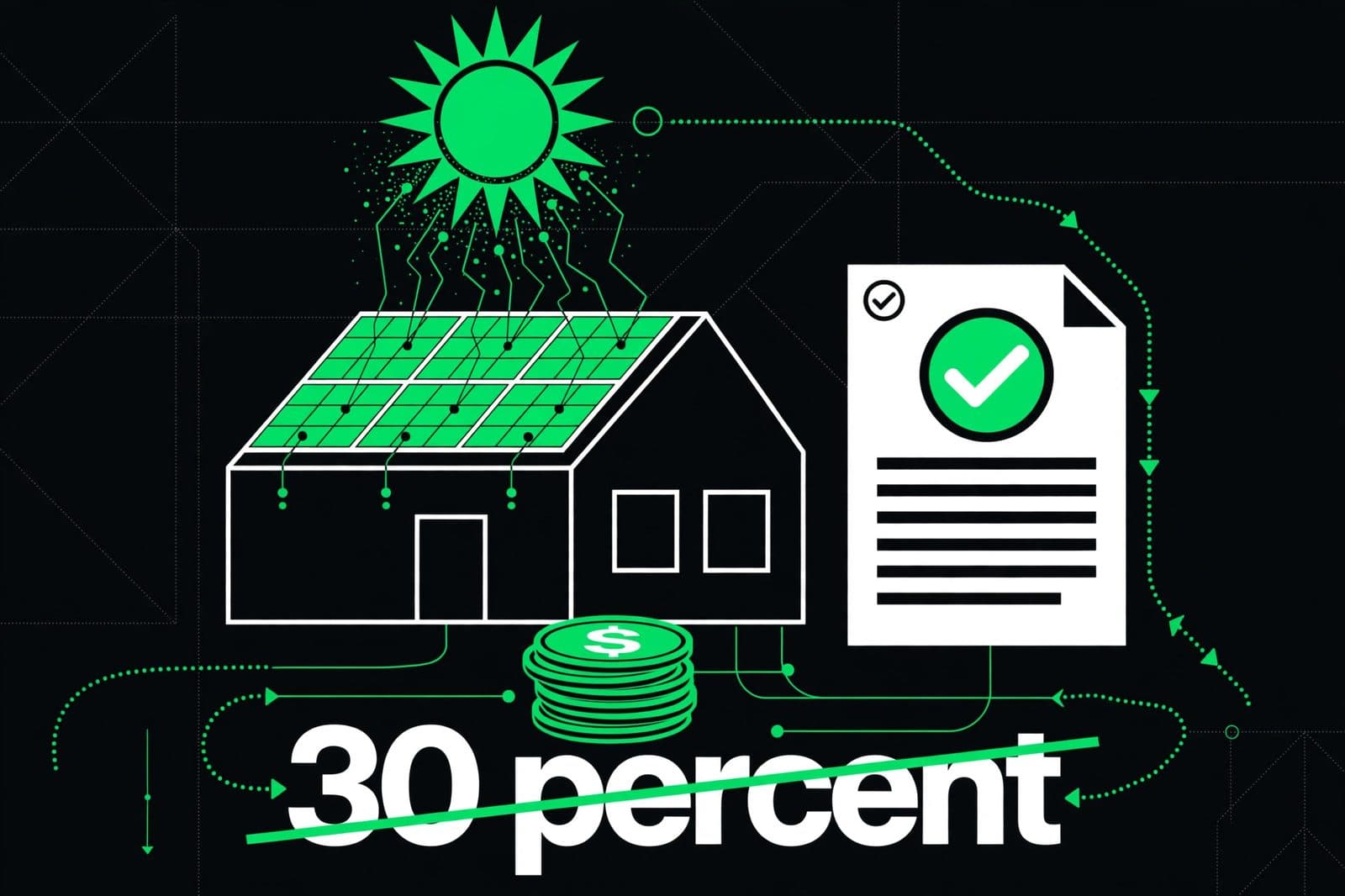
- The 30 percent federal solar credit (Section 25D) ended for installations completed after December 31, 2025. Payment date and contract date do not matter; the completion date decides.
- Unused credit from a 2025 installation carries forward with no expiry, and a missed claim can still be fixed by amending the 2025 return.
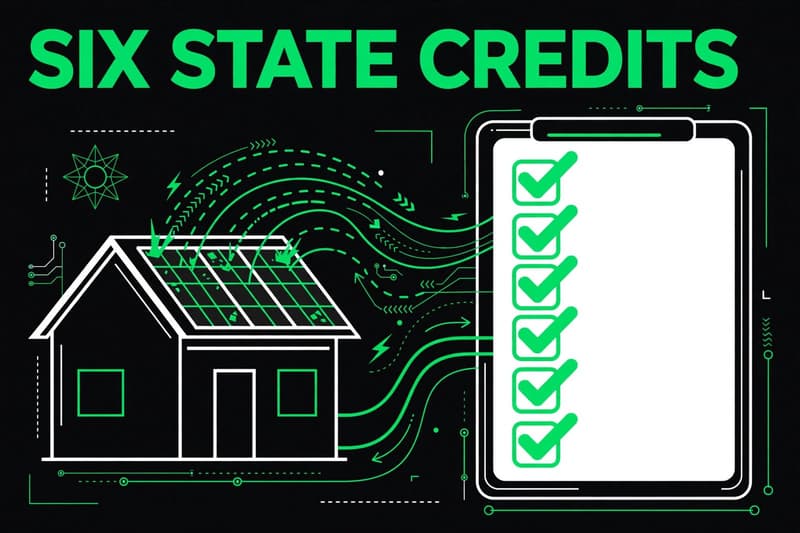
- Six states still pay their own solar income tax credit in 2026, led by New York at 25 percent up to US$5,000. Leases and PPAs run on a separate business credit that survives until 2027.
Section 25D: the Residential Clean Energy Credit, the federal tax credit that paid 30 percent of the cost of a home solar system, battery or geothermal installation. It applied to expenditures made through December 31, 2025, and to no expenditure after that date.
Homeowners shopping for solar in late 2026 keep asking the same question, and the answer is short: no, there is no federal solar tax credit for a system installed in 2026. The 30 percent Residential Clean Energy Credit ended for expenditures made after December 31, 2025, when the One Big Beautiful Bill Act (Public Law 119-21, signed July 4, 2025) pulled its termination date forward from 2032. The confusion is understandable. Quotes still circulate that price in the old credit, installers still advertise it, and the IRS’s own credit page still carries older phase-down wording alongside the new cutoff. The rules that decide what a homeowner can still claim are narrower than the headlines suggest, and they turn on dates most buyers never think to check.
The IRS set out the new dates in Fact Sheet FS-2025-05, published August 21, 2025. Its table is blunt: for Section 25D, “the credit will not be allowed for any expenditures made after December 31, 2025.” The same fact sheet ended the companion Energy Efficient Home Improvement Credit (Section 25C) for property placed in service after the same date, and it set September 30, 2025 as the end for the new and used clean vehicle credits. Nothing in the fact sheet restores any of them, and no new federal homeowner credit has replaced them.
The completion date decides the claim
The single most expensive misunderstanding in 2026 is the belief that paying in 2025 saves the credit. It does not. The IRS fact sheet answers the question directly: an expenditure under Section 25D “is treated as made when the original installation of the item is completed.” If installation finished after December 31, 2025, the expenditure counts as made after that date, even if the homeowner paid in full before it. A signed contract in 2025 changes nothing either. Only the completion date matters, and for a system built with a new or reconstructed home, the test is when the taxpayer’s original use of the home begins.
| Your system | Federal 25D credit? | Why |
|---|---|---|
| Finished and running by Dec 31, 2025 | Yes, 30% of cost | Expenditure made in 2025 |
| Paid in full in 2025, installed in 2026 | No | Expenditure counts as made when installation completes |
| Contract signed in 2025, installed in 2026 | No | Contract date is not the test |
| Installed in 2026 or later | No | Credit ended Dec 31, 2025 |
| Installed 2022 to 2025 with credit left unused | Yes, the unused part carries forward | Carryforward has no expiry |
| Home battery of 3 kWh or more, installed 2026 | No | Same cutoff applies to batteries |
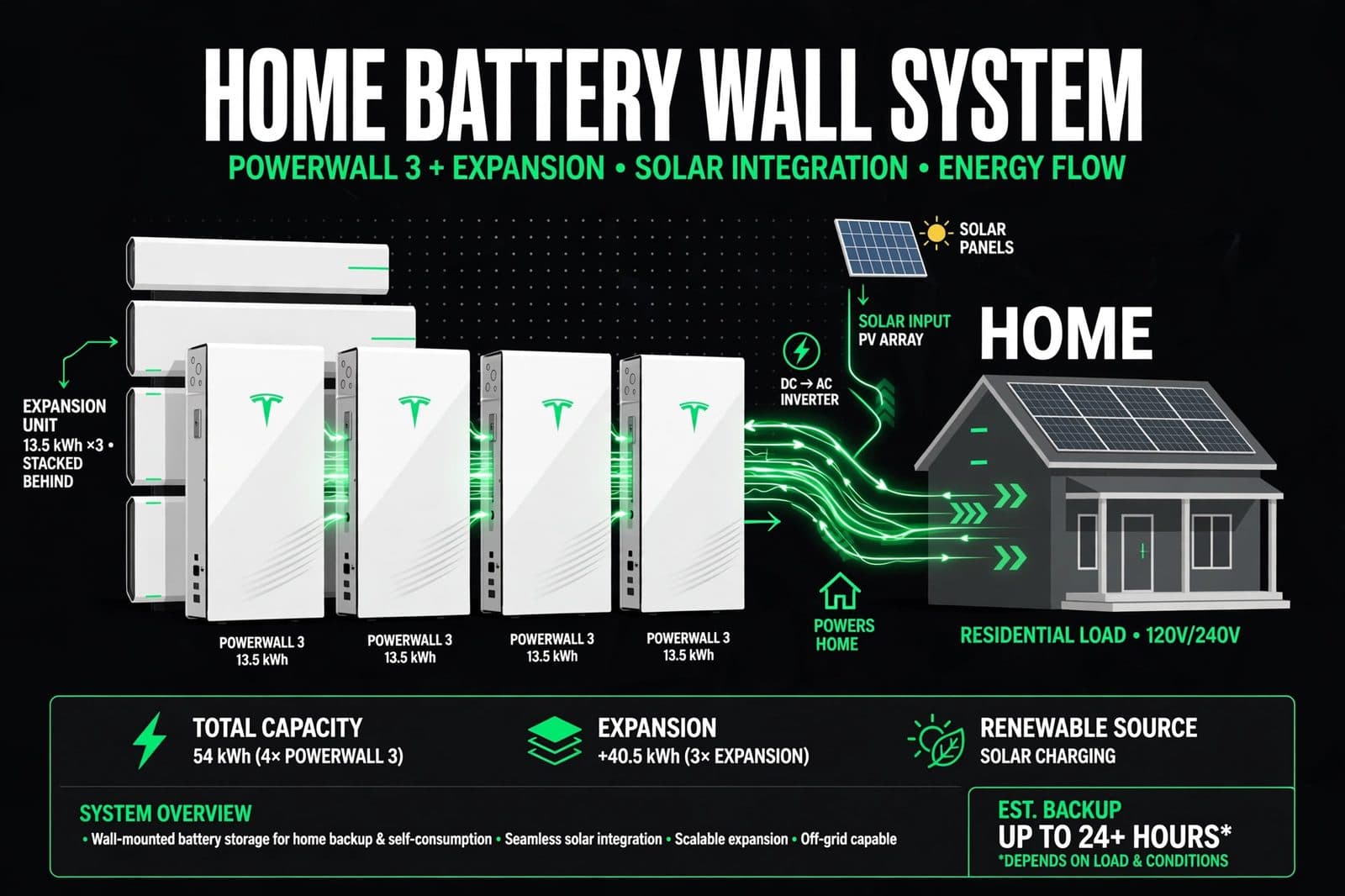
The same cutoff catches home batteries bought as a 25D expense. A battery of 3 kWh or more installed alongside solar in 2025 qualified for the 30 percent credit. The same battery installed in 2026 gets no federal credit at all. That change matters for the payback math later in this guide, because batteries were already the hardest part of a home system to justify on economics alone, and the credit was doing a lot of the work.
What to do if your system finished in 2025
Homeowners whose installation was completed in 2025 still hold a live claim, and three situations cover nearly everyone. First, if the 2025 return already claimed the credit on IRS Form 5695, Part I, there is nothing to do except keep the form. Any unused portion carries forward to later returns until it is used up. Second, if the 2025 return was filed without the credit, file an amended return on Form 1040-X. The IRS generally allows three years from the filing date to claim a refund, so a return filed in April 2026 can be amended until April 2029. Third, if the return has not been filed yet, because of an extension or late filing, include Form 5695 with the return when it goes in.
The carryforward is the part most 2025 installers never explain. The credit was nonrefundable, which meant it could only reduce tax owed, never produce a refund. A homeowner whose credit exceeded the year’s tax bill did not lose the difference. The IRS states plainly: “You can carry forward any excess unused credit, though, and apply it to reduce the tax you owe in future years.” There is no expiration on that carryforward. A worked example shows how it plays out. An 8 kW system at the 2024 national median price of about US$4.0 per watt from Berkeley Lab costs US$32,000, and the 30 percent credit was US$9,600. With a US$5,000 federal tax bill in 2025, the homeowner uses US$5,000 in year one and carries US$4,600 into 2026 and beyond.
A smaller example makes the same point for modest systems. A homeowner who finished an US$18,000 system in November 2025 earned a US$5,400 credit. With US$4,000 of 2025 federal tax, US$4,000 is used and US$1,400 carries into 2026, where it offsets that year’s tax. The carryforward belongs to the credit earned under the old rules, and installing a second system in 2026 creates no new credit. Keep the Form 5695 from the original year, because the carryforward is cited on every later return until it runs out.
Six state credits that still pay in 2026
With the federal credit gone, state credits are the only tax credit left for a homeowner who buys solar in 2026, and six states still offer one. They are smaller than the old 30 percent federal credit, and they only help a homeowner who owes state income tax, but on a typical system they are worth thousands. New York is joint-most valuable in cash terms (tied with Hawaii at US$5,000): 25 percent of qualified equipment costs up to US$5,000, claimed on Form IT-255, with unused credit carrying forward up to five years. New York is also the only state in the group where a lease or a power purchase agreement of at least ten years can qualify.
| State | Credit | Cap | Carryforward | Form |
|---|---|---|---|---|
| New York | 25% of equipment cost | US$5,000 | 5 years | IT-255 |
| Hawaii | 35% of cost | US$5,000 per system | Varies | State tax form |
| South Carolina | 25% of cost | US$3,500 a year, or 50% of tax if less | 10 years | TC-38 |
| New Mexico | 10% of cost | US$6,000 | Varies | State tax form |
| Arizona | 25% of cost | US$1,000 total for the home | 5 years | Form 310 |
| Massachusetts | 15% of net cost | US$1,000 | 3 years | Schedule EC |
South Carolina’s credit illustrates why the fine print matters more than the headline rate. At 25 percent it looks as generous as New York’s, but the yearly cap of US$3,500, or half the year’s state tax if that is less, stretches the payout over several years. A US$25,000 system earns a US$6,250 credit on paper, yet a household with US$5,000 of state tax can use only US$2,500 a year. The ten-year carryforward makes the full amount reachable, but slowly. Arizona and Massachusetts cap out at US$1,000, which is real money but a small fraction of a system that costs twenty times that. Hawaii’s 35 percent rate is the highest in the group, capped at US$5,000 per system.
Two cautions apply across all six states. First, these are credits against state income tax. They reduce the tax owed rather than arriving as cash, so a retired homeowner with little taxable income may take years to use one, and the carryforward periods in the table are the limit. Second, leased systems usually do not qualify. Arizona requires the homeowner to purchase the system, South Carolina requires the facility to be owned by the claimant, and New York is the exception that proves the rule. Other states run rebates, property tax exemptions and sales tax exemptions instead of income tax credits, and the Database of State Incentives for Renewables and Efficiency lists them by ZIP code. Confirm the current figures with the state revenue department before signing a contract, because state rules change in any legislative session.
Leases and PPAs run on a different credit
The lease and power purchase agreement market did not die with the homeowner credit, because it never used that credit. In a lease or PPA, a company owns the panels on the roof and the homeowner pays a monthly fee or a per-kWh rate. The company claims the business credit, Section 48E, the Clean Electricity Investment Credit, and the homeowner claims nothing. Section 48E survived the 2025 law in shortened form: for wind and solar facilities, the credit does not apply to property placed in service after December 31, 2027, but only for facilities whose construction began after July 4, 2026. A facility that began construction by that date keeps the credit with no placed-in-service deadline in the statute, and energy storage at a solar facility is carved out of the 2027 cutoff.
That survival is why leases and PPAs are still offered, and it is also why a homeowner should read the price rather than the pitch. Nothing in the IRS guidance or in Public Law 119-21 requires an installer to pass any of the business credit through to the customer. Whatever discount exists lives in the monthly payment or the PPA rate, and the only way to judge it is to compare the rate in cents per kWh and the annual escalator against the utility rate today. Ask the installer which construction-start date applies to the project, and what happens to the price if the credit is lost. A project that began construction after July 4, 2026 must be running by December 31, 2027 for the company to claim the credit, and a delay past that date can land on the homeowner’s bill.
Foreign-sourcing rules add a second risk. The law denies the 48E credit for solar facilities beginning construction after 2025 that include material assistance from a prohibited foreign entity, and the IRS explained how to measure that in Notice 2026-15. Installers using equipment from restricted sources may not be able to claim the credit, which affects the price they can offer. A lease also complicates a home sale, because the buyer has to take over the contract or the seller has to buy out the system. Read the transfer clause before signing. Over 20 to 25 years, owning almost always costs less than leasing for a homeowner who can pay cash or borrow at a reasonable rate, and our explainer on how power purchase agreements work sets out the contract terms that decide the difference.
What solar costs without the 30 percent credit
The arithmetic without the credit is simple enough to do on a single page, and it is the calculation every 2026 quote should survive. Take the same 8 kW system at US$32,000 from the Berkeley Lab median price of about US$4.0 per watt. Assume it produces 1,300 kWh per kW per year, about 10,400 kWh, and that the household uses all of it at the retail rate. Both are assumptions: output per kW varies widely by location and roof angle, and the right number for a specific roof comes from NREL’s PVWatts calculator. The payback is cost divided by yearly savings, leaving out panel degradation, rate increases, financing costs and any export shortfall.
| Electricity rate | Savings a year | Simple payback, no federal credit | Payback with the old 30% credit |
|---|---|---|---|
| US$0.15 per kWh | US$1,560 | 20.5 years | 14.3 years |
| US$0.20 per kWh | US$2,080 | 15.4 years | 10.8 years |
| US$0.30 per kWh | US$3,120 | 10.3 years | 7.2 years |
| US$0.40 per kWh | US$4,160 | 7.7 years | 5.4 years |
The table shows what the credit was doing. At 20 cents per kWh, the payback stretches from 10.8 years with the credit to 15.4 years without it, a gap of nearly five years. At 15 cents, the system takes over twenty years to pay for itself, longer than most homeowners stay in one house. At 30 cents, the payback is 10.3 years, which is workable for a system warrantied for 25 years. Add a state credit and the picture improves: in New York, a 20-cent rate with the US$5,000 credit brings the net cost to US$27,000 and the payback to about 13 years. Berkeley Lab also found that loan-financed systems carried a median price near US$4.7 per watt in 2024, against about US$3.5 per watt for cash buyers, because lenders fold fees into the price. A high-fee loan can add more to the cost than the lost credit did.
Net metering decides what exported power is worth, and it matters more now that the credit is gone. Under net metering, each exported kWh earns close to the retail rate. Under net billing, exports earn a lower rate tied to the wholesale or avoided-cost value of power at that hour, which is how California’s successor to net metering works. A system sized to cover daytime use does better under net billing than one sized to export, and a battery helps by moving noon production to the evening, though the battery now carries its full cost with no federal credit. Ask any installer for the export rate in writing and whether it is locked for a fixed number of years. For the wider verdict on whether panels still pay, see our earlier analysis of whether solar panels are still worth it after the credit ended.
When the numbers still work in 2026
Solar still pays for a clear set of homeowners. The rate is above 25 cents per kWh, which covers California, New England, Hawaii and parts of New York. The buyer can pay cash or borrow at a low rate rather than through a high-fee solar loan. The roof faces south or west with little shade, and the household plans to stay at least 12 to 15 years. The utility gives full or near-retail credit for exports, or the household uses most of the power itself. A state credit on top of those conditions shortens the payback by two to three years, which is often the difference between a sound purchase and a marginal one.
The cases to skip are equally clear. A rate under 15 cents per kWh with no state credit produces a payback over twenty years. A roof that needs replacing within five years should be fixed first, because removing and reinstalling panels costs thousands. A household that may sell within seven years will rarely recover the cost, and any quote whose payback still counts a federal credit is quoting a credit that no longer exists for 2026 installs. That last check is the easiest and the most important: if the quote shows a 30 percent federal credit on a 2026 installation, the installer is either using old software or old sales material, and the rest of the quote deserves the same scrutiny.
Cheaper ways to cut the bill often beat solar on payback when the numbers are close. Air sealing, a heat pump water heater and a smart thermostat cost a fraction as much, and some still qualify for state or utility rebates. None of that makes solar a bad purchase in 2026. It makes it a purchase that has to be judged on the rate, the roof, the state and the financing, rather than on a federal credit that carried a third of the cost for years and is now gone.
Frequently asked questions
Is there a federal solar tax credit in 2026?
No, not for homeowners who buy a system. Section 25D does not apply to any system whose installation is completed after December 31, 2025. The business credit, Section 48E, still exists for companies that own solar equipment, which is why leases and PPAs are still offered.
I paid for solar in 2025 but it was installed in 2026. Can I claim the credit?
No. The IRS treats the expenditure as made when the original installation is completed. The payment date does not decide it. A system paid in full in 2025 but finished in 2026 earns no Section 25D credit. The same rule applies to a contract signed in 2025 with installation in 2026.
What happens to unused credit from a 2025 installation?
It carries forward with no expiry. The credit was nonrefundable, so if it exceeded the 2025 tax bill, the unused part reduces tax owed in future years. Claim it on Form 5695 with the 2025 return, and cite the carryforward on each later return until it is used up. A return filed without the credit can be amended on Form 1040-X, generally within three years of filing.
Which states still offer a solar tax credit?
Six states pay their own income tax credit for home solar in 2026: New York (25 percent, up to US$5,000), Hawaii (35 percent, up to US$5,000 per system), South Carolina (25 percent, up to US$3,500 a year), New Mexico (10 percent, up to US$6,000), Arizona (25 percent, up to US$1,000) and Massachusetts (15 percent, up to US$1,000). All are credits against state income tax, so they only help if the homeowner owes state tax, and unused amounts carry forward for a limited number of years.
Can I claim a credit on a leased solar system?
No, except in New York. In a lease or PPA the company owns the system and claims the business credit, Section 48E. The homeowner gets whatever discount is built into the monthly payment or the per-kWh rate, and no federal rule requires the company to pass the credit through. New York is the exception: leases and PPAs of at least ten years can qualify for its state credit.
Sources
- FAQs for modification of sections 25C, 25D, 25E, 30C, 30D, 45L, 45W, and 179D under Public Law 119-21, IRS, Fact Sheet FS-2025-05, 21 August 2025
- Is There Still a Solar Tax Credit in 2026? What Still Pays, Home Energy Planner, verified 4 November 2026
- State Solar Tax Credits 2026: Who Still Pays, Solar Powered Tech, 13 November 2026
- Solar Incentives by State (2026): What’s Still Available, Solar and Battery Guide, October 2026