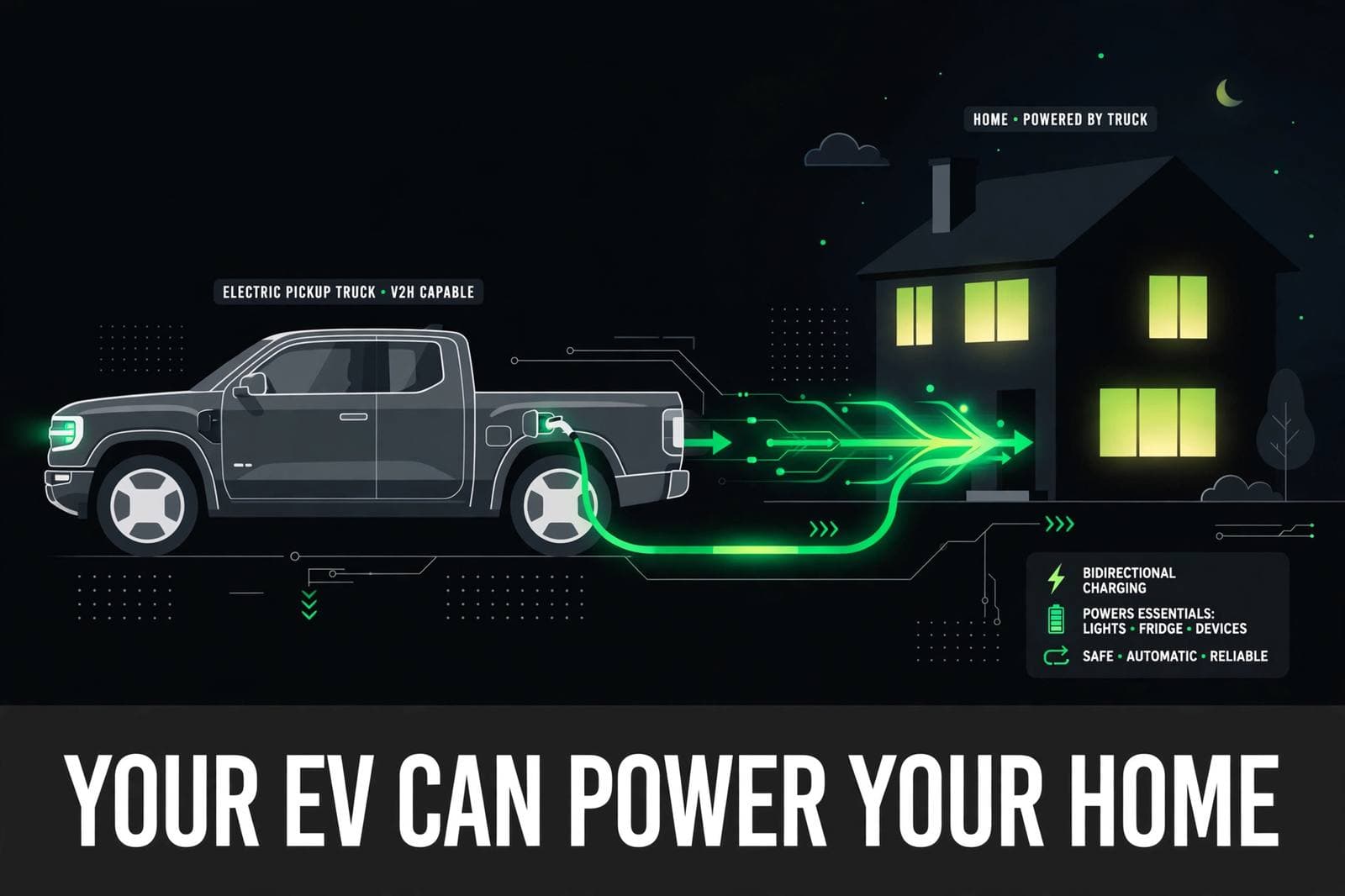
- Only a handful of EVs can run a whole home during an outage in late 2026: the Ford F-150 Lightning, GM’s Ultium range, the Tesla Cybertruck, the Kia EV9, and the Volvo EX90 and Polestar 3.
- Outputs run from 9.6 kW for the Ford and GM systems to 11.5 kW for Tesla Powershare and 12 kW for the Kia EV9 with a Wallbox charger.
- Every full vehicle-to-home setup needs a bidirectional charger, a transfer switch and professional installation, with hardware alone costing roughly US$2,000 to US$10,000 before installation.
Vehicle-to-home (V2H): letting an electric car’s battery keep a house lit when the grid goes dark, through home hardware that sends power both ways and a switch that separates the house wiring from the street supply. It differs from vehicle-to-load, which runs one appliance from the car’s outlets, and from vehicle-to-grid, which sells stored energy back to the utility.
The most capable truck on the list is one you can no longer buy new. Ford discontinued the F-150 Lightning in late 2025, so its 9.6 kW Intelligent Backup Power system, the first vehicle-to-home setup most Americans ever heard of, is now available only on the used market. The hardware that makes it work costs US$5,205 before installation, which sets the tone for the whole category: vehicle-to-home is real, it works, and it costs about as much as a small home battery before a single wire is run.
The list below covers every EV a US buyer can actually use for full home backup in late 2026, with the output, the battery, the claimed days of backup and the hardware each one needs. It also covers the cars that look as if they qualify and do not, because the gap between running a fridge from a car’s outlet and running a house from its battery is the most expensive misunderstanding in this market.
- Vehicle-to-home is not vehicle-to-load
- Ford F-150 Lightning: 9.6 kW, but no longer sold new
- GM Energy: the widest V2H lineup at 9.6 kW
- Tesla Powershare: 11.5 kW, and Model 3 and Y join with a catch
- Kia EV9: 12 kW through a third-party charger
- Volvo and Polestar join through dcbel
- How many days each vehicle covers on one charge
- What the hardware costs, and why none of it is DIY
- The EVs that cannot do this yet
Vehicle-to-home is not vehicle-to-load
Three terms get mixed up in showrooms, and the difference between them is worth thousands of dollars. Vehicle-to-load (V2L) runs a single device from the car’s built-in outlets: a laptop, a kettle, a power tool. Most modern EVs offer it, and it needs no extra hardware. Vehicle-to-home (V2H) powers the house’s circuits through the electrical panel, which needs a bidirectional charger, a transfer switch and an electrician. Vehicle-to-grid (V2G) goes a step further and sells the car’s stored energy back to the utility, which needs utility approval and a programme to join.
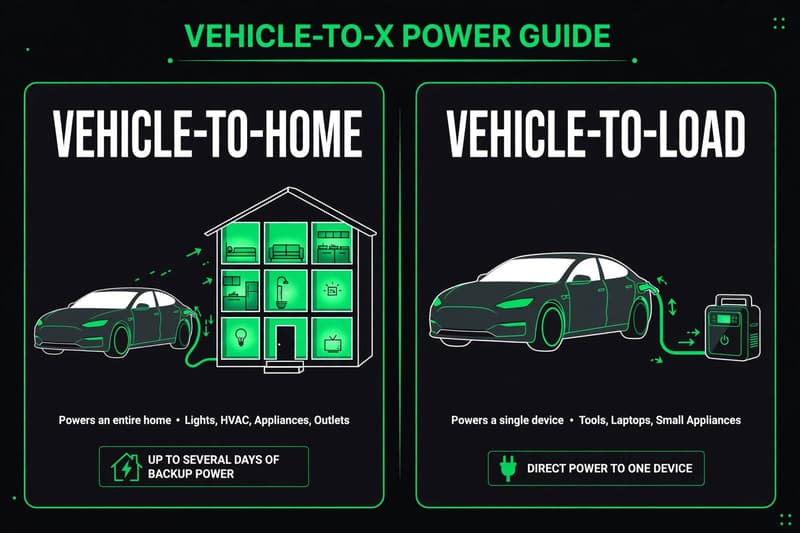
The safety line matters. Hyundai states that its V2L system must never be connected to the home grid: backfeeding a house through a dryer outlet risks electrocution and fire. A proper V2H installation isolates the home from the grid with a transfer switch, so the car’s power cannot energise lines that utility crews believe are dead. Any setup that skips that step is not a bargain, it is a hazard.
Ford F-150 Lightning: 9.6 kW, but no longer sold new
The F-150 Lightning was the first mass-market EV to offer full home backup, and its numbers still set the benchmark. Intelligent Backup Power delivers up to 9.6 kW to the home. With the extended-range 131 kWh battery, Ford claims up to 3 days of full-home power, or up to 10 days with rationed use, at its 30 kWh per day home-use assumption. The standard-range 98 kWh battery covers up to 2 days, or a single fridge for up to 10 days rationed.
The hardware is two parts. The 80-amp Ford Charge Station Pro is the bidirectional charger, listed at US$1,310. The Home Integration System, sold exclusively through Sunrun, adds the inverter, transfer switch and dark-start battery, and costs US$3,895. Combined hardware is US$5,205 before installation, and installed quotes from Sunrun run around US$8,900 to US$9,400 all-in. Ford discontinued the Lightning in late 2025, and its support pages list compatibility with 2022 to 2025 models, so new buyers are shopping used. The used Lightning remains the cheapest route into full V2H for buyers who want a truck.
GM Energy: the widest V2H lineup at 9.6 kW
GM offers the broadest vehicle-to-home range of any manufacturer, all running through its GM Energy system at 9.6 kW of backup power. The V2H-capable list covers the Silverado EV (2024 to 2027), Sierra EV (2024 to 2027) and Escalade IQ (2025 to 2027), plus the Blazer EV, Equinox EV, Hummer EV SUV and pickup, LYRIQ, OPTIQ, VISTIQ, CELESTIQ and the 2027 Bolt EV. Some 2024 models need a dealer or over-the-air update first.
GM claims up to 5 days of backup for a properly equipped home with the 2026 Silverado EV Max Range. The hardware is the GM Energy PowerShift Charger, which charges at up to 19.2 kW, plus the V2H Enablement Kit containing the Home Hub, inverter and dark-start battery. The bundle lists at US$8,998; the charger alone is US$1,999 and the kit alone US$6,999, with installation extra through GM preferred installers. GM’s system is not compatible with other manufacturers’ battery systems, so a household with a non-GM home battery cannot mix the two.
Tesla’s Powershare gives the Cybertruck up to 11.5 kW of continuous home backup power, the highest output of any manufacturer-branded system, with Tesla claiming over 3 days of backup at its 30 kWh per day assumption. The Cybertruck’s pack holds about 123 kWh, which Tesla describes as the equivalent of nine Powerwalls. The hardware is the Universal Wall Connector plus the Powershare Gateway, which controls the grid connection and switches the home to backup power automatically when an outage is detected. Tesla lists installation costs of US$1,800 to US$2,100 for the Gateway and US$600 to US$900 for the Wall Connector, and hardware for the bundle runs about US$2,000 to US$2,500 before installation.
A change in October 2026 widened the system and narrowed it at the same time. Model 3 and Model Y can now use Powershare, but only with a Powerwall 3 in the home, and only for vehicles ordered in the US and Puerto Rico after October 1, 2026. The Cybertruck remains the only Tesla that does standalone Powershare with no home battery. The Cybertruck also offers 9.6 kW of vehicle-to-load power through five onboard outlets, a separate feature from home backup.
Kia EV9: 12 kW through a third-party charger
The Kia EV9 is the only Hyundai or Kia model that does full vehicle-to-home in the United States, and it does it through third-party hardware rather than a Kia-branded system. The Wallbox Quasar 2 bidirectional charger and Power Recovery Unit deliver up to 12 kW, the highest output in this guide, with retail pricing from US$6,440 before tax and installation. Wallbox claims up to 3 days of backup, assuming 25 kWh per day of home use and the EV9’s 99.8 kWh battery. Pre-orders opened on March 4, 2025, initially in seven states: California, Texas, Florida, New York, Washington, New Jersey and Illinois. It was the first CCS residential V2H system in the United States.
The rest of the Hyundai and Kia range is vehicle-to-load only in the US. The Ioniq 5, Ioniq 6, EV6 and Genesis GV60 can run appliances from their outlets at up to 3.6 kW, with the US interior 120-volt outlet rated at 1.9 kW, but none of them can power a home through the panel. Buyers who assume an Ioniq 5 can back up their house are buying the wrong capability.
Volvo and Polestar join through dcbel
Volvo and Polestar entered the market in November 2025 through the dcbel Ara Home Energy Station, a 15.2 kW DC hybrid solar inverter that also manages rooftop solar. The Volvo EX90 is covered across the United States, with the Polestar 3 launching first in California. Dcbel claims up to 2.5 days of unrationed backup, or up to 10 days with rationing. The Ara unit is priced around US$9,999, and the system needs vehicles with the Nvidia Orin-core computer. It is the newest entry on this list and the only one built around a solar hybrid inverter rather than a standalone charger.
How many days each vehicle covers on one charge
Every maker quotes backup in days, and the day counts are not directly comparable because each maker assumes a different daily home use. Ford, Tesla and GM all base their claims on 30 kWh per day, slightly above the Energy Information Administration’s figure of about 28 to 30 kWh per day for the average American home. Wallbox assumes 25 kWh per day for the EV9. The table below recomputes the days from the battery sizes at a common 30 kWh per day, so the vehicles can be compared on the same basis. The arithmetic is ours, from the published battery sizes.
| Vehicle | Battery | Output | Days at 30 kWh/day (calculated) | Maker’s claim |
|---|---|---|---|---|
| Ford F-150 Lightning, extended range | 131 kWh | 9.6 kW | 4.4 days | Up to 3 days full-home, 10 days rationed |
| Tesla Cybertruck | About 123 kWh | 11.5 kW | 4.1 days | Over 3 days |
| Kia EV9 (Wallbox Quasar 2) | 99.8 kWh | 12 kW | 3.3 days | Up to 3 days at 25 kWh/day |
| GM Silverado EV Max Range | Not stated here | 9.6 kW | Not calculated | Up to 5 days |
| Volvo EX90 / Polestar 3 (dcbel Ara) | Not stated here | 15.2 kW (inverter) | Not calculated | Up to 2.5 days unrationed, 10 days rationed |
The pattern is consistent: makers claim fewer days than the simple division gives, because they hold a reserve margin and assume the household keeps using power normally. A Lightning with 131 kWh divides to 4.4 days at 30 kWh a day, and Ford claims 3. A Cybertruck divides to 4.1 days, and Tesla claims over 3. The honest reading is that a full EV battery covers three to five days of normal home use, and a week or more if the household rations to essentials. Sizing the backup to the household’s actual evening load is covered in our home battery sizing guide, and the cost of a dedicated home battery for the same job is in our home battery cost per kWh guide.
What the hardware costs, and why none of it is DIY
Hardware prices run from about US$2,000 to about US$10,000 before installation, and installation adds thousands more. Ford’s combined hardware is US$5,205. GM’s bundle lists at US$8,998. Tesla’s bundle runs about US$2,000 to US$2,500. Wallbox’s Quasar 2 starts at US$6,440. Dcbel’s Ara is around US$9,999. None of these prices includes the electrician, the permits or the panel work, and every manufacturer requires professional installation. The transfer switch, the permits and the utility notification are part of the job, and a system installed without them can endanger utility crews and void the vehicle warranty.
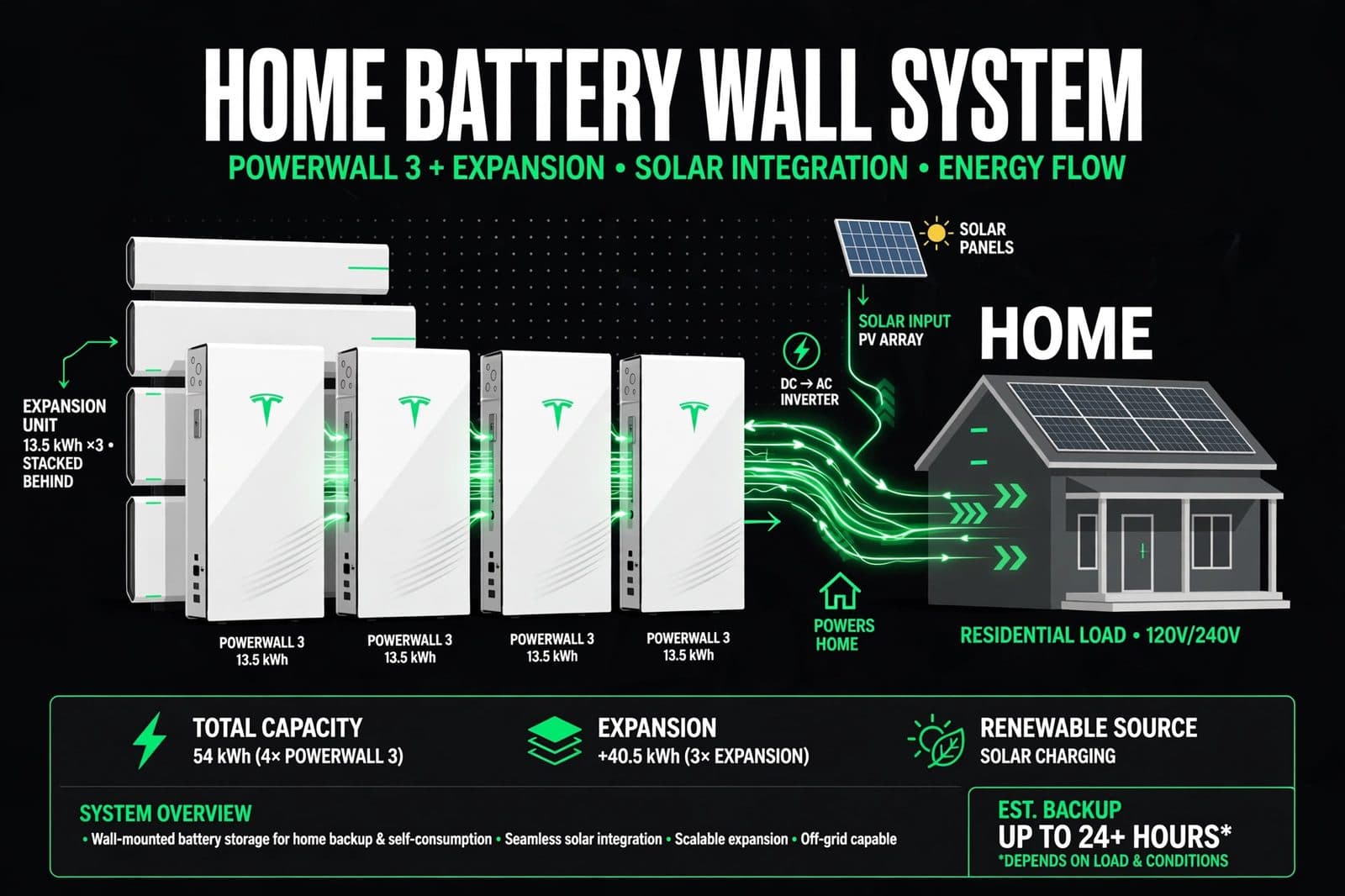
The cost comparison that matters is against a home battery doing the same job. A 13.5 kWh Powerwall 3 holds about a tenth of a Lightning’s battery, so the EV is a far larger store of energy for a household that already owns the car. But the EV is also a vehicle that leaves the driveway, so it cannot back up a home it is not parked at. Households that want backup while the car is away still need a home battery, which is why the two products complement rather than replace each other. Joining a virtual power plant, where the stored energy earns money, is a separate decision covered in our virtual power plant guide.
The EVs that cannot do this yet
Several well-known EVs stay off the list. Rivian announced a 24 kW DC bidirectional home charger for the R1T and R1S, but it is not shipping, with no sale date or price, and current Rivians offer only 1.5 kW of vehicle-to-load power shared across their 120-volt outlets. Lucid has no certified home-backup option as of 2026. The redesigned 2026 Nissan Leaf dropped the CHAdeMO connector for NACS and is vehicle-to-load only at 1.5 kW, with no V2H, although older Leafs with CHAdeMO can do V2H through third-party bidirectional chargers. Hyundai and Kia models other than the EV9, including the Ioniq 5 and EV6, are vehicle-to-load only in the United States.
Ford’s next truck may change the maths. The Fathom, announced in October 2026, builds the inverter into the truck and promises more than 10 kW of backup with hardware about 60 percent cheaper than the Lightning’s US$5,205, from a starting price of US$28,350. It is a 2027 model, so it does not change what a buyer can use today, but it shows where the cost curve is heading: the inverter moves into the vehicle, and the home hardware shrinks to a switch.
Frequently asked questions
Which electric vehicles can power your home?
In late 2026, the Ford F-150 Lightning (2022 to 2025 models), GM’s Ultium range including the Silverado EV and Sierra EV, the Tesla Cybertruck, the Kia EV9 with a Wallbox Quasar 2 charger, and the Volvo EX90 and Polestar 3 with a dcbel Ara station can power a home. Tesla Model 3 and Model Y can do it only with a Powerwall 3, for vehicles ordered after October 1, 2026.
Can I use my EV to power my house?
Yes, if the vehicle supports full vehicle-to-home and the home has a bidirectional charger, a transfer switch and professional installation. A car that only offers vehicle-to-load can run individual appliances from its outlets, but it cannot power the house through the panel.
Can an EV power a house?
Yes, for three to five days of normal use from a full battery, or a week or more with rationing. A Ford F-150 Lightning with the extended-range battery holds 131 kWh, about four days of average home use at 30 kWh a day, and makers hold a reserve margin in their published claims.
How much does vehicle-to-home hardware cost?
Hardware alone runs from about US$2,000 to US$2,500 for Tesla’s Powershare bundle to US$8,998 for GM’s bundle, before installation. Ford’s combined hardware is US$5,205, Wallbox’s Quasar 2 starts at US$6,440, and dcbel’s Ara is around US$9,999. Installation, permits and panel work add thousands more.
Do I need a transfer switch for vehicle-to-home?
Yes. Every full vehicle-to-home system needs a transfer switch and professional installation to isolate the home from the grid during an outage. Never connect a car’s outlets to the home wiring through a dryer outlet or similar workaround: it risks electrocution and fire, and Hyundai states its V2L system must never be connected to the home grid.
Sources
- Home Backup Power, Ford
- 2025 Ford F-150 Lightning Technical Specifications, Ford
- 2023 Integrated Sustainability and Financial Report, Ford, p. 11
- GM Energy V2H Enablement Kit, GM Energy
- V2H-Capable Vehicles, GM Energy
- GM Energy Products, GM Energy
- Powershare, Tesla
- How Much Does Powershare Cost?, Tesla
- Powershare Datasheet, Home Backup, Tesla, 2026
- Cybertruck Owner’s Manual: Powershare, Tesla
- Wallbox Opens Pre-Orders for Quasar 2 Bi-Directional Charger, Business Wire, March 4, 2025
- Vehicle to Load (V2L), Hyundai New Zealand
- Polestar 3 Bidirectional Charging Comes to the US, InsideEVs, November 2025
- Volvo and Polestar Launch Bi-Directional Vehicle-to-Home Charging, The Driven, November 26, 2025
- How much electricity does an American home use?, U.S. Energy Information Administration
- V2H Compatible Cars, The ChargePort, verified November 8, 2026