- EV winter range loss varies enormously by model: Recurrent’s analysis of 10,000+ EVs found the 2020–21 Hyundai Kona Electric kept 84% of its EPA range at 32°F, while the 2021 VW ID.4 lost 45%.
- Independent tests agree: Consumer Reports measured ~25% loss at 16–17°F, AAA recorded a 41% drop at 20°F with the heater on, and Norway’s 2026 El Prix test averaged a 38% loss at −32°C.
- The most effective countermeasure is preconditioning the cabin and battery while still plugged in, so warming energy comes from wall power instead of the battery.
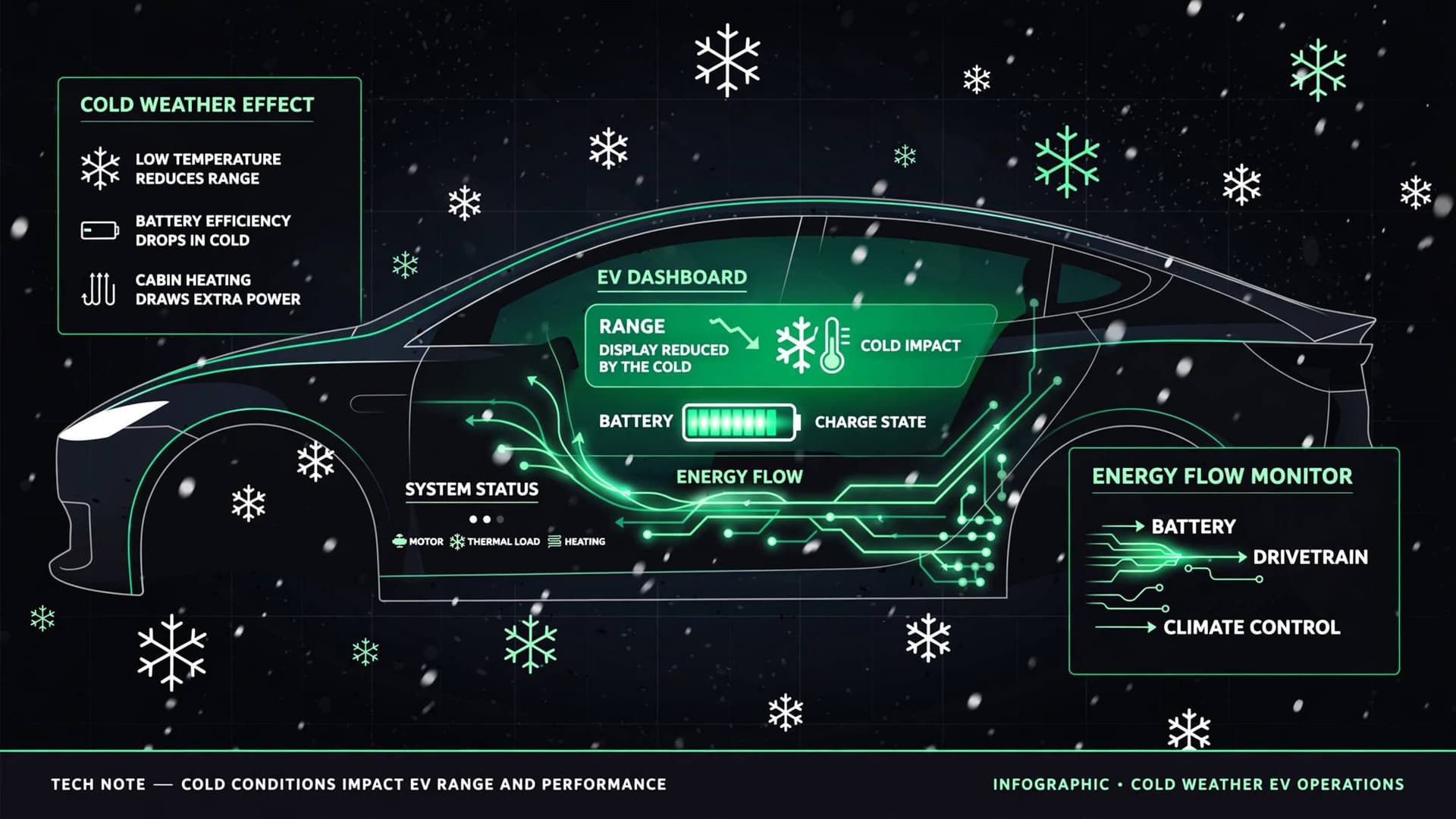
EV winter range loss: the reduction in how far an electric car can drive on a full charge when temperatures fall. Cold slows the chemical reactions inside lithium-ion cells and forces the car to spend battery energy warming both the cabin and the pack itself, cutting real-world range by roughly 25% to 45% depending on the model and temperature.
Every January, the same question freezes EV forums across the northern United States: how far will my car actually go when it is 20 degrees outside? For winter commuters, EV winter range loss is the difference between making the morning drive without stopping and hunting for a working fast charger in the dark. Data from more than 10,000 real cars now gives a precise, model-by-model answer.
Recurrent, which tracks battery health across a large owner community, updated its cold-weather range analysis for 2024 with observed data from over 10,000 vehicles. Consumer Reports ran instrumented tests at 16–17°F, AAA tested at 20°F, and Norway’s automobile federation drives EVs until their batteries die in real Scandinavian winter, twice a year. Compiled into one cold weather EV range by model comparison, they form the most complete picture available anywhere.
EV winter range loss by model: the 32°F numbers
Recurrent’s dataset is the closest thing to a census: real owners, real commutes, observed range versus the EPA rating at 32°F (0°C):
| Model | EPA (mi) | Range at 32°F (mi) | % of EPA retained |
|---|---|---|---|
| 2020–21 Hyundai Kona Electric | 258 | 216 | 84% |
| 2021 VW ID.4 | 260 | 165 | 55% |
| Tesla Model 3 Long Range (4,576 vehicles) | Varies by year | ~50% of EPA | ~50% |
| 2021–22 Audi E-Tron (heat pump) | 222 | ~178 | 80% |
| Tesla Model Y Long Range AWD (heat pump) | 326 | ~157 | 48% |
| Nissan Leaf (all packs) | Varies by pack | 78% of EPA rating | 78% |
Sources: Recurrent’s 2024 analysis of 10,000+ EVs (via The Autopian) for all rows except the Leaf, from Recurrent’s model guide. Model 3 figure is approximate; E-Tron and Model Y miles are derived from EPA ratings and retained percentages.
The standouts say as much about expectations as engineering. The Kona Electric wins among cars without heat pumps partly because Hyundai set a conservative EPA target it could beat in ideal conditions, leaving headroom for winter. The ID.4 is the cautionary tale: a 45% loss at a temperature that merely qualifies as freezing. Across 4,576 Model 3 Long Range cars, freezing-weather range worked out to roughly half the sticker, though ideal-conditions range was already below EPA, so the winter-to-ideal drop alone was 24%.

What independent winter tests found at deeper cold
Three independent programs confirm the pattern and extend it below 32°F:
| Test | Conditions | Result |
|---|---|---|
| Consumer Reports: Mach-E, Model Y, ID.4, Ioniq 5 | 16–17°F, 70 mph, same 142-mi route | All four lost ~25% vs. 65°F |
| AAA, several older EVs | 20°F, dyno, heater on | 41% drop in driving range |
| NAF El Prix 2024, 23 EVs, cabin 21°C | Norwegian winter roads | Avg 21.8% below WLTP; best HiPhi Z −5.9%; Model 3 ~−30% (19th); worst VW ID.7 −31.9%, bZ4X −31.8% |
| NAF El Prix 2026, 24 newest EVs | As low as −32°C | Avg −38%; least: DEEPAL S05 −34.2%; A6 e-tron −38.4%; Capri −39.5% |
Sources: Consumer Reports; AAA 2019 (via The Autopian); El Prix 2024; El Prix 2026 (Business Motoring).
Consumer Reports drove the cars concurrently, extrapolating range from miles-per-percent-of-charge, and found short trips with repeated cabin reheating could sap 50% of range. The 2026 El Prix showed extreme cold spares almost nobody: even the best performer lost a third of its rated range at −32°C. The losses start at 32°F and compound steeply below it.
Plan winter legs at 60–65% of the EPA rating
These tables change buying decisions three ways. Cold-climate buyers: the heat-pump Model Y lost the same percentage as its heat-pump-less Model 3 sibling while the heat-pump Audi E-Tron held 80%. Ask how a model performs at 32°F, not just whether it has a heat pump. Used-EV shoppers: winter loss is a temporary chemical slowdown, not permanent degradation: packs lose only ~2.3% capacity per year, so 160 miles on a January morning is physics, not a dying battery. Road-trippers: plan winter legs at 60–65% of the EPA rating; plan at 90% and you risk turtle mode two blocks from the charger.
Why cold hits EVs this hard
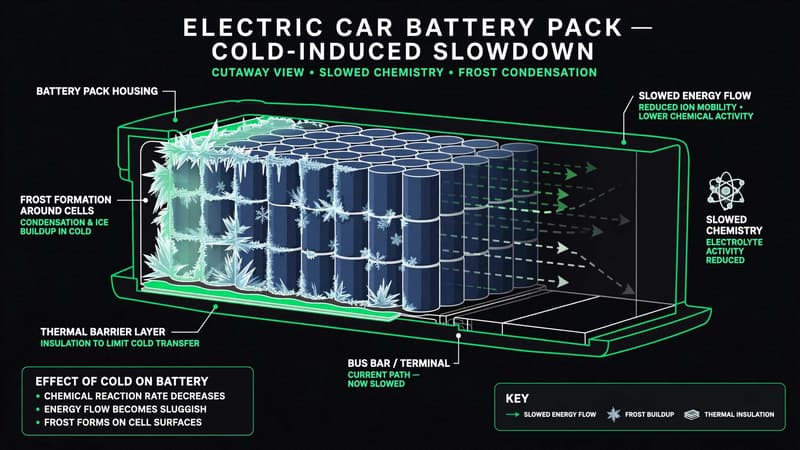
Three mechanisms stack up. Cold thickens the electrolyte and slows ion movement inside lithium-ion cells, so the pack delivers less usable energy. Cabin heating in most EVs uses resistance heaters drawing 3,000–5,000 watts continuously. A gasoline car loses only about 15% of its city fuel economy at 20°F versus 77°F, per the EPA, because its cabin heat is free engine waste heat. And cold batteries cannot safely accept as much regenerative-braking energy, so some of the free miles recovered on deceleration vanish.
Does a heat pump fix it?
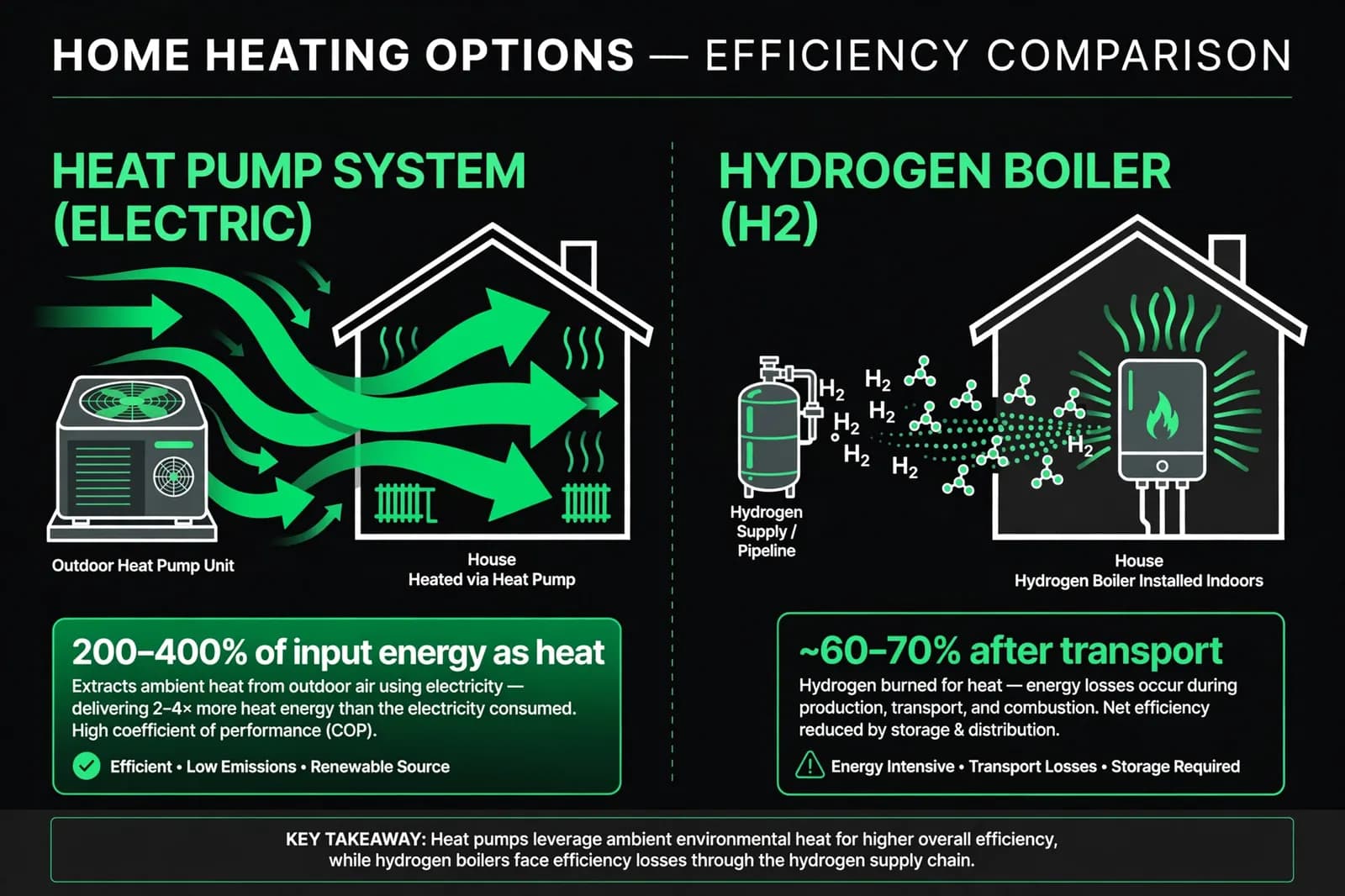
Heat pumps move heat from outside air into the cabin instead of generating it, using far less electricity per unit of warmth, which is the source of the heat pump EV winter range hype. The evidence is mixed: the Audi E-Tron’s 80% retention is the strongest case, but the heat-pump Model Y’s 48% matched the Model 3’s percentage drop, and Recurrent’s study included only two heat-pump models. The honest read: heat pumps help in mild-to-moderate cold (roughly 32–50°F), their advantage shrinks as the mercury falls, and thermal strategy matters at least as much as the badge.
Why the window sticker won’t warn you
The EPA does account for cold: its protocol includes a 20°F test with heating and defrost at specific settings, and label results are adjusted (usually by a 0.7 factor) for real-world conditions including cold, per the EPA’s own testing explainer. But a weighted lab average cannot tell you what a specific car does at a sustained 32°F, or during 70-mph winter highway driving with the heater running continuously. The NAF’s Nils Sødal has argued Europe needs an official winter WLTP test at −7°C, because without it, shoppers compare numbers never measured in the conditions they actually drive in.
The one fix that actually works: precondition while plugged in
Consumer Reports preconditioned each test car’s cabin to 72°F while it was still plugged in, so the heating energy came from the wall, not the battery. Norway’s 2026 El Prix confirmed the same for the battery: preconditioned packs charged near rated speeds even at −32°C. So the routine is simple: use departure-time scheduling or the car’s app to warm the cabin and battery while connected to home power, then unplug and drive on a full battery with a warm pack. Lean on seat heaters and set the cabin a few degrees lower, the closest thing to a free lunch in winter EV driving, and one more reason home charging is worth the installation cost.
Frequently asked questions
Do electric cars lose range in winter?
Yes. Real-world data shows 16% to over 50% losses by model and temperature: 16–52% at 32°F (Recurrent), ~25% at 16–17°F on the highway (Consumer Reports), 41% at 20°F with the heater on (AAA), and an average 38% at −32°C (Norway’s 2026 test). The slowdown is temporary: range returns when temperatures rise.
Which EVs lose the least range in cold weather?
At 32°F, the 2020–21 Hyundai Kona Electric was best of the non-heat-pump cars, holding 84% of EPA range (216 miles). In Norway’s 2024 El Prix the HiPhi Z came closest to its official figure at 5.9% deviation, and at −32°C in the 2026 test the Changan DEEPAL S05 lost the least at 34.2%. Compare within each dataset, not across them.
Does a heat pump help EV winter range?
Sometimes, and less than marketing suggests. The heat-pump Audi E-Tron retained 80% of EPA range at 32°F, the best observed, but the heat-pump Tesla Model Y retained only 48%, the same as the Model 3 without one. Heat pumps help most in mild-to-moderate cold; near or below 20°F, resistive auxiliary heating tends to take over.
Does preconditioning really save that much range?
It does not add capacity, but it stops winter from stealing it at the worst moment. Warming the cabin and battery while still plugged in puts the heating energy on your home supply, so you start with a full charge and a warm pack, and Norway’s 2026 test showed preconditioned batteries charge near rated speeds even at −32°C.