- The 30% federal tax credit for owned solar (Section 25D) ended December 31, 2025, and the solar lease vs buy 2026 math changed overnight. Cash buyers lost roughly $7,500 on a $25,000 system, while leasing companies kept their 48E credit.
- Our original 25-year model for an 8 kW system: cash $25,000, PPA $45,360, lease $57,655, grid-only $75,655. Cash wins on lifetime cost, but only if you have the capital.
- A lease or PPA now beats the utility bill from day one. Sign one only with no down payment, a rate clearly below your utility, and a small or capped escalator.
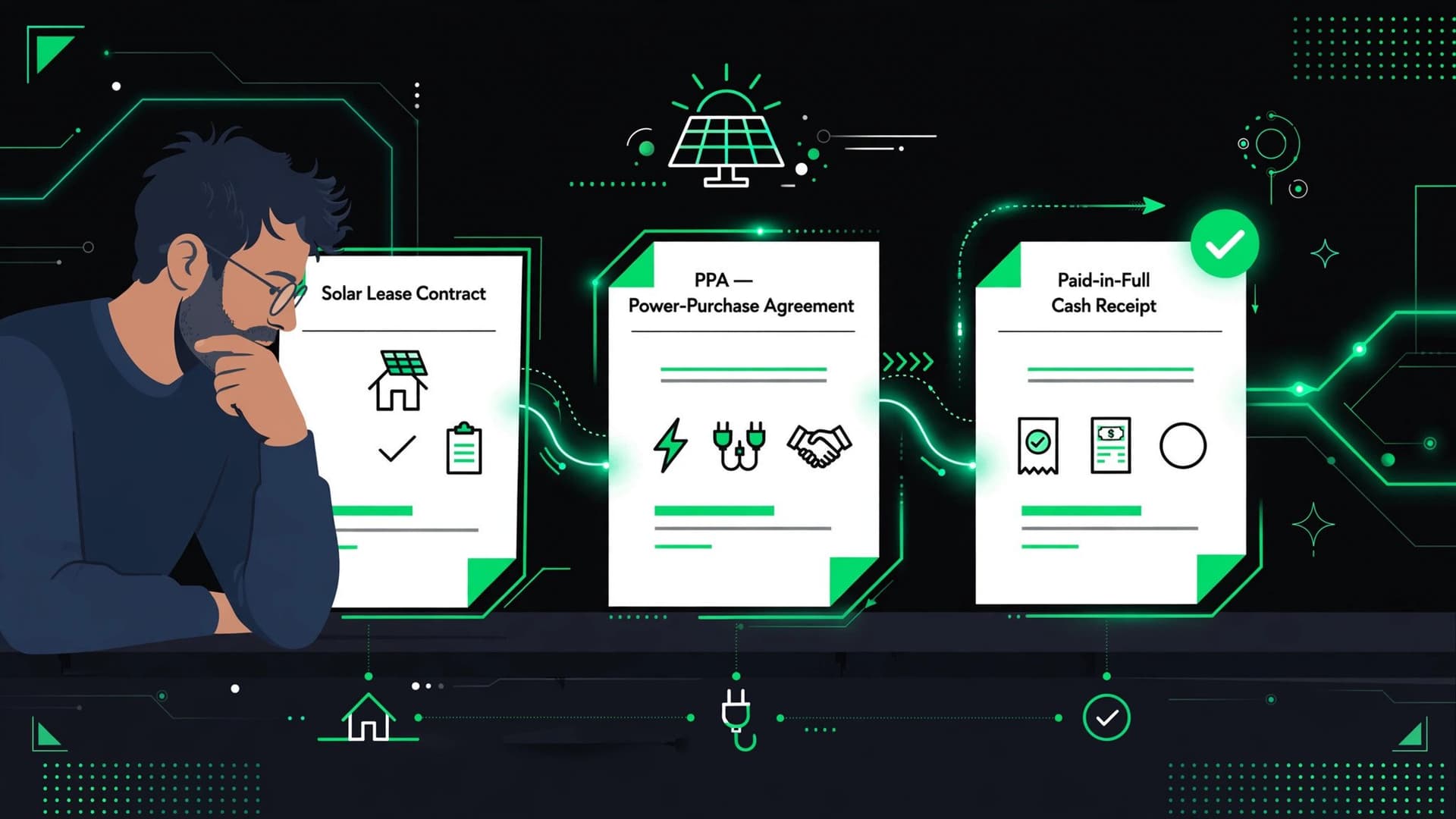
Third-party-owned solar: An arrangement where a solar company installs panels on your roof, owns the equipment, and either rents it to you for a fixed monthly payment (a lease) or sells you the electricity it produces per kilowatt-hour (a PPA). No upfront cost for you; the company keeps the federal tax credit and handles maintenance.
For a decade, the solar lease vs buy 2026 question had a boring answer: buy. The 30% federal Residential Clean Energy Credit cut nearly a third off a cash purchase, and leased systems forfeited that credit to the installer. On December 31, 2025, the residential credit expired, terminated by the One Big Beautiful Bill Act (Public Law 119-21), signed July 4, 2025, and the math changed overnight.
We built an original 25-year cost model pricing cash, lease, PPA, and grid-only power side by side, with every input stated and every formula reproducible. In 2026, the right answer depends on your bank account, your roof, and one contract clause most buyers skim past.
What changed on January 1, 2026
Two federal credits now govern residential solar, pointing in opposite directions. Section 25D, the homeowner-claimed 30% credit for systems you buy, ended for any installation completed after December 31, 2025. Completion date controls: finish in January 2026 and you get nothing, even if you signed and paid in 2025.
Section 48E, the Clean Electricity Investment Credit, survived, but only for business-owned systems. A leasing company that owns your rooftop array can still claim 30% on systems placed in service by December 31, 2027 (or begun before July 4, 2026, under a safe-harbor rule). The credit goes to the company, not to you: whether any of it reaches your wallet depends on whether the provider prices it into your rate, and no rule forces them to. Get any pass-through in writing. Net effect: cash buyers’ costs jumped roughly 40% overnight, and salespeople are steering shoppers toward leases.
Cash, lease, PPA, and prepaid: how each path works
Cash purchase. You pay the full installed price (about $2.50–$3.50 per watt in 2026, per our reporting on how solar panels work) and own everything. No escalator, no contract transfer on resale; owned systems consistently add home value. The 2026 downside is the full sticker price, with no federal credit, plus maintenance after warranties lapse.
Solar lease. The company owns the equipment and charges a fixed monthly rent regardless of production. Typical terms run 20–25 years at $50–$200 per month, with an annual escalator of 0–3%. Predictable, but you pay the same in a cloudy December as in a sunny July.
Power purchase agreement (PPA). You buy the electricity the panels generate at a contracted per-kWh rate. Typical rates land at $0.06–$0.12/kWh against a US average grid rate now above $0.18/kWh, giving day-one savings where the gap is real. Your bill moves with the seasons. Regulated as electricity sales, PPAs are available in roughly 28 states plus Washington, D.C., fewer than leases.
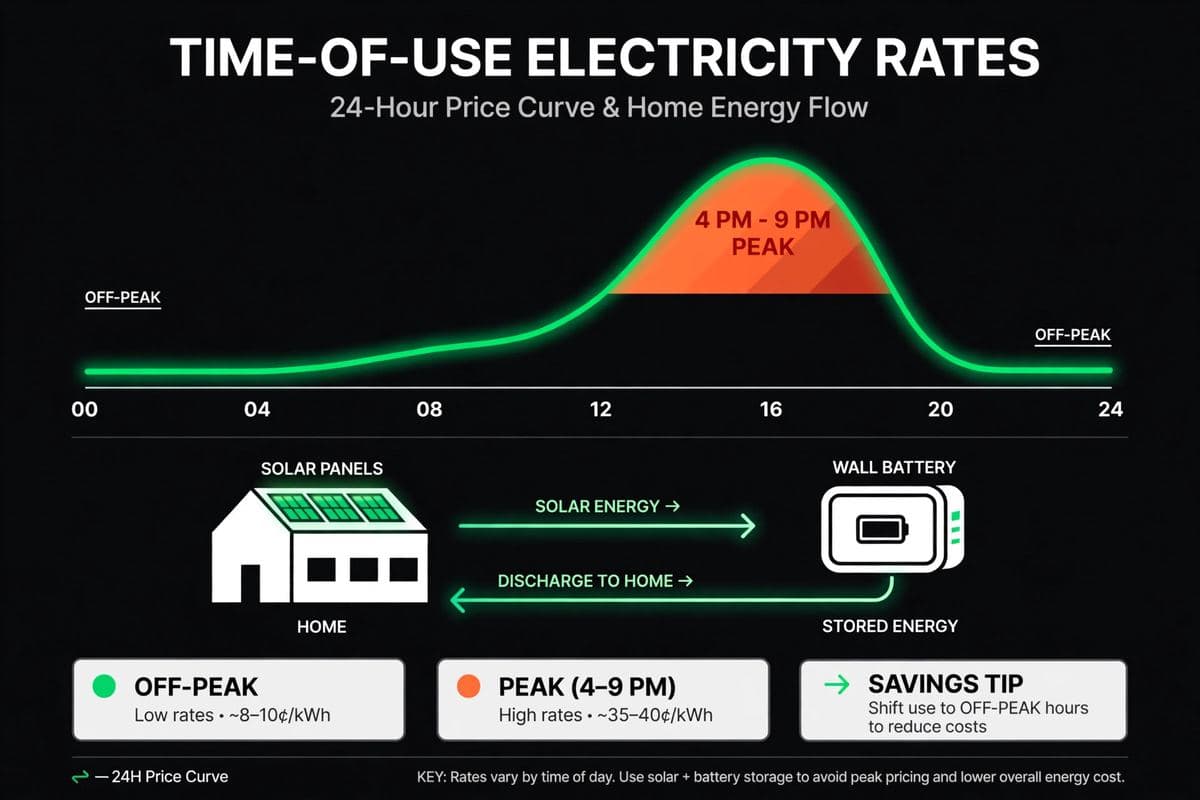
Prepaid lease / prepaid solar lease PPA hybrids. Pay one discounted upfront sum, then nothing monthly. The provider still owns the hardware, so it can still claim 48E and pass the value through as a lower upfront price. Solar.com groups these “prepaid solar products” with leases and PPAs as third-party ownership’s three buckets. Pairing a battery with any TPO product can shift solar power into expensive evening hours; see our battery storage explainer for the economics.
Solar lease vs buy 2026: the Joule Post 25-year cost model
We modeled one household four ways, with every input stated so a reader can reproduce the math.
- System and usage: 8 kW array producing 10,791 kWh in year one, the average U.S. home’s annual use, per EIA 2023 data. Household consumption held constant at 10,791 kWh/year.
- Cash: $25,000 installed (~$3.13/W, inside the 2026 national range), no federal credit, no loan interest, no maintenance reserve.
- Lease: $150/month in year one (mid-range of the typical $50–$200 band), rising 2% per year.
- PPA: $0.14/kWh in year one, rising 2% per year, near the top of the typical $0.06–$0.12 national band.
- Grid-only baseline: $0.18/kWh in year one (the current national average), rising 3.5% per year. This escalation is our assumption, not a forecast; utility increases vary by state.
- Panel degradation: 0.5% per year, the industry standard for modern monocrystalline panels (see our panel technology guide).
- Not modeled: solar loans (dealer fees vary too much), inverter replacement, net-metering export credits, resale value changes. Effective $/kWh divides each path’s total by 25-year household consumption (269,775 kWh).
| Path | Year-1 cost | 25-year total cost | Effective $/kWh |
|---|---|---|---|
| Cash purchase | $25,000 upfront | $25,000 | $0.093 |
| PPA ($0.14/kWh, 2% escalator) | $1,511 | $45,360 | $0.168 |
| Solar lease ($150/mo, 2% escalator) | $1,800 | $57,655 | $0.214 |
| Grid only ($0.18/kWh, 3.5% escalation) | $1,942 | $75,655 | $0.280 |
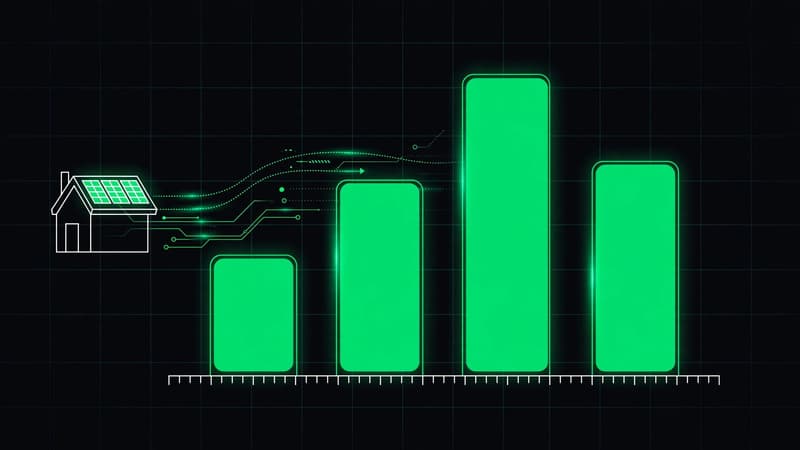
The interpretation: cash costs most on day one (thirteen times the grid’s year-one bill) but is cheapest over 25 years at roughly 9 cents per kWh, only if the homeowner has the capital. It also confirms the 2026 story: with 48E still flowing to third-party owners, both the lease ($1,800) and the PPA ($1,511) beat the grid’s $1,942 in year one, with zero down. The full-term ranking runs cash, then PPA, then lease, then grid. Note the lease’s effective 21.4 cents per kWh lands above the grid’s starting 18 cents, purely because of the escalator.
The solar lease escalator clause: where deals quietly die
The solar lease escalator clause is the contract line that raises your payment every year, typically 1.99% to 2.99%. Installers frame it as tracking utility inflation, but U.S. residential electricity prices have historically risen only around 1.5–2% per year. A 2.99% escalator means your solar bill grows faster than the utility bill it is supposed to beat: our model’s $150/month lease becomes about $179 by year 10 and $241 by year 25 at just 2%. Electrified Experts documents a real 25-year lease at 2.9% whose projected savings worked out to less than $40 a month.
The FTC’s consumer guidance is direct: before you sign, get detailed written bids from several companies, and confirm the contract matches what the salesperson promised: term length, what you pay, whether payments increase and by how much, who keeps the tax credits and RECs, early-termination fees, and buyout cost if you sell. If a 0%-escalator version is offered, price it seriously: less upfront savings, far better long-term protection.
$50,000 over 25 years: what the cash check still buys
The expiration of Section 25D did not just change prices; it changed the industry’s incentive to tell you the truth. When buyers had a 30% credit, installers sold ownership because ownership paid. Now the credit survives only on the provider’s side of the table, and the fastest-growing sales channel is the one where the company keeps it. Our model puts hard numbers on the shift: the $25,000 check saves roughly $50,000 over the grid over 25 years, but a household that cannot write it is no longer punished as 2024’s advice implied. A fairly priced PPA or lease with a capped escalator beats the utility from month one and saves around $18,000–$30,000 over the term.
The new risk of 2026 is the contract itself. More shoppers are choosing between 25-year commitments whose terms (escalators, buyout schedules, guarantees, what happens when you sell) matter more than the headline rate. Our model answers the financing half; only a line-by-line reading of the paperwork answers the rest.
Frequently asked questions
Should I lease or buy solar in 2026?
Buy if you can, ideally with cash: you keep all long-term value and the cleanest resale; our model puts cash at roughly 9 cents per kWh. “Lease or use a PPA only if you have no down payment and the offered rate clearly beats your utility with a small or capped escalator,” advises Trey Linder of Electrified Experts.
Can I still get the 30% federal tax credit if I buy solar in 2026?
No. Section 25D expired for systems installed after December 31, 2025. You can still claim it if your system was fully installed by the deadline (completion date, not contract date, controls) and unused credit from a 2025 system can be carried forward.
Are solar leases a better deal now that the credit ended?
Relatively, yes. Before, leases were penalized because buyers forfeited the 30% credit; now nobody buying in 2026 gets it, while the leasing company can still claim Section 48E through 2027 and price part of it into your rate. They are not a better deal than a cash purchase you can afford, but they beat the grid from year one, and they are a better deal than leases were in 2025.
Do I still get the solar tax credit in 2026?
Not if you own the system: Section 25D ended December 31, 2025. With a lease or PPA, the solar company can still claim the credit through Section 48E, but that value goes to them, not you, unless passed through as a lower rate. Confirm any pass-through in writing.
What happens to my lease or PPA if I sell my home?
Usually three options: transfer the contract to the buyer (who must qualify and agree), buy out the remaining term at closing, or prepay the balance. Transfers can complicate a sale: some buyers welcome the lower bills, others balk at a 20-year obligation with an escalator. The FTC advises confirming transferability, fees, and buyout cost in writing before you sign, not when you list.