- Wondering whether to buy an EV now or wait for solid-state batteries? Solid-state EVs debut in 2027, but only as limited-run flagships from premium brands; affordable mass-market models are not expected before roughly 2030.
- Today’s lithium-ion packs are at record-low prices (battery-electric-vehicle packs averaged $99/kWh in 2025, per BloombergNEF), while even solid-state’s long-term cost targets price it as a premium product at about $150/kWh.
- The honest answer: if you need a car within the next two years, buy now. Waiting for solid-state means waiting past 2030 for a car you can afford. Every year of waiting is another year of gas money spent.
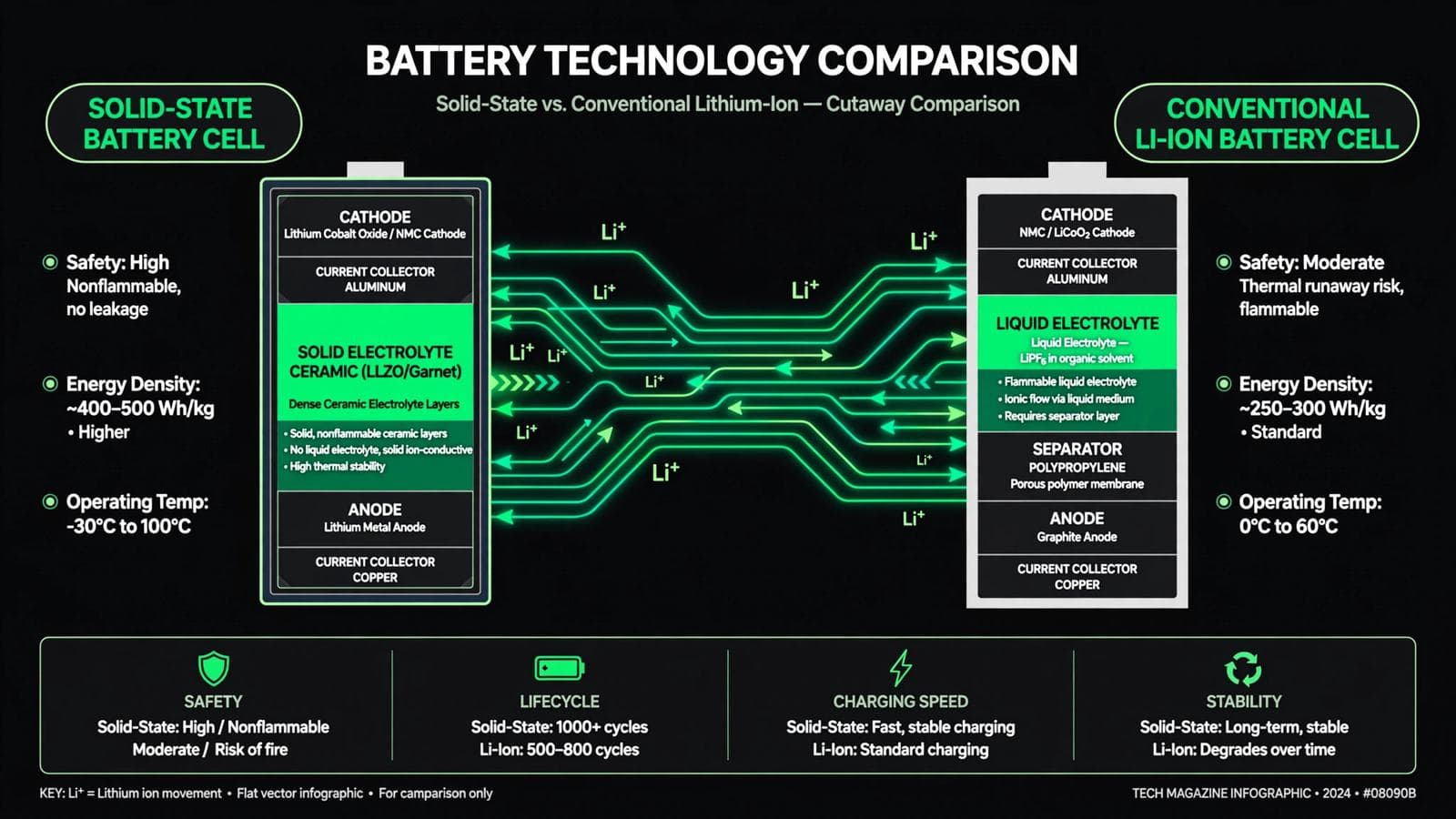
Solid-state battery: A rechargeable battery that replaces the flammable liquid electrolyte inside conventional lithium-ion cells with a solid material, usually a sulfide compound or ceramic. The solid layer can be thinner and tolerates more stress, so the battery stores roughly twice the energy in the same space, charges faster, and carries far lower fire risk.
Trying to decide whether to buy an EV now or wait for solid-state batteries is the trickiest timing question in the car market right now. The uncomfortable truth: the solid-state batteries making headlines in 2026 will not be inside a car you can afford for most of this decade. The 2027 debuts everyone is excited about are real. They are also, almost without exception, limited-production flagships with prices to match.
Solid-state is not a fantasy. But the timeline that matters to a buyer is not the one in the press releases. Below: what the launch schedules actually say, how much better solid-state really is, and a framework for deciding whether to buy now or keep waiting.
Buy EV now or wait for solid-state batteries? The honest answer
Buy now, if you need a car within the next two years. The wait is longer than two years: two years for the first halo cars, plus another three to five for the technology to trickle down to mass-market models at real scale. Every year you wait is another year of gasoline and maintenance on the car you already drive, for a payoff that keeps moving.
The only buyers who should seriously wait are those who can comfortably keep their current car for four to five more years and want a premium EV, the segment where solid-state debuts. For everyone else, waiting is the expensive choice.
The 2027 debuts are real, but they are halo cars
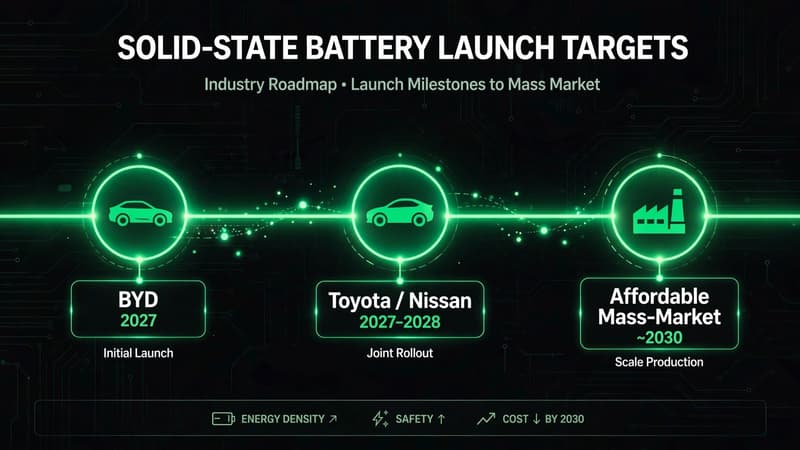
BYD has the most detailed public roadmap: researching solid-state since 2013, it expects to begin producing sulfide-based cells in limited batches in 2027, per its investor-relations department via Electrek. The first two years are a demonstration phase of roughly 1,000 vehicles, launching on premium sub-brands Denza, Yangwang, and Fangchengbao before trickling down to volume models. Mass production is targeted for 2030.
The Japanese programs run a beat slower. Toyota first promised a solid-state car in 2020; the date slipped to 2023, then 2026, and now stands at 2027–2028, most likely a Lexus. Nissan opened a pilot line in Yokohama in early 2025 and targets fiscal 2028. Samsung SDI aims for mass production at Ulsan in late 2027 and has shipped evaluation samples to automakers. Honda opened a demonstration line in Tochigi in late 2024, targeting the second half of the 2020s with no named model.
Volkswagen-backed Gotion may be furthest along in China: its Jinshi sulfide-based cells have exceeded 400 Wh/kg, passed nail-penetration and 200°C heat tests with no smoke or fire, and been road-tested in real vehicles. A 2 GWh production line is under construction with volume delivery targeted for early 2027. But even Gotion’s framing puts mass production around 2030. (See our coverage of Gotion’s 400 Wh/kg Jinshi cells.)
The pattern is clear: 2027 means limited batches and flagships. Every credible roadmap puts affordable solid-state EVs at 2030 or later, and new battery chemistries historically need a four-to-six-year qualification cycle before reaching production cars at scale.
| Company | 2027 | 2028–2029 | Mass production |
|---|---|---|---|
| BYD | Limited-batch sulfide cells on Denza, Yangwang, Fangchengbao | ~1,000-vehicle demonstration phase | 2030 |
| Toyota | 2027–2028 flagship, most likely Lexus | n/a | After 2028 |
| Nissan | Pilot line opened in Yokohama, early 2025 | Fiscal 2028 target | After 2028 |
| Samsung SDI | Mass production at Ulsan, late 2027; evaluation samples shipped | n/a | Late 2027 |
| Honda | Demonstration line opened in Tochigi, late 2024 | Second half of the 2020s | No named model |
| Gotion (Jinshi) | 2 GWh line; volume delivery targeted for early 2027 | n/a | Around 2030 |
How much better will solid-state actually be?
Strip away the marketing and the improvement is real but bounded. Gotion’s 400 Wh/kg target is roughly double the 160–200 Wh/kg of current mass-market LFP cells, translating to claimed ranges of 800–1,000+ km and 0–80% charging in about 10–12 minutes. BYD’s chief scientist calls the technology “a critical stage” while warning hurdles remain before commercialization. The clearest win is safety: cells that survive puncture and extreme heat without smoke or flames.
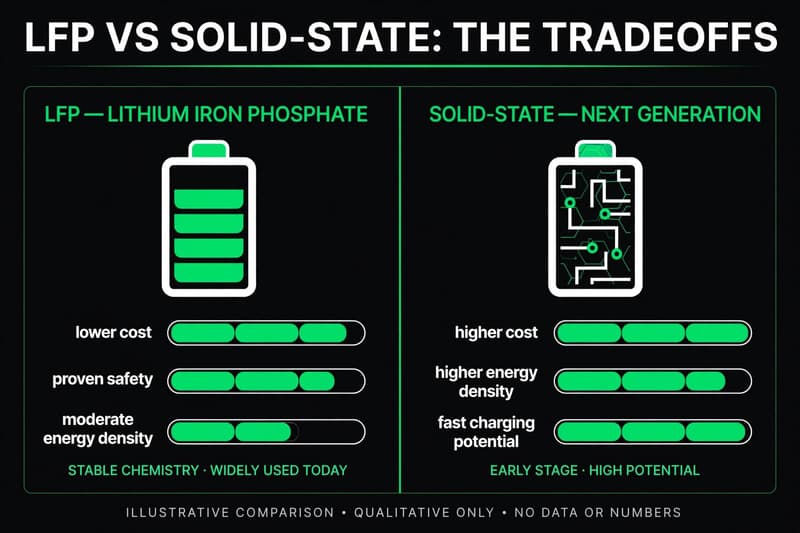
The cost side is where the fantasy usually dies. Today, solid-state production is estimated at five to ten times the cost of conventional lithium-ion, roughly $400–$800/kWh against about $115/kWh for lithium-ion packs in 2024. Gotion’s long-term ambition, its “one-yuan era,” would bring solid-state down to about $150/kWh. Now compare that with where lithium-ion already is: BloombergNEF’s 2025 survey put the average lithium-ion pack at a record-low $108/kWh, battery-electric-vehicle packs at $99/kWh, and LFP packs at just $81/kWh.
Even at its most optimistic long-term cost target, solid-state lands at roughly twice the price of today’s LFP packs for roughly twice the energy density, a premium product, not a mass-market disruptor.
| Category | Price per kWh |
|---|---|
| Solid-state today (estimate) | $400–$800 (5–10x lithium-ion) |
| Solid-state long-term target (Gotion “one-yuan era”) | ~$150 |
| Average lithium-ion pack, 2025 | $108 |
| BEV packs, 2025 | $99 |
| LFP packs, 2025 | $81 |
Meanwhile the incumbent keeps improving: BYD’s Blade Battery 2.0 already delivers over 1,000 km of CLTC range on plain LFP chemistry, and pack prices have fallen more than 93% since 2010.
“Cutthroat competition is making batteries cheaper every year,” says Evelina Stoikou, head of the battery technology team at BloombergNEF. “This is an important moment for the industry, as record-low battery prices create an opportunity to lower EV costs and accelerate the deployment of grid-scale storage to support renewables integration around the world.”
The gap solid-state is chasing is a moving target, and it keeps moving in lithium-ion’s favor. (Confused by the chemistry alphabet soup? Our explainer on LFP vs NMC vs sodium-ion breaks down what each does well.)
Airbags to lithium-ion: new battery tech always debuts at the top
Most coverage skips the key piece of analysis: new automotive battery tech always debuts at the top of the market. Airbags, turbocharging, lithium-ion itself: all started in flagships and took years to reach affordable cars. Early solid-state production is expensive, so it must go into cars whose buyers can absorb the premium. Waiting for solid-state before buying an EV means waiting past 2030 for anything affordable. That single fact should anchor your decision.
2026 is also an unusually good time to be a buyer. The $7,500 federal EV tax credit ended September 30, 2025, with no federal credit for 2026 buyers. But the market adjusted. Edmunds data shows average used-EV asking prices fell to $36,367 by September 2026, down almost 7% since the credit died, as off-lease cars flooded in. “The market is positioned to receive a steady influx of off-lease electric vehicles through 2028,” said Ivan Drury, Edmunds’ director of insights. New EVs still carry average dealer incentives of $8,829 per unit, per J.D. Power and GlobalData’s September 2026 forecast. Translation: new EVs are discounted and used EVs are the cheapest in years.
So who should buy now? You, if you need a car within the next 24 months anyway; you drive enough miles that fuel savings start paying back immediately; you can charge at home overnight (see our 2026 Level 2 home charger cost breakdown); or you are shopping used, where off-lease deals are the best in years. For these buyers, waiting has a price: a year or more of gasoline bills traded for a battery arriving in someone else’s luxury car first.
Who can afford to wait? Drivers whose current car has years of life left and who specifically want a flagship EV, the segment where solid-state debuts. Also anyone who treats 500-plus miles of range or 10-minute charging as non-negotiable.
There is also a middle path: buy a used EV now, drive it four or five years, then upgrade to solid-state when it is actually affordable. Used EVs are cheap right now precisely because the market fears obsolescence: that fear is your discount. Modern packs degrade slowly, so a three-year-old EV has most of its useful life ahead of it (see how long EV batteries really last).
Frequently asked questions
Should I wait for solid-state batteries before buying an EV?
Only if you can wait four to five years and want a premium EV, which is where solid-state debuts in 2027–2028. If you need a car sooner, buy now: affordable solid-state EVs are not expected before roughly 2030, and each year of waiting is another year of fuel and maintenance on your current car.
When will solid-state EV batteries be affordable?
Not before about 2030, per every major manufacturer’s roadmap. BYD targets mass production in 2030 after a 2027–2029 demo phase; Gotion indicates 2030; Toyota and Nissan target 2027–2028 for flagship first vehicles. Even at its $150/kWh long-term cost target, solid-state costs roughly twice today’s LFP packs, so expect a premium-tier product well into the 2030s.
Will solid-state batteries make current EVs obsolete?
No. Solid-state debuts in expensive halo cars while affordable segments keep using lithium-ion through 2030, so today’s EVs will have a normal used market. Modern packs also lose capacity far more slowly than early EV batteries did. The bigger influence on resale through 2028 is the wave of off-lease EVs entering the used market, not solid-state specs.
Is it worth buying an EV now?
For most buyers, yes, with eyes open. No federal credit exists in 2026, but dealer incentives still average $8,829 per EV (J.D. Power/GlobalData, September 2026), used prices are down about 7% since the credit ended, and pack prices sit at record lows. Run the math on your mileage and home charging; if fuel savings work, the battery question should not stop you. Just don’t buy new expecting Land Cruiser resale. Buy for the running costs.
What if solid-state arrives earlier than expected?
You still win by buying now. Battery improvements diffuse gradually: early solid-state cars will be expensive flagships, not $30,000 commuters, and your running costs are locked in from day one. Want optionality? Lease instead of buy: a three-year lease ending in 2029 puts you back in the market as the first flagships arrive, with zero resale risk.