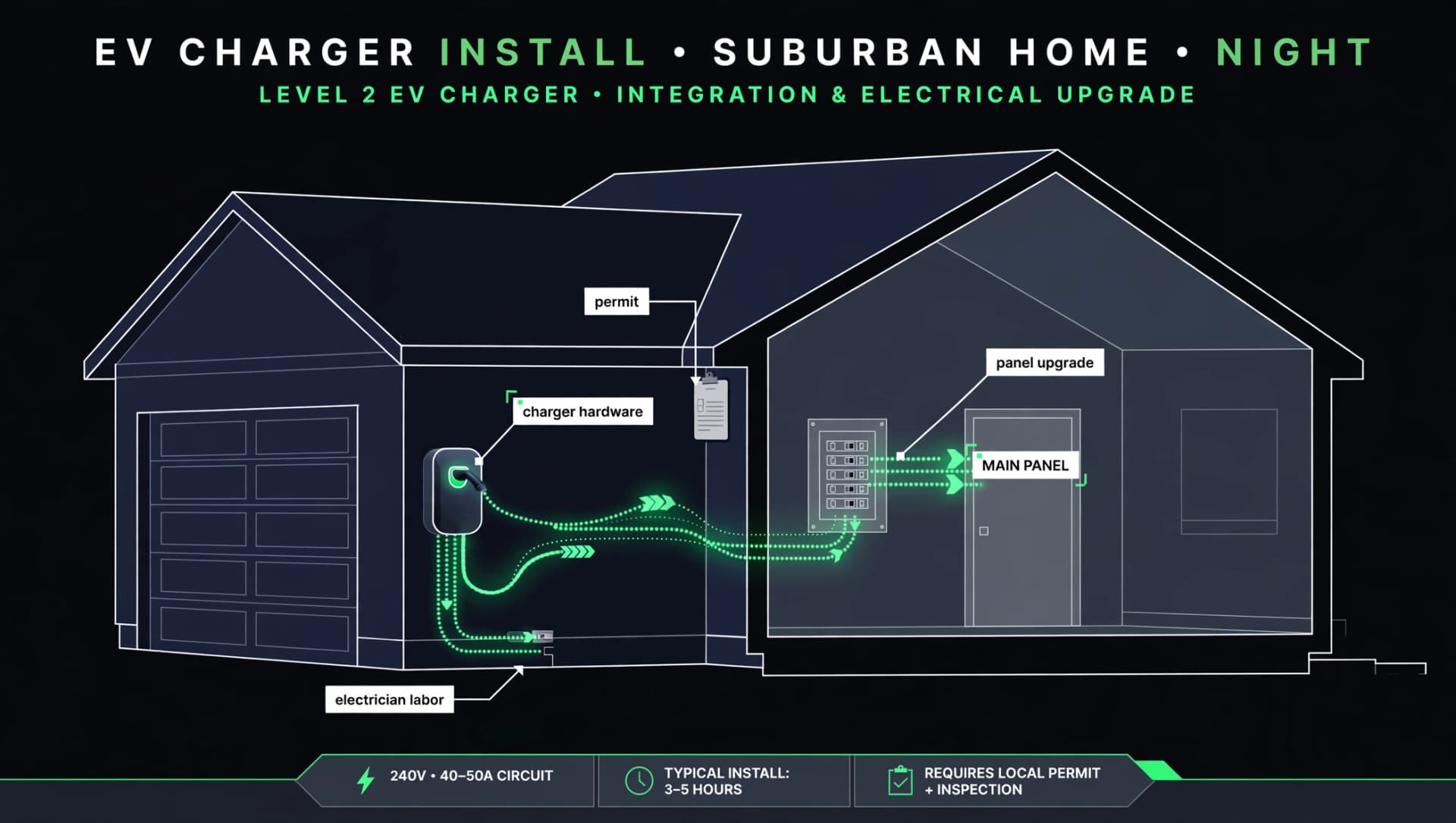
- A standard Level 2 home charger installation runs $749–$2,500 nationally, averaging about $1,700 — and the charger hardware is often the cheapest line on the invoice.
- The 30% federal tax credit (up to $1,000) expired for chargers placed in service after June 30, 2026. Utility and state rebates are now the main help available.
- Your electrical panel decides the final bill: upgrades add $1,500–$5,000 or more, and roughly one in five homes needs electrical work beyond a basic install.
Level 2 EV charger: A 240-volt home charging station — the same voltage as a clothes dryer — that adds roughly 25 to 40 miles of range per hour, five to ten times faster than a standard 120-volt wall outlet. It is how the overwhelming majority of everyday EV charging gets done.
Ask three electricians what a level 2 ev charger installation costs in 2026 and you may get three wildly different answers — sometimes thousands of dollars apart. That confusion is not an accident. The price of the charger itself is the most predictable part of the job; everything else depends on your panel, how far it sits from your parking spot, and whether your town wants a permit pulled. With EV sales hitting records in 2026, more homeowners than ever are getting their first quote — and discovering that the $449 box in the online store is only the beginning.
This guide lays out what US homeowners actually pay in 2026, line by line: hardware, labor, permits, and the panel upgrades that turn a $1,200 job into a $4,000 one. Every figure below comes from installer data and cost guides published this year — and it accounts for the biggest change of all: the federal tax credit that used to shave 30% off the bill is gone.
On this page
- Level 2 EV charger installation cost in 2026: the national numbers
- What you are actually paying for
- Charger hardware: what the box itself costs
- The panel question: do you need an electrical upgrade?
- Permits and inspections: the paperwork contractors fight over
- Plug-in outlet or hardwired?
- The 30% federal credit is gone: what that changes
- Why it matters: the math still works, just differently
- How to get three honest quotes
- Frequently asked questions
Level 2 EV charger installation cost in 2026: the national numbers
Two national installer networks published fresh pricing in March 2026, and their ranges anchor everything else. Qmerit, the installer network used by several automakers, put a standard install at $749 to $2,500 with an average of $1,700 — without specifying whether that includes the charger itself. A second installer, Treehouse, quoted $1,500 to $2,750 to “purchase and install” a charger the same month. An independent cost guide updated in April 2026 lands in the same zone: most homeowners pay $900 to $2,200 all-in, including hardware, electrician labor, and permits.
The headline ranges hide the real story, which is how much the layout of your house matters. The same guide breaks the job into scenarios, and the spread is dramatic:
- Panel in or next to the garage, with spare capacity: $750–$1,300 total. This is the best case — a short wire run and an afternoon’s work.
- Panel on the opposite side of the house: $1,150–$2,100. Every extra 25 feet of wire run adds roughly $150–$300 in labor and materials.
- Panel upgrade required (common in older homes): $2,450–$5,200. The upgrade dominates the bill.
- Detached garage needing trenching: $2,950–$6,700. Digging a trench for conduit is the most expensive common scenario.
Put the line items in one place and the anatomy of the bill becomes clear:
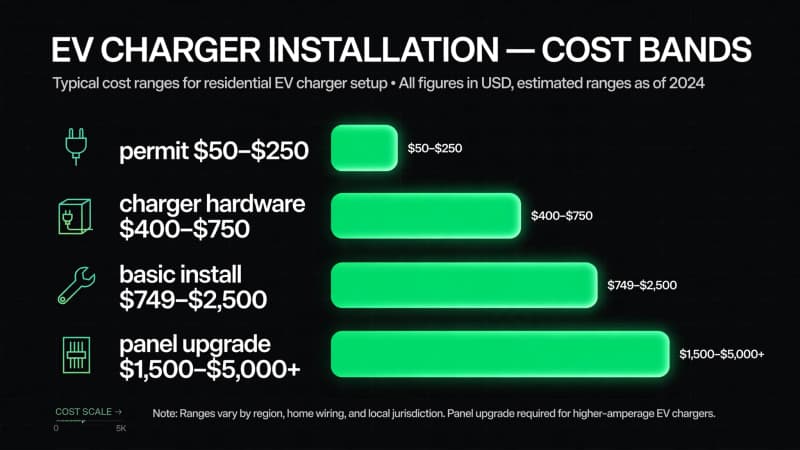
| Cost band | Typical range | What moves it |
|---|---|---|
| Charger hardware | $400–$750 | Amperage, smart features, brand |
| Basic install (labor, wire, breaker, permit) | $749–$2,500 (avg. ~$1,700) | Distance from panel, local labor rates |
| Panel or service upgrade | $1,500–$5,000+ | 100A→200A service, sub-panel vs. full replacement |
| Permit and inspection | $50–$250 (some areas up to $800) | Municipality; quoted separately by some installers |
Qmerit’s own data adds a useful rule of thumb: about 20% of homes need additional electrical work beyond a basic installation. One in five — worth keeping in mind before you budget the average.
What you are actually paying for
A Level 2 install has five components, and only one of them is the charger. The independent guide itemizes them as: the EVSE unit itself ($400–$750); the breaker and wire ($80–$250, typically a 40A or 50A double-pole breaker with 6 AWG copper); conduit and mounting hardware ($50–$200); electrician labor ($300–$1,500, or 2 to 10 hours depending on run length); and the permit and inspection ($50–$250). The labor line is where quotes diverge most — it is also the line most worth interrogating.
This breakdown explains the quote chaos homeowners report. Two electricians can look at the same garage and see different jobs: one prices a four-hour surface run, the other prices a full day with attic work and a permit application. Neither is necessarily dishonest; they are just solving different versions of the problem. The fix is to make them solve the same one — more on that in the quotes section below.
Charger hardware: what the box itself costs
Hardware prices checked on October 11, 2026 show how commoditized the basic units have become: Emporia’s Classic sells for $449 with a J1772 plug or $479 with the Tesla-style NACS plug, Tesla’s Wall Connector is $585, and Tesla’s Universal Wall Connector — which adds a built-in J1772 adapter for non-Tesla EVs — is $660. The April cost guide’s model table shows the same shape: budget 40A units like the Grizzl-E Classic at $460, mid-range smart chargers like the ChargePoint Home Flex ($699) and Wallbox Pulsar Plus ($649), and value picks like the 48A Emporia at $399.
Higher amperage means faster charging but also thicker, pricier wiring. A 40A charger (drawing 32A continuous) delivers about 30 miles of range per hour — enough to refill most commutes overnight. Stepping up to 48A only matters if you drive more than 150 miles a day or share one charger across two EVs. And here is the detail many buyers miss: the car sets the ceiling, not the charger. Tesla’s own documentation notes that several Model 3 and Model Y variants max out at 32A (7.7 kW), so a 40A circuit gives those cars everything they can use. How quickly a battery can accept charge depends on its chemistry and onboard hardware — our explainer on EV battery chemistries walks through why that ceiling exists.
If you are cross-shopping new EVs to go with the charger — from Volkswagen’s 600-km ID. Tiguan to Jaguar’s 1,015-hp Type 01 GT — check the vehicle’s maximum AC charge rate before paying for a bigger circuit. The cheapest way to overspend on this project is to buy charging speed your car cannot use.
The panel question: do you need an electrical upgrade?
This is the swing factor, and it deserves its own section because it is where $1,700 jobs become $4,000 jobs. A 48A charger needs a dedicated 60A circuit, which means your panel needs 60A of spare capacity after existing loads are counted. Warning signs: a pre-1980 home with a 100A panel, a panel already near capacity, no free breaker slots, or a house running central AC, an electric dryer, and an electric range at once.
A full upgrade from 100A to 200A service typically costs $2,000–$4,500, including the new panel, meter base, permit, and utility coordination. Qmerit puts the panel-upgrade adder at $1,500–$3,000; Treehouse at $1,500–$5,000 and up. A field guide published this summer breaks the ladder down further: a simple circuit addition $500–$1,500, a sub-panel $800–$2,000, a full panel replacement $1,500–$4,000, and a complete service upgrade reaching $5,000 or more.
But an upgrade is not always mandatory, and this is where 2026’s best cost-saving trick lives. The National Electrical Code allows a charger with automatic load management to be counted at its capped load rather than its full rating — the 2023 code states that where an energy management system provides load management, “the maximum equipment load on a service and feeder shall be the maximum load permitted by the EMS.” In plain terms: a charger that throttles itself when the oven and dryer are running can legally live on a panel that could not otherwise host it. Tesla’s Wall Connector has this built in, letting installers dial the output down to fit the existing service. A 24A install on a 30A circuit still delivers 20+ miles of range per hour — plenty for daily driving — and can dodge a $3,000 upgrade entirely. Ask your electrician about load management before you authorize a panel replacement; many will not volunteer it.
Permits and inspections: the paperwork contractors fight over
The strangest cost story of 2026 is not about money at all — it is about permits. An Indiana homeowner who collected three electrician quotes in October found that two companies first agreed to pull a permit, then refused on the job — with master electricians dismissing the $600–$700 installation as a job that “will never be inspected” and insisting “there’s no need to pull a permit,” even though the homeowner believed local code required one.
The permit itself is cheap — usually $50–$250, though Qmerit notes some jurisdictions charge up to $800, averaging about $310. The value is not the paper; it is what the paper protects. Unpermitted electrical work can complicate an insurance claim after a fire and get flagged by buyers and inspectors at resale. As one commenter on the homeowner’s Reddit thread put it: “the risk and consequences of not having a required permit is yours.” The practical fix endorsed across the thread: verify requirements directly with your local permitting office — a phone call or a look at the permits website — rather than taking any contractor’s word as final. If an electrician refuses to permit a job your town requires, that is information about the electrician, not the permit.
Plug-in outlet or hardwired?
A NEMA 14-50 outlet — the four-prong 240V receptacle an electric range uses — sounds like the flexible option: the charger plugs in, and you can take it when you move. Since the 2020 electrical code, it carries a catch. Code requires GFCI protection on receptacles installed for EV charging, but the charger already has GFCI protection built in — and the two devices watching the same circuit can “double-trip” on harmless leakage, cutting power for no reason. ChargePoint’s own installation guide tells electricians to fit a non-GFCI breaker and, where local code insists on one, recommends hardwiring instead.
Hardwiring removes the receptacle and with it the receptacle rule. Qmerit notes it is often cheaper than the outlet route because it skips the expensive GFCI breaker, and Tesla’s Universal Wall Connector does not offer a plug-in option at all. The outlet still has genuine advantages — portability for renters, and a charger that moves with you at sale — but if you go that route, insist on a commercial-grade receptacle rated for continuous EV loads; cheap dryer outlets are a known melt risk. And if you want the full 48A with the fewest headaches, hardwire it.
The 30% federal credit is gone: what that changes
Until this summer, the Alternative Fuel Vehicle Refueling Property Credit (Section 30C of the tax code) covered 30% of charger and installation costs, up to $1,000 per residence. The One Big Beautiful Bill Act (P.L. 119-21) moved the credit’s sunset from 2032 to June 30, 2026: per the IRS Form 8911 instructions revised in December 2025, “you can’t claim the credit for alternative fuel vehicle refueling property placed in service after June 30, 2026.” The date that matters is when the charger was energized and ready to use — not when you bought the box. A unit the electrician powered up on June 28 can still be claimed on the 2026 return; one energized July 2 cannot.
Two details make the loss smaller than the headline suggests. First, the credit never applied everywhere: property placed in service after 2022 only qualified in eligible low-income or non-urban census tracts. Second, the $1,000 cap meant that even applied to every dollar of Qmerit’s $1,700 average install, the credit topped out near $510 — real money, but not the difference between doing the job and skipping it. The practical warning for 2026 shoppers: installer guides have gone stale unevenly. A September survey of nine top-ranking guides found one still advertising the credit with no end date and one calling it current — if a quote arrives with “30% federal credit” on it, the quote is out of date.
What is left is local. Utilities and states now carry the incentive load: Puget Sound Energy, for example, offers up to $300 for a qualifying smart Level 2 charger, rising to $600 plus up to $2,000 toward installation costs for income-qualified households. Programs vary wildly by utility, most require the charger to be on an approved list and installed professionally, and application windows can be as short as 60 days after installation. The Department of Energy’s Alternative Fuels Data Center keeps a searchable list of state and utility programs — check your utility’s EV page before you schedule the install, not after.
Why it matters: the math still works, just differently
Here is the comparison that decides whether the installation is worth it: once the charger is in, home charging is dramatically cheaper than every alternative. At the average US residential rate of $0.16/kWh, a Level 2 charger fills 100 miles for about $4.57; off-peak rates cut that to $2.29. Public Level 2 runs $7.14–$12.86 per 100 miles, DC fast charging $10.00–$17.14, and gasoline at 30 MPG and $3.80 a gallon costs $12.67. For a 12,000-mile-a-year driver, charging at home saves $900–$1,400 a year versus relying on public fast charging alone — meaning even a $1,700 installation pays for itself in one to two years. Expect the electricity itself to add roughly $30–$70 a month to the bill, halved on an EV-specific off-peak rate.
That payback math is why the install decision matters at national scale. Department of Energy EVGrid Assist data projects home Level 1 and Level 2 chargers will handle 80% of all EV charging by 2030, with the National Renewable Energy Laboratory estimating 33 million EVs on US roads that year. The garage is where the energy transition actually plugs in — and the same decade pushing battery technology forward, from solid-state prototypes to ever-cheaper LFP packs, is quietly turning the humble breaker panel into grid infrastructure. The charger on your garage wall is a small piece of that; pricing it correctly is the first step.
How to get three honest quotes
The single most repeated advice across every 2026 cost guide is also the simplest: get three itemized bids, and have the electrician assess your panel before you budget. Itemized matters — a lump-sum “$2,000” tells you nothing, while a bid split into hardware, wire and breaker, labor hours, and permit lets you compare like with like and spot the outlier. Ask each bidder the same four questions: Do you pull the permit and schedule the inspection? What does the load calculation say about my panel — and would a load-managed or lower-amperage setup avoid an upgrade? Is the quote for hardwired or plug-in, and why? And which utility rebates does this setup qualify for?
Then sanity-check the answers against the bands in this guide. A basic install quoted at $4,000 with no panel work deserves a follow-up question; a $600 quote with no permit on a job your town requires deserves a different electrician. The market is efficient enough that three comparable, itemized bids will cluster — and the cluster is the truth.
Frequently asked questions
How much does it cost to install a level 2 charger at home?
National installer data from March 2026 puts a standard installation at $749–$2,500, averaging about $1,700, with charger hardware ($400–$750) on top or bundled depending on the quote. An independent cost guide puts the typical all-in range at $900–$2,200. Panel upgrades add $1,500–$5,000 or more, and detached garages needing trenching can reach $3,000–$6,700.
Do I need a permit to install an EV charger?
Almost always yes — most municipalities require a permit and inspection for a new 240V circuit, typically costing $50–$250. Some contractors may tell you it is unnecessary; verify directly with your local permitting office. Unpermitted work can complicate insurance claims and home sales, and utility rebates generally require inspection sign-off.
Do I need a panel upgrade for a home EV charger?
Not necessarily. About one in five homes needs extra electrical work, but a full 100A-to-200A upgrade ($2,000–$4,500) is only required when the panel truly lacks spare capacity. Ask about load management first: chargers that throttle themselves during peak household demand can legally be counted at their capped load, and a lower-amperage setup (e.g. 24A on a 30A circuit) fits most older panels while still adding 20+ miles of range per hour.
What is the average cost to install a Level 2 EV charger?
Qmerit’s March 2026 national figure — $1,700 average within a $749–$2,500 range — is the most-cited benchmark. Treat it as a midpoint for a straightforward install with no panel work, not a quote: distance from the panel, local labor rates, and permit fees move real prices more than the charger brand does.
Can I still claim the federal tax credit on a charger installed in late 2026?
No. The 30% Alternative Fuel Vehicle Refueling Property Credit (Section 30C, up to $1,000) ended for property placed in service after June 30, 2026, when the One Big Beautiful Bill Act moved the sunset forward from 2032. If your charger was energized on or before June 30 and sits in an eligible census tract, you can still claim it on your 2026 return via IRS Form 8911. For new installs, look to utility and state rebates instead.