- About 95,000 metric tons of spent nuclear fuel sits at nearly 75 sites across the United States, and the total will roughly double to 180,000 tons by the time today’s reactors retire.
- Every fuel assembly starts in a water pool for at least five years, then moves to a passively cooled dry cask that needs no fans or pumps.
- Finland licensed the world’s first permanent repository in October 2026. The United States still has no operating one, and its inventory already exceeds Yucca Mountain’s 70,000-ton legal cap.
Spent nuclear fuel: The uranium fuel assemblies removed from a reactor after they can no longer sustain an efficient chain reaction. The fuel still contains most of its original uranium, plus plutonium and fission products created in the reactor, so it stays hot and radioactive for thousands of years and needs shielding, cooling and isolation from people and the environment for far longer than any reactor operates.
Spent nuclear fuel storage follows a two-step routine that has barely changed in four decades. A fuel assembly leaves the reactor core, cools underwater for years, and then moves into a steel and concrete cask that sits on a concrete pad and cools itself with nothing but moving air. The routine works. The part that does not work is the ending. After the cask comes the question of a permanent home, and the United States has never built one for commercial spent fuel. Finland has now moved first, with an operating licence for its Onkalo repository granted in October 2026, according to the World Nuclear Association.
The scale of the backlog explains why the question matters now. The US Department of Energy puts the current inventory at about 95,000 metric tons, stored at close to 75 sites in more than 30 states, and projects roughly 180,000 metric tons by the time the current reactor fleet reaches the end of its life. About 4,300 dry storage systems have been loaded so far, against a final projected total above 10,000. Every year adds roughly 2,000 metric tons more. The storage system has absorbed all of it without a known radiation release affecting the public since casks were first loaded in 1986, according to the Nuclear Regulatory Commission. The open question is how long a temporary system can carry a permanent problem.
Spent Nuclear Fuel Storage Starts in a Pool
A reactor runs on bundles of uranium pellets sealed inside metal rods, grouped into assemblies. Over time the fuel becomes less able to sustain a chain reaction, and about one-third of the fuel in a reactor is replaced at each refuelling. The reaction is stopped before the spent fuel is removed, but the fuel still produces a lot of radiation and heat that must be managed. That is why the first stop is always water.
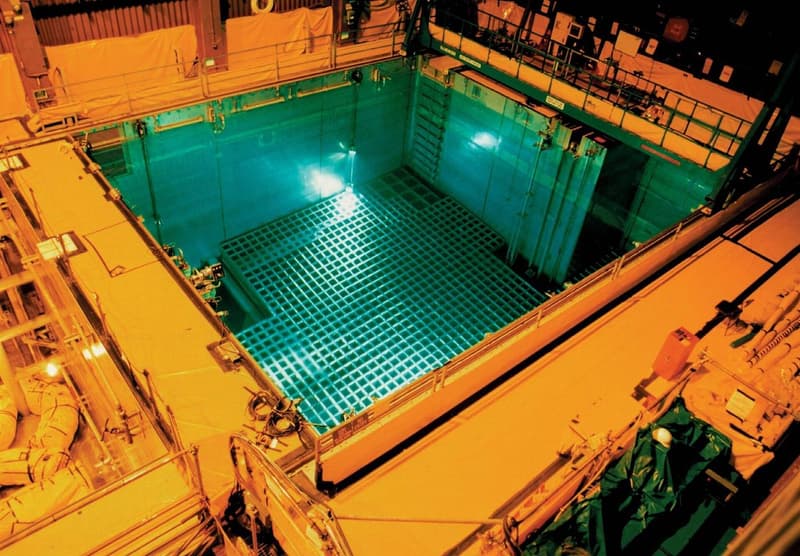
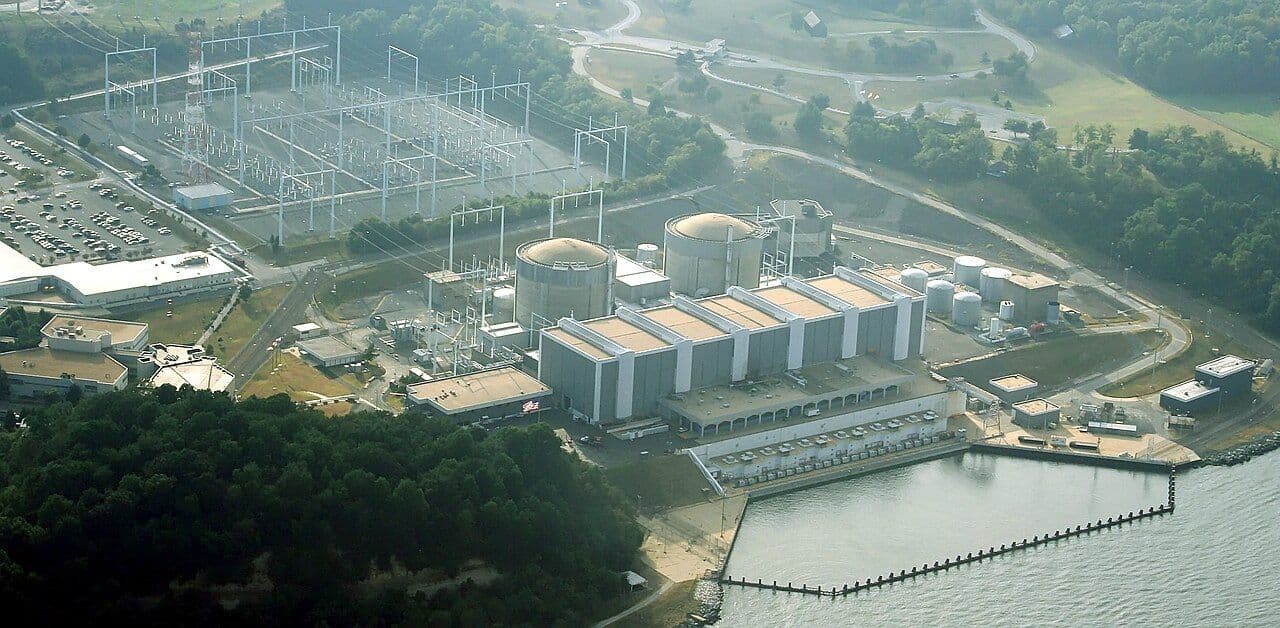
Every reactor site has at least one spent fuel pool, and the pools are built for the job. The Nuclear Regulatory Commission describes pools that sit inside the plant’s protected area, hold an enormous amount of water for cooling and radiation shielding, and carry about 20 feet of water above the top of the fuel. That depth gives operators time to correct a problem if water levels fall. The pools have no drains that would let the water escape, walls of thick steel-reinforced concrete with stainless steel liners, and in some plants a location below ground level or behind structures that shield the pool from an aircraft impact or other strike.
Standard practice keeps fuel in the pool for at least five years before a move to dry storage. The water does two jobs at once: it carries heat away from the assemblies, and it blocks radiation. A worker standing beside a pool sees blue water and steel racks. The hazard is invisible, and the water is the shield. Pool storage also has a capacity problem. Pools were designed to hold the fuel a plant produces over its operating life, and many have filled up as plants ran longer than planned. Oak Ridge National Laboratory reports that roughly two-thirds of US spent fuel assemblies remain in pools, with the rest in dry storage. As pools reach their limits, utilities move older and cooler fuel into casks to make room for fresh discharges.
The Fukushima accident in March 2011 changed how pools are monitored in the United States. The Nuclear Regulatory Commission studied how a spent fuel pool at a US reactor similar to Fukushima would respond to an earthquake far stronger than the one that struck Japan, then ordered licensees to install additional instruments to monitor water levels and to develop ways to maintain or restore pool cooling in an emergency. After September 11, 2001, the Commission also upgraded protection requirements for storage facilities, including the ability to detect and stop an intrusion. No known or suspected attempt to sabotage a spent fuel storage facility has been recorded.
Dry Casks Take Over After Five Years
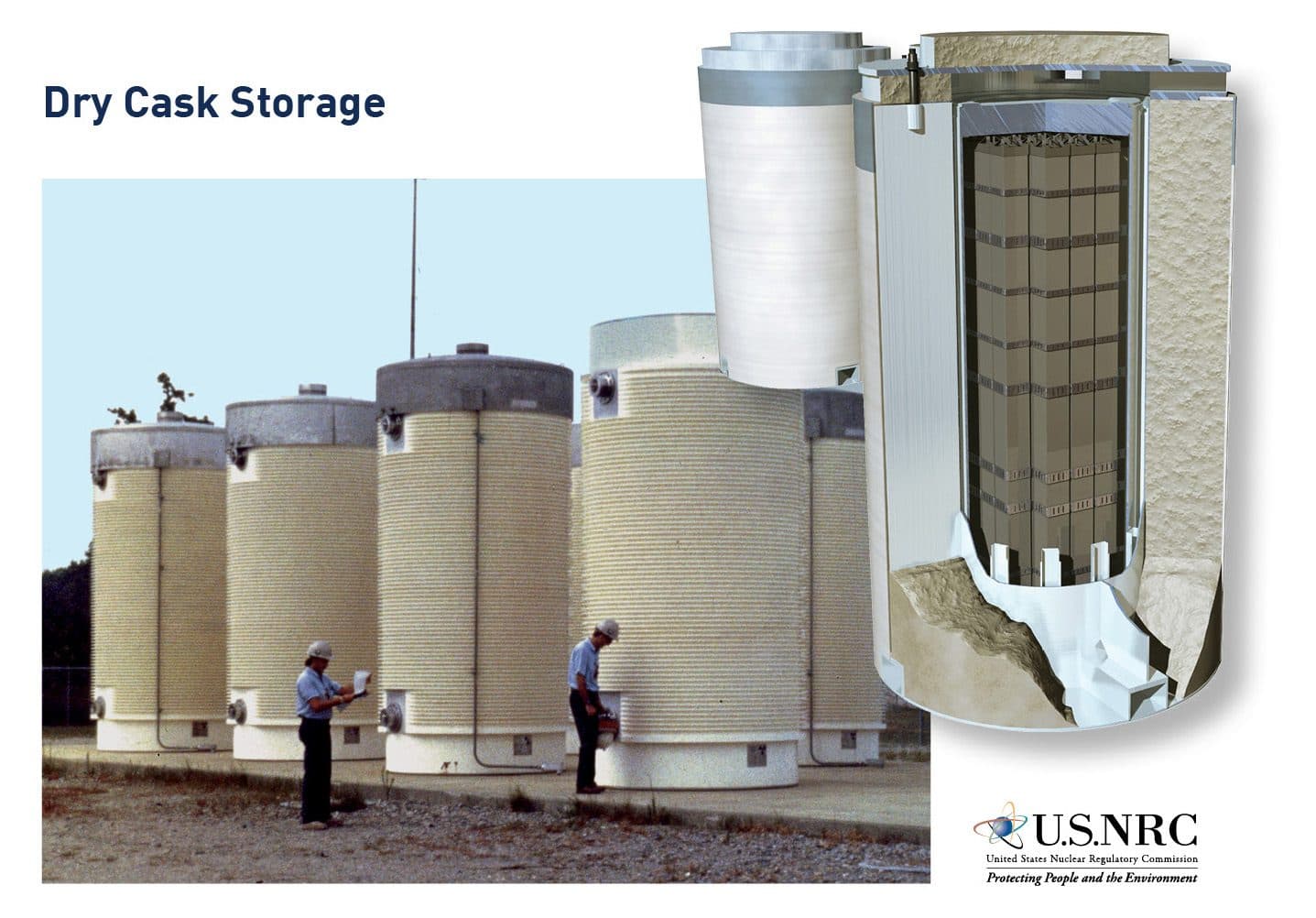
Once fuel has cooled for five years or more, it can move to dry storage. The Nuclear Regulatory Commission allows plants to store spent fuel on site in approved dry storage casks, and the World Nuclear Association reports that at least one-third of all US used fuel is now held that way. The casks sit inside the plant’s protected area, on concrete pads, in rows that look from a distance like oversized silos.
A dry cask is a layered container. The outer shell is very thick metal or steel-reinforced concrete, and inside it sits a sealed inner metal cylinder holding the fuel assemblies. Some systems use sealed steel casks or multi-purpose canisters that hold up to 89 fuel assemblies each in inert gas, enclosed in a ventilated concrete and steel module about 6 metres high. The design must resist floods, earthquakes, tornadoes, projectiles and temperature extremes, prevent any release of radiation, prevent a fission reaction from restarting, and manage heat with materials that withstand radiation, heat and corrosion.
The cooling is entirely passive. Fresh air enters at the bottom without fans or pumps, and heated air rises through vents at the top. A typical cask emits roughly the same heat as a home heating system, according to the Nuclear Regulatory Commission, and individual casks carry heat loads up to 45 kW, according to the World Nuclear Association. There is no powered system to fail. That simplicity is the point. A cask needs no electricity, no operator action and no moving parts to keep its fuel cool.
The regulator’s confidence rests on inspection and testing rather than on the design alone. Commission inspectors review vendor submittals, inspect the design, construction and use of storage equipment, and observe dry runs of handling procedures before a system is loaded. Periodic testing and analysis have shown that spent fuel and cask components perform as predicted after years of dry storage, and that the potential health risks from loading and storing fuel in dry casks are very small. The record the Commission cites is plain: no known radiation releases have affected the public since casks were first loaded in 1986.
Dry storage was first licensed for 40 years for high burnup fuel, the fuel that stays in a reactor longer to extract more energy before discharge. The Department of Energy started a research project in 2014 with the Electric Power Research Institute to test whether high burnup fuel can stay in dry storage beyond that initial period. A research cask was loaded at the North Anna Power Station in Virginia, and 62 US nuclear power plants now reference the project in their storage facility licences. The answer matters because the fuel now being loaded will need to stay put for decades longer than the first casks were licensed for.
How Much Spent Fuel the United States Holds
The numbers behind the storage system are large and still growing. The table below gathers the figures the Department of Energy, Oak Ridge National Laboratory and the World Nuclear Association publish for the US and global inventories.
| Measure | Value | Source |
|---|---|---|
| US commercial spent fuel inventory today | About 95,000 metric tons | US Department of Energy, April 2025 |
| Projected US inventory at end of current fleet life | About 180,000 metric tons | US Department of Energy, April 2025 |
| US sites holding spent fuel | Close to 75 sites in more than 30 states | US Department of Energy, April 2025 |
| New spent fuel discharged each year | About 2,000 metric tons | Oak Ridge National Laboratory |
| Dry storage systems loaded so far | About 4,300 | US Department of Energy, April 2025 |
| Projected dry storage systems at fleet end of life | More than 10,000 | US Department of Energy, April 2025 |
| Spent fuel discharged worldwide | About 430,000 tonnes | International Atomic Energy Agency via World Nuclear Association |
| Share of global spent fuel reprocessed | About 30 percent | International Atomic Energy Agency via World Nuclear Association |
Three calculations from those figures put the trajectory in perspective, and each is Joule Post arithmetic from the cited numbers. First, the US inventory roughly doubles: 180,000 minus 95,000 is 85,000 additional metric tons, an increase of about 89 percent over today’s stockpile. Second, the cask count is less than halfway there: 4,300 loaded systems against a projected total above 10,000 means about 43 percent of the eventual dry storage fleet is in place. Third, the annual discharge of about 2,000 metric tons adds roughly 2.1 percent to the current inventory every year, so the stockpile grows by about a fifth each decade even if no new reactor is built.
The global picture runs on the same pattern at a larger scale. The International Atomic Energy Agency estimates that about 430,000 tonnes of spent fuel has been discharged worldwide, with around 30 percent reprocessed. That leaves roughly 301,000 tonnes in storage as waste, by Joule Post arithmetic. Countries that reprocess, including France, Russia and Japan, recover uranium and plutonium for reuse and vitrify the remaining high level waste into glass for eventual disposal. The United States does not reprocess commercial spent fuel, so its full inventory stays in pools and casks.
High level waste is a small share of the volume and nearly all of the hazard. The World Nuclear Association reports that high level waste accounts for just 3 percent of the volume of all radioactive waste but 95 percent of the total radioactivity. That ratio is why the storage system is engineered the way it is: a small amount of material, shielded heavily, cooled continuously, and watched for decades.
Finland Opens the First Permanent Repository While the US Waits
Storage is a delay, and the industry’s own guidance says the delay should last about 50 years. The World Nuclear Association notes that the radioactivity of the waste decays with time, providing a strong incentive to store high level waste for about 50 years before disposal, by which point its heat and radioactivity have fallen by more than 99 percent. After that, the widely agreed destination is deep geological disposal: sealed tunnels or boreholes hundreds of metres underground in stable rock, where the waste stays isolated from groundwater and the surface for thousands of years.
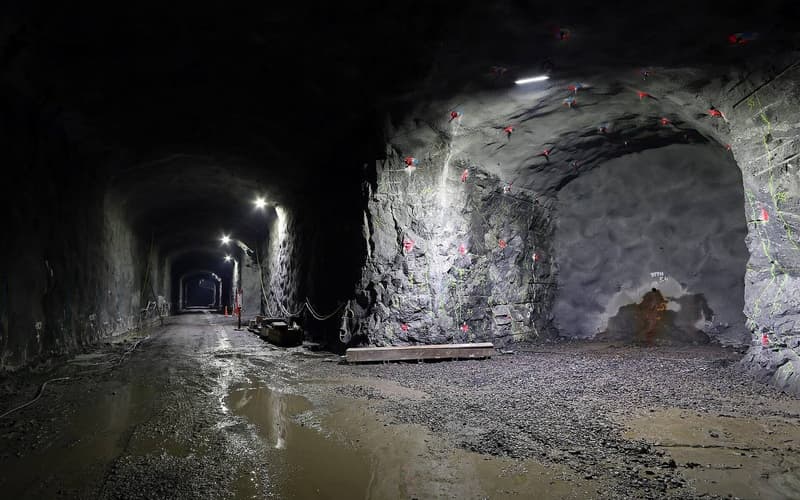
Finland is the first country to reach that destination. Its Onkalo repository, built into bedrock at Olkiluoto, was granted an operating licence by the Finnish government in October 2026, according to the World Nuclear Association’s November 2026 update. Sweden has a similar repository advancing through licensing, and France has selected a site at Bure. The United States has one operating deep repository, the Waste Isolation Pilot Plant in New Mexico, but it takes defence transuranic waste from the weapons programme, not commercial spent fuel.
The American repository story stopped at Yucca Mountain in Nevada. The Department of Energy investigated the site for decades and submitted a detailed licence application to the Nuclear Regulatory Commission in 2008. The project was then defunded, the licence review was suspended, and no permanent repository for commercial spent fuel has operated in the United States since.
The legal arithmetic makes the gap sharper. The Yucca Mountain repository was capped by law at 70,000 metric tons of heavy metal. Today’s inventory of about 95,000 metric tons already exceeds that cap by about 25,000 metric tons, or roughly 36 percent, by Joule Post arithmetic from the Department of Energy inventory and the Environmental Protection Agency’s repository limit. Even if Yucca Mountain were revived tomorrow, it could not hold what the country already has, let alone the 180,000 tons projected by the end of the current fleet’s life. Any permanent solution needs either a larger repository, a second one, or a change in the law.
What 95,000 Tons With No Repository Means for New Reactors
The storage system works, and that success creates a policy problem. Because pools and casks have absorbed 95,000 tons without a public radiation release, there is little day-to-day pressure to finish a repository. The fuel sits quietly on concrete pads at plants that have already closed, in some cases the only thing left at the site. A 2012 Congressional Research Service report counted nine US storage sites holding fuel with no operating reactor at all — so-called stranded fuel that stays because there is nowhere else to send it.
That quiet creates three costs that rarely appear in the debate over new reactors. The first is money. Under the Nuclear Waste Policy Act of 1982, the government promised to start taking spent fuel by January 31, 1998. Utilities paid about US$750 million a year into the Nuclear Waste Fund, US$16.3 billion over 25 years, and the Congressional Budget Office reported in 2009 that the government had already paid US$565 million in compensation for missing the deadline, with total liabilities estimated above US$12 billion. The bill grows with every year of delay. The second is land. Each decommissioned plant that keeps its fuel cannot fully return its site to other uses, and the casks occupy pads that were meant as a stopgap. The third is trust. Communities asked to host new reactors, including the small modular reactors now in development, reasonably ask where the waste will go, and the honest answer for 40 years has been that nobody has decided.
Finland’s licence changes the argument from whether a repository can be built to whether a country is willing to build one. Onkalo uses the same approach the United States studied at Yucca Mountain: copper canisters in bentonite clay, placed in tunnels deep in stable bedrock. The engineering was never the blocker. The blocker was a political process that could not sustain a decision across decades and administrations. For readers following the thorium reactor debate and the wider nuclear revival, that distinction matters: the fuel cycle problem is solved on paper and demonstrated in Finland, and unsolved in practice in the United States.
The near-term outlook is more of the same storage, done well. Utilities will keep loading about 200 casks a year, the dry share of the inventory will keep rising past one-third, and the research cask at North Anna will keep producing data on how high burnup fuel ages. The Studsvik deal to manage Norway’s legacy spent fuel shows the same pattern in miniature: a multi-billion contract to handle fuel that has waited decades for a final destination. None of this is a crisis. It is a bill coming due slowly, at about 2,000 tons a year, in steel and concrete, on pads that were supposed to be temporary.
Frequently asked questions
Where does nuclear waste go?
Spent fuel from US commercial reactors goes first into a water pool at the reactor site for at least five years, then into a passively cooled dry cask on a concrete pad at the same site. There is no operating permanent repository for commercial spent fuel in the United States. Finland licensed the world’s first one, Onkalo, in October 2026.
Is spent fuel stored safely?
The Nuclear Regulatory Commission reports no known radiation releases affecting the public since dry casks were first loaded in 1986. Pools and casks are inspected and monitored continuously, and casks are designed to resist floods, earthquakes, tornadoes and projectiles while cooling passively with no fans or pumps.
What is the difference between a spent fuel pool and a dry cask?
A pool stores fuel underwater, where the water provides both cooling and radiation shielding. A dry cask stores fuel that has already cooled for at least five years in a sealed metal cylinder inside a thick concrete or steel shell, cooled by air moving naturally through vents. Pools need active water systems. Casks need none.
How long does spent fuel stay radioactive?
Some fission products decay within decades, but plutonium and other actinides remain radioactive for thousands of years. That is why the industry stores high level waste for about 50 years to let heat and radioactivity fall by more than 99 percent before placing it in a deep geological repository.
What happened to Yucca Mountain?
Yucca Mountain in Nevada was studied for decades as the US permanent repository, and a licence application was submitted in 2008. The project was then defunded and the licence review suspended. Its legal cap of 70,000 metric tons is already below the current US inventory of about 95,000 metric tons.
Sources
- Backgrounder on Storage of Spent Nuclear Fuel, US Nuclear Regulatory Commission, last reviewed October 30, 2024
- Storage and Disposal of Radioactive Waste, World Nuclear Association, updated November 2, 2026
- Radioactive Waste Management, World Nuclear Association, updated November 22, 2025
- High Burnup Research Cask Project fact sheet, US Department of Energy, April 2025
- Spent Nuclear Fuel Characterization, Oak Ridge National Laboratory
- The Federal Government’s Responsibilities and Liabilities Under the Nuclear Waste Policy Act, Congressional Budget Office, July 16, 2009