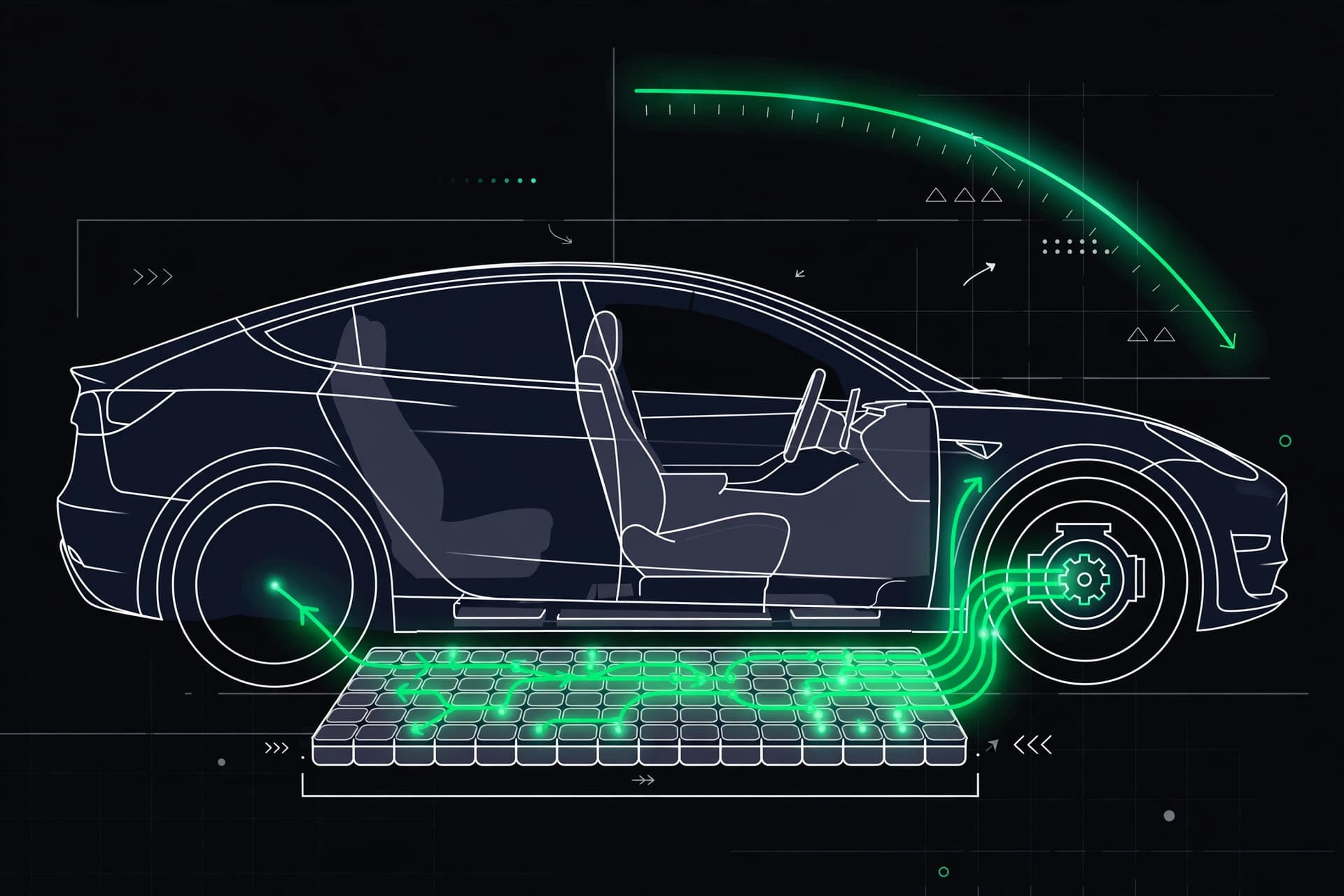
- Geotab’s 2026 study of more than 22,700 EVs across 21 models found average battery degradation of 2.3% per year, projecting 81.6% state of health after eight years and roughly 13 years before reaching the 70% warranty threshold.
- How you charge dominates the outcome: vehicles with fewer than 12% of sessions on DC fast charging degrade at 1.5% per year, versus 3.0% for heavy fast-chargers. Recurrent’s data puts replacement at just 0.3% for 2022-and-newer models, down from 8.5% in the first generation.
- The two moves that matter: do most of your charging on AC at home and keep DC fast charging rare, and track your battery’s state of health, not the range number on the dashboard.
EV battery lifespan: The number of years a car battery keeps enough capacity for normal driving: about 12 to 15 years in moderate climates, per the US Department of Energy. Degradation averages 2.3% a year in 2026 fleet data, meaning most packs outlast the 8-year warranty and rarely need full replacement.
Ask a prospective EV buyer what keeps them up at night and one answer dominates: the battery will die at eight years and the replacement will cost more than the car. That anxiety is understandable, but according to the largest real-world datasets ever collected, it is wrong. The question how long do EV batteries last now has a data-backed answer, and it is much kinder than the myth.
The numbers come from Geotab’s 2026 battery-health analysis, which tracked more than 22,700 electric vehicles across 21 models, plus Department of Energy research and Recurrent’s battery-health monitoring of over 30,000 cars. Together they tell a consistent story: modern EV batteries degrade slowly, fail rarely, and their lifespan is largely in the driver’s hands.
The 22,700-car answer: 2.3% a year
Geotab’s headline finding is disarmingly simple. Across its fleet of 22,700 vehicles, the average battery lost about 2.3% of its capacity per year. Run that forward and the typical pack holds 81.6% of its original capacity after eight years, Geotab’s own projection. Compare that with the warranty line: most manufacturers guarantee the battery for 8 years or 100,000 miles with at least 70% capacity retained. At 2.3% a year, a pack starting at 100% reaches 70% after roughly 13 years, five years past the warranty’s end.
That 13-year figure is my projection from the Geotab rate, and it comes with a caveat: real batteries do not degrade in a perfectly straight line. Early research suggests degradation can be slightly faster in the first years and again very late in life. But the independent estimates land in the same place. The Department of Energy estimates today’s EV batteries may last 12 to 15 years in moderate climates, and 8 to 12 years in extreme ones. Two datasets, two methods, one answer.
“Our latest data shows that batteries are still lasting well beyond the replacement cycles most fleets plan for,” said Charlotte Argue, Geotab’s Senior Manager of Sustainable Mobility, in the company’s January 2026 release. And there is an intriguing bonus from Stanford researchers: real-world driving, with its stops, starts and long rest periods, appears gentler on cells than steady lab cycling, potentially stretching battery life up to 40% longer than earlier forecasts assumed.
How long do EV batteries last depends on how you charge
The 2.3% average hides a split that matters more than any other single factor. Geotab divided its vehicles by charging behavior, and the gap is enormous. Cars with fewer than 12% of their charging sessions on DC fast chargers degraded at just 1.5% per year, holding 88% after eight years. Cars where more than 12% of sessions were DC fast charging, with over 40% of those above 100 kW, degraded at 3.0% per year, holding only 76%. Same chemistry, same era of engineering; double the wear.
Heat adds its own tax: vehicles spending over 35% of their days above 25°C degraded about 0.4% per year faster. And the charge-level panic, should I charge to 100%, turns out to be mostly misplaced. Geotab found extreme state of charge only mattered when vehicles spent more than 80% of their time above 80% or below 20%. Moderate exposure barely moved the needle, thanks to the hidden software buffers manufacturers build in: 100% on the dashboard is chemically less than a full charge, and 0% is not chemically empty.
The hierarchy of influence is clear: charging power first, climate second, charge habits a distant third:
| Charging pattern | Annual degradation | Projected health after 8 years |
|---|---|---|
| Mostly AC charging, under 12% DC fast sessions | ~1.5% | ~88% |
| Fleet average (mixed habits) | 2.3% | 81.6% |
| Heavy DC fast charging (over 100 kW) | ~3.0% | ~76% |
| Hot climate (over 35% of days above 25°C) | +0.4% on top | n/a |
The practical takeaway: make AC home charging your default and treat DC fast charging as the road-trip tool it is. For a US homeowner, that usually means a Level 2 charger on a 240-volt circuit (see what a Level 2 home charger actually costs to install in 2026), which also happens to be far cheaper per mile than public fast charging.
What actually wears an EV battery out
Batteries do not age because of one flaw; they age because of a small set of physical processes that all chew on the same thing: the lithium inventory inside the cells. The clearest walkthrough comes from the engineering video that walks through the cell-level causes, which pairs Geotab’s fleet data with a literal cut-open lithium-ion cell.
The biggest culprit is a film called the solid-electrolyte interphase, or SEI. It forms on the graphite anode from day one and keeps slowly growing, consuming lithium that could otherwise be shuttling between electrodes. Then there is cracking: as cells swell and shrink with each cycle, particles in the electrodes fracture, exposing fresh surface where more SEI grows. A third mechanism is lithium plating: when charging is too fast or the battery too cold, lithium deposits as metal on the anode instead of slipping inside the graphite, permanently removing it from circulation. Heat accelerates all of it, which is why thermal management is now the defining difference between battery generations.
Understanding this list explains why the charging data looks the way it does. Fast charging at high power drives plating and heat; gentle AC charging does neither. Cold-weather fast charging is the worst combination. The cells resist accepting charge quickly, and plating risk spikes. None of this requires exotic maintenance to avoid. It requires exactly the boring habits: charge slowly at home, don’t hammer the battery with high-power sessions daily, and park out of brutal heat when you can.
The chemistry split: LFP vs NMC
Not all lithium-ion batteries are the same chemistry, and the split shapes both lifespan and buying decisions. Volkswagen’s ID. Tiguan launch this October shows the industry’s standard division of labor: a 58 kWh lithium-iron-phosphate (LFP) pack for the 450-km entry model and a 77 kWh nickel-manganese-cobalt (NMC) pack for the 600-km flagship.
The trade-off is well documented in our explainer on grid battery chemistries: LFP is cheaper, tolerates heat better and cycles longer, at the cost of lower energy density. NMC packs more energy per kilogram (hence the longer range), but costs more and generally has a shorter cycle life. The ID. Tiguan’s own product split says it plainly: cheaper, longer-lived lithium iron phosphate for the entry car; energy-dense nickel manganese cobalt for the long-range flagship.
| Trait | LFP (lithium iron phosphate) | NMC (nickel manganese cobalt) | |||
|---|---|---|---|---|---|
| Energy density | Lower (~140–160 Wh/kg) | Higher (~200–260 Wh/kg) | |||
| Cycle life | Longer (3,000–7,000 cycles at grid scale) | Shorter (2,000–4,000 cycles) | |||
| Heat tolerance | Better | More sensitive | Typical EV role | Entry models, e.g. ID. Tiguan 450-km | Long-range flagships, e.g. ID. Tiguan 600-km |
For lifespan, the chemistry choice is a genuine fork in the road. All else equal, the LFP car will cycle longer, while the NMC car goes farther per charge. Buyers who keep cars a decade should weigh that explicitly. And on the horizon, solid-state lithium-metal designs like QuantumScape’s PowerBlock are commercializing first in data centers: too expensive and hard to qualify for millions of cars today, but a signal of where the technology is headed.
Why Nissan Leaf batteries degraded faster
No car shaped the battery-anxiety myth more than the original Nissan Leaf, and no car is less representative of today’s EVs. When Nissan shipped the first Leaf in 2010, it went without the active battery-cooling hardware found in newer EVs, per Recurrent’s 2025 study. Those early packs wore down fast enough in hot climates to make headlines, and the reputation stuck to the entire industry.
The generational data tells the real story. Recurrent’s November 2025 update found battery replacement rates of about 8.5% for first-generation EVs like the early Leaf, around 2% for the second generation (early Chevy Bolt, Tesla Model 3), and just 0.3% for vehicles built from 2022 onward, all excluding major recalls. Modern packs add liquid cooling, smarter battery management systems and better chemistries; the DOE’s separate analysis of ~15,000 plug-in vehicles found replacement rates below 1% for every model year from 2016 through 2023. The Leaf problem was a first-generation thermal-management problem, not an EV problem.
Track state of health, not the dashboard number
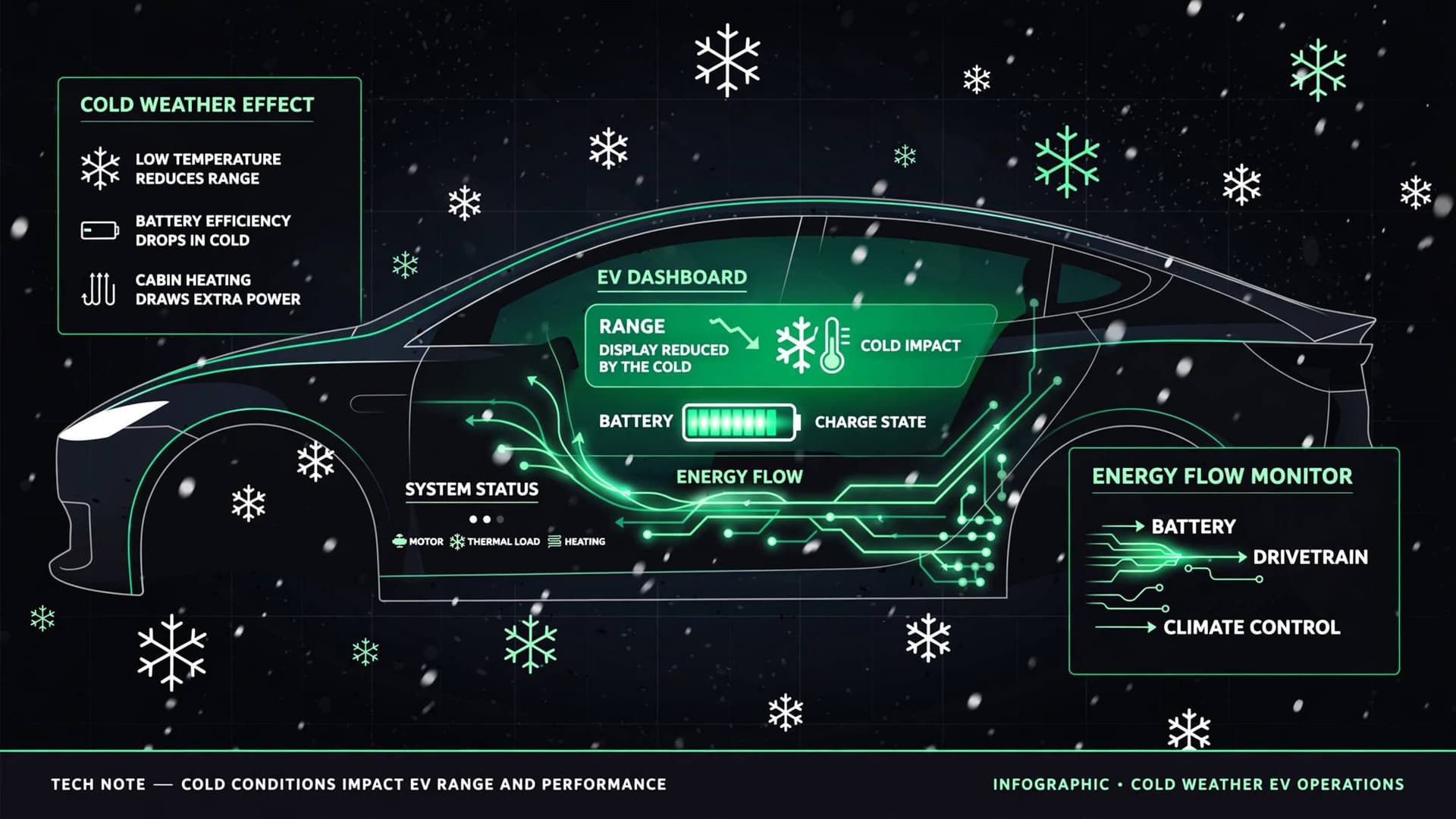
This corrects the most common self-diagnosis error. Battery state of health (SOH) describes how much usable energy the pack holds compared with when it was new. It is the industry’s standard measure of capacity retention. The miles displayed on your dashboard are not that number. Cold weather, cabin heating and cooling, highway speeds, aggressive acceleration, hills and extra weight can all change how far the car travels on a charge (cold alone can produce a noticeable temporary drop) without the battery having degraded at all.
What deserves attention is a persistent decline under comparable conditions: the same commute in similar weather repeatedly using much more battery than it did before. That is when degradation becomes the plausible explanation, and when a battery-health check is worth booking. An EV-qualified service center can read diagnostic codes and battery data to determine whether the car shows ordinary degradation, a repairable fault or a genuine problem. A smaller module repair sometimes turns out to be possible instead of a full-pack replacement.
Warning behavior follows the same logic. A gradual capacity fade is normal aging. A sharp unexplained drop in available range, a new limit on maximum charge or a high-voltage battery alert alongside a dashboard warning deserves prompt professional diagnosis. Some automakers document specific battery alerts. Tesla’s owner documentation, for example, tells drivers to schedule service if a relevant alert persists. The pattern is consistent: gradual loss is aging; sudden change plus warnings is a fault. Do not confuse the two, and do not replace a pack on the strength of a winter range reading.
How often do EV batteries actually get replaced?
With degradation averaging 2.3% a year, full replacement is a rare event, and getting rarer. The DOE analysis of about 15,000 plug-in vehicles found just 1.5% had batteries replaced because of failure, excluding recalls. Recurrent’s broader community tracking puts total replacements under 4% across every model year including decade-old cars, falling to 0.3% for 2022-and-newer models. Recurrent’s researchers concluded the batteries were “holding up better than expected and should outlast the cars themselves.”
When replacement does happen outside warranty, the bill is real: Recurrent’s survey puts many replacements at roughly $5,000 to $16,000, varying with pack size, vehicle design, labor and parts availability. That is why the warranty check comes first. Most manufacturers cover the traction battery separately for 8 years or 100,000 miles, though mileage limits, duration and capacity guarantees vary by model. Given that the typical pack projects a battery lifespan of 13 years before touching 70% health, most owners will sell or retire the car long before the battery needs replacing. Replacement is not a maintenance item; it is an insurance event that almost never triggers.
0.3% Replacements vs. the 8-Year Myth: What the Data Changes
The battery-lifespan myth is not harmless folklore. It is actively distorting the market. A 2025 AutoPacific survey identified fear of expensive battery swaps as the top reason some buyers avoid EVs. That fear is why used EVs trade at a discount and why shoppers overpay for extended warranties they will never use. Compare the anxiety with the data: the story says packs die at eight years; the data says 2022-and-newer models replace packs at 0.3%, the DOE projects 12–15 years of life in moderate climates, and the fleet average needs ~13 years to reach the warranty floor.
This mispricing lands exactly as EV adoption hits its stride. Europe’s record 1.64 million EV sales in the first eight months of 2026 and BMW’s Q3 2026 European surge, where one in three buyers went all-electric, mean millions of new owners will make charging and warranty decisions in the next few years. An owner who understands that gentle AC charging halves their degradation rate gets a longer-lived car for free; an owner who fast-charges daily out of habit pays twice: once at the charger, once in lost capacity. The data is a consumer-protection story disguised as an engineering paper.
The two moves that actually extend battery life
The actionable core is short. First: prioritize AC home charging and keep DC fast charging rare. The Geotab split, 1.5% versus 3.0% annual degradation, is the single largest controllable lever any owner has, worth roughly five extra years above the warranty threshold over the car’s life. A home Level 2 charger makes this the default rather than a discipline.
Second: track state of health, not the dashboard range number. Temporary drops come from cold, speed, HVAC and load. True degradation shows as a persistent decline under comparable conditions. Watch the right metric and you will neither panic over winter nor miss a real fault developing. Do those two things and the data says your battery’s story will be unremarkable: a slow, predictable fade over a decade-plus of service, ending most likely with the car’s retirement, not the battery’s.
Frequently asked questions
How long do EV batteries last in years and miles?
Geotab’s 2026 analysis of 22,700 EVs found 2.3% annual degradation, projecting 81.6% capacity after eight years (strong capacity retention by any measure) and roughly 13 years before reaching the 70% warranty threshold. The DOE estimates 12–15 years in moderate climates. In mileage terms, high-mileage examples regularly exceed 150,000 miles while keeping at least 83% of original range. There is no fixed mileage expiration.
How often do EV batteries need replacement?
Very rarely in modern cars. Recurrent’s November 2025 data shows replacement rates of about 8.5% for first-generation EVs, 2% for the second generation, and 0.3% for 2022-and-newer models, all excluding major recalls. Replacement is an insurance event, not maintenance. Out-of-warranty bills typically run $5,000 to $16,000.
Does fast charging ruin an EV battery?
It does not ruin it, but heavy use measurably accelerates wear. Geotab found cars with over 12% of sessions on high-power DC fast charging degraded at 3.0% per year versus 1.5% for cars charged mostly on AC, double the rate. Occasional fast charging on road trips barely registers; daily high-power sessions are what compound.
Why do Nissan Leaf batteries degrade faster?
The original 2010 Leaf shipped without the active battery-cooling hardware that newer EVs use, so heat accelerated degradation, especially in warm climates. First-generation EVs show ~8.5% battery replacement rates in Recurrent’s data versus 0.3% for modern models. It was a thermal-management gap in early designs, not a verdict on EVs as a category.
How do I know if my EV battery is degrading?
Watch for a persistent decline under comparable conditions: the same commute in similar weather repeatedly consuming much more battery than before. Ignore single winter dips; cold, speed and HVAC cause temporary range drops that are not degradation. If decline persists or arrives with a battery warning, get a battery-health check at an EV-qualified service center before assuming replacement is needed.