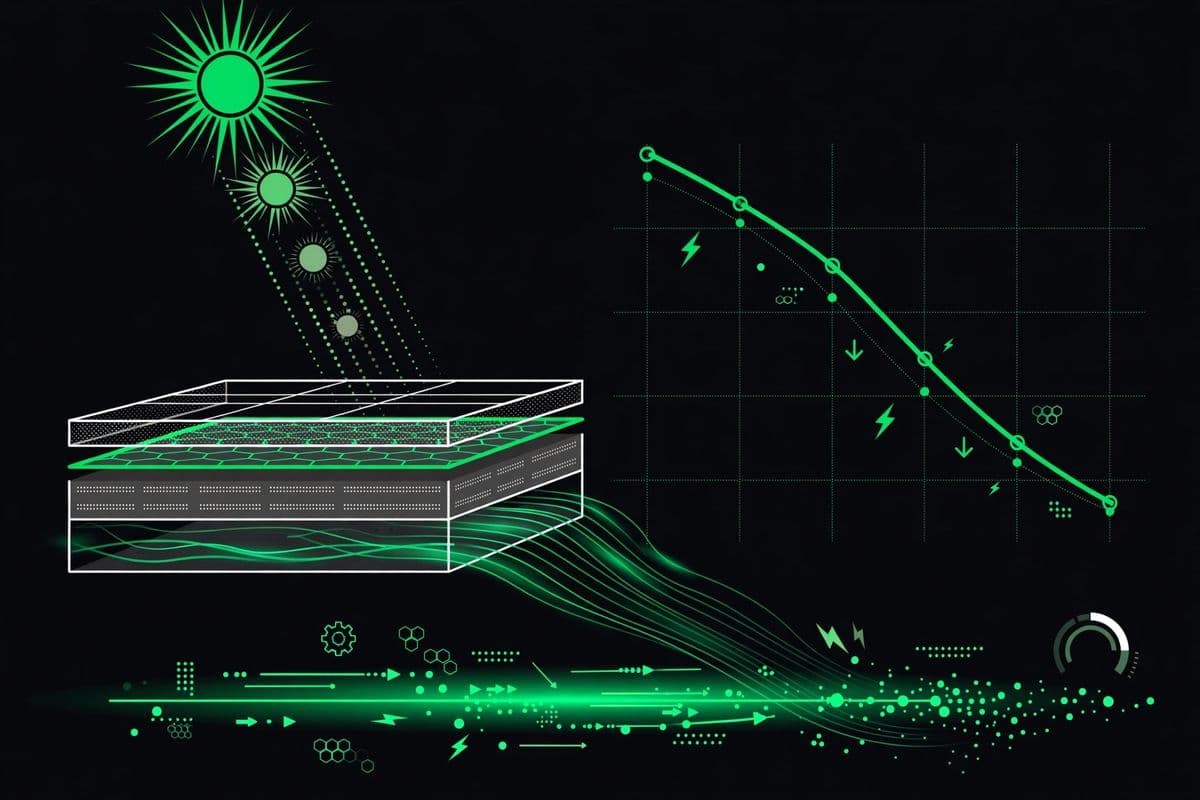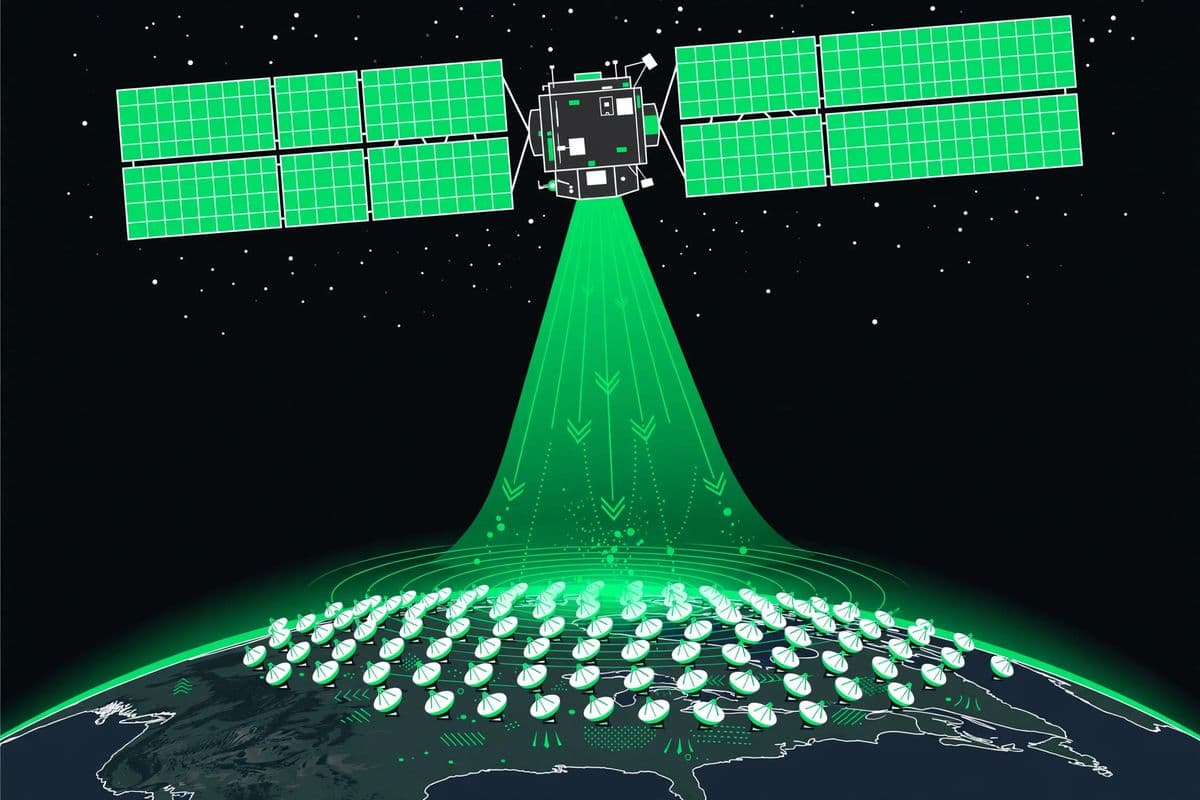
- Space-based solar power collects sunlight in orbit, converts it to microwaves or lasers, and beams it to a ground rectenna that turns it back into electricity.
- Caltech demonstrated wireless power transfer in space in March 2023 and detected a beam on a Pasadena rooftop on 22 May 2023, at detectable signal level rather than useful power level.
- NASA estimated grid-scale costs of $0.61 to $1.59 per kWh under 2050 baseline assumptions, against $0.02 to $0.05 per kWh for terrestrial alternatives, so cost is the barrier that demonstrations have not removed.
Space-based solar power: Electricity generated by solar panels on satellites, usually in geostationary orbit where sunlight is almost constant, then transmitted to Earth as microwaves or laser light and converted back to grid electricity by a large ground receiving antenna called a rectenna.
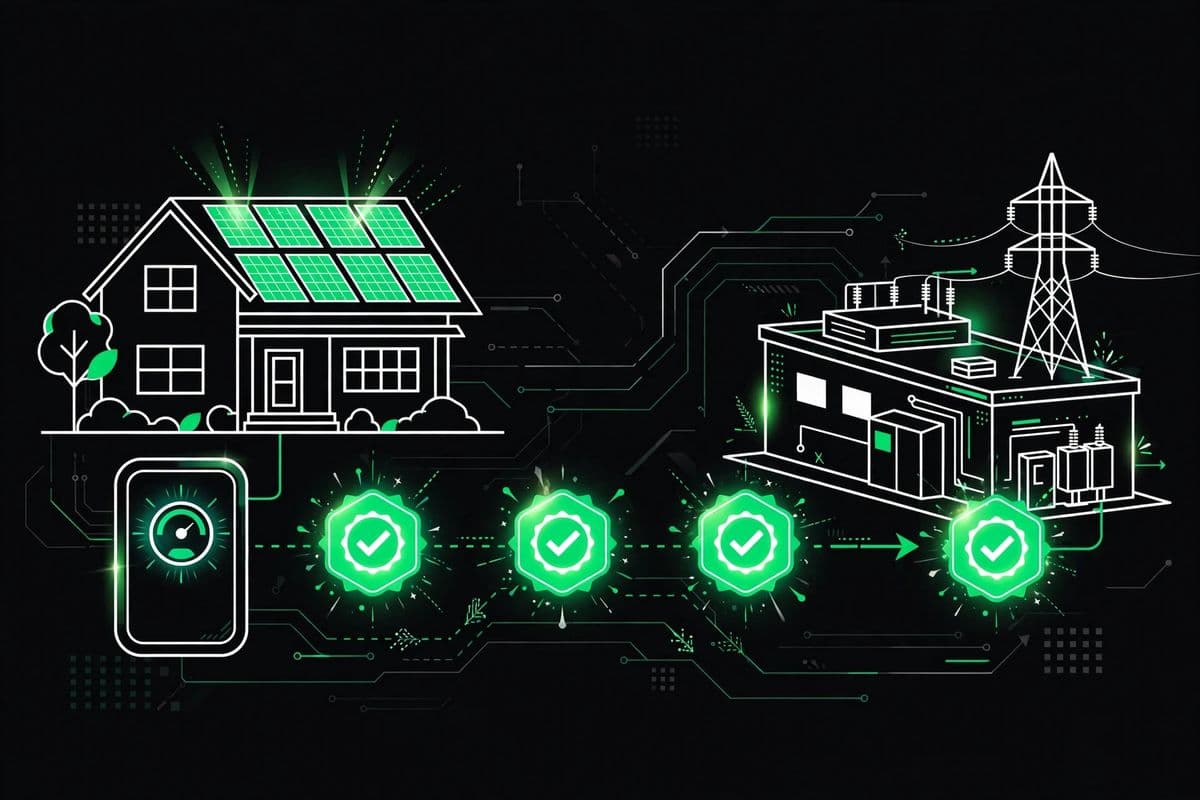
The chain has four links, and each link loses energy. Solar cells in orbit convert sunlight to direct current. A transmitter converts that current to microwaves. The beam crosses tens of thousands of kilometres to a ground rectenna. The rectenna converts microwaves back to direct current, which an inverter turns into alternating current for the grid. Caltech proved the beam can be aimed and detected from orbit. Japan’s OHISAMA satellite was built to test the same chain end to end at about 1 kilowatt, and as of November 2026 no confirmed orbital transmission from OHISAMA had been reported in the sources checked for this article. The gap between a detected signal and a power plant is measured in launch mass, ground area and dollars per kilowatt-hour.
The appeal is real. In geostationary orbit, about 36,000 kilometres above the equator, a satellite stays over one spot on Earth and spends almost no time in shadow. Caltech states that space solar power could yield eight times more power than solar panels at any location on Earth’s surface, because ground panels face night, seasons and cloud cover. A ground rectenna can receive power around the clock, which would remove the storage problem that shapes every terrestrial solar system. The question is whether that advantage survives the cost of building, launching and maintaining kilometre-scale hardware in orbit.
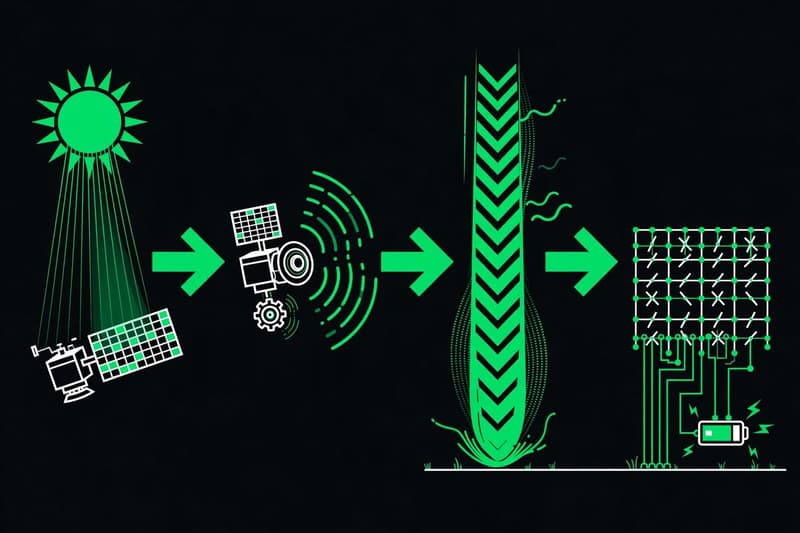
How space-based solar power moves energy from orbit to the grid
The concept dates to 1968, when NASA engineer Peter Glaser proposed a satellite in geostationary orbit that would collect sunlight, convert it to microwaves, and beam it to a receiving antenna on Earth. The United States Department of Energy and NASA studied the idea in the late 1970s and shelved it when launch costs and cell weights made the economics untenable. The physics was sound. The launch bill was not. Cheaper rockets and lighter cells brought the idea back, and the current designs still follow Glaser’s layout: collect in orbit, transmit as microwaves, receive on a rectenna.
Microwaves are the usual choice because they pass through cloud and rain with modest losses, unlike visible light. Lasers are the alternative, with a smaller ground receiver and tighter beam control, at the cost of weather sensitivity and stricter safety controls. The rectenna is a field of dipole antennas with rectifiers, often described as a wire mesh that is largely transparent to sunlight and rain, so the land beneath can remain in agricultural use. Beam intensity at the centre of the rectenna is designed to stay well below noon sunlight intensity, around 250 watts per square metre in commonly cited reference designs. Safety depends on beam control: the beam must stay on the rectenna, shut down if it drifts, and never dwell on an unplanned target.
Scale is the hard part. NASA’s 2024 Office of Technology, Policy, and Strategy study normalised two reference designs to 2 gigawatts of delivered power. One design needed a solar panel area of 19 square kilometres and 10 million kilograms of upmass. The other needed 11.5 square kilometres and 5.9 million kilograms. The study counted 2,321 to 3,960 launches across assembly, maintenance and disposal, depending on the design. Dividing the lighter design’s upmass by its launch count gives an average of roughly 2,500 kilograms per launch in Joule Post arithmetic from the study figures, which shows why launch cost dominates every other cost line in the study.
What Caltech proved in 2023 with a 50 kilogram demonstrator
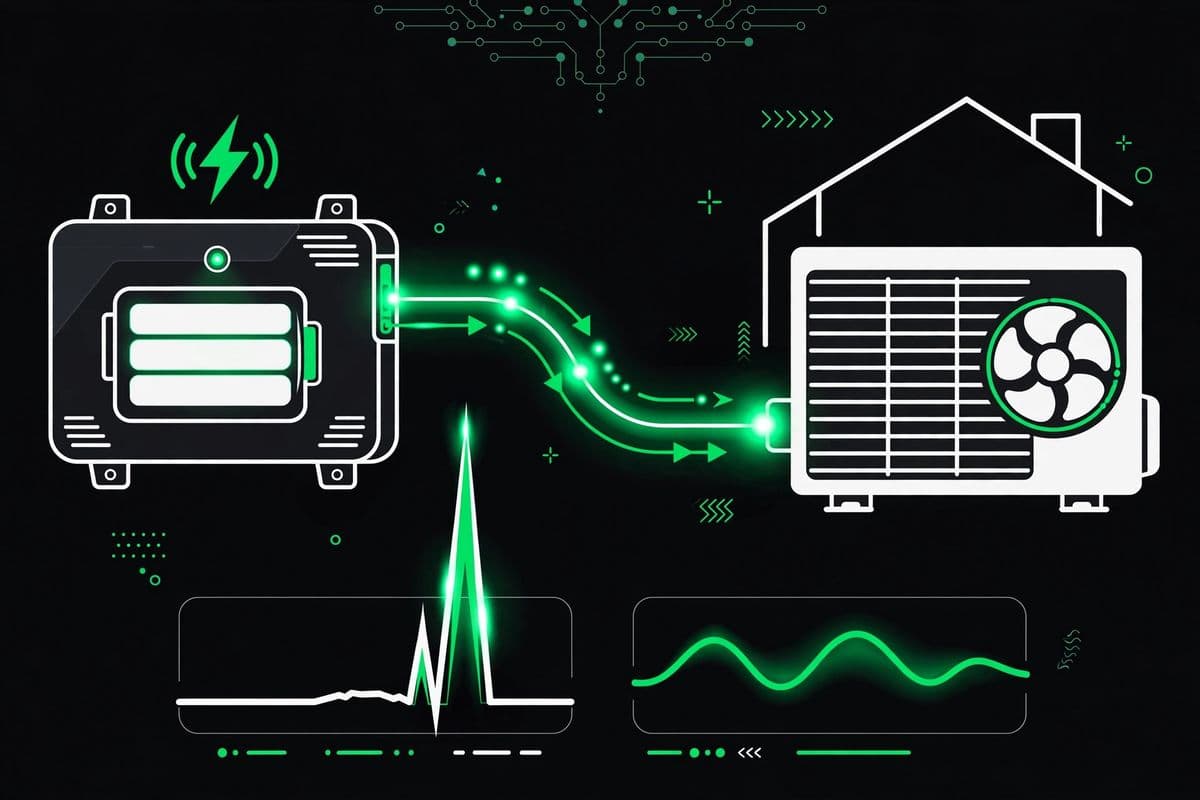
Caltech launched the 50 kilogram Space Solar Power Demonstrator, SSPD-1, on 3 January 2023 aboard a SpaceX Transporter-6 mission. The demonstrator carried three experiments. MAPLE, the Microwave Array for Power-transfer Low-orbit Experiment, tested wireless power transfer. DOLCE tested a foldable lightweight structure. ALBA tested 32 types of photovoltaic cells. MAPLE demonstrated wireless power transfer in space on 3 March 2023 by beaming energy between transmitter and receiver arrays about a foot apart inside the spacecraft and lighting LEDs in sequence, which verified beam steering by phase control with no moving parts.
MAPLE also beamed energy through a small window toward Earth. A receiver on the roof of the Gordon and Betty Moore Laboratory of Engineering on the Caltech campus in Pasadena detected the signal on 22 May 2023, at the expected time and frequency and with the frequency shift predicted from the satellite’s motion. Caltech co-director Ali Hajimiri said: “Through the experiments we have run so far, we received confirmation that MAPLE can transmit power successfully to receivers in space. We have also been able to program the array to direct its energy toward Earth, which we detected here at Caltech. We had, of course, tested it on Earth, but now we know that it can survive the trip to space and operate there.”
The result was a first, and its limits matter as much as its novelty. The power detected on the rooftop was a signal, sufficient to prove aiming and survival in orbit. It was not usable power for the grid. Caltech’s own account describes lighting LEDs inside the spacecraft and detecting a signal on the ground. Any account that describes the 2023 test as delivering power to homes overstates what happened. The demonstrator validated the aiming problem. It did not validate the economics problem.
OHISAMA and the difference between a plan and a result
Japan has studied space-based solar power since the 1980s, through the Japan Aerospace Exploration Agency and university research groups. The OHISAMA project, named from the Japanese word for the sun, was designed as a small satellite test of high-precision beam control using a phased array antenna. Published descriptions of the planned mission put its mass at about 180 kilograms, its orbit at about 400 kilometres, and its delivered power at about 1 kilowatt during brief orbital passes, enough for small appliances. Some reports described a 2 square metre panel and a 5.8 gigahertz microwave beam aimed at a ground array in Suwa. Other reports described a target of lighting a single LED at the JAXA Usuda Deep Space Center dish. The descriptions differ on the receiver, and the mission’s formal objective in peer-reviewed documentation was to confirm the feasibility of long-distance wireless power transmission for a future lunar energy system, with Earth as the test range.
Readers should treat claims about OHISAMA with care. A fact check published in December 2025 found no announcement from JAXA, peer-reviewed publication or major science outlet confirming an orbital power transmission by Japan, and described claims of a completed December 2025 event as misleading. Later reporting described OHISAMA as booked on a Space One Kairos rocket whose earlier flights had failed, with a flight then targeted for Japan’s fiscal 2026. This article found no confirmed OHISAMA orbital transmission as of November 2026 and makes no claim that one took place. The Caltech 2023 detection remains the confirmed orbital beaming result in the sources checked. A commercial deal does exist on paper: Virtus Solis signed a 20-year space solar power purchase agreement with Brae Systems in October 2026 to supply orbital power to subsea data centres, which is a contract for future delivery, and the delivery hardware has not been demonstrated at grid scale.
Why NASA puts grid-scale space solar at $0.61 to $1.59 per kWh
NASA’s 2024 study assessed two first-of-a-kind designs under assumptions for 2050, with launch and assembly beginning in 2038 to 2043 and initial operations in 2050. Under baseline assumptions, the study put lifecycle cost at $0.61 to $1.59 per kWh across the two designs, and described space-based solar power as expensive and not cost competitive with terrestrial renewable electricity production. The study put the lifecycle cost range for terrestrial alternatives at $0.02 to $0.05 per kWh. Joule Post arithmetic from those ranges puts the baseline space solar cost at roughly 12 to 80 times the terrestrial range, depending on which ends of the two ranges are compared. That gap is the central finding of the study, and it survives the study’s own sensitivity tests.
| NASA 2024 assumption set | Space solar lifecycle cost | Terrestrial alternative range | Competitive? |
|---|---|---|---|
| Baseline, 2050 assumptions | $0.61 to $1.59 per kWh | $0.02 to $0.05 per kWh | No |
| Single-variable sensitivities | $0.20 to $0.45 per kWh | $0.02 to $0.05 per kWh | No |
| Combined optimistic sensitivities | $0.03 to $0.08 per kWh | $0.02 to $0.05 per kWh | Only at the low end, with every improvement together |
Competitiveness required everything to improve at once. The combined case assumed launch costs halved from $1,000 to $500 per kilogram, electric propulsion for transfer to geostationary orbit, solar cell efficiency raised from 35 percent to 50 percent, hardware lifetime extended from 10 to 15 years, servicer and debris-removal first-unit costs cut by 90 percent, and manufacturing learning improved by 5 percent. The study also listed challenges that cost models cannot wish away: large-scale autonomous assembly across kilometres in orbit, spectrum allocation, orbital slot allocation, security requirements, and active debris removal. NASA concluded that space-based solar power is not a driver for its technology development, while recommending partnership exploration and deeper studies every few years.
Ground-based alternatives frame the comparison. Terrestrial solar panels already deliver power at a fraction of the modelled space cost, and grid battery storage addresses the night-time gap that space solar is meant to solve, at costs that fall every year. Space solar would need to beat solar plus storage on cost, not on the elegance of constant sunlight. The NASA numbers say it does not, under baseline assumptions, and only approaches parity when launch, manufacturing, efficiency and lifetime all improve together.
What would have to change before orbital power reaches the grid
Three thresholds decide the timeline. Launch cost must fall far below the study’s $500 per kilogram sensitivity case and stay there across thousands of launches, including maintenance and disposal flights over a 30-year operating life. Assembly must move from a 50 kilogram demonstrator with a 6 foot by 6 foot foldable structure to autonomous construction of arrays measured in square kilometres, with servicing and debris removal as routine operations. Ground infrastructure must secure rectenna sites measured in kilometres, spectrum rights and orbital slots, with beam safety systems that regulators and neighbours accept. Each threshold is an engineering programme in its own right. None has a demonstrated grid-scale solution today.
The honest summary is narrow. Wireless power beaming from orbit is no longer theory. Caltech aimed a beam from a small demonstrator and detected it on Earth in 2023. Grid-scale space solar power is not a demonstrated technology, not a costed power plant, and not a contracted delivery in operation. The Virtus Solis agreement shows commercial interest in the idea. The NASA study shows the cost distance still to travel. Readers who see headlines about power beamed from space should ask three questions: how much power, detected or delivered, and at what cost per kilowatt-hour. The answers to date are a signal, a plan, and a price far above the grid.
Frequently asked questions
What is space-based solar power?
Space-based solar power collects sunlight with solar panels on satellites, usually in geostationary orbit, converts the electricity to microwaves or laser light, beams it to a ground rectenna, and converts it back to grid electricity. The advantage is near-constant sunlight. The disadvantage is the cost of building and launching the hardware.
Has power ever been beamed from space to Earth?
Caltech detected a microwave signal beamed from its SSPD-1 demonstrator on a Pasadena rooftop on 22 May 2023, which was the first detection of a power beam from orbit to Earth. The signal proved aiming and survival in orbit. It did not deliver usable grid power. No confirmed OHISAMA orbital transmission had been reported as of November 2026 in the sources checked.
How much does space-based solar power cost?
NASA estimated $0.61 to $1.59 per kWh for first-of-a-kind 2 gigawatt designs under 2050 baseline assumptions, against $0.02 to $0.05 per kWh for terrestrial alternatives. Costs only approached competitiveness when launch, efficiency, lifetime and manufacturing assumptions all improved together.
What is a rectenna?
A rectenna is a rectifying antenna, a large ground field of dipole antennas that captures incoming microwaves and converts them back to direct current electricity. Reference designs cover kilometres of land, with beam intensity at the centre kept well below noon sunlight intensity.
When could space solar power supply the grid?
NASA modelled launch and assembly beginning in 2038 to 2043, with initial operations in 2050, for first-of-a-kind systems. That timeline depends on launch cost, autonomous assembly and regulatory approvals that have not been demonstrated at scale. Commercial agreements signed today are contracts for future delivery.
Sources:
- California Institute of Technology, In a First, Caltech’s Space Solar Power Demonstrator Wirelessly Transmits Power in Space, 1 June 2023
- NASA Office of Technology, Policy, and Strategy, Space Based Solar Power Study, 1 August 2024
- FactCrescendo, Japan Has Not Yet Launched a Fully Operational Space-Based Solar Power System, 29 December 2025
Cost multiples and per-launch averages in the text are Joule Post arithmetic from NASA study figures, as labelled. All dollar figures are US dollars.