
- Studies published in 2013 and 2014 put United States wind turbine bird deaths at 140,000 to 679,000 a year, a range the MIT Climate Portal says likely understates today’s toll.
- The United States Fish and Wildlife Service reports songbirds make up 57 percent of fatalities at onshore wind facilities, with diurnal raptors at 9 percent.
- Painting one blade black cut bird fatalities by more than 70 percent in a Norwegian study cited by MIT, and careful siting remains the strongest safeguard.
Wind turbine bird mortality: The death of birds through collision with turbine blades, towers and related structures, plus habitat loss and displacement around wind facilities. Researchers estimate it from carcass searches corrected for scavenger removal and searcher detection, then scaled up across facilities, which is why national figures arrive as wide ranges rather than exact counts.
Per unit of electricity, wind kills far fewer birds than the fossil fuel generation it replaces, and that comparison frames every honest discussion of the toll. A 2012 study cited by the MIT Climate Portal found wind projects killed 0.269 birds per gigawatt-hour of electricity, against 5.18 birds per gigawatt-hour from fossil fuel projects, a gap of about 19 times by Joule Post arithmetic from those two figures. The fossil fuel figure includes habitat destruction from mining, air pollution effects and climate change pressure on bird populations, so it measures a system-wide impact, while the wind figure concentrates on collisions at the facility itself.
The national range itself needs the same care. Much of the United States data comes from studies published in 2013 and 2014, and the MIT Climate Portal states the numbers are likely higher today because many more wind farms have been built in the past decade. That caveat cuts both ways: it warns against quoting the old range as a current ceiling, and it warns against treating any single new estimate as settled, because monitoring coverage, turbine size and siting practice have all changed since the underlying studies were done.
Where wind turbines kill birds most often
Location dominates the risk. The United States Fish and Wildlife Service states that collision risk depends on facility location, including turbine placement, how birds move across the landscape and turbine design, and it calls siting at both the macro and micro scale a critical element in reducing risk. A turbine placed on a ridge used by soaring raptors, beside a wetland used by waterbirds or across a migration corridor faces a different risk profile from a turbine placed in intensively farmed land with low bird activity, even when the machines are identical.
Species mix shapes the conservation meaning of the toll. The Fish and Wildlife Service reports nearly 300 bird species known to have been killed at onshore wind facilities in the United States, with songbirds the most frequent at 57 percent of fatalities and diurnal raptors at 9 percent. Songbirds dominate the count because they are abundant, while raptors carry outsized conservation weight because they are less abundant, reproduce slowly and live long, so a small number of raptor deaths can matter more for a population than a larger number of common songbird deaths. Golden eagles illustrate the point: collisions with wind turbines make up less than 5 percent of human-caused golden eagle mortality according to research cited by the Renewable Energy Wildlife Institute, yet eagle deaths still trigger permitting and mitigation requirements because the species is protected and slow to replace.
Offshore wind adds a different evidence gap. The Fish and Wildlife Service page covers land-based wind, and the MIT material focuses on United States onshore data, so offshore bird deaths in American waters lack a comparable national estimate in these sources. Seabirds, migration routes over water and the difficulty of finding carcasses at sea all complicate offshore monitoring, and a reader should treat any offshore total quoted without a method as a guess. Joule Post’s guide to how wind turbines work explains the machine itself, including rotor size and placement, which helps a reader see why a larger rotor sweeps a larger area: How Wind Turbines Work.
Cats, buildings and power lines on the same scale
The comparison that puts wind in context is stark, and it comes from the same MIT material. Past studies estimated cats kill up to 4 billion birds a year in the United States, and buildings kill up to 988 million, while power lines kill between 12 million and 64 million a year. Against those figures, even the top of the wind range, 679,000, sits at roughly 0.02 percent of the cat figure and roughly 0.07 percent of the building figure by simple division. The Fish and Wildlife Service’s own framing is consistent: it states that wind projects account for less than 0.1 percent of all human-caused bird mortality in material summarising its position.
| Source of bird deaths in the United States | Annual estimate | What the figure covers |
|---|---|---|
| Cats | Up to 4 billion | Pet and feral cats, from past studies cited by MIT |
| Buildings and windows | Up to 988 million | Collisions with glass and structures, from past studies cited by MIT |
| Power lines | 12 million to 64 million | Collisions and electrocution on lines serving all generation |
| Wind turbines | 140,000 to 679,000 | Collisions at wind facilities, from 2013 and 2014 studies cited by MIT |
| Fossil fuel electricity, per gigawatt-hour | 5.18 birds per GWh | System-wide impact, from a 2012 study cited by MIT |
| Wind electricity, per gigawatt-hour | 0.269 birds per GWh | Facility collisions, from a 2012 study cited by MIT |
Scale alone does not settle the argument, because the figures measure different things. Cat and building deaths fall heavily on common species in settled areas, while wind deaths fall on species using open ridges, grasslands and migration corridors, including some protected raptors. A national total can hide a local problem, and a wind facility sited in the wrong place can harm a local raptor population even while the national wind total stays small. That distinction explains why conservation groups support wind energy in general while opposing specific poorly sited projects, and why the Fish and Wildlife Service developed Land-Based Wind Energy Guidelines that it says have the most potential to reduce adverse impacts when followed.
Climate change belongs in the same ledger. The National Audubon Society estimates about two-thirds of bird species in North America face increased extinction risk from rising temperatures and habitat change, according to MIT. Michael Howland, a professor of civil and environmental engineering at MIT, put the comparison this way: “When assessing electricity generation technologies, it is important to evaluate against baseline generation alternatives, because electricity generation is a requirement of modern society.” His point is that the relevant question is rarely wind against zero impact, and usually wind against the generation it displaces, with its own bird toll through mining, pollution and climate pressure.
Bats face a separate and steeper wind risk
Bats deserve a separate section because their wind risk runs higher relative to their populations than the bird numbers suggest. Bats die from direct blade strikes and from barotrauma, the pressure change near a moving blade that injures lungs, and their slow reproduction makes population recovery slow. The Fish and Wildlife Service’s screening material for wind projects notes research showing that feathering turbine blades below the manufacturer’s cut-in speed can reduce all bat fatalities by approximately 35 percent to 57.5 percent, and that feathering below a cut-in speed of 5.0 metres per second can reduce all bat fatalities by an average of 62 percent. Curtailment, the practice of pausing turbines in low-wind conditions when bats are most active, therefore trades a small amount of generation for a large reduction in bat deaths, and it is one of the most established mitigation tools in the industry.
Small home turbines sit at a different scale again. A rooftop or garden turbine turns a smaller rotor at a lower height, and its bird risk depends heavily on local bird activity and placement near hedges, trees and flight lines. Joule Post’s guide to small home turbines covers costs and output, and the same siting caution applies at household scale: Are Small Wind Turbines Worth It for Homes in 2026?. Offshore turbines, with longer blades and larger rotors, raise a different set of questions about lifespan and decommissioning, covered in Joule Post’s offshore lifespan guide: Offshore Wind Turbines Are Built for 25 Years and Can Run for 40.
The mitigation tools with evidence behind them
Siting comes first, because no operating fix fully compensates for a turbine placed across a migration bottleneck or beside a raptor nesting area. Pre-construction surveys map bird activity across seasons, and developers can move turbines, reduce turbine numbers in sensitive areas or leave habitat corridors untouched. The Fish and Wildlife Service stresses early communication and collaboration in project planning, so that avoidance measures are built into the layout rather than added after concrete is poured.
Blade visibility offers a strikingly simple operating fix. Scientists found that painting one blade of a turbine black, which increases visibility, can reduce bird fatalities by more than 70 percent, according to MIT, drawing on a Norwegian study. The mechanism is straightforward: birds see the moving rotor as a single blurred disc when all blades share one colour, and a contrasting blade breaks up that blur. The result comes from one study site and one set of species, so it should not be quoted as a universal 70 percent saving, but it shows that visibility, beyond placement, shapes collision risk.
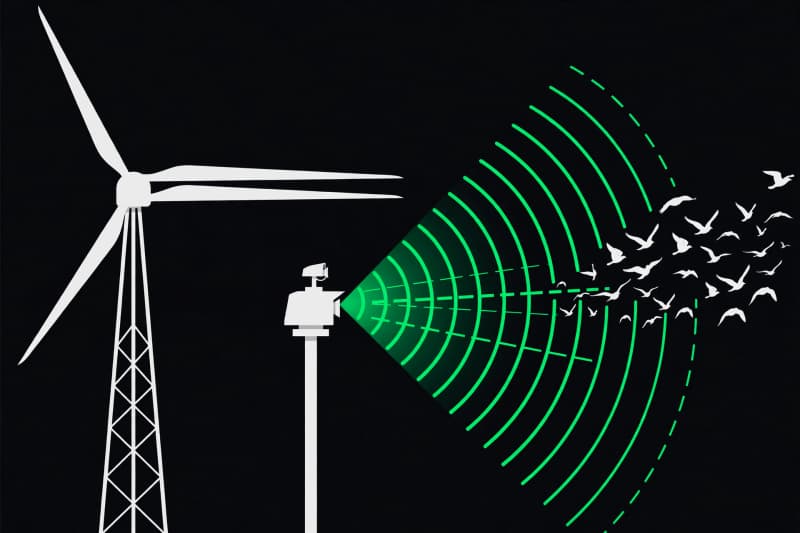
Detection and shutdown systems form the third layer. Some wind companies experiment with artificial intelligence cameras that sense an approaching bird and pause the turbine, according to MIT, and radar-based shutdown systems serve a similar purpose for bats and birds at larger facilities. These systems cost money and pause generation, so their value depends on the species at risk and the frequency of shutdowns, and they work best where surveys have already identified the high-risk periods, such as peak migration nights or dawn and dusk activity windows.
Lighting and habitat management complete the toolkit. Artificial lighting can disorient migrating birds, according to the Fish and Wildlife Service, so lighting design that limits unnecessary illumination reduces an avoidable risk. Habitat work around a facility, such as managing prey habitat away from turbine bases for raptors, can reduce the time hunting birds spend near blades, though such measures need local ecological advice rather than a generic recipe.
Reading the next wind-versus-birds claim
Three checks separate a solid claim from a slogan. First, ask for the date and method: a national total from 2013 and 2014 studies describes a smaller, older fleet, and a per-gigawatt-hour figure describes intensity rather than total impact, so the two should never be swapped. Second, ask for the species: a total dominated by common songbirds and a total dominated by protected raptors carry different conservation weight, and a claim that hides the species mix hides the argument. Third, ask for the alternative: a wind toll quoted without the fossil fuel toll it displaces, and without the climate risk to two-thirds of North American bird species, answers a narrower question than the one a reader faces.
Wind turbines do kill birds, and the honest answer stays with that fact rather than explaining it away. The research also shows the toll is small beside cats, buildings and fossil fuel generation, concentrated by siting and species, and reducible through surveys, blade visibility, curtailment and detection systems. A wind programme that sites carefully, monitors honestly and shuts down when protected species approach can hold both truths at once: turbines carry a real wildlife cost, and the generation they replace carries a larger one.
Sources:
- Avoidance and Minimization Measures: Land-Based Wind (U.S. Fish and Wildlife Service)
- Do Wind Turbines Kill Birds? (MIT Climate Portal)
- A Large-Scale Mitigation Experiment to Reduce Bat Fatalities at Wind Energy Facilities (Baerwald et al., Journal of Wildlife Management, 2009)
- A Decade of Curtailment Studies Demonstrates a Consistent and Effective Strategy to Reduce Bat Fatalities at Wind Turbines in North America (Whitby et al., Ecological Solutions and Evidence, 2024)
Frequently asked questions
Do wind turbines kill birds?
Yes. Birds collide with blades and towers, and habitat change around facilities adds further pressure. The question with a useful answer is how many, which species and where, rather than whether any deaths occur.
How many birds do wind turbines kill annually?
Studies published in 2013 and 2014 put the United States total at 140,000 to 679,000 birds a year, according to MIT. The range is dated, and MIT states the true current figure is likely higher because the wind fleet has grown since those studies.
Do wind turbines kill more birds than cats or buildings?
They kill far fewer. Past studies cited by MIT estimate cats kill up to 4 billion birds a year in the United States and buildings up to 988 million, against a wind range topping out at 679,000.
Does painting a turbine blade black help birds?
A Norwegian study cited by MIT found painting one blade black reduced bird fatalities by more than 70 percent at the study site, by making the rotor more visible. The result is promising and site-specific, rather than a guaranteed saving everywhere.
What about bats and wind turbines?
Bats face a distinct risk from blade strikes and pressure injury, and their slow reproduction makes recovery slow. Feathering blades below cut-in speed in low-wind conditions can cut bat fatalities substantially, with reductions averaging 62 percent at a 5.0 metres per second cut-in speed in research noted by the Fish and Wildlife Service.