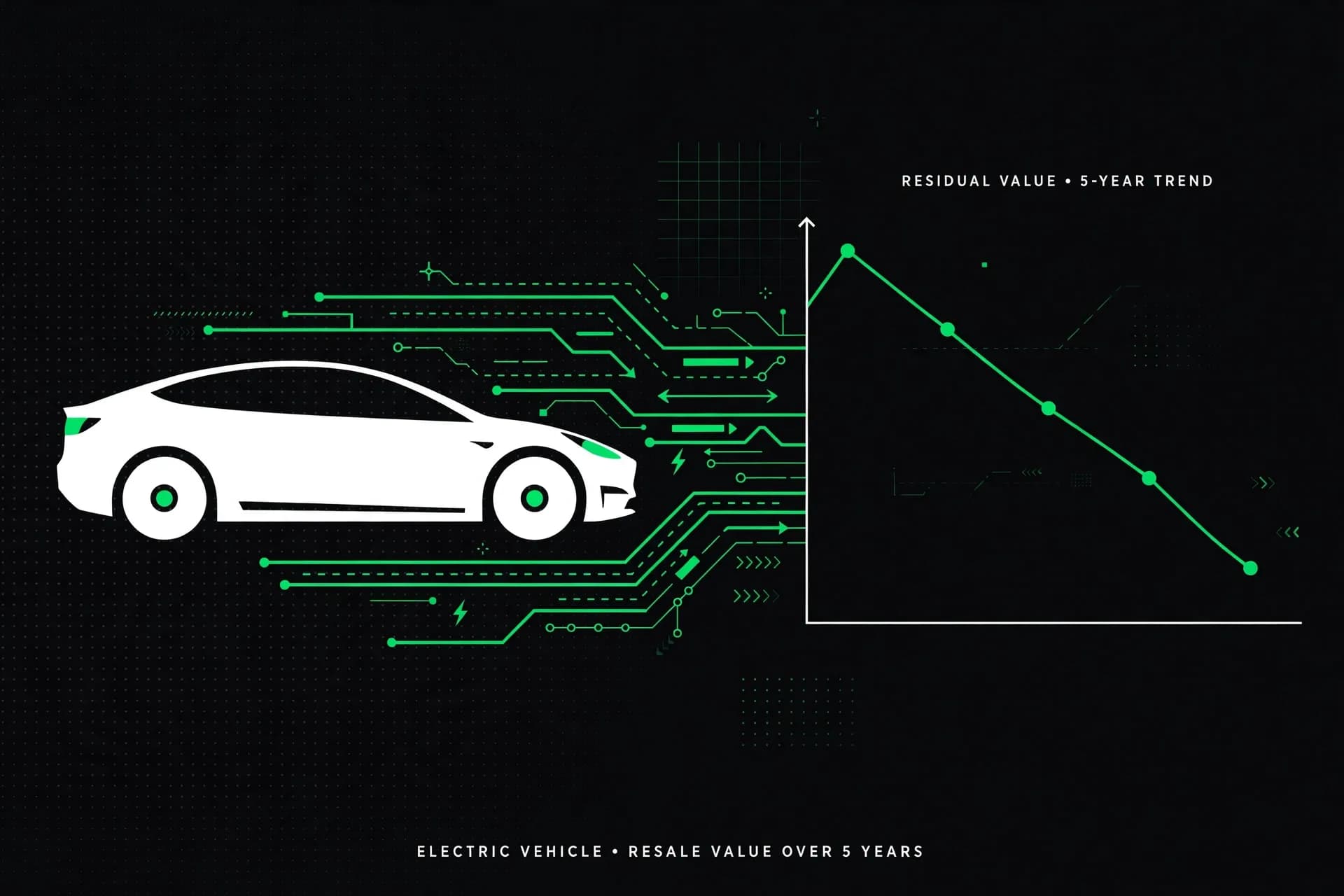
- Electric vehicles lose 57.2% of their value after five years, against 41.8% for the average vehicle, in iSeeCars’ 2026 study of 950,000 cars.
- Model-specific: the Tesla Model 3 loses 54.6% while the Nissan LEAF loses 63.1%.
- Used EV wholesale values rose 4.3% year over year in September 2026 even as the five-year gap widened.
EV depreciation: The loss in market value an electric car suffers over time, usually measured against its original sticker price. It runs faster than for gas cars: buyers discount the battery, technology dates quickly, and new-car price cuts drag used prices down.
Why do EVs depreciate so fast? The question has a sharper answer in 2026 than it did a year ago, and the newest data cuts both ways. Wholesale used-EV values rose 4.3% year over year in September 2026 while non-EV values fell 1.6%, per Cox Automotive’s Manheim index, and retail EV sales hit a record of about 124,000 units. The five-year gap is real, but the forces behind it explain the fall and the turn.
Depreciation is a price for risk, and used-car buyers price four risks into every EV: battery, technology cycle, new-car price, and buyer pool. Each risk is real and measurable, and each is shrinking at a different speed.
Battery fear discounts every used EV, even healthy ones
The battery dominates every used-EV negotiation: the most expensive part of the car and the hardest for a buyer to judge. iSeeCars’ 2026 study of more than 950,000 five-year-old cars sold between March 2025 and February 2026 puts average EV depreciation at 57.2% and the average dollar loss at USD 28,435, against USD 16,571 overall. The Tesla Model 3 loses 54.6%, the best result among the ten EVs ranked, while the Nissan LEAF loses 63.1%.
The LEAF loses the highest percentage but only USD 17,743 in cash, because it started cheap. The Tesla Model S loses 62.0% and USD 58,907, the largest dollar loss of any EV ranked.
iSeeCars executive analyst Karl Brauer put the mechanism plainly: “Electric vehicles consistently cost more than the equivalent gasoline or hybrid model,” Brauer said. “That high upfront cost comes back to haunt electric cars on the used market, where buyers aren’t willing to pay the premium.” A buyer who paid more for an EV expects the used buyer to pay more too, and the used buyer refuses.
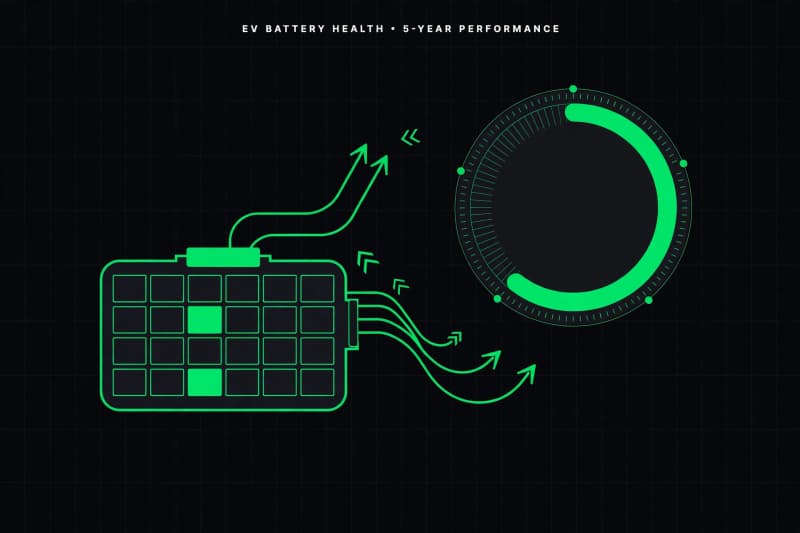
The fear runs ahead of the data. Modern EV batteries degrade slowly, but a buyer cannot see battery health from the curb, so the market discounts every EV as if its pack were average. The discount is a tax on uncertainty. That discount is driven by battery anxiety among used-EV buyers: the buyer cannot see pack health, so the price assumes the worst. Joule Post’s guide to how long EV batteries last works through the degradation data, and the used-EV battery health checklist shows what to test before paying.
Each model year makes last year’s EV look old
Gas cars age slowly: a five-year-old one differs from a new one in trim and infotainment, with the same engine, gearbox and fuel economy. A five-year-old EV can differ from a new one in range, charging speed, battery chemistry and driver-assistance hardware.
Battery chemistry is the fastest-moving part. Lithium iron phosphate packs have pushed into mainstream models, nickel manganese cobalt packs keep the long-range crown, and sodium-ion cells are nearing production. Joule Post’s comparison of LFP, NMC and sodium-ion battery chemistries sets out what each chemistry gives up and gains, and Joule Post’s guide to how long EV batteries last works through the degradation data.
The result is a market where a three-year-old EV competes with a new EV that goes further, charges faster and costs little more after incentives, while a three-year-old gas car competes mostly with other used gas cars.
New-car price cuts and the end of the federal credit reset used values
A used car’s value is anchored to the equivalent new car, so when new prices fall, used prices follow the same day. Kelley Blue Book puts the average new EV transaction price at USD 55,715 in January 2026, down 0.6% from a year earlier and 3.1% from December. Tesla averaged USD 52,628, down 2.2% year over year in a market where overall new-car prices rose 1.9%.
Incentives add a second lever. EV incentives averaged 12.4% of transaction price in January 2026, down from 18.3% in December, according to Kelley Blue Book. When a manufacturer raises incentives on new cars, the effective new price falls even if the sticker price does not move, and EV resale values follow the effective price. Incentives work on resale value through that same anchor: a bigger incentive on the new car is a smaller value for the used one.
The federal EV tax credit ended on 30 September 2025. Buyers rushed to close deals before the deadline, new EV sales then fell sharply, with Kelley Blue Book estimating January 2026 sales at just over 66,000, down nearly 30% year over year. Demand moved to the used market: Cox Automotive recorded about 124,000 used retail EV sales in the third quarter of 2026, a record, up 11.4% year over year.
What the 15.4-point depreciation gap means for buyers in 2026
The headline gap is 15.4 percentage points: EVs lose 57.2% of their value in five years while the average vehicle loses 41.8%. In cash, the average EV sheds USD 28,435 against USD 16,571 for the average vehicle, a USD 11,864 difference. That gap is also what makes a two- or three-year-old EV the best used value for a buyer who checks the battery first.
| Segment | 5-year depreciation 2019 | 5-year depreciation 2023 | 5-year depreciation 2025 | 5-year depreciation 2026 |
|---|---|---|---|---|
| Overall market | 49.6% | 38.8% | 45.6% | 41.8% |
| Electric vehicles | 67.1% | 49.1% | 58.8% | 57.2% |
| Hybrids | 56.7% | 37.4% | 40.7% | 35.4% |
| Trucks | 42.7% | 34.8% | 40.4% | 34.2% |
The gap widened over the year. In 2025, EVs lost 58.8% against 45.6% overall, a gap of 13.2 points. In 2026 the overall market improved by 3.8 points while EVs improved by only 1.6, stretching the gap to 15.4 points. iSeeCars put it plainly: although every vehicle type retained more value in 2026 than in 2025, EV depreciation has barely improved.
For a buyer, the arithmetic points to one strategy: buy at two or three years old, after the steepest depreciation, and spend the saving on a battery health check and home charging. Joule Post’s guide to Level 2 charger installation costs works through the prices, and the used-EV battery health checklist shows what to test before paying.
Why do EVs depreciate so fast while used EV prices rise
Two statements about the 2026 EV market look contradictory until the windows are separated. The five-year depreciation gap widened to 15.4 points, and used EV wholesale values rose 4.3% year over year in September 2026 while non-EV values fell 1.6%. Both are correct, because they measure different things.
The iSeeCars study looks backward: five-year-old cars sold between March 2025 and February 2026, capturing the price collapse that followed the new-EV price cuts of 2023 and 2024. The Manheim index looks at today’s wholesale market, where EV days’ supply has fallen and wholesale EV sales rose 45% year over year in the third quarter.
The recovery faces one test: supply. EVs were about 10% of off-lease supply in the first half of 2026 and are expected to reach about 16% in the second half, trending toward 19% by summer 2027, according to Cox Automotive. A wave of three-year-old EVs returning from leases will meet a used market that has learned to pay more for them. Global demand gives the recovery a tailwind, as Joule Post’s coverage of global EV registrations tracks a market that keeps growing even as the US cycle turns.
Sources: iSeeCars 2026 cars that hold their value study; Cox Automotive Manheim Used Vehicle Value Index, September 2026; Cox Automotive Q3 2026 Manheim Used Vehicle Value Index release; Kelley Blue Book January 2026 new-vehicle average transaction price report.
Frequently asked questions
Do electric cars depreciate faster than gas cars?
Yes, and the electric car depreciation rate 2026 numbers are stark: 57.2% over five years, against 41.8% for the average vehicle and 35.4% for hybrids. The gap is 15.4 points, or USD 11,864.
Which EV holds its value best?
The Tesla Model 3 at 54.6% over five years, followed by the Porsche Taycan at 54.7%. The Nissan LEAF holds value worst at 63.1%.
Why did used EV prices rise in 2026 if EVs depreciate so fast?
The two measures cover different windows: the 57.2% figure tracks 2021 cars sold in the year to February 2026. The Manheim index tracks today’s wholesale market, where EV values rose 4.3% year over year in September 2026.
Should I buy a used EV in 2026?
A two- or three-year-old EV is the best value if the battery checks out. Get a battery health report, favor slow-depreciating models such as the Model 3, and budget for home charging first.