- More than 270,000 rooftop solar systems were fitted across the UK in 2026, beating the 2025 record with over a month of the year still to go.
- The record covers MCS-certified installations up to 50 kW, and the industry expects the final 2026 total to pass 300,000.
- Stadiums, supermarkets, markets and leisure centres joined homes in the surge, with solar now covering up to 61% of one leisure centre’s electricity costs.
The driver behind the number is the housebuilding pipeline. More than a third of last year’s certified systems went onto new-build homes, and the Future Homes Standard is about to make panels a default feature of new houses. The official DESNZ confirmation comes in December, and the MCS count behind the headline covers only systems up to 50 kW, so the largest commercial roofs are missing from the total entirely.
The figures come from MCS, the certification body for small-scale renewables, and were announced by the Department for Energy Security and Net Zero (DESNZ) on 20 November 2026. MCS data covers certified installations of up to 50 kW, which means homes and smaller business roofs. Larger commercial arrays sit outside the count, so the 270,000 figure understates the total rooftop build.
UK rooftop solar record falls with a month to spare
For the sixth consecutive year, the annual record for total MCS-certified installations has been broken, with solar and battery storage leading the way. Lisa Cooke, managing director of MCS, said: “It is incredible to see that, for the sixth consecutive year, the annual record for total MCS certified installations has been broken, with solar and battery leading the way. This shows just how quickly the small-scale renewables industry is growing and leading the UK’s transition to home-grown energy, as more people than ever invest in low-carbon technologies to power their homes.”
The 2025 baseline shows how fast the market has moved. Rooftop solar beat the long-standing record set in 2011 by 31% in 2025, with 267,032 certified installations. The 2011 figure of 203,125 was set during the feed-in tariff boom and stood for 14 years. England accounted for more than 280,000 certified small-scale renewables installations in 2025, up a third on 2024, while Scotland recorded almost 40,000, Wales almost 33,000 and Northern Ireland more than 2,800.
| Year | MCS-certified rooftop solar installations | What happened |
|---|---|---|
| 2011 | 203,125 | Feed-in tariff peak; record stood for 14 years |
| 2025 | 267,032 | Beat the 2011 record by 31% |
| 2026 (to 20 Nov) | 270,000+ | Record beaten with more than a month to go |
| 2026 (projected) | 300,000+ | Solar Energy UK full-year expectation |
DESNZ says its own official data confirming the record will be published in December. MCS data is updated daily, and the certification body’s figures carry a two-week window for commissioning and registration, so the final 2026 total will shift slightly from the headline number. If the year closes at 300,000, that is 12% above the 2025 total and 48% above the 2011 peak, while the 270,000 counted so far beats 2025 by just over 1%.
Stadiums and supermarkets drive the commercial side
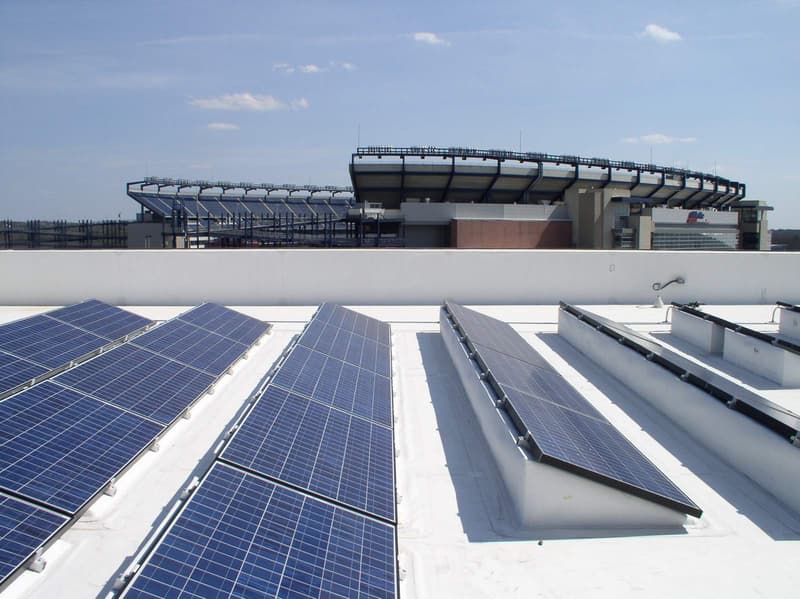
The government announcement deliberately led with businesses rather than homes. Cardiff’s Principality Stadium switched on more than 3,250 solar panels in 2026, enough to power more than 50 matchdays a year. Ascot Racecourse installed more than 1,200 panels, expected to meet around 9% of its annual electricity needs, and Lincoln City fitted panels and battery storage at its football stadium.
On the high street, Lincolnshire Co-op installed panels at 53 sites over two years, with solar providing around 12% of a site’s electricity demand. New Spitalfields Market installed 2,730 panels, which the City of London Corporation describes as London’s largest rooftop solar installation. Aldi fitted 19,000 panels at its new £500 million (pounds sterling) distribution centre in Leicestershire, capable of powering the entire site at peak generation, while Wren Kitchens and Bedrooms is installing more than 13,000 additional panels at its Lincolnshire headquarters, expected to meet around 23% of the site’s electricity needs.
| Site | Panels | Share of electricity needs |
|---|---|---|
| Principality Stadium, Cardiff | 3,250+ | Enough for 50+ matchdays a year |
| Ascot Racecourse | 1,200+ | Around 9% of annual needs |
| New Spitalfields Market | 2,730 | London’s largest rooftop solar installation |
| Aldi distribution centre, Leicestershire | 19,000 | Entire site at peak generation |
| Wren Kitchens, Lincolnshire | 13,000+ | Around 23% of site needs |
| Redbourn Leisure Centre, Hertfordshire | Not stated | 61% cost cut, saving over £19,000 a year |
Redbourn Leisure Centre in Hertfordshire shows the sharpest economics in the announcement. Its rooftop solar and battery storage are expected to cut electricity costs by 61%, saving more than £19,000 a year, with the savings helping fund a new sports hall and football pitches. Tottenham Hotspur is planning 3,800 solar panels on its stadium roof, and London Stansted’s newly operational solar farm has more than 24,000 panels supplying electricity directly to the airport.
What 300,000 installations would mean for UK rooftop solar
A 300,000 finish would mean the UK installed more rooftop solar in one year than the entire 2011 feed-in tariff peak by nearly half, and it would come in a year when the government is also pushing solar into new homes. Chris Hewett, chief executive of Solar Energy UK, said: “Solar is going from strength to strength at all scales. By the end of the year, it looks like more 300,000 MCS-certified installations will be completed, slashing bills for homes, junior schools and village halls across the country.”
Hewett pointed to two policy drivers behind the 2027 outlook: cheap finance through the Warm Homes Loan Scheme and rules effectively mandating solar for new homes and buildings entering into force. The Future Homes Standard is set to mandate solar panels on new homes, and 28% of all MCS installations in 2025 were already on new builds, rising to more than 36% for solar alone. Energy Secretary Miatta Fahnbulleh said: “Britain’s rooftops are powering a solar revolution. From homes and community centres to football clubs, households and communities are putting up panels, generating their own electricity and taking control of their energy bills.”
The record also lands in the same week as the COP31 climate talks, where Britain backed a pledge for 35% of the world’s energy demand to come from electricity by 2035. Joule Post covered that pledge in COP31 35-by-35 Pledge Aims for 35% Electricity by 2035. The UK figure is a small slice of the global rooftop market, but it is one of the few national markets where certified installation counts are published daily, which makes the record unusually easy to verify.
Two gaps in the announcement matter for anyone reading the record as a market signal. First, the government does not split the 270,000 between homes and businesses, so the commercial share is unknown. Second, the MCS count stops at 50 kW, so the biggest commercial arrays, including the Aldi and Stansted projects named in the same announcement, sit outside the record entirely. The grid connection question also hangs over the numbers: Ofgem opened an inquiry into grid connection delays on 19 November 2026, and connection queues remain the main brake on how fast rooftop solar can keep growing.
For homeowners weighing the same decision, the economics start with how much power a roof can actually produce. Joule Post’s guide to how many solar panels a home needs works through the sizing maths, and the community solar guide covers the option for households without a suitable roof.
Sources
- Department for Energy Security and Net Zero, “Sports stadiums and supermarkets drive 2026 solar revolution”, GOV.UK, 20 November 2026
- MCS, “The 2025 Low Carbon Landscape”, MCS Certified, 2026