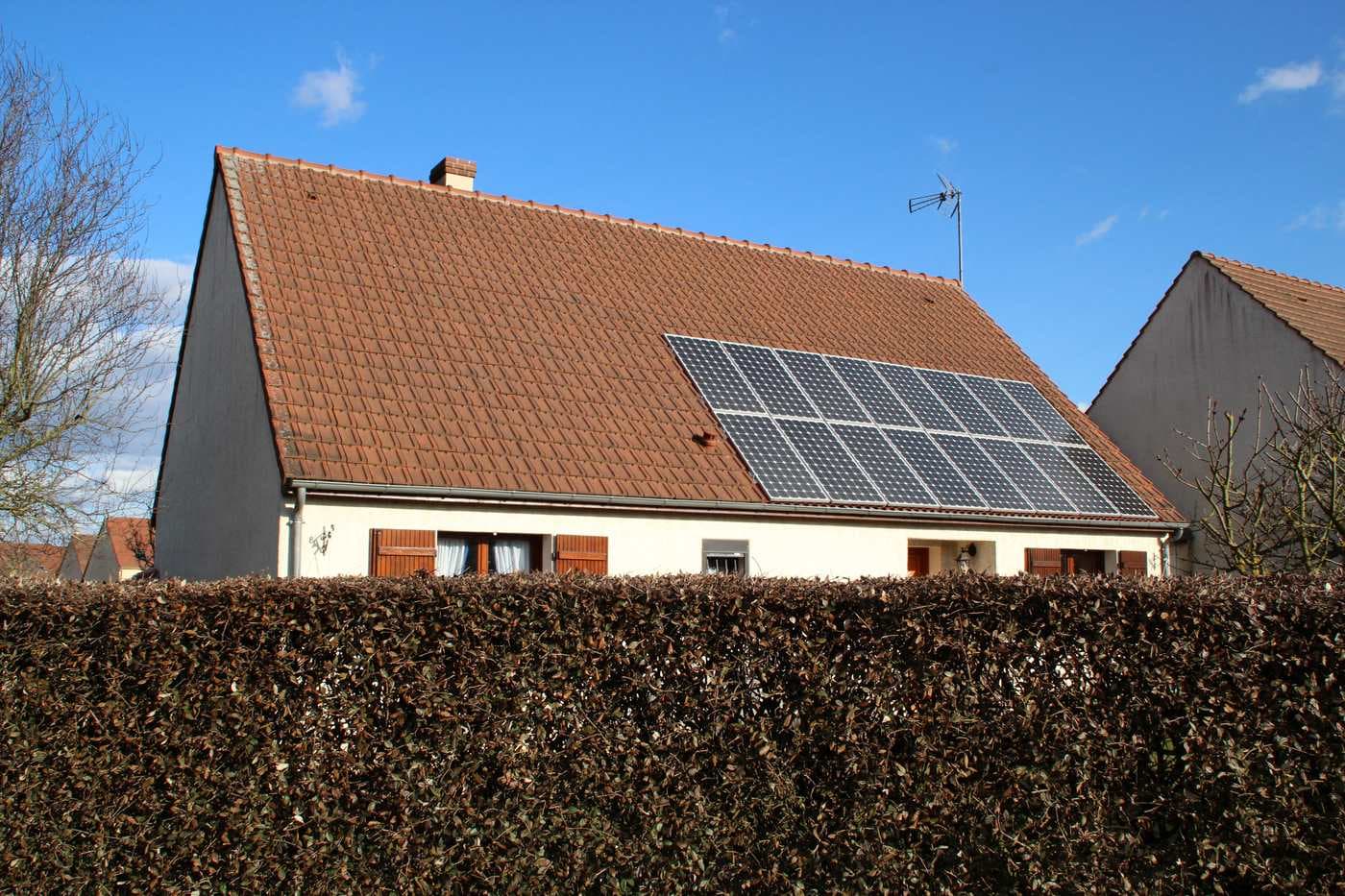
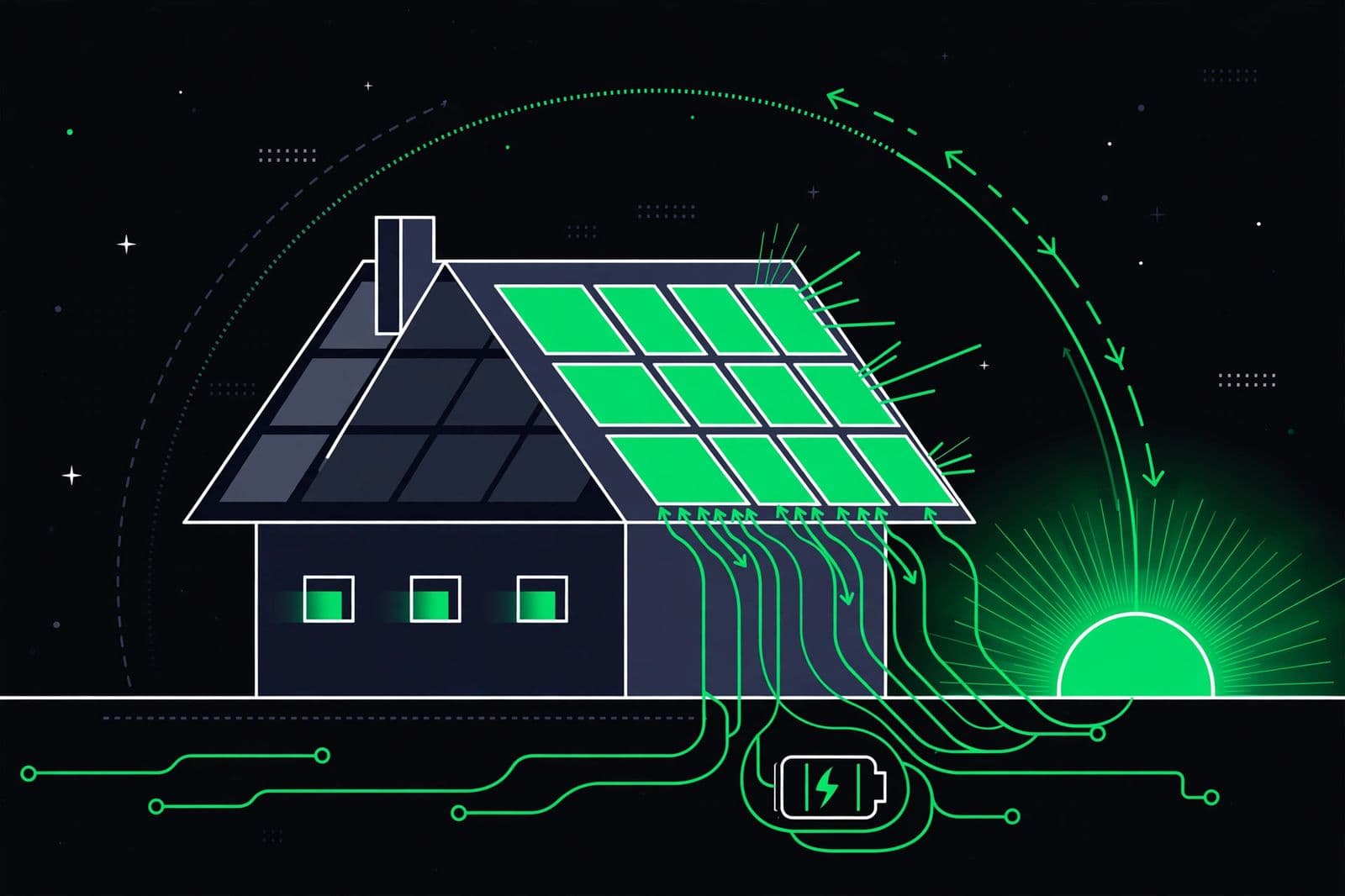
- A north-facing array in the northern hemisphere produces less than a south-facing array, and roof pitch decides how much less.
- At a typical 20-degree pitch the loss is about 30 percent, while a low-pitch north roof keeps roughly 80 percent of south-facing output.
- Tilt-up racking, a larger array, an east-west split, a battery, or community solar can each close part of the gap.
Solar panels on a north-facing roof: a rooftop solar array installed on the side of a roof that faces away from the sun in the northern hemisphere. The panels still generate electricity from diffuse and reflected light, plus direct sun in early morning and late evening, but annual output runs below a south-facing array on the same roof.
A solar panels north-facing roof question usually starts with direction, yet roof pitch answers it. Two houses can share the same compass direction and get very different results, because a shallow north slope still catches a useful share of sky light while a steep north slope turns its face away from the sun for most of the day. Pitch sets the size of the penalty, and pitch also sets which fix is worth paying for.
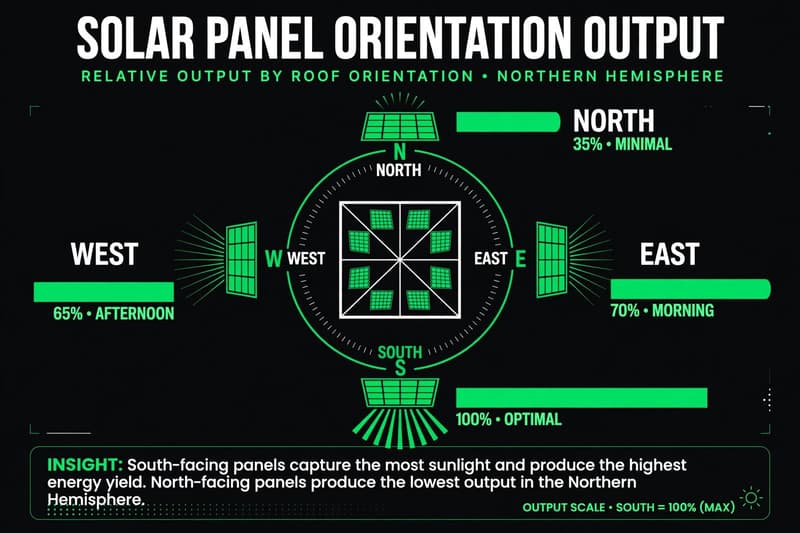
Direction still matters. In the northern hemisphere the sun spends most of the day in the southern sky, so a south-facing panel meets direct sunlight head on for the longest stretch. A north-facing panel meets direct sunlight only at the edges of the day, in summer, when the sun rises north of east and sets north of west. The rest of its output comes from diffuse skylight and light reflected off nearby surfaces. That is a real source of energy, and it explains why a north-facing array produces a substantial share of a south-facing array rather than nothing at all.
Contents
- Solar panels north-facing roof output at a 20-degree pitch
- Why tilt changes the loss from 12 percent to 50 percent
- Output by orientation and tilt in the Atlanta model runs
- What a 30 percent output loss does to a north-facing roof’s payback
- Workarounds that close the gap on a north roof
- When a north-facing roof still makes sense
- Frequently asked questions
Solar panels north-facing roof output at a 20-degree pitch
A typical US roof pitch sits in the range the US Department of Energy homeowner solar guide describes as best for panels, namely south-facing roofs sloped between 15 and 40 degrees. Most homes fall somewhere inside that band, and a 20-degree pitch is a useful reference point because it sits near the middle of it. At that pitch, three independent sources point to the same answer for a north-facing array.
Fronius, the inverter manufacturer, puts north-facing output at 30 to 50 percent below a south-facing array, with south-west and south-east orientations at 95 percent of maximum yield and east or west orientations around 20 percent below south. Installer guidance from Angi lands in the same place, with east and west panels producing 10 to 20 percent less than south-facing panels and north-facing panels losing up to 30 percent. A PVGIS model run for Atlanta, using a 1 kW crystalline silicon system on a fixed mount with 14 percent system losses, gives the same result in numbers: at a 20-degree tilt, a north-facing array produces 1,038 kWh per year, which is 70 percent of the best case in that run, against 1,467 kWh for a south-facing array at the same tilt.
The agreement across those three sources is the point. A manufacturer guide, an installer guide and a solar resource model each arrive at roughly a 30 percent loss for a north-facing array at a typical pitch. That consensus is stronger than any single figure, because each source reaches it by a different route. Treat 30 percent as the planning figure for a standard-pitch north roof in the northern hemisphere, and treat the wider 30 to 50 percent range as the warning that pitch can push the loss higher.
Small deviations from true south cost almost nothing, which matters for houses whose roofs face south-southwest or south-southeast rather than due south. Angi notes that panels 10 degrees off true south lose only about 1 percent of output. The penalty grows slowly at first and then accelerates as the azimuth turns further from south. A roof that faces mostly south with a slight turn toward the east or west is a strong solar roof. A roof that faces mostly north is a different case, and the rest of this guide is about measuring that case honestly and fixing it where a fix pays.
Why tilt changes the loss from 12 percent to 50 percent
Tilt and azimuth work together. The solar panel azimuth is the compass direction a panel faces, and tilt is the angle of the panel above horizontal. The US Energy Information Administration explains that latitude is often the primary factor determining tilt, and that tilting toward the south at an angle equal to latitude maximises annual exposure to direct sunlight. Most utility-scale fixed-tilt systems in the United States are tilted 20 to 30 degrees, according to the same EIA article. A roof panel follows the same geometry, with the roof pitch standing in for the tilt angle.
On a flat or nearly flat roof, direction barely matters. The Atlanta model run puts a flat roof at 1,315 kWh per year in every direction, which is 88 percent of the best case in that run. A flat north-facing array loses only about 12 percent against the best south-facing result, because a horizontal panel sees the same sky in every direction. The penalty for facing north is small when the panel is nearly level, and it grows as the panel tilts further from level.
At a 10-degree tilt, the Atlanta model run puts a north-facing array at 1,190 kWh per year, or 80 percent of the best case. That is a loss of roughly 20 percent against the best case, and the north roof solar loss grows from there as the tilt rises. At a 20-degree tilt, the north-facing figure falls to 1,038 kWh, or 70 percent of the best case. On a steep roof, Fronius puts the loss at up to 50 percent, which matches the direction of the model trend: every extra degree of northward tilt turns the panel further from the sun path and cuts deeper into direct sunlight hours.
The EIA study of Los Angeles adds a second angle on the same geometry. In that PVWatts-based study, a south-oriented fixed-tilt system at a 20-degree tilt yielded 11 percent more annual energy than a flat fixed system, while a west-oriented system yielded little more than a flat system and an east orientation yielded substantially less. On an ideal sunny summer day in Los Angeles, with a 1 kW system at a 20-degree tilt, a west orientation reduced daily production by 10 percent and an east orientation by 5 percent compared with south-facing. The pattern is consistent: south gains from tilt, north loses from tilt, and east and west sit in between.
Roof pitch therefore decides whether a north-facing roof is a marginal case or a poor case. Solar roof orientation sets the direction of the loss, and pitch sets its size. A low-pitch north roof in the 10 to 15 degree range keeps roughly 80 percent of south-facing output, which many households can work with. A standard-pitch north roof near 20 degrees keeps roughly 70 percent. A steep north roof above 30 degrees can keep only about half, and at that point the roof itself is the problem rather than the panels. Any honest assessment of a north-facing roof starts by measuring the pitch, because the pitch number changes the answer more than the compass reading alone.
Shading interacts with pitch in the same way. A north-facing array already runs on a thinner margin of direct sunlight, so a chimney, a dormer or a neighbouring tree that shades it for part of the day takes a larger share of its output than the same shade would take from a south-facing array. A site survey that maps shade hour by hour matters more on a north roof, and a roof that combines a steep north pitch with heavy shading is the combination most likely to fail a cost check. Sizing the array correctly starts with that survey, because panel count follows from the output each panel can actually deliver on that specific roof.
Output by orientation and tilt in the Atlanta model runs
The table below collects the Atlanta model runs in one place. These are PVGIS version 5.2 model runs for Atlanta, using a 1 kW crystalline silicon system on a fixed mount with 14 percent system losses. They are model runs for one city, and they are a guide to the size of the effect rather than measured output for every US location. PVGIS gives about 5 percent more than a PVWatts version 8 run for the same south-facing 20-degree case, so read the percentages as the takeaway and treat the kilowatt-hour figures as the model output for Atlanta.
| Orientation | Tilt | Annual output (kWh) | Share of best case |
|---|---|---|---|
| South | 20 degrees | 1,467 | 98 percent |
| East | 20 degrees | 1,279 | 86 percent |
| West | 20 degrees | 1,273 | 85 percent |
| North | 20 degrees | 1,038 | 70 percent |
| North | 10 degrees | 1,190 | 80 percent |
| Any direction | Flat roof | 1,315 | 88 percent |
Three readings follow from the table. First, the gap between south and north at the same 20-degree tilt is 429 kWh per year on a 1 kW system, which is the clearest picture of north-facing roof solar output in the Atlanta run. Second, lowering the tilt from 20 degrees to 10 degrees recovers 152 kWh per year on the north face, which is why tilt-up and tilt-down racking matter so much on a north roof. Third, a flat roof beats a tilted north roof outright, at 1,315 kWh against 1,038 kWh, which shows that tilt can hurt as well as help when the azimuth points the wrong way.
East and west deserve a note of their own, because many houses with a north-facing front have east- or west-facing sides. At a 20-degree tilt, east produces 1,279 kWh and west produces 1,273 kWh in the Atlanta run, or 86 and 85 percent of the best case. That is a loss of roughly 15 percent against south, which sits inside the 10 to 20 percent range Angi reports for east and west panels. A split array across east and west faces can therefore outperform a single north-facing array by a wide margin, and it also spreads production across morning and evening, which lines up with household demand better than a midday peak in many homes.
Latitude shifts the numbers without changing the pattern. Atlanta sits at a latitude near 34 degrees north, and the tilt that maximises south-facing output there is close to that latitude. Further north, the sun sits lower in the sky, the south-facing advantage grows, and the north-facing penalty grows with it. Further south, toward Florida or southern Texas, the sun sits higher, the penalty shrinks, and a low-pitch north roof performs closer to a south-facing roof. A model run for a specific address, using PVWatts or PVGIS with the real roof pitch and azimuth, is the step that turns these general figures into a number a household can plan around.
What a 30 percent output loss does to a north-facing roof’s payback
A 30 percent output loss is a 30 percent loss in the energy the array sells back to the household, and the financial effect follows the same arithmetic. Take the Atlanta model numbers and scale them to a household-size array. A 6 kW south-facing array at a 20-degree tilt produces about 8,802 kWh per year in the model, from 6 multiplied by 1,467. A 6 kW north-facing array at the same tilt produces about 6,228 kWh per year, from 6 multiplied by 1,038. The gap is 2,574 kWh per year, which is the energy the household buys from the grid instead of generating on its own roof. That gap repeats every year for the life of the system, and it is the cost of the wrong-facing roof in its simplest form.
The same arithmetic shows why a low-pitch north roof is a different financial case from a steep one. At a 10-degree tilt, a 6 kW north-facing array produces about 7,140 kWh per year in the model, from 6 multiplied by 1,190, which closes more than a third of the gap to the south-facing figure. On a flat roof, the same 6 kW array produces about 7,890 kWh per year, from 6 multiplied by 1,315, which closes most of the gap. Pitch is the lever that moves the financial result, and a household that knows its pitch knows which side of the line it sits on.
Panel degradation adds a slow second layer to the same calculation. Panels lose a small share of output each year, and a north-facing array starts from a lower baseline, so its absolute output falls further behind a south-facing array over time even when the percentage loss stays steady. The degradation rate for modern panels is low enough that it rarely decides a purchase on its own, yet it belongs in a long-term estimate for a north-facing roof, because the roof that barely clears the bar in year one can slip below it as the years pass.
Electricity prices set the value of each kilowatt-hour, and that value decides whether a 30 percent loss still leaves a working system. A household on a high retail electricity rate recovers the cost of a north-facing array faster than a household on a low rate, because every kilowatt-hour the array generates displaces an expensive kilowatt-hour from the grid. A household with a battery and a time-of-use tariff can add a second layer of value by storing midday output for evening use, when the grid price is higher. Time-of-use rates change the value of stored solar output in ways a simple annual total cannot show, and a north-facing array paired with a battery can earn more per kilowatt-hour than its raw output figure suggests.
The honest conclusion is that a north-facing roof is not automatically a bad solar roof. It is a roof that needs a larger array, a lower pitch, a battery, or a cheaper installation to reach the same result as a south-facing roof. When none of those levers is available, and the roof is steep and shaded, the money is usually better spent elsewhere, and community solar is the fallback that keeps the household in solar without touching the roof at all.
Workarounds that close the gap on a north roof
A north-facing roof leaves a household with a short list of fixes, and each fix trades something. The fixes below are ordered from the cheapest change to the largest change, and each one carries its own cost. No fix turns a north-facing array into a south-facing array. Each one recovers part of the loss, and the right combination depends on the roof pitch, the available roof space, and the local electricity tariff.
Tilt-up racking on a low-slope north roof
Tilt-up racking lifts panels on a low-slope or flat north roof so they sit closer to level, or tilts them toward the south. The Atlanta model numbers show why this works: moving a north-facing array from a 20-degree tilt to a 10-degree tilt recovers about 15 percent of the best-case output, and flattening it entirely recovers more. On a flat roof, racking can also tilt panels south, which recovers most of the loss outright. The tradeoff is cost and wind load. Racking hardware adds to the installation bill, it raises the profile of the array, and it increases the wind load the roof must carry, so a structural check comes first. On a steep north roof, tilt-up racking cannot fix the geometry without lifting panels to an impractical angle, which is why this fix belongs on low-slope roofs.
Oversizing the array to offset the loss
Oversizing means installing more panels to make up for lower output per panel. A north-facing array that produces 70 percent of a south-facing array needs roughly 43 percent more capacity to match the same annual output, from 1 divided by 0.70. A household that needs 6 kW of south-facing output would need about 8.6 kW of north-facing capacity at a 20-degree tilt to generate the same energy. The tradeoff is roof space and upfront cost. More panels need more roof area, more racking and more wiring, and the extra panels generate at the same reduced rate, so the cost per kilowatt-hour stays higher than on a south-facing roof. Oversizing works best when the roof is large, the pitch is low, and the household has room to add panels without shading them.
Splitting panels across east and west faces
Many houses with a north-facing front also have east- and west-facing roof sections, and a split array across those faces outperforms a single north-facing array. The Atlanta model run puts east at 86 percent and west at 85 percent of the best case at a 20-degree tilt, against 70 percent for north. A split array also produces power in the morning from the east face and in the evening from the west face, which matches the hours when a household uses the most electricity. The tradeoff is complexity. A split array needs more wiring runs, and it often needs module-level power electronics so that a shaded face does not drag down the other face. The gain is real, and it is the first option to check when the roof has usable east or west sections.
Using the north face for part of the array
A partial north-facing array treats the north face as a secondary surface rather than the main array. The south, east or west faces carry the bulk of the system, and the north face adds panels that fill out the total capacity. This works when the main faces are too small for the household load and the north face has spare area. The north-facing panels still produce at the reduced rate, so they contribute less per panel, yet they add energy the household would otherwise buy from the grid. Keeping every panel clean matters more on a marginal face, because dirt and debris take a larger share of output when the baseline is already low.
Pairing with a battery and time-of-use rates
A battery does not increase the energy a north-facing array produces, and that limit needs stating plainly. What a battery does is change when the household uses the energy, by storing midday output for the evening peak when grid electricity costs the most under a time-of-use tariff. A north-facing array produces less in total, so the battery cycles less energy, yet each stored kilowatt-hour can be worth more than a kilowatt-hour used at midday. The tradeoff is the cost of the battery itself, which is a large addition to the system price. A battery makes sense on a north-facing roof when the evening tariff is high enough to repay it, and it makes less sense when the household already uses most of its solar output during the day.
Ground-mount, pergola or carport when the roof is wrong
When the roof pitch and direction both work against solar, the panels can leave the roof entirely. A ground-mount array can face due south at the ideal tilt, a pergola can carry panels over a patio, and a carport can carry them over a driveway. Each option recovers the full south-facing output that the roof denied, and each one adds its own structure cost. Ground mounts need yard space and a foundation, pergolas and carports need a structure strong enough to carry panels through wind and snow loads, and all three need a cable run back to the house. The tradeoff is space and money against output, and for a household with a steep north roof and a sunny yard, the ground option can beat the roof option outright.
Community solar when the roof cannot work
Community solar is the fallback for a roof that cannot carry a working array. The household subscribes to a share of a solar farm elsewhere and receives credits on its electricity bill for the energy that share produces. Community solar works for renters and for homes without a suitable roof, and it needs no installation, no roof work and no upfront panel cost. The tradeoff is control. The household does not own the panels, the savings depend on the subscription terms, and availability depends on the state and the local utility. For a steep, shaded north-facing roof, community solar is often the better financial choice, and it is the option to compare against any roof fix before signing a contract.
When a north-facing roof still makes sense
A north-facing roof still makes sense in a short list of cases. A low-pitch north roof near 10 degrees keeps about 80 percent of the best-case output in the Atlanta model run, and that figure supports a working system in most US locations. A household with high retail electricity rates can make the numbers work at a 30 percent loss, because each generated kilowatt-hour displaces an expensive grid kilowatt-hour. A household with a large north roof and room to oversize can recover the lost energy by adding panels. A household with a battery and a time-of-use tariff can earn more per kilowatt-hour than the raw output figure suggests. A household in the southern United States, where the sun sits higher and the north-facing penalty shrinks, has a better case than a household in the northern states.
The cases that fail are equally clear. A steep north roof above 30 degrees, combined with heavy shading and low electricity rates, rarely repays its cost. A small north roof with no room to oversize and no east or west faces leaves no lever to pull. A household that would need a battery, tilt-up racking and oversizing all at once is paying three times to fix one roof, and the combined cost usually exceeds the value of the energy recovered. In those cases the honest answer is to skip the roof and take community solar, or to wait for a roof replacement that changes the pitch.
Everything in this guide reverses south of the equator. In the southern hemisphere the sun spends most of the day in the northern sky, so a north-facing roof is the ideal orientation there and a south-facing roof carries the roughly 30 percent loss. The physics is the same, and only the compass direction flips. A household in Australia, South Africa or southern South America should read every north and south reference in this guide in reverse.
Before signing a contract, get a model run for the specific address. A PVWatts or PVGIS run with the real roof pitch, the real azimuth and the real shading takes the general figures in this guide and turns them into an annual kilowatt-hour estimate for that roof. Compare that estimate against the household load, the retail electricity rate and the quoted system price, and the decision usually makes itself. A roof that clears the bar on those numbers is a working solar roof, whatever direction it faces.
Frequently asked questions
do solar panels work on north facing roof
Yes, solar panels work on a north-facing roof in the northern hemisphere, and they produce a substantial share of a south-facing array. At a typical 20-degree pitch they produce about 70 percent of the best-case output in the Atlanta model run, and on a low-pitch roof they produce about 80 percent. They generate from diffuse skylight and reflected light plus direct sun at the edges of the day, so output is lower rather than zero.
how much less energy do north-facing solar panels produce
At a typical 20 to 30 degree roof pitch, north-facing panels produce about 30 percent less than south-facing panels, based on the agreement between Fronius, Angi and the Atlanta PVGIS model run. The loss rises toward 50 percent on a steep roof and shrinks to roughly 12 to 20 percent on a low-pitch or flat roof. Roof pitch decides where inside that range a specific house falls.
can solar panels face north in the southern hemisphere
Yes, and in the southern hemisphere north-facing is the ideal direction. The sun spends most of the day in the northern sky south of the equator, so a north-facing array there gets the direct sunlight that a south-facing array gets in the northern hemisphere. A south-facing roof in the southern hemisphere carries the roughly 30 percent loss instead.
is it worth putting solar panels on a north-facing roof
It is worth it when the roof pitch is low, electricity rates are high, the roof has room to oversize, or a battery and time-of-use tariff raise the value of each kilowatt-hour. It is rarely worth it on a steep, shaded north roof with low electricity rates and no room for extra panels. A model run for the specific address, using PVWatts or PVGIS with the real pitch and azimuth, gives the number that settles the question.
what is the best direction for solar panels
In the northern hemisphere the best direction is south, at a tilt near the local latitude, which the US Energy Information Administration describes as the tilt that maximises annual exposure to direct sunlight. South-west and south-east orientations reach about 95 percent of maximum yield, and east or west orientations produce roughly 10 to 20 percent less than south. In the southern hemisphere the best direction is north.
Sources
- US Energy Information Administration, Today in Energy, 27 December 2018: fixed-tilt solar orientation and tilt, Los Angeles PVWatts study.
- US Department of Energy, Homeowner’s Guide to Going Solar: panels perform best on south-facing roofs sloped between 15 and 40 degrees.
- Fronius blog, Solar panels orientation: south-west and south-east at 95 percent of maximum yield, east or west around 20 percent less than south, north-facing 30 to 50 percent less.
- Solar Powered Tech, PVGIS version 5.2 model runs for Atlanta: orientation and tilt output table for a 1 kW crystalline silicon system with 14 percent system losses.
- Angi, What direction should solar panels face: east and west panels produce 10 to 20 percent less than south-facing, north-facing panels lose up to 30 percent, panels 10 degrees off true south lose about 1 percent.