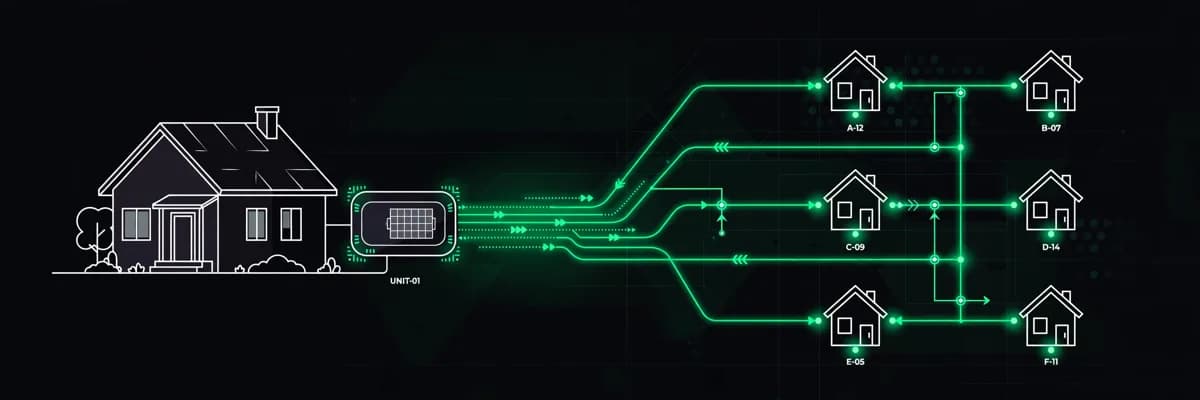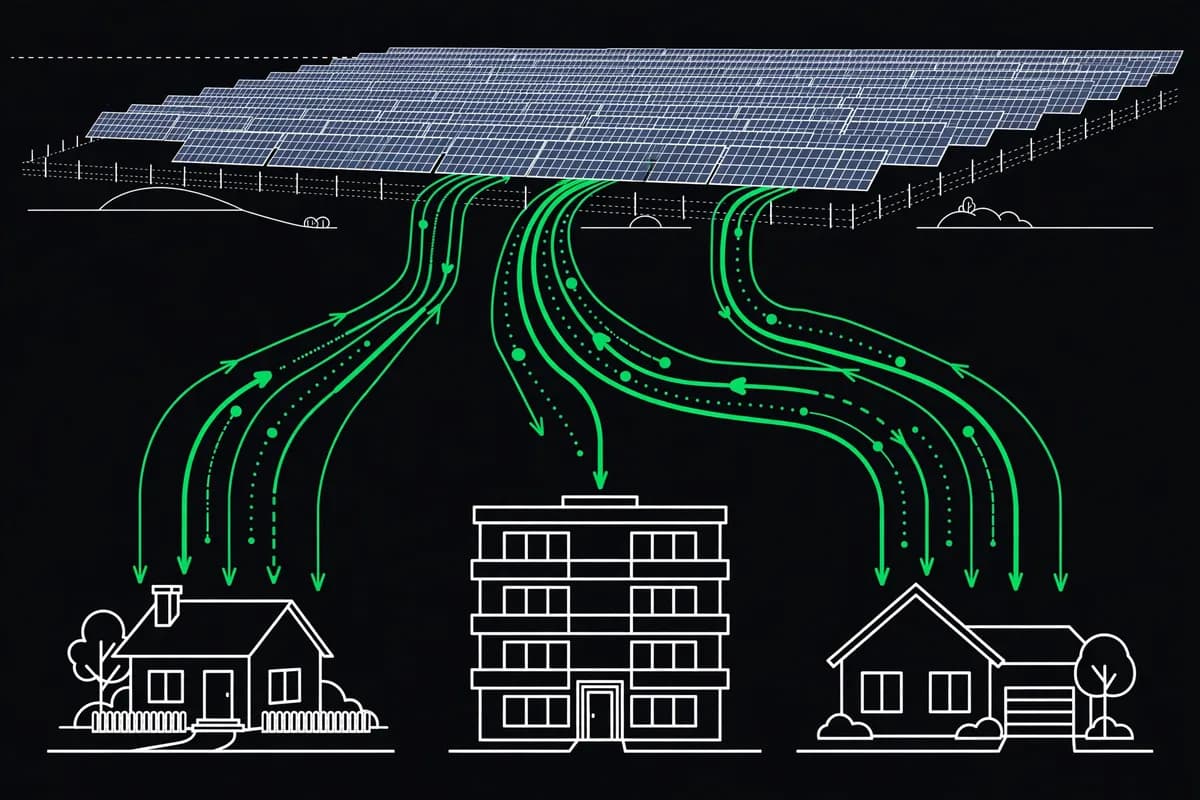
- Community solar lets a household subscribe to a share of an off-site solar array and receive credits on its own utility bill, with no panels on its own roof.
- The saving is the gap between the bill credit and the subscription fee, so the contract terms matter more than the size of the solar farm.
- Availability is set by state policy and the local utility, which means two renters in different states can face entirely different offers.
Community solar: A solar project shared by multiple customers, where each subscriber receives bill credits for a share of the electricity the off-site array produces, instead of installing panels on their own property.
The decision a renter faces is not whether shared solar works in principle. The credit mechanism is settled. The decision is whether a specific subscription leaves money on the table after the second bill arrives. Community solar creates two monthly charges that move in opposite directions. The utility applies a credit for the subscriber’s share of generation, and the solar provider invoices a fee for that same share. A household saves money only when the credit exceeds the fee, month after month, under contract terms that can change how the fee is calculated.
The U.S. Department of Energy defines community solar as any solar project or purchasing program, within a geographic area, in which the benefits flow to multiple customers such as individuals, businesses, nonprofits, or other groups. In most cases, customers benefit from energy generated by solar panels at an off-site array. Subscribers can buy or lease a portion of the panels, and they typically receive an electric bill credit for electricity generated by their share, similar to someone with rooftop panels on their own home. The Department lists renters, households with insufficient sunlight or unsuitable roofs, and households that cannot afford the upfront cost among the people the model is built for.
How the two bills work in practice
Generation starts at the shared array, which feeds electricity into the local grid through a utility meter. The utility measures production, allocates a share to each subscriber, and applies a dollar credit to the subscriber’s monthly electric bill. Separately, the subscriber pays the community solar provider a monthly fee for that share. The two amounts are linked to the same production, so a cloudy month shrinks both the credit and the fee in a typical subscription structure, while a sunny month raises both.
That linkage is the part to understand before signing. A fixed discount structure, where the fee is set as a percentage of the credit value, keeps the saving proportional to production. A fixed monthly fee, by contrast, can leave a subscriber paying the same amount in a low-production winter month when the credit is smaller. The contract should state which structure applies, whether the fee can escalate, and how credits are treated when they exceed a month’s usage. Some programs carry excess credits forward, while others apply different rules at year end.
| Monthly bill credit | Subscription fee | Monthly saving |
|---|---|---|
| $100 | $95 (95 percent of credit value) | $5 |
| $100 | $90 (90 percent of credit value) | $10 |
| $100 | $80 (80 percent of credit value) | $20 |
| $60 (low-production month) | $57 (95 percent of credit value) | $3 |
| $60 (low-production month) | $80 (fixed fee) | -$20 |
The table above is an illustration built from the discount structure described by the Department of Energy, not a quote from any provider. It shows why a five-point difference in the discount rate matters more than a headline claim about savings. At a $100 monthly credit, moving from a 5 percent discount to a 20 percent discount quadruples the saving from $5 to $20. A fixed fee that looks reasonable in summer can turn negative in a low-production month, which is why the fee structure deserves as much attention as the discount rate.
Renters, shaded roofs, and households that move
Three groups gain the most from the model. Renters cannot usually alter a landlord’s roof, and a subscription requires no permission for physical work on the building. Owners with heavy shading, a roof facing the wrong direction, or a roof too small for a useful array can buy into a larger, well-sited project instead. Households that expect to move within a few years avoid a 25-year asset tied to one address, provided the subscription allows transfer or cancellation without a large exit fee.
The trade is real. A well-sited rooftop system owned outright can deliver larger lifetime savings than a subscription, because the owner keeps the full value of generation after payback instead of sharing it with a provider. Rooftop ownership also pairs directly with a home battery or an electric vehicle charger behind the same meter, while community solar credits touch only the supply portion of the bill. The comparison below sets out the practical differences, using the Department of Energy description of the shared model and the standard rooftop ownership case covered in Joule Post’s rooftop economics guide.
| Feature | Community solar subscription | Owned rooftop solar |
|---|---|---|
| Upfront cost | Usually none | Thousands of dollars before incentives |
| Roof required | No | Yes, with suitable orientation and condition |
| Bill effect | Credit minus subscription fee | Reduced purchases plus export credits |
| Moving home | Transfer or cancel under contract terms | System stays with the house |
| Maintenance | Provider responsibility | Owner responsibility |
| Lifetime saving potential | Modest, steady discount | Higher after payback, if the roof suits solar |
The state map decides whether a good offer exists
Community solar is not a national product. Each project serves customers inside a specific utility territory, under state rules that set how credits are valued and who may subscribe. The Department of Energy notes that more than 1,600 community solar projects operate across 39 states and the District of Columbia, with 72 percent of them in only four states: Minnesota, Florida, Massachusetts, and New York. A household outside an enabling state may have no subscription to buy at any price, while a household inside one of the leading states may have several competing offers.
California shows how policy can stall a market that looks ready on paper. Governor Gavin Newsom vetoed the latest community solar legislation, AB 1813, on 30 September 2026, as Joule Post reported at the time, while signing bills supporting virtual power plants and plug-in balcony solar in the same round of decisions. Renters in California therefore cannot rely on a community solar subscription as a near-term route to solar savings, and should check the current program status with their utility rather than assume a national offer applies locally.
The Department of Energy also reports that nearly 50 percent of households and businesses are unable to host rooftop solar systems, based on analysis by the National Renewable Energy Laboratory. That figure frames the size of the audience for shared solar, and it explains why state programs aimed at low- and moderate-income households treat community solar as an access policy as much as an energy policy. The Department’s consumer guidance recommends that subscribers receive a bill credit with at least 20 percent household savings, with no sign-up, exit, or termination fees, and states that programs designed for low-income households all require subscribers to achieve energy savings.
What 5 to 25 percent means in dollars
The National Renewable Energy Laboratory’s Sharing the Sun analysis, cited by the Department of Energy, found that community solar can lead to bill savings of 5 to 25 percent, with a $1 billion national savings target implying an average saving of about 20 percent across projects. Applied to a household whose share earns $1,200 in bill credits over a year, the arithmetic is straightforward. A 5 percent discount leaves $60. A 10 percent discount leaves $120. A 20 percent discount leaves $240. The calculation is Joule Post’s own, built from the laboratory’s percentage range and a round $1,200 annual credit figure used only to make the percentages concrete.
Those annual figures look small beside rooftop ownership, and that comparison is the honest one. A subscription saving of $120 a year is worth about $10 a month, which will not transform a household budget. Its value sits elsewhere: no capital outlay, no roof work, no maintenance, and access for households locked out of rooftop solar entirely. A subscriber who treats the offer as a discount on an existing bill, rather than as an investment, will judge it correctly. A subscriber who expects rooftop-scale returns from a subscription will be disappointed by design, because the provider keeps part of the value to finance, build, and operate the shared array.
Four checks before signing a subscription
First, confirm the discount is guaranteed in the contract and not described only as an estimate. A guaranteed percentage of the credit value protects the saving when production varies. Second, read the exit terms. The Department of Energy guidance recommends no exit or termination fees, but not every commercial offer follows that guidance, and a fee can erase years of modest savings if a move forces cancellation. Third, ask how long credits take to appear. Utilities typically need one to three months to set up virtual net metering on an account, so the first saving arrives later than the first invoice in some programs. Fourth, ask who keeps the renewable energy certificates. In some programs the utility or provider retains them, which means the subscriber supports solar generation financially without being able to claim the renewable attributes for their own use.
Subscribers should also check whether the share size matches their usage. A share sized well above annual consumption can generate credits the household cannot use, depending on program carryover rules. A share sized too small leaves most of the bill untouched. Providers typically size shares from 12 months of usage history, and a household that recently changed its usage, for example by buying an electric vehicle, should ask for the share to be sized on the new pattern rather than the old one. Sizing guidance for a home’s own energy needs is covered in Joule Post’s panel-count guide, and the same usage-first logic applies to choosing a subscription share.
Frequently asked questions
How does community solar work for renters?
A renter subscribes to a share of an off-site solar array in the same utility territory. The utility applies credits for that share to the renter’s electric bill, and the renter pays the solar provider a subscription fee. No panels are installed at the rented home, and no landlord permission for roof work is needed.
Is community solar worth it?
It is worth it when the contract guarantees a discount on the credit value, charges no exit fee, and matches the share to actual usage. National laboratory analysis puts savings at 5 to 25 percent of the bill. It is not worth it when the fee is fixed regardless of production, the discount is only an estimate, or cancellation carries a large fee.
Does community solar require a suitable roof?
No. The array sits elsewhere in the utility territory. Roof condition, shading, and orientation do not affect eligibility, which is why the model suits renters and owners with unsuitable roofs.
What happens if I move house?
It depends on the contract and the new address. Some subscriptions transfer within the same utility territory, while others require cancellation. Check the transfer and exit terms before signing, and confirm whether any fee applies.
Who owns the solar panels in a community solar project?
Ownership varies. Utilities, third-party developers, nonprofits, and community-owned companies all operate projects. In a subscription model the subscriber usually owns no panels and holds no maintenance responsibility. In an ownership model the subscriber buys a share of the array upfront and receives credits based on actual generation.