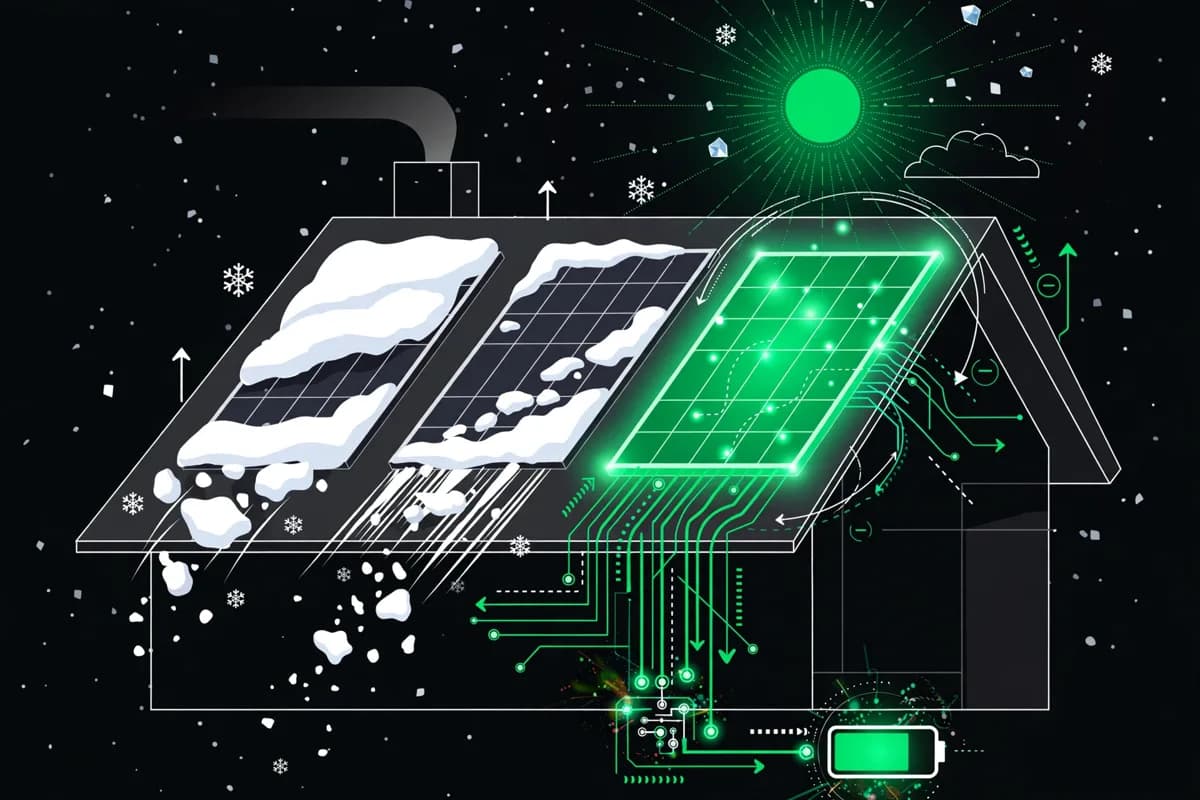
- Cold air raises the power a panel delivers for each hour of sunlight, because output falls once cell temperature rises above 25°C.
- Snow hurts output only while it covers the glass, and tilted panels usually shed it on their own once sun returns.
- Short days and low sun angles drive most of the winter drop, and a three-day snow cover on a typical roof costs roughly $10 in lost generation.
Solar panels in winter: Photovoltaic panels convert sunlight into electricity in any season. Winter output falls mainly because days are shorter and the sun sits lower, while cold temperatures improve the conversion itself.
Solar panels in winter sit at the center of a durable misunderstanding. Heat is the enemy of panel output, so a bright January day can deliver more watts per hour of sunshine than a hazy July afternoon. EnergySage puts the turning point at a cell temperature of 25°C (77°F), above which output starts to fall, with the size of the fall set by each panel model. The winter problem is limited light. Days are shorter, the sun tracks lower across the sky, and snow can block the glass until it slides clear.
The physics is straightforward. A solar cell turns photons into electric current, and rising cell temperature trims voltage faster than it lifts current. Manufacturer datasheets express the effect as a temperature coefficient, a percentage of rated power lost for each degree above 25°C. Take an illustrative coefficient of 0.35% per degree, stated here as an assumption for the arithmetic that follows. A cell running at 65°C sits 40 degrees above its rating point, which implies a 14% instantaneous derate. A cell at 25°C on a cold, bright day carries no such penalty. That gap explains why installers in snowy states report strong per-hour winter performance even as daily totals fall.
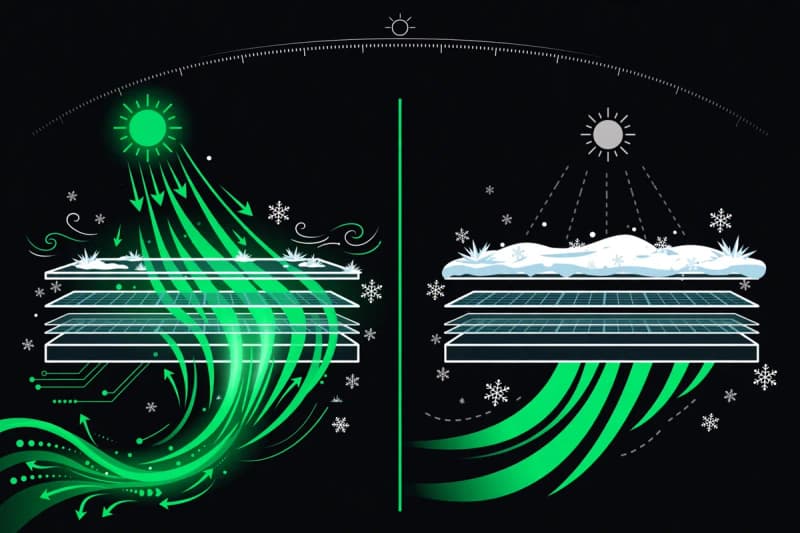
What cold air does to solar panels in winter
EnergySage states that solar panels work well in winter as long as they do not stay covered in snow, and that cold temperatures typically improve output. Snow on the ground can add a small bonus, because white surfaces reflect extra light onto the array. The same page notes that panels are tilted, so snow tends to slide off on its own, and that panels are pressure tested for snow loads, with higher pressure ratings indicating stronger resistance to heavy snow weight. None of that removes the seasonal arithmetic. The worst of winter lasts about three months in the northern United States, EnergySage notes, and long summer days repay part of the winter shortfall.
Day length sets the ceiling. A northern roof that sees about 15 hours of daylight near the June solstice sees about 9 hours near the December solstice, roughly 60% of the summer figure. Output per hour can be higher in winter, and total daily output can still fall by a third or more, because the sun is available for far fewer hours and arrives at a lower angle. Cloud cover compounds the effect on the dullest days. Readers comparing a December bill with a June bill are mostly comparing daylight, plus whatever snow cover intervened.
Snow cover decides the daily total
A panel fully covered in snow produces close to nothing, because the cells receive no light. A partly covered panel produces in proportion to the clear area, and modern string layouts can lose a whole string when one shaded section drags it down. The practical question is how long cover lasts. Tilt helps. EnergySage notes that snow typically melts or slides off panels installed at an angle, and that a snow rake made for panel cleaning can clear stubborn cover from the ground. The safety line that matters most is simple: do not climb onto a snowy roof to clear panels. A fall from a roof costs far more than the generation at stake, and a metal shovel can scratch the glass.
Put a number on a typical snow event with stated assumptions, so the stakes stay concrete. Assume an 8 kW roof that would generate 20 kWh on an average winter day, and a retail electricity price of 17 cents per kWh. One fully covered day loses about 20 kWh, worth $3.40. Three covered days lose about 60 kWh, worth $10.20. Seven covered days lose about 140 kWh, worth $23.80. Those figures describe one household illustration with stated assumptions, and the real loss depends on local sun, tilt, and how quickly snow slides. The point is scale. A single storm costs a few dollars of generation. A roof that stays covered for weeks, because of a shallow tilt or repeated storms with no thaw, is where the loss turns material.
| Snow cover on an 8 kW roof | Generation lost | Value at 17 cents per kWh |
|---|---|---|
| 1 day fully covered | About 20 kWh | $3.40 |
| 3 days fully covered | About 60 kWh | $10.20 |
| 7 days fully covered | About 140 kWh | $23.80 |
| Partial cover, half the array | About 10 kWh per day | $1.70 per day |
For context, the same 8 kW roof in the earlier Joule Post cleaning guide was modelled at 12,000 kWh a year. Winter snow losses of tens of kilowatt-hours sit beside annual totals in the thousands. Cleaning a roof in summer, when soiling can persist for months, can matter more than one winter storm. Snow is a short, sharp interruption. Soiling is a slow leak.
Why snowy states still rank near the top for solar
EnergySage reports that the Solar Energy Industries Association ranked Colorado, Ohio, New Jersey, and New York among the top 10 states for installed solar in 2023, and all four see snow every year. Cold-climate homeowners also tend to pay higher electricity prices, which raises the value of each kilowatt-hour their panels produce. The combination of efficient cold-weather operation and expensive grid power explains why rooftop solar pays in places far from the Sun Belt. Shoppers sometimes assume the opposite, that solar belongs only in deserts. The installed-capacity ranking says otherwise.
Winter can also be the cheapest time to buy. EnergySage notes that installers often lower prices in winter as demand wanes, and that winter is a good time to shop for solar. A homeowner who signs in November or December still faces the same permitting and interconnection waits, so an install agreed in winter may switch on in spring. The seasonal price dip affects shopping costs only, and buyers should weigh it against the loss of the federal residential credit for expenditures after 31 December 2025, which the Joule Post 2026 tax credit guide covers for the wider clean-energy picture.
How to size winter expectations before you buy
Start with the annual production estimate in the installer quote, then ask for the monthly split. A quote that shows only an annual total hides the winter trough. Ask how the estimate treats snow, and whether the modelling tool applies a snow-loss factor for the local climate. If two quotes differ mainly in winter months, the difference usually traces to snow assumptions or tilt, and the installer should be able to name which one changed. A roof facing south at a steeper tilt sheds snow faster than a shallow east-west roof, and that single design choice can matter more than panel brand in a snowy climate.
Existing owners can check their own winter pattern in minutes. Open the monitoring app covered in the Joule Post guide to finding a dead panel, and compare a clear cold day with a snowy day in the same week. The clear day shows the cold-weather rate. The snowy day shows the cover penalty. A panel that stays dark after snow has cleared on its neighbours deserves the same diagnostic steps as any underperformer, starting with the array view and ending with an installer call if the gap persists. Winter is a useful diagnostic season precisely because cover is visible and temporary.
Frequently asked questions
Do solar panels work when it is snowing?
Panels can generate electricity while snow falls, as long as light reaches the cells. Heavy cover that blocks the glass stops production until it slides or melts.
Should I clear snow off my solar panels?
Use a long-handled snow rake designed for panels, from the ground, if cover persists and the sun is out. Stay off the roof, and never use a metal shovel on the glass.
Does cold weather damage solar panels?
Panels are built and pressure tested for snow loads and freezing temperatures. Extreme accumulation can require removal, and ratings vary by panel, according to EnergySage.
Do solar panels produce more power in winter or summer?
Power per hour of sunlight can be higher in cold winter air, and total daily output is usually higher in summer because days are longer and the sun is higher.
Is winter a good time to install solar panels?
Installers often quote lower prices in winter, EnergySage notes. Permitting and utility approval still take weeks, so a winter purchase may switch on in spring.