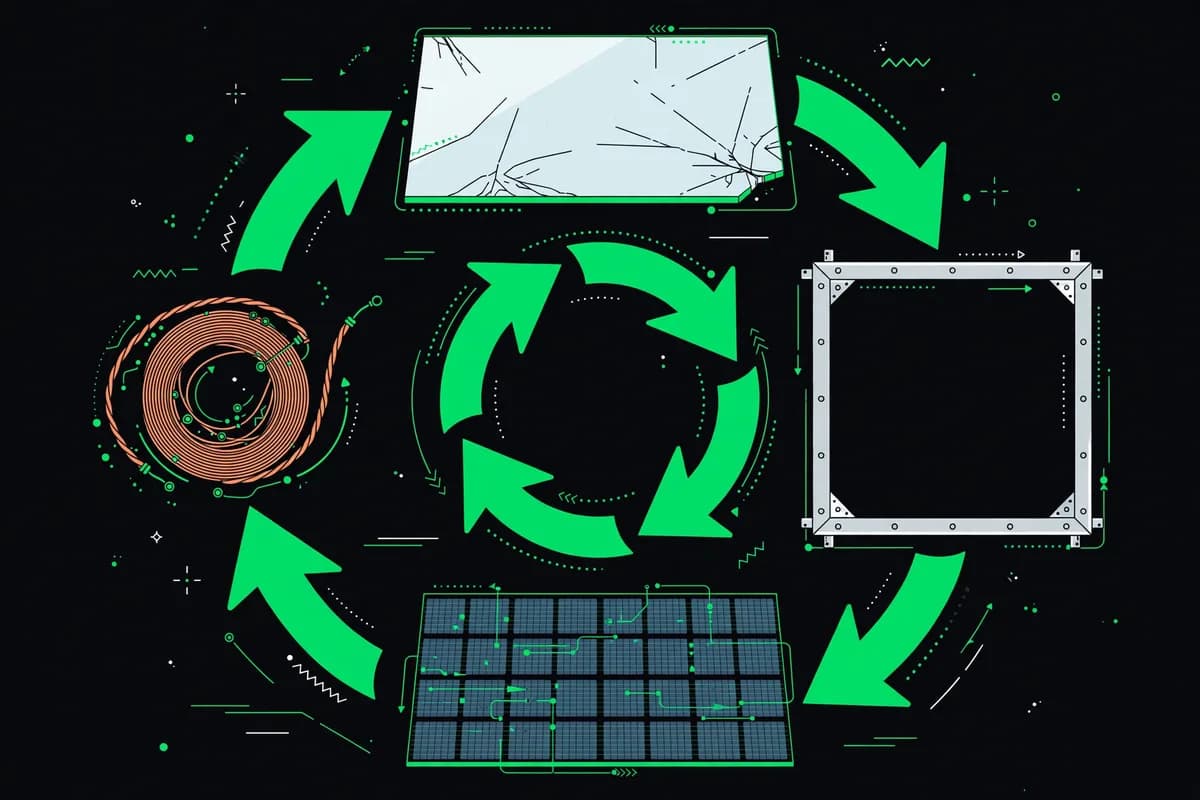
- IRENA projects cumulative global solar panel waste of 78 million tonnes by 2050, while the US alone could reach 10 million tonnes.
- About 75% of a crystalline silicon panel by weight is glass, with aluminium, silicon, copper and a trace of silver making up most of the rest.
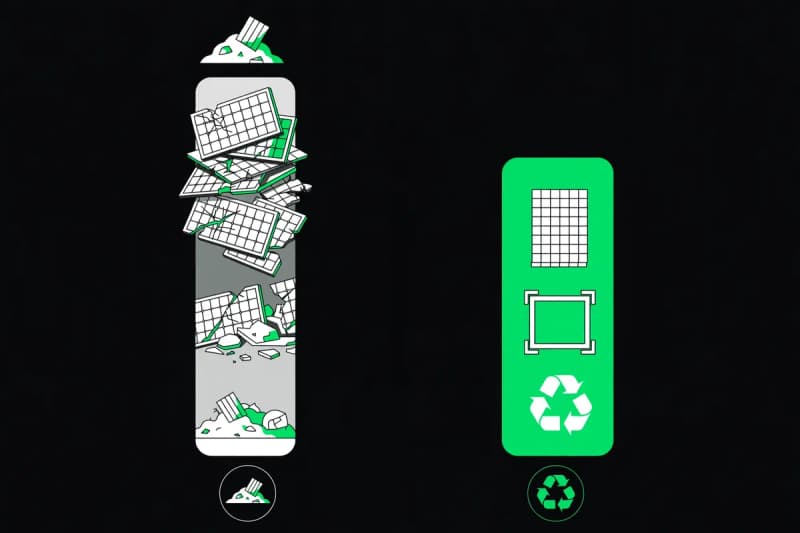
- Recycling costs roughly $15 to $45 per panel against $1 to $5 for landfill, which is why about 90% of retired US panels still go to landfill.
Old solar panels recycling: The process for photovoltaic modules removed from service after 25 to 30 years, storm damage, repowering or a failed component. Most still contain recoverable glass, aluminium, silicon, copper and silver, so retirement is a materials decision rather than a simple disposal job.
A 20-panel home system carries a disposal bill that looks small until the two prices are placed side by side. Landfill fees run about $20 to $100 for the whole set at $1 to $5 per panel. Full recycling runs about $300 to $900 at $15 to $45 per panel. That $280 to $800 gap, multiplied across millions of systems, is the main reason a product that is about 95% recoverable by material weight still ends up buried in the United States.
The first large wave of panels is now reaching retirement age. Panels installed in the early 2000s were built for 25 to 30 years of service, and utility-scale solar expanded sharply in the following decade. IRENA, the International Renewable Energy Agency, projects cumulative global photovoltaic waste of 78 million tonnes by 2050. The US Environmental Protection Agency expects the United States to generate as much as 1 million tonnes of panel waste by 2030 and up to 10 million tonnes by 2050, the second-largest national total in the world.
What a retired panel is made of
A crystalline silicon panel, the type that dominates the market, is mostly glass. Glass accounts for roughly 70% to 76% of its weight, the aluminium frame for 8% to 13%, polymer layers for about 10% to 11%, silicon cells for 3% to 5%, copper wiring for near 1%, and silver for less than 0.1%. Thin-film panels work differently. First Solar, the main US thin-film maker, has run a closed-loop take-back programme since 2005 and reports recovery above 90% of each module, including the semiconductor material.
Weight and value point in opposite directions. Glass and aluminium are heavy, easy to recover and cheap to sell. Silver and high-purity silicon are light, harder to extract and worth far more per kilogram. A recycler that only removes the frame and shreds the rest captures most of the weight and little of the value. A recycler that separates glass cleanly from the silicon cells can reach silver, copper and silicon, but the extra steps cost money and need volume to pay.
| Material | Share of panel weight | Recovery in advanced recycling |
|---|---|---|
| Glass | 70% to 76% | About 90% |
| Aluminium frame | 8% to 13% | Above 95% |
| Polymer layers | About 10% to 11% | Low resale value, hard to resell |
| Silicon cells | 3% to 5% | 80% to high 90% range in advanced systems |
| Copper | Near 1% | Above 95% |
| Silver | Below 0.1% | 80% to high 90% range in advanced systems |
Old solar panels recycling follows reuse, repair, then recycling
Reuse comes first for panels that still work. A panel removed during a roof replacement or a system upgrade can serve a second installation if it passes electrical testing and shows no cracked cells, delamination or failed junction box. Resale only makes sense with test data. A buyer who cannot see flash-test results and insulation resistance is buying a guess, and a panel with hidden cell damage will underperform for its whole second life.
Repair is narrower. A failed junction box, a broken connector or a damaged cable can sometimes be replaced. A cracked cell, widespread delamination or a failed backsheet usually cannot be fixed at a price below replacement. Installers should document which fault ended the panel’s first life, because that record decides whether reuse is honest or optimistic.
Recycling is the route for panels that fail testing or carry damage that repair cannot fix. Mechanical recycling removes the frame and shreds the module into glass cullet and mixed fractions. Thermal and chemical processes go further and recover silicon, silver and copper at higher rates. Industry reporting puts advanced recovery at up to 95% of a panel’s material value, and US recycler SOLARCYCLE reports about 96% material recovery for its process. The gap between a shredder and a full recovery plant is the gap between recovering weight and recovering value.
The US recycling rate trails Europe by 75 percentage points
The United States recycles only about 10% of decommissioned panels, while the European Union recovers around 85%, according to figures cited by Public Citizen and industry reporting. Europe’s Waste Electrical and Electronic Equipment directive has covered photovoltaic modules since 2012 and assigns extended producer responsibility, with recovery targets up to 85% and preparation for reuse and recycling up to 80% by weight. The United States has no comprehensive federal mandate for panel recycling. Panels fall under general waste rules in the Resource Conservation and Recovery Act, and oversight sits largely with individual states.
That policy gap shows up in arithmetic. For every 100 retired panels, about 90 reach landfill in the United States and about 15 do so in Europe, using the reported rates. At 78 million tonnes of global waste by 2050, the difference between a 10% system and an 85% system is tens of millions of tonnes of glass, aluminium and silicon either recovered or buried. IRENA estimated in 2016 that recoverable raw materials from end-of-life panels would be worth about $450 million globally by 2030, enough material for about 60 million new panels, rising to $15 billion and roughly 2 billion panels worth of material by 2050.
| System | Panel recycling rate | Panels landfilled per 100 retired | Policy driver |
|---|---|---|---|
| United States | About 10% | About 90 | No federal mandate, state rules vary |
| European Union | About 85% | About 15 | WEEE directive, producer responsibility since 2012 |
What homeowners should do when panels come off the roof
Start with the installer or the manufacturer. Some manufacturers run take-back programmes, and some installers will collect retired panels when they replace a system. If neither route exists, look for a dedicated solar recycler rather than a general scrap yard, and ask three questions before handing panels over. First, does the recycler test for reuse before shredding. Second, does it recover silicon and silver or only glass and aluminium. Third, does it provide a certificate of recycling with weights and downstream destinations. A recycler that cannot answer those questions is likely selling weight recovery as full recycling.
Never break panels apart at home and never put them in household waste. Broken modules expose sharp glass edges and, in older thin-film types, semiconductor materials that need controlled handling. Keep panels intact, store them dry and upright, and keep the original datasheet with the batch. The datasheet identifies the cell technology and backsheet type, and recyclers price and sort on that information.
For buyers of used panels, the same test discipline applies. Ask for flash-test data, electroluminescence images if available, and a written statement of any known defects. A used panel priced at half of new sounds attractive until a 15% output shortfall and a missing warranty are priced in. Our guide to how many solar panels a home needs in 2026 sets out the sizing math that a second-life purchase still has to satisfy, and our explainer on how solar panels work explains the cell and glass structure that recycling has to separate.
Why the economics should improve before the waste wave peaks
Recycling costs have already fallen. Industry analysis reported by Solar Power World puts the decline at 42% over three years for true recycling costs. Volume is the other lever. A plant that processes one panel per minute, the throughput claimed by a planned Dallas-area facility scheduled for the third quarter of 2027, can spread fixed costs across far more units than a plant handling a few pallets a week. That plant’s own claims remain unproven at commercial scale, and its developers acknowledge the polymer encapsulant layer still has no resale market. Even a plant that recovers 96% of metals and glass leaves the plastic layer as a cost to carry.
The honest reading is that panel recycling is a scale problem with a deadline. The waste wave peaks after 2040, which leaves time to build collection routes, standards and capacity. The Solar Energy Industries Association is developing ANSI standards SEIA 602 and 603 for recyclers and end-of-life management, with publication anticipated by the end of 2026. Standards will let buyers compare recyclers on recovery rates rather than marketing claims, and they will give utilities and installers a defensible way to choose a recycler for thousands of panels at once. Until collection and standards close the $280 to $800 gap for a home system, landfill will keep winning on price even though it loses on materials. That gap, more than any single technology, is the problem the next decade has to solve.
Sources: IRENA end-of-life projections and 2016 material value estimates as reported by Earth911 and PV Tech; US and EU recycling rates as reported by Earth911 and Public Citizen figures; panel composition and recovery rates from American Clean Power Association reporting in PV Tech; cost per panel from Earth911; SEIA standards timeline from industry reporting.
Frequently asked questions
Can old solar panels be recycled?
Yes. About 95% of a crystalline silicon panel’s material is recoverable in advanced recycling, including glass, aluminium, silicon, copper and silver. The practical limit in the United States is collection and cost, since only about 10% of retired panels are currently recycled.
How long do solar panels last before they need recycling?
Most panels are designed for 25 to 30 years of service, with performance warranties typically guaranteeing 80% to 90% of original output at year 25. Panels can be retired earlier by storm damage, roof work or repowering, and can keep producing beyond 30 years at reduced output.
How much does it cost to recycle a solar panel?
Reported costs run $15 to $45 per panel for full recycling, against $1 to $5 per panel for landfill. For a 20-panel home system that is $300 to $900 for recycling against $20 to $100 for landfill, before transport.
Can I reuse old solar panels instead of recycling them?
Panels that pass electrical testing and show no cell damage can be reused, but buyers should require flash-test data and a written defect statement. Panels with cracked cells or delamination should go to recycling rather than a second installation.
Are solar panels hazardous waste?
Most crystalline silicon panels are not classified as hazardous waste at the federal level, but they must be handled intact and kept out of household waste. Some older thin-film panels contain cadmium telluride, which needs controlled recycling through the manufacturer’s programme.