- Published program ranges put typical United States VPP income at $75 to $400 a year for one home battery, with California event pay and Vermont bill credits at the upper end of that range.
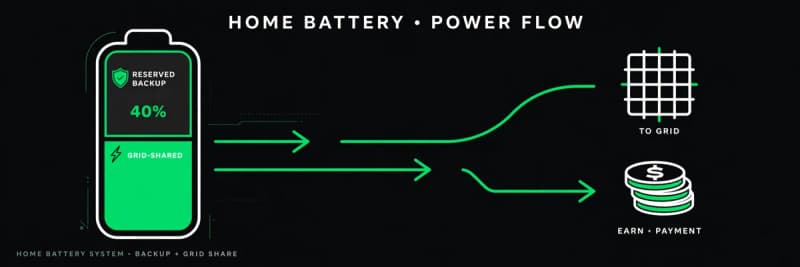
- Every program holds back a reserve, usually 20 to 30 percent of the battery, for household backup during dispatch events, and most programs let owners opt out of a single event.
- VPP income is an adder to self-consumption savings, and it does not by itself pay back a $13,500 battery in a reasonable period.
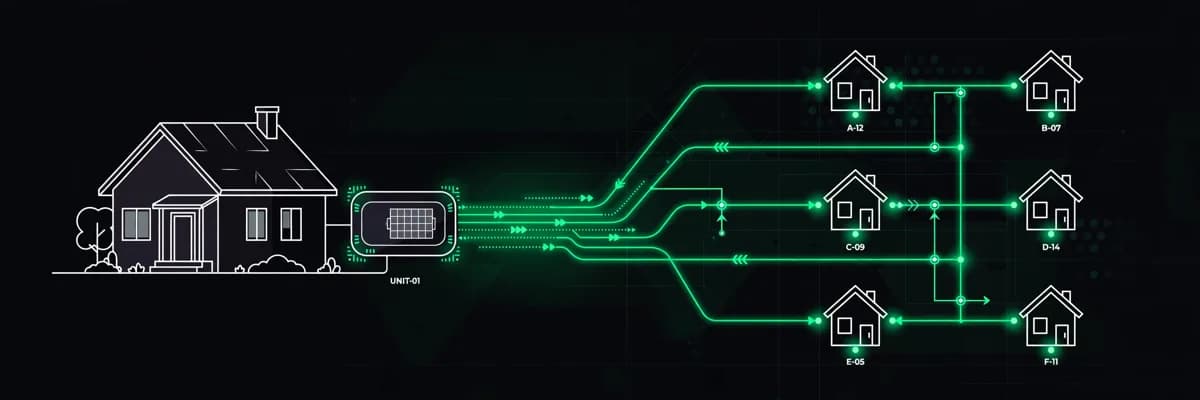
Virtual power plant (VPP): A virtual power plant links thousands of home batteries, rooftop solar systems, smart thermostats and electric vehicle chargers through software so they discharge, charge or reduce use together, acting as one dispatchable power plant that a grid operator can call on during peak demand or emergencies.
- How a virtual power plant home battery gets paid
- What VPP pay looks like by program
- The reserve tradeoff and the energy you cannot use during events
- Cycling math and what extra wear costs
- What $300 of VPP earnings does to a $13,500 battery payback
- Who should join and who should wait
- How to enroll and what to check before signing
- Frequently asked questions
A virtual power plant home battery earns in two distinct ways. A capacity payment rewards the household for standing ready to dispatch, whether or not the grid calls on the battery in a given month. An energy payment rewards each kilowatt-hour the battery sends during an event, at a rate that reflects peak-period value. The operator chooses the dispatch window, the household keeps a reserve for backup, and each event adds a small amount of cycling wear to the battery. The financial question is whether the first two payments outweigh the third cost, and the answer depends on the program, the rate plan and the size of the battery.
Grid planners treat that aggregated capacity as a serious resource. The United States Department of Energy Liftoff analysis found that deploying 80 to 160 gigawatts of virtual power plants by 2030 could expand grid capacity to support rapid electrification while reducing overall grid costs by $10 billion a year, according to coverage of the report. That national ambition explains why utilities and aggregators now compete for home batteries, and it explains why the pay on offer varies so widely by state. A battery in a constrained, high-cost grid is worth more to an operator than the same battery in a low-cost, flat-rate territory.
How a virtual power plant home battery gets paid
Capacity payments are the most predictable part of home battery grid payments. The household receives a fixed monthly or annual amount for enrollment and availability, and the amount often scales with the kilowatts the operator can reliably call on. Energy payments are variable. They depend on the number of events, the hours of each event and the kilowatt-hours the battery delivers above its normal behavior. Some programs pay cash, some pay bill credits, and some combine a seasonal capacity payment with per-event energy pay. The distinction matters for budgeting, because a capacity payment arrives even in a quiet summer, while an energy-only payment can fall to near zero in a year with few grid emergencies.
Event frequency sets the shape of the income. A program built around summer peaks may call 10 to 50 events a year, each lasting 1 to 4 hours, according to the 2026 program guide that compiled current operator terms. A program built around winter peaks or capacity markets may call fewer, longer events. Households should ask for three numbers before enrolling: the capacity rate, the energy rate and the expected event count. A program that quotes only an annual earnings range hides the mix, and the mix decides whether the income is steady or lumpy.
Timing also decides how much VPP dispatch conflicts with household use. Most events fall in the late afternoon and early evening, the same window when time-of-use prices peak and when a solar household most wants its battery for its own loads. That overlap cuts both ways. Dispatch during the peak window can displace expensive grid imports, so the household loses less than it would from a midday dispatch. At the same time, a battery sent to the grid at 6 p.m. has less energy left for the 8 p.m. cooking and cooling load. Programs handle the overlap with a reserve setting and, in many cases, an opt-out for a single event. The reserve is the household control that matters most, and it deserves more attention than the headline earnings figure.
For context on the rate plan underneath all of this, our time-of-use rates and solar battery strategy guide shows how the 4 to 9 p.m. peak window drives battery value in California. A household that already discharges its battery through that window for its own bill will find VPP dispatch less disruptive than a household that keeps its battery fully charged for backup alone.
What VPP pay looks like by program
Published VPP earnings 2026 ranges cluster between $75 and $400 a year for a single battery, with the exact figure set by the state, the operator and the battery size. California offers the clearest primary-source example. Under the Tesla VPP California program with Southern California Edison, Tesla states that participants receive $2.00 for every additional kilowatt-hour delivered during Emergency Load Reduction Program events, with events running from May 1 to October 31 between 4 p.m. and 9 p.m. Tesla also states that customers typically earn up to $16 per Powerwall per event, and between $100 and $450 per Powerwall over a season depending on the number of emergency events. Those two sentences, taken from Tesla’s published Southern California Edison VPP terms, give a household a usable way to test any earnings claim: multiply the per-event figure by a realistic event count, and check the result against the seasonal range.
Other programs pay in different forms. Vermont’s Green Mountain Power bring-your-own-device program pays bill credits rather than cash, and the compiled 2026 benchmark range for that program is $150 to $400 a year. Sunrun and Enphase programs in California, Texas and Illinois sit in a similar band in the same compiled benchmarks, at $100 to $250 a year. OhmConnect, which also enrolls thermostats and chargers, sits lower for battery owners in the compiled range, at $75 to $200 a year. Aurora Solar, writing about battery backup economics in 2026, puts the broader VPP range at $50 to $200 or more a year in supported markets, a reminder that the lower end of the market is real and that a household outside the best states should expect the lower end. The table below keeps the program types separate, because a bill credit, a cash payment and an upfront incentive are worth different amounts to different households.
| Program | Pay form | Published 2026 range for one battery | What sets the figure |
|---|---|---|---|
| Tesla VPP with Southern California Edison, Emergency Load Reduction Program | Cash, paid after the season | $100 to $450 per Powerwall per season | $2.00 per additional kilowatt-hour delivered, up to about $16 per event, event count in the May to October season |
| Green Mountain Power bring-your-own-device, Vermont | Monthly bill credits | $150 to $400 a year | Capacity made available for grid peaks and winter demand, credited against the utility bill |
| Sunrun Shift, California, Texas and Illinois | Capacity-based payments | $100 to $250 a year | Enrolled capacity and seasonal availability, mainly in the summer peak window |
| Enphase Grid Services, California, Texas, New Jersey and others | Capacity plus energy | $100 to $250 a year | Utility demand response partnerships and market access in each territory |
| OhmConnect, California, New York, Texas and others | Energy-based points or credits | $75 to $200 a year | Kilowatt-hours reduced or exported during grid stress alerts |
Sources for the table: Tesla’s published Southern California Edison VPP terms for the Tesla row; the 2026 virtual power plant program guide for the compiled benchmark ranges in the remaining rows; Aurora Solar’s 2026 battery backup cost guide for the broader $50 to $200 or more market floor. Ranges are benchmarks, and the utility or aggregator terms for a specific address control the actual payment.
Two cautions belong with every range in that table. First, stacking changes the total. A household that can combine a capacity program with a state battery incentive or a time-of-use saving will see a larger combined return than the VPP row alone suggests, while a household that must choose between two demand response programs will see only one row. Tesla’s Southern California Edison terms, for example, require that participants are not enrolled in another demand response program or another virtual power plant. Second, payment timing changes the value. A seasonal cash payment that arrives after October 31 is worth less in cash-flow terms than monthly bill credits that reduce each bill through the summer, even if the annual totals match.
The reserve tradeoff and the energy you cannot use during events
A VPP battery reserve is the share of stored energy the operator agrees to leave untouched during dispatch. Published program descriptions put the typical reserve at 20 to 30 percent of usable capacity. On a 13.5 kilowatt-hour battery, a 20 percent reserve leaves 2.7 kilowatt-hours protected and 10.8 kilowatt-hours available for dispatch, while a 30 percent reserve leaves 4.05 kilowatt-hours protected and 9.45 kilowatt-hours available. That protected slice is the household backup during the event window, and it is the number to set deliberately rather than accepting the default.
The reserve tradeoff bites in a specific scenario: an outage that starts during or shortly after a dispatch event. A battery that entered the evening at full charge, dispatched down to its 20 percent reserve, and then faces a grid failure has 2.7 kilowatt-hours left for essential loads. For a household running a refrigerator, lights, Wi-Fi and phone charging, that reserve covers several hours, and it falls short of a full night of whole-home use. A household that raises the reserve to 40 or 50 percent gives up some VPP earnings and buys a longer backup runway. The right setting depends on outage history, medical loads and the season, and it can change through the year. A household in wildfire season has a different reserve need than the same household in a mild spring month.
Opt-out rights soften the tradeoff. Tesla’s Southern California Edison program lets participants opt out of a single event through the app, and lets them suspend participation through a toggle in settings while staying enrolled. That control matters most on days when a storm forecast, a planned medical device charge or a family event makes backup certainty worth more than one event payment. A program that offers no opt-out, or that penalizes opt-outs heavily, should be priced differently in the household decision, because the household is selling flexibility without keeping a way to reclaim it on the days it matters most.
Households weighing backup value against VPP income should also read our standalone home battery analysis, which separates outage insurance value from bill savings, and our AC-coupled retrofit guide for households adding a battery to existing solar. Both decisions turn on the same underlying question: how much of the battery is reserved for the household, and how much is put to work for the bill.
Cycling math and what extra wear costs
Extra cycling is the real cost of VPP participation, and it is small for a typical program. The arithmetic starts with throughput. A battery that dispatches 8 kilowatt-hours in each of 12 events in a season moves 96 kilowatt-hours of extra energy in that year. That figure is the VPP cycling load, separate from the daily cycling the battery already does for self-consumption or time-of-use arbitrage.
The wear cost of those 96 kilowatt-hours depends on the battery lifetime throughput. A 13.5 kilowatt-hour battery rated for 4,000 full cycles has a lifetime throughput of 54,000 kilowatt-hours, and the same battery rated for 6,000 cycles has a lifetime throughput of 81,000 kilowatt-hours. Dividing a $13,500 installed cost by those throughput figures gives a wear cost of $0.25 per kilowatt-hour at 4,000 cycles and $0.17 per kilowatt-hour at 6,000 cycles. Multiplying by 96 kilowatt-hours gives an annual wear cost of $24 at the lower cycle rating and $16 at the higher rating. Those are Joule Post calculations from the cited installed cost, capacity and cycle ratings, and they assume each VPP kilowatt-hour consumes lifetime throughput at the same rate as a self-consumption kilowatt-hour.
That wear cost looks small against the California event payment in the same arithmetic. Twelve events at 8 kilowatt-hours each, paid at $2.00 per kilowatt-hour, produce $192 in a season. Subtracting $16 to $24 of wear cost leaves $168 to $176 of net VPP value before tax and before the cost of recharging the battery. Recharging matters, because the battery must buy or generate the energy it sends. A battery recharged from rooftop solar gives up a low export credit, while a battery recharged from the grid pays the off-peak rate. Either way, the recharge cost is a few dollars per event at most, and it does not overturn the net figure in the California example.
Chemistry changes the wear story at the edges. Lithium iron phosphate, the chemistry now standard in most new residential batteries, tolerates thousands of cycles and deep discharge better than older nickel manganese cobalt designs. Our LFP versus NMC home battery comparison puts LFP cycle life at 3,000 to 6,000 cycles against 1,000 to 2,500 for NMC, and our battery lifespan guide shows most modern units holding strong performance for 10 to 15 years with a 10-year warranty as the industry norm. A battery already near the end of its warranted throughput, or an older NMC unit with a low cycle ceiling, faces a higher wear cost per VPP kilowatt-hour than a new LFP unit, and that difference can decide whether enrollment makes sense for that specific battery.
What $300 of VPP earnings does to a $13,500 battery payback
The payback test is where VPP enthusiasm meets arithmetic. A $13,500 battery earning $300 a year from VPP payments alone would need 45 years to pay back its installed cost, calculated as $13,500 divided by $300. At $200 a year, the payback stretches to 67.5 years. At $400 a year, the top of the published range, the payback is still 33.8 years. Every one of those figures exceeds the 10 to 15 year useful life of the battery, which proves a plain point: a household should never buy a battery for VPP income alone.
The honest comparison puts VPP income beside the larger savings the battery already produces. Our retrofit analysis found that a 10 kilowatt-hour battery cycled daily under California net billing returns roughly $900 to $1,100 a year in self-consumption value, by storing midday solar that would export at about 5 cents and using it in the evening instead of buying power at 30 to 65 cents. Adding $192 of California VPP value to $1,000 of self-consumption value lifts the annual total to $1,192, and shortens the simple payback on a $13,500 battery from 13.5 years to 11.3 years. That 2.2 year improvement is the real contribution of VPP enrollment for a solar household in a strong program, and it is worth having, provided the reserve setting and the event terms do not erode the self-consumption saving that does most of the work.
| Scenario, one 13.5 kilowatt-hour battery | Annual value | Simple payback on $13,500 |
|---|---|---|
| VPP only, at $200 a year | $200 | 67.5 years |
| VPP only, at $300 a year | $300 | 45.0 years |
| VPP only, at $400 a year | $400 | 33.8 years |
| Self-consumption only, California net billing example | $1,000 | 13.5 years |
| Self-consumption plus $192 California VPP value, wear cost deducted | $1,168 | 11.6 years |
Assumptions for the table: installed cost $13,500, taken from the standalone battery analysis midpoint; self-consumption value $1,000, the midpoint of the $900 to $1,100 range in the retrofit analysis; California VPP value $192, calculated as 12 events multiplied by 8 kilowatt-hours multiplied by $2.00 per kilowatt-hour from Tesla’s published terms, minus $24 of wear cost at the 4,000-cycle rating. The table ignores tax on VPP income, financing cost and rate changes, and it treats payback as installed cost divided by annual value with no discounting.
Tax treatment deserves a line of its own, because it trims the net figure. VPP payments are generally treated as taxable income when paid in cash, while bill credits may be treated differently depending on program structure and jurisdiction. A household in a 22 percent federal bracket that receives $192 in cash keeps about $150 after federal tax, before state tax. That adjustment does not change the verdict for a household that already owns the battery, because the payment is still incremental income from an asset already on the wall. It does change the verdict for a household considering a purchase, because it widens the gap between the VPP-only payback and the battery lifetime even further.
The same arithmetic flips the question for a household that already owns a battery and already cycles it daily. For that household, the battery cost is sunk, the self-consumption saving continues whether or not the household enrolls, and the VPP decision is purely incremental: $168 to $176 of net seasonal value against a smaller backup reserve during event hours. On those terms, enrollment is worth it in a program that pays $2.00 per kilowatt-hour or a solid capacity rate, and worth it in a bill-credit program only if the credits reduce a bill the household actually pays. A household on a flat-rate plan with a small battery and no solar faces a thinner case, because the VPP payment must carry the whole argument without a time-of-use saving underneath it.
Who should join and who should wait
Joining makes the strongest sense for four household profiles. The first is a solar household in California, Texas, Vermont or the Northeast with a time-of-use plan, a battery of 10 kilowatt-hours or more, and a program that pays a capacity rate or $2.00 per dispatched kilowatt-hour. The second is a household that already cycles its battery daily for self-consumption, so the extra VPP cycles are a small addition to a large existing cycling load. The third is a household with two batteries, where one unit can carry the reserve while the other dispatches more freely. The fourth is a household in a territory where the utility offers a generous upfront incentive for enrollment, turning the VPP decision into a purchase subsidy rather than a trickle of annual payments.
Waiting makes sense for a different set of households. A household with a single small battery, under 5 kilowatt-hours, will earn little in absolute dollars and will feel the reserve tradeoff most sharply, because the protected slice leaves little usable energy for an outage. A household with an older battery near its warranty throughput cap should check the remaining warranted megawatt-hours before adding VPP cycles, since the extra throughput could consume warranty headroom that a future fault claim might need. A household that depends on battery backup for medical equipment should set a high reserve or skip enrollment until the program terms allow a reserve that covers the medical load through a full event plus an outage. A household that is about to move should check the program term and any early-exit repayment, since some programs tie an upfront incentive to a multi-year commitment.
Geography remains the largest single filter. California, Texas, Vermont, Massachusetts and parts of the Northeast have mature programs with published rates and multiple aggregators. Many other states have no residential VPP program at all, or only a pilot with a capped enrollment. A household outside the mature territories should check the utility program page for its exact address before assuming any published national range applies, because the national range blends the best states with states where the payment is zero.
How to enroll and what to check before signing
Enrollment usually starts in the battery app or on the utility program page, followed by a utility eligibility check. Tesla’s Southern California Edison path runs through the Tesla app, requires a residential service account in the utility territory, a valid interconnection agreement, and no simultaneous enrollment in another demand response program. Other programs enroll through the installer or the aggregator app, and then link the utility account and smart meter. The eligibility check can take days or weeks, and the household should not count VPP income until the enrollment confirmation arrives.
Before signing, a household should confirm seven items in writing. First, the capacity rate and the energy rate, stated separately. Second, the reserve setting, and whether the household can change it at any time. Third, the opt-out rule for a single event, and any penalty for opting out. Fourth, the program term and any repayment if the household leaves early. Fifth, whether enrollment blocks participation in another demand response program. Sixth, the payment form and timing, cash or bill credit, monthly or seasonal. Seventh, the warranty position: whether the battery manufacturer treats VPP dispatch as normal use, and whether the program operator covers any warranty consequence. A program that cannot answer those seven items in plain terms is asking the household to sell flexibility without a price.
After enrollment, the household should watch the first three events closely. Check the app for the dispatch amount, the reserve level reached, the recharge that follows, and the payment or credit that posts. Compare the first payment against the per-event arithmetic in the program terms. If the first events deliver far less than the terms imply, the cause is usually a high reserve setting, a baseline calculation that credits only energy above normal behavior, or an event that ended early. Each cause has a different fix, and the fix is easier to negotiate in the first month than after a full season of short payments.
Frequently asked questions
Is joining a virtual power plant worth it in 2026?
For most owners with a battery already on the wall, yes, provided the program pays a solid capacity rate or a strong energy rate and the household keeps a reserve that covers its backup needs. Typical published ranges run $75 to $400 a year, which is meaningful as an adder to self-consumption savings and weak as a standalone reason to buy a battery.
What is a Virtual Power Plant (VPP) and how does it work for homeowners?
A virtual power plant is software that coordinates thousands of home batteries, solar systems, thermostats and chargers so they act as one dispatchable power plant. For a homeowner, enrollment means the operator can dispatch part of the battery during grid stress events, usually in the late afternoon and early evening, while a reserve stays protected for household backup and the owner can often opt out of a single event.
How much can I earn from a VPP program with my solar battery?
Published 2026 ranges run $75 to $400 a year for one battery, with California event pay at $2.00 per kilowatt-hour producing $100 to $450 per Powerwall in a season according to Tesla’s published terms, and Vermont bill credits reaching $150 to $400 a year in compiled benchmarks. The actual figure depends on the state, the operator, the battery size and the number of events in the season.
Does VPP dispatch damage my battery?
Dispatch adds cycling wear, and the cost is small for a typical program. Twelve events dispatching 8 kilowatt-hours each add 96 kilowatt-hours of annual throughput, which costs $16 to $24 in lifetime wear value on a $13,500 battery rated for 6,000 or 4,000 cycles. A new lithium iron phosphate battery absorbs that load more easily than an older battery near its warranty throughput cap.
Can I opt out of a VPP event or leave the program?
Most major programs allow a single-event opt-out through the app, and Tesla’s Southern California Edison terms allow participants to suspend participation through a settings toggle while staying enrolled, and to terminate enrollment by contacting Tesla support. Check the specific program term before signing, because an upfront incentive program may require repayment of part of the incentive if the household leaves early.