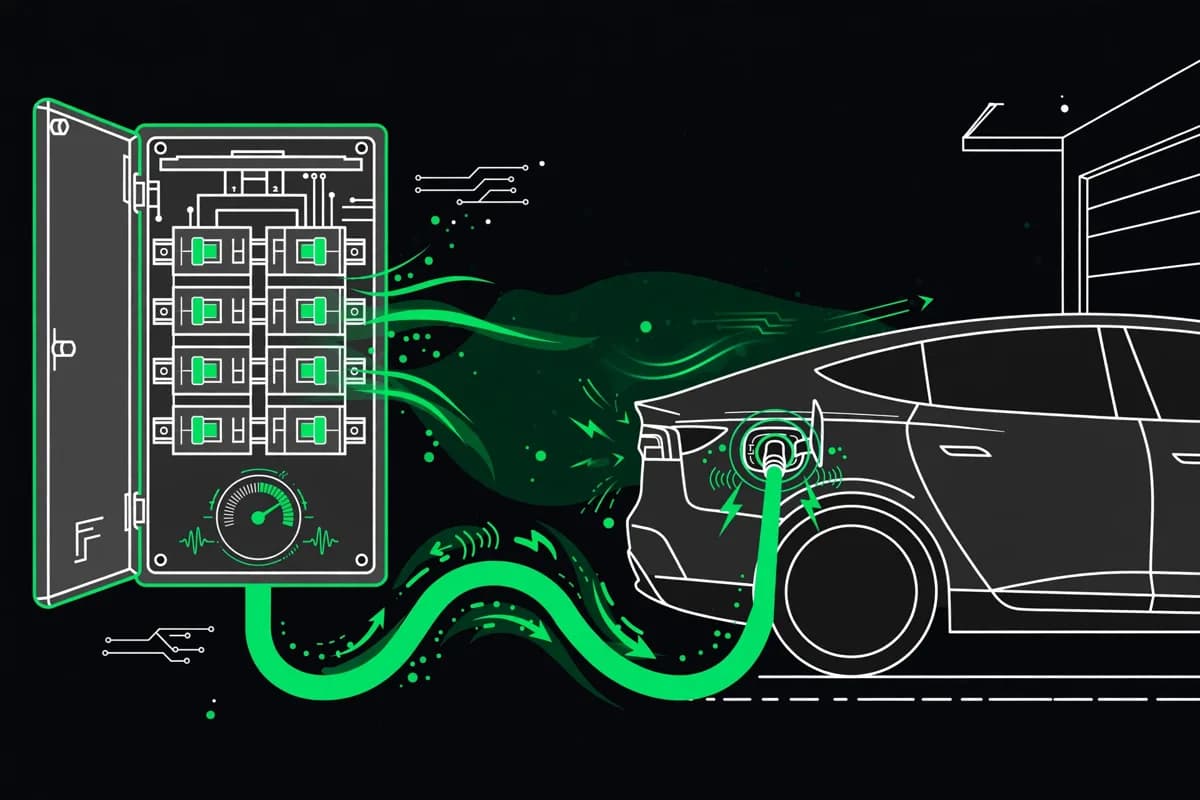
- Electricians who specialise in EV installs report that 70 to 80 percent of Level 2 jobs need no panel upgrade, only a dedicated circuit.
- A written load calculation, not a guess about panel age, decides whether a 50-amp EV circuit fits within the 80 percent safe-load limit.
- A load management device at $500 to $1,000 can defer a $2,500 to $6,000 upgrade for years on a borderline 100-amp service.
EV charger panel upgrade: Replacing a home electrical panel and usually raising its service size, for example from 100 amps to 200 amps, so it can safely carry a new Level 2 EV charger circuit alongside existing household loads.
The first quote many EV buyers receive includes a panel upgrade priced in the thousands, quoted before anyone has opened the panel or run the numbers. PanelNerd, a guide written for homeowners facing this decision, reports that electricians who specialise in EV installs consistently find 70 to 80 percent of Level 2 jobs need no upgrade. The gap between that finding and the quote in your inbox is the reason to insist on one document before approving any work: a written load calculation for your own home.
A Level 2 charger runs on 240 volts and draws 32 to 48 amps while charging, according to PanelNerd. The standard setup is a dedicated 40-amp circuit protected by a 50-amp breaker, using a NEMA 14-50 outlet or a hardwired unit. That is the same electrical profile as an electric dryer or range. The panel question is whether adding that circuit pushes total household demand past the safe limit, and the answer comes from arithmetic with your square footage, heating type, appliances, and existing circuits as inputs.
The 80 percent rule that decides an EV charger panel upgrade
PanelNerd describes the threshold plainly. Total demand should not regularly exceed 80 percent of panel capacity. On a 200-amp service, that leaves 160 amps of usable headroom. If normal household demand runs 100 to 110 amps, adding a 40-amp EV circuit brings the total to 140 to 150 amps, safely inside the limit. If demand already sits at 150 amps, the same circuit changes the answer. The same arithmetic explains why panel age alone misleads. A 200-amp panel from the 1980s with open slots and moderate loads usually has room. A 100-amp panel in a home with electric heat, an electric dryer, and an electric range may have none, even if the panel looks tidy.
Find your own starting point before the electrician arrives. The main breaker at the top of the panel carries an amperage rating. PanelNerd lists the usual tiers: 60 or 100 amps in older service, often in pre-1975 homes; 150 amps as a transitional tier; 200 amps as the current United States standard; and 400 amps for large homes or prior upgrades. Count open breaker slots as well. A full panel with adequate service calls for a sub-panel, a secondary breaker box fed from the main panel, rather than a full upgrade. A panel with no open double-pole slots and no room for a sub-panel is a different conversation. Either way, the load calculation remains the document that settles it, and any contractor recommending an upgrade should be able to walk through the inputs and the result.
| Panel situation | What is usually required | Typical cost from PanelNerd |
|---|---|---|
| 200-amp panel with open slots | Dedicated 50-amp circuit only | $400 to $1,200 |
| Full panel, adequate service | Sub-panel plus circuit | $800 to $2,500 |
| 100-amp panel or overloaded service | Full panel upgrade, circuit usually included | $2,500 to $6,000 or more |
| Borderline 100-amp panel, single EV | Load management device instead of an upgrade | $500 to $1,000 installed |
Three panel scenarios and the one most quotes skip
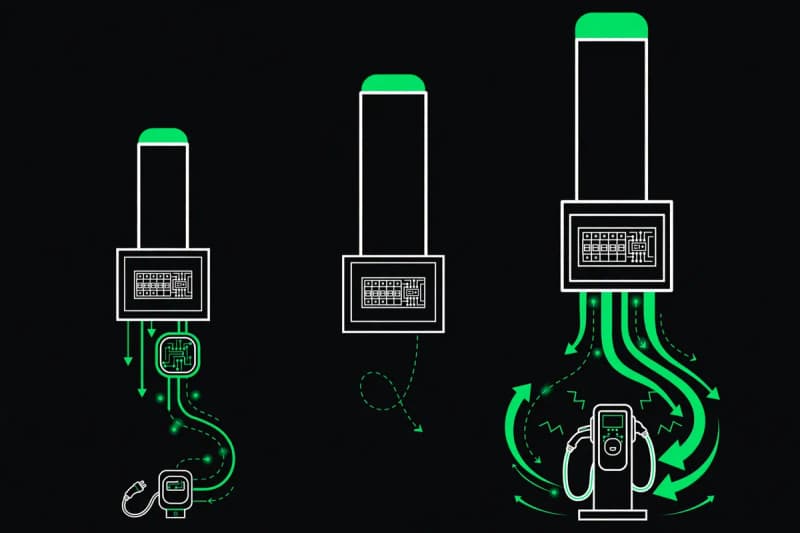
PanelNerd sets out three scenarios. In the first, a 200-amp panel with moderate loads takes the new circuit with no panel work at all. In the second, a physically full panel with adequate service takes a sub-panel near the garage, which adds circuit capacity without changing service size, at a meaningfully lower cost than a full upgrade. In the third, a 100-amp service, or a home whose demand already presses against its service limit, genuinely needs a full upgrade, especially where two EVs, solar, or battery storage will compound loads. The second scenario is the one many quotes skip, because a sub-panel is a smaller job than a full upgrade.
A fourth path sits between the second and third scenarios. Smart load management panels, such as the Span Panel or Square D Energy Centre named by PanelNerd, route power between circuits and can defer a full upgrade where solar is in the future. For a borderline 100-amp panel, a simpler load management device, also called an EVEMS, monitors real-time household load and pauses or reduces EV charging when a water heater or heating system cycles on. PanelNerd puts installed cost at $500 to $1,000, against $2,500 to $6,000 or more for a full upgrade, an avoided outlay of $1,500 to $5,500 on those ranges. The device suits a single EV in a home with mostly gas appliances. It does not suit a genuinely undersized panel or a household planning multiple EVs, where the upgrade is the right call.
Permits, recalled panels, and the federal credit that ended
Most United States jurisdictions require an electrical permit even for a dedicated circuit, PanelNerd notes, and a licensed electrician should pull it as part of the job. An unpermitted circuit can create problems at sale or on an insurance claim. The same visit should settle a separate safety question. Panels from recalled brands, Zinsco or Federal Pacific, should be replaced regardless of EV plans, according to PanelNerd. A load calculation will not fix a panel that is itself a hazard, and no charger saving justifies keeping one.
The money around the job changed in 2026. The federal 30C tax credit covered 30 percent of home charger installation costs, up to $1,000 per charging port, including electrical work tied directly to the charger. PanelNerd records that the credit expired on 30 June 2026 under the One Big Beautiful Bill Act, and installs after that date are no longer eligible, while installs completed before the date can still be claimed on a 2025 or 2026 return. The credit also carried a census-tract condition, applying only in low-income or non-urban tracts, so dense urban suburbs often failed to qualify even before expiry. State and utility rebates remain available in many places, and the Joule Post guide to Level 2 installation costs in 2026 sets out the wider cost picture that a panel decision sits inside. The DSIRE database of state incentives, linked from PanelNerd, is the place to check a specific state before assuming a rebate applies.
How to get a straight answer before you sign
Ask for three things, in this order. First, the written load calculation, with inputs and result. Second, a quote that separates the circuit, the sub-panel if any, and the full upgrade if any, so the upgrade line can be compared on its own. Third, confirmation that the permit is included and that the installer has pulled EV charger permits in the same jurisdiction before. If a contractor quotes a full upgrade before seeing the panel, get a second quote from an installer who starts with the calculation. Apartment and condo owners face a different process, starting with building management approval, as PanelNerd notes, and the Joule Post guide to owning an EV without a home charger covers the charging options where no panel work is possible at all.
One fault deserves a check before any panel spending. PanelNerd reports that a recent code update requires special safety breakers for EV charger outlets, and that overly sensitive breakers can trip on the self-test routines of modern chargers, stopping an overnight charge halfway. Hardwiring the charger instead of using an outlet usually fixes it. A car that wakes up half charged may point to the breaker, rather than to panel capacity, and an electrician should rule that out before recommending an upgrade.
Frequently asked questions
Do you need a panel upgrade for an EV charger?
Most homes do not. A 200-amp panel with open slots and normal loads usually takes a dedicated 50-amp circuit, and a load calculation confirms whether your home is in that majority.
Can a 100-amp panel support an EV charger?
Sometimes, depending on existing load. A load calculation decides, and a load management device can defer an upgrade on a borderline panel for a single EV.
What does an EV charger panel upgrade cost?
PanelNerd gives $2,500 to $6,000 or more for a full upgrade, against $400 to $1,200 for a dedicated circuit alone and $800 to $2,500 for a sub-panel plus circuit.
Do I need a permit to install a home EV charger?
Yes, in most United States jurisdictions, even for a dedicated circuit. A licensed electrician should pull the permit as part of the job.
Is the federal EV charger tax credit still available?
No, for new installs. The 30C credit expired on 30 June 2026. Installs completed before that date can still be claimed, subject to the census-tract condition.