- Most modern home solar batteries keep strong performance for 10–15 years, and a 10-year manufacturer warranty is the industry norm, and EnergySage puts the typical lithium-ion home battery squarely in that range.
- A real-world dataset of 2,000 Tesla Powerwall 2 units shows most still hold around 90% of rated capacity after 7 years, but a distinct 2018–2019 manufacturing batch degrades far faster, and owners have won warranty replacements by auditing their own data.
- The owner move that matters: read your battery’s diagnostic capacity (Tesla’s gateway API exposes total_pack_energy), divide by the rated capacity, and track it against the 70%-at-10-years warranty line.
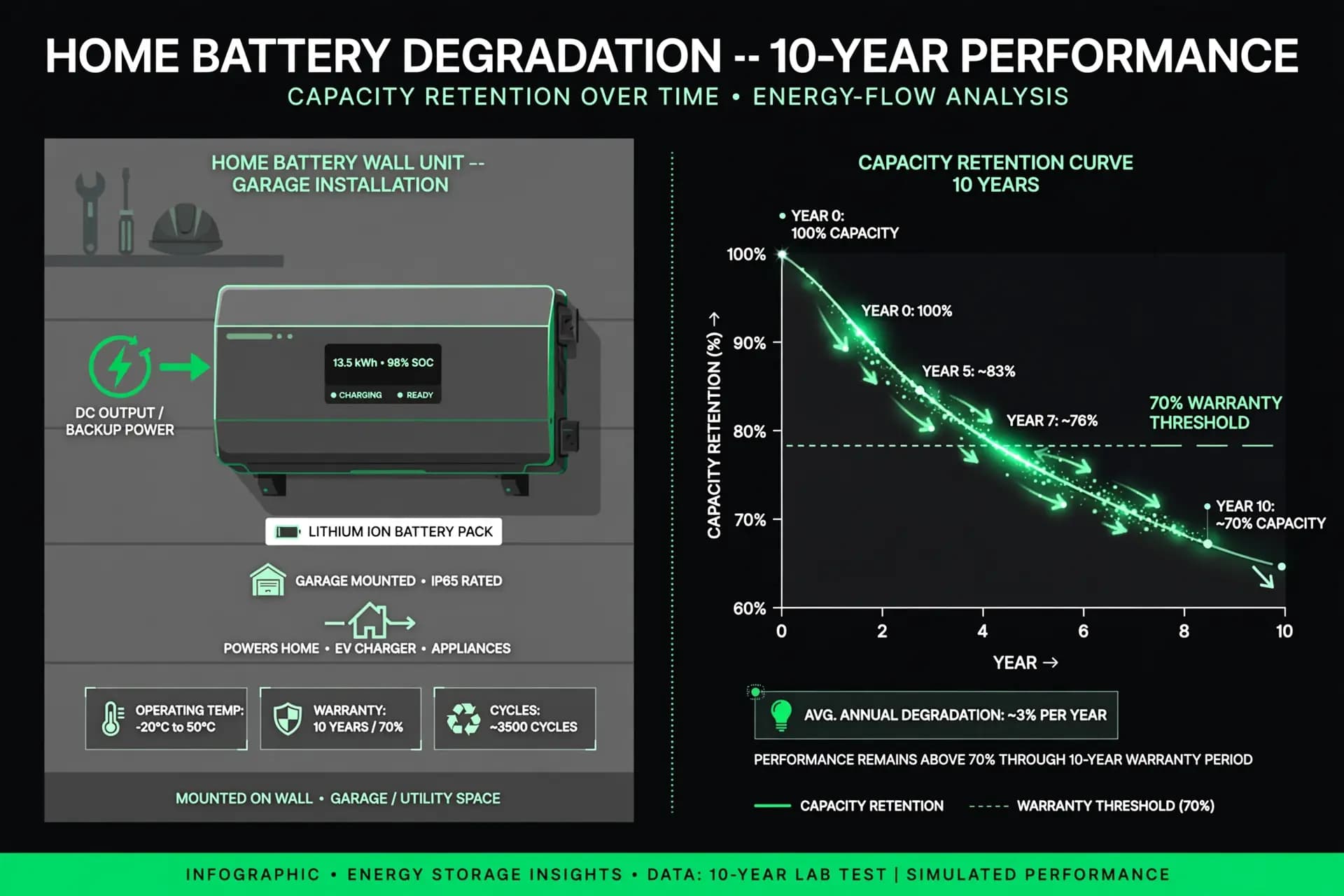
Home solar battery lifespan: the number of years a residential battery keeps enough usable capacity to do its job, typically 10 to 15 years for modern lithium-ion units, with most manufacturers guaranteeing at least 70% of the original capacity for the first 10 years.
- The 10-year answer, with the fine print
- How degradation actually works
- Which batteries last longest: LFP vs NMC and the warranty table
- Audit your own battery against the warranty line
- The median battery degrades at half the rate the warranty allows
- When replacement beats repair
- Frequently asked questions
The question of how long do home solar batteries last usually arrives at one of two moments: right before you sign a five-figure quote, or right after you notice the battery holding less than it used to. Both moments deserve a better answer than “about ten years.” The honest answer is that battery longevity is not one number. It is a spread, and where your battery lands on that spread depends on chemistry, how hard it is cycled, the temperature it lives in, and occasionally the factory batch it came from.
Manufacturer warranty terms and measured real-world degradation from thousands of installed batteries settle this question. Between them, a clear picture emerges, including a practical method owners are already using to check whether their battery qualifies for a warranty replacement.
How long do home solar batteries last: the 10-year answer
The industry’s standard answer is 10 to 15 years of strong performance for a modern lithium-ion home battery, with most units carrying a 10-year manufacturer warranty. That figure comes from EnergySage’s home battery lifespan guide, which also notes that batteries typically continue operating past the warranty’s end. The warranty expiring is not the same as the battery dying.
It helps to separate two different meanings of “last.” The first is calendar life: how many years the battery keeps enough capacity to be useful. The second is runtime: how many hours a charged battery powers your home during an outage, a different question that depends on the battery’s size and which appliances you run. For the outage-math side, see our breakdown of what a home battery actually buys you in 2026, including the time-of-use arbitrage case for batteries with no solar attached.
The warranty is where calendar life becomes a contract. The dominant US pattern is a 10-year warranty guaranteeing at least 70% of the original capacity: Tesla’s Powerwall 3 carries exactly this structure, with unlimited cycles for solar self-consumption, time-based control, and backup use, according to 2026 installer documentation. Some competitors stretch the term to 15 years, as the comparison table below shows. But a longer warranty is not automatically a stronger promise, because the guaranteed capacity floor differs.
How degradation actually works: calendar aging vs cycle aging
Batteries wear out through two mechanisms that run simultaneously. Calendar aging is the slow chemical decay that happens whether you use the battery or not, accelerated by heat and by sitting at very high or very low states of charge. Cycle aging is the wear from each charge-discharge cycle: electrode particles swell and shrink, microscopic cracks form, and lithium gets consumed by side reactions. Heat accelerates both, which is why a battery in a cool garage outlasts an identical one baking against a sun-facing wall.
Depth of discharge, cycle life, and the utilization link
Depth of discharge (DoD), how deeply you drain the battery each cycle, is one of the strongest levers on cycle life. Shallower cycles wear the chemistry less than deep ones. Most home lithium-ion batteries are designed for deep usable discharge: EnergySage’s battery comparison puts lithium-ion DoD at about 85% with around 95% round-trip efficiency, versus roughly 50% DoD for old lead-acid designs. Modern lithium units are meant to be used hard; the question is how hard.
The clearest real-world evidence comes from Netzero’s analysis of 2,000 Tesla Powerwall 2 batteries, which used diagnostic data pulled directly from owners’ Tesla gateways. Two findings stand out. First, utilization matters exactly as the physics predicts: batteries with high lifetime discharged energy sit measurably lower on the capacity curve than lightly used ones. The heaviest-used units in the sample had discharged around 35 MWh over their lives, roughly 2,590 full cycles, or a complete daily cycle for seven straight years.
What 2,000 real Powerwalls reveal about the curve
Second, degradation is not linear. As the Netzero analysis puts it: “Degradation is more pronounced in the first 4 years but stabilizes thereafter, with many Powerwalls within 90% of the rated 13.5 kWh capacity, 7 years in.” Early capacity loss followed by a long plateau is the normal shape of lithium-ion aging: the first-year drop that alarms new owners is, in most cases, the battery settling, not failing.
The third finding is the one most buyers never hear about: a distinct outlier cluster. Powerwalls manufactured between late 2018 and 2019, hardware revisions with part numbers starting 2012170, degrade substantially faster than units built before or after. Forum owners have been triangulating this independently for years: in a long-running Tesla Motors Club degradation thread, one Adelaide owner reported nearly 20% capacity loss within 18 months of an April 2020 installation and eventually secured a warranty replacement; another owner logged 577 cycles over 2.5 years and measured just 77.6% of original capacity, a trajectory pointing at a warranty claim well inside the 10-year term. The replacement units, notably, behave like everyone else’s: one owner reported the new pack holding 95% after 2.5 years, concluding the original was simply faulty.
Which batteries last longest: LFP vs NMC and the warranty table
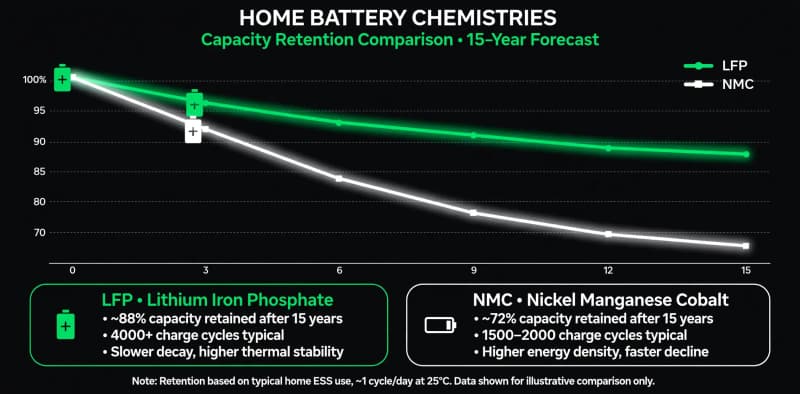
Chemistry is the biggest structural determinant of lifespan. The two lithium-ion chemistries that matter for home batteries are LFP (lithium iron phosphate) and NMC (nickel manganese cobalt). LFP tolerates heat better, survives far more cycles, and can be charged to 100% routinely without accelerated wear; NMC packs more energy per kilogram but ages faster. Our full chemistry explainer walks through the trade-offs, but for home storage, where weight barely matters, the industry has decisively moved to LFP. The Tesla Powerwall 2 used NMC cells; the Powerwall 3 is widely reported to use LFP.
That shift shows up directly in warranty terms. Here is how the leading 2026 home batteries compare:
| Battery | Usable capacity | Chemistry | Warranty term | Guaranteed capacity | Cycle/throughput limit |
|---|---|---|---|---|---|
| Tesla Powerwall 3 | 13.5 kWh | LFP (reported) | 10 years | 70% | Unlimited (solar/self-consumption use) |
| Enphase IQ Battery 5P | 5.0 kWh (modular) | LFP | 15 years | 60% | 6,000 cycles |
| FranklinWH aPower 2 | ~15 kWh | LFP | 15 years | n/a* | 60 MWh throughput |
| Tesla Powerwall 2 (legacy) | 13.5 kWh | NMC | 10 years | 70% | n/a |
*FranklinWH’s warranty is structured around the 15-year / 60 MWh throughput cap rather than a stated end-of-warranty capacity percentage.
Warranty figures: Tesla terms via the product’s published warranty structure; Enphase 15-year / 6,000-cycle terms via Enphase’s official IQ Battery 5P page; FranklinWH terms via the manufacturer’s published warranty documentation.
Read the table carefully: the terms are not directly comparable, and that is the trap. A 15-year warranty guaranteeing only 60% of capacity is a looser promise than a 10-year warranty guaranteeing 70%: the manufacturer is allowing more degradation over a longer period. As the arithmetic shows, daily time-of-use cycling can burn through a throughput cap like FranklinWH’s 60 MWh in roughly 11 years (60,000 kWh divided by roughly 15 kWh a day), while a backup-only battery may never reach it. Match the warranty’s fine print to how you will actually use the system. For the broader storage picture, including how these home units relate to grid-scale deployments, see our battery energy storage explainer.
Audit your own battery against the warranty line
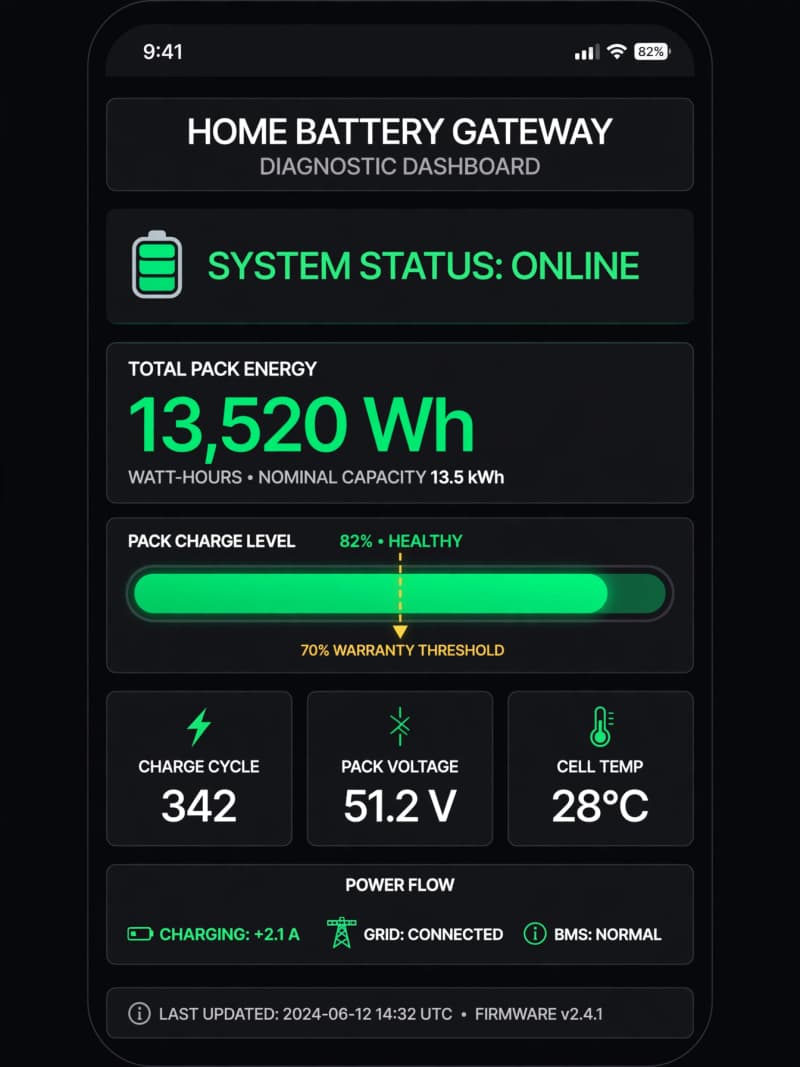
The practical method owners in those forum threads converged on is the single most useful thing in this article. Your battery management system knows its own capacity; the manufacturer’s app just does not always show it to you. On a Tesla system, the local gateway API exposes a field called total_pack_energy: the battery’s current full-pack energy in watt-hours. Third-party tools like the Netzero app surface the same diagnostic data, and owners on the DIY Solar Forum have been comparing these readings across NMC and LFP units for years.
The audit is simple arithmetic:
- Get your current capacity. Read
total_pack_energyfrom the gateway API or a diagnostic tool, after a full charge. - Divide by the rated capacity. For a Powerwall 2, the rated usable capacity is 13.5 kWh (13,500 Wh). A reading of 11,500 Wh means 85.2% retention.
- Compare against the warranty line. Tesla’s common warranty variant guarantees 70% of 13.5 kWh, a floor of 9,450 Wh, for 10 years. Below that line, inside the term, you have a warranty claim.
- Project the trajectory. Log the number monthly. A unit losing 1–2% a year is aging normally; one losing 0.5–1% a month, as the Adelaide owner measured, is on a path to cross the warranty line years early. Document it.
What counts as normal vs warranty-triggering
Normal: a noticeable first-year drop of a few percent, then a slow fade of roughly 1–2% per year. Units kept at high backup reserve and cycled gently, the “kept charged for backup” profile forum members describe, tend to sit at the top of the retention curve. The car world shows the same physics: our analysis of 22,700 EVs found degradation averaging 2.3% a year, with gentle charging habits halving the wear rate.
Warranty-triggering: capacity below 70% of rated within the 10-year term, or a degradation rate that clearly projects below it. Note the practical reality owners report: Tesla generally does not replace a unit until it actually crosses the 30%-loss threshold, so a unit at 75% after three years may need to keep degrading before the claim is honored. In Australia, owners have additionally invoked consumer law. One successful claim cited the “major failure” provisions after Tesla initially declined. That path is jurisdiction-specific.
Fault signatures: degradation has a tell when something is genuinely wrong rather than aging. Multiple owners in the degradation thread linked rapid capacity loss to cooling-system problems: a cooling fan running during charging that had never run before, followed by the replacement unit behaving perfectly. A sudden step-change in capacity, a new charge limit, or a thermal alert is a fault, not aging, and deserves a service call regardless of where the warranty line sits.
One administrative detail worth knowing: Tesla’s warranty assumes the unit stays connected to the internet and registered: Tesla’s own owner manual notes that a disconnected unit can see its minimum guaranteed floor drop to just 4 years. Keep the app set up and the Wi-Fi alive; it is the cheapest warranty protection available.
The median battery degrades at half the rate the warranty allows
Compare the rates. The Netzero dataset shows typical Powerwall 2 units holding around 90% or better at 7 years, a degradation rate of roughly 1.4% a year. Tesla’s warranty permits 30% loss over 10 years, or 3% a year. In other words, the median battery degrades at less than half the rate the warranty allows. The 70%-at-10-years line is a worst-case guarantee, not a prediction of your battery’s fate. Most units will never come near it.
| Group | Observed rate | Context |
|---|---|---|
| Median Powerwall 2 (Netzero dataset) | ~90% capacity at 7 years (~1.4% per year) | Less than half the rate the warranty allows |
| Warranty allowance | 70% at 10 years (3% per year) | A worst-case guarantee, not a forecast |
| 2018–2019 outlier batch | Up to ~13× the median annual rate | Adelaide owner: ~20% loss in 18 months; replacements behave normally |
But the spread is the story. The same dataset’s 2018–2019 outlier batch, plus unlucky individual units, degrade two to three times faster than the median: the Adelaide owner’s ~20% loss in 18 months is roughly thirteen times the median annual rate. Those are the units the warranty exists for. And because only owners who actively check their diagnostic data tend to discover it, the practical lesson is asymmetric: if your battery is normal, checking costs you nothing; if it is an outlier, checking is the difference between a free replacement and a dead asset.
This matters more in 2026 than it did three years ago for a simple economic reason: the 30% federal residential credit ended for systems placed in service after December 31, 2025, so new batteries are bought at full price. A battery that dies at year 11 instead of year 16 is a materially worse investment than it used to be, which is exactly why the warranty terms, the chemistry choice, and the audit habit in this article deserve the attention. The post-credit economics of home solar and the net metering rules that decide what your stored power is worth complete the financial picture.
When replacement beats repair
Most aging batteries should simply keep running. A unit at 82% after 9 years has done its job; lithium batteries commonly keep working for years past the warranty’s end, and a replacement bought today resets the clock at full price with no federal credit. The cases for replacement are specific:
- Below the warranty line, inside the term: push for the warranty replacement: that is what the guarantee is for. Document the degradation trajectory with monthly readings first.
- Fault signatures: cooling failures, sudden step-drops, or thermal alerts. These are service issues, and a single faulty module or cooling assembly is sometimes repairable without a full-pack replacement.
- Outlier-batch units: if your Powerwall 2 was manufactured in 2018–2019 and is degrading fast, check the part number against the known outlier revisions and start the warranty conversation early, with data in hand.
- Chemistry upgrades: an aging NMC Powerwall 2 replaced under warranty today likely returns as a newer unit. New-production home batteries are overwhelmingly LFP, with longer cycle life and better heat tolerance. A warranty swap can be a quiet chemistry upgrade.
For sizing and cost context on what a replacement actually involves in 2026, our standalone battery cost breakdown works through the installed-price math step by step.
Frequently asked questions
How long do solar batteries typically last?
Most modern lithium-ion home solar batteries deliver strong performance for 10 to 15 years, per EnergySage’s lifespan data. Manufacturers typically warrant 10 years at a minimum 70% capacity retention, and batteries often keep working for several years beyond the warranty’s end: the warranty expiring is not the battery dying.
Does depth of discharge affect how long a solar battery lasts?
Yes: deeper, harder cycling accelerates wear. Real-world data from 2,000 Powerwall batteries shows heavily cycled units retaining measurably less capacity than lightly used ones, with the hardest-used units logging the equivalent of a full daily cycle for seven years. That said, modern lithium home batteries are designed for deep discharge (around 85% usable), so normal daily cycling is expected use, not abuse.
Is Powerwall 2 degradation a real problem?
For most units, no: the large-scale data shows many Powerwall 2 batteries holding around 90% of rated capacity after 7 years. But a distinct batch manufactured in 2018–2019 degrades substantially faster, and individual faulty units exist. One documented owner lost nearly 20% in 18 months. Checking your unit’s diagnostic capacity against the 70%-at-10-years warranty line is the way to know which group yours is in.
When should I replace my solar battery?
Replace when it can no longer do its job, holding too little charge to cover your backup needs or daily cycling, or when it drops below the warranty’s capacity floor inside the warranty term (in which case push for a free replacement first). Gradual aging alone is not a reason to replace: a battery at 80% after a decade is behaving normally and can keep serving for years.
Do solar batteries degrade if you barely use them?
Yes, slowly: calendar aging continues even at rest, driven by time, temperature, and state of charge. Batteries kept at full backup reserve with minimal cycling actually retain capacity better than heavily cycled ones, but they still lose a small amount each year. Heat is the main enemy of an idle battery, so a cool installation location matters even for backup-only systems.