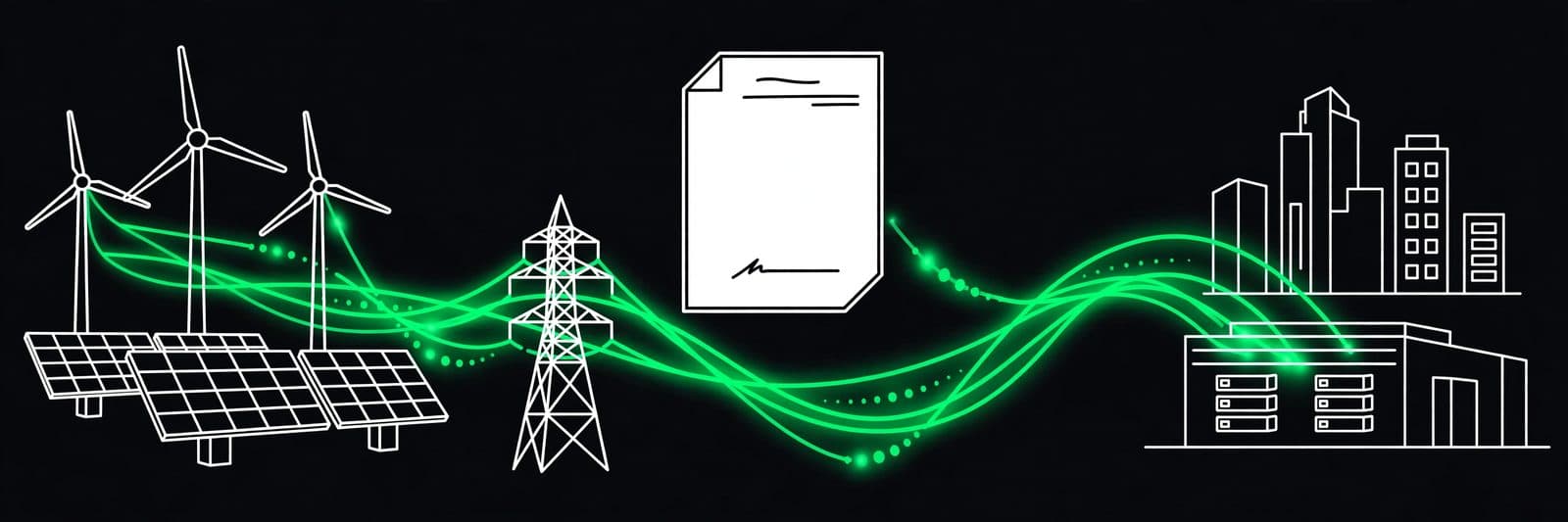
- Corporate buyers signed 55.9 GW of clean power deals in 2025, and four tech giants accounted for 49% of the total.
- A power purchase agreement locks in a price for electricity from a specific plant for 10 to 20 years, and it answers four questions: which plant, how much power, at what price, and for how long.
- The same three letters mean something different on a rooftop: a residential solar PPA charges per kilowatt-hour, the homeowner owns nothing, and a 3% annual escalator can lift a US$240 monthly bill past US$400 before the term ends.
Power purchase agreement: A long-term contract in which a buyer agrees to pay for electricity from a specific power plant at an agreed price, usually for 10 to 20 years. The generator gets revenue it can borrow against, and the buyer gets price certainty and a claim on that plant’s output.
Contents
- How power purchase agreements work, in four questions
- Physical and virtual PPAs settle money in opposite ways
- The 55.9 GW market in four numbers
- The four deals that moved the market
- What a 1 GW data centre pays for power
- The residential PPA is a different contract with the same name
- What the 55.9 GW tally means for new wind and solar
Four companies signed almost half of all the clean power deals in the world last year. BloombergNEF counted 55.9 GW of corporate clean power deals worldwide in 2025, and Meta, Amazon, Google and Microsoft accounted for 49% of that total, about 27 GW between them. The contract behind nearly every one of those deals is a power purchase agreement, and understanding how it works explains where new wind, solar and nuclear plants get their money, and why the cheapest power on the market is not always the power that gets built.
A power purchase agreement, or PPA, is a long-term contract to buy electricity from a specific plant at an agreed price. The buyer commits to pay for the plant’s output, or a share of it, for a long period, usually 10 to 20 years. The plant owner gets a revenue stream it can borrow against to finance construction. The buyer gets a known price and, usually, a claim on the clean or firm energy that plant produces. That exchange is the whole mechanism. Everything else in the market, from virtual settlements to co-located data centres, is a variation on who carries the risk when prices move.

How power purchase agreements work, in four questions
Every PPA answers the same four questions, and the answers decide who carries the risk. Which plant supplies the power, how much power the buyer takes, at what price, and for how long. A fixed price over 20 years moves the risk of falling power prices from the generator to the buyer, and the risk of rising prices the other way. When Talen Energy expanded its Amazon contract in June 2025, it said plainly that the long-term deal would cut its market risk and its reliance on a federal nuclear tax credit. That is the generator’s side of the bargain. The buyer’s side is price certainty on a load that will run around the clock for decades.
The contract does not usually mean the buyer runs on that plant’s electrons. In most deals the plant sends its output into the grid, the campus draws from the same grid, and the contract matches the two on paper and in money. The distinction matters because a PPA is a financial and contractual claim as much as a physical one, and the gap between signing a deal and receiving power is where most PPA stories are decided.
| Question | What it decides | Who carries the risk |
|---|---|---|
| Which plant | The source of the power and its claim to clean or firm energy | Buyer, if the plant is delayed or underperforms |
| How much power | The volume, often a share of output or a fixed annual amount | Shared, through minimum-take and ramp terms |
| At what price | Fixed, escalating, or market-linked per megawatt-hour | Buyer if prices fall, generator if prices rise |
| For how long | Usually 10 to 20 years | Both, locked in for the full term |
Physical and virtual PPAs settle money in opposite ways
A physical PPA delivers power. The buyer, or a retail supplier acting for it, takes the energy through the grid and pays the agreed price. A virtual PPA, also called a financial PPA, delivers only money. The plant sells its power into the wholesale market at whatever the market pays, and the buyer settles the gap: if the market price is below the agreed price, the buyer pays the difference, and if it is above, the buyer receives it. The two forms look identical in a press release and behave very differently when prices move.
LevelTen Energy, which runs a marketplace for these contracts, publishes a widely used benchmark of what North American wind and solar developers are offering. For the third quarter of 2026 it put the benchmark solar offer at US$64.23 per megawatt-hour and wind at US$68.27. Those are offer prices for energy only. Round-the-clock supply is a different product with a higher price, and that gap is the reason the market has shifted toward firm power.
| Type | How power moves | How money moves | Recent example |
|---|---|---|---|
| Physical PPA | Plant sends power into the grid; the buyer is served through the same grid | Buyer pays the agreed price for the contracted energy | Talen and Amazon at Susquehanna, after the move to front-of-the-meter |
| Virtual or financial PPA | Plant sells into the wholesale market; the buyer keeps buying from its normal supplier | Cash settles the gap between market price and agreed price | A common structure for corporate wind and solar deals |
| Co-located | Campus wired directly to the plant, partly or fully off the grid | Buyer pays the plant directly | The original Talen and Amazon arrangement before 2026 |
| Upgrade-funded PPA | Buyer contract pays for new output at an existing plant, which goes to the grid | Long-term price covers the cost of the uprate | Google and Constellation, 890 MW of uprates; Meta and Vistra, 433 MW |
A third form, co-location, wires a campus straight to a plant. The original Talen and Amazon arrangement at Susquehanna in Pennsylvania worked this way. Under the expanded deal it was set to move to a front-of-the-meter structure, in which the plant sells into the grid, Talen acts as Amazon’s retail supplier and the local utility, PPL, handles delivery. The shift shows how much of a PPA is really about grid rules rather than generation.
The 55.9 GW market in four numbers
The 2025 market was smaller than the year before and more concentrated. BloombergNEF counted 55.9 GW of corporate clean power deals worldwide in 2025, down 10% from the 2024 record. The fall came from smaller buyers stepping back: the number of different companies signing deals in the United States fell by about half, to 33, even as US volume hit a record 29.5 GW. Close to half of the corporate PPA market is now four hyperscalers.
| Figure | Value | Source |
|---|---|---|
| Corporate clean power deals worldwide, 2025 | 55.9 GW | BloombergNEF, via Second Order |
| Change vs 2024 record | Down 10% | BloombergNEF, via Second Order |
| US corporate volume, 2025 | 29.5 GW, a record | BloombergNEF, via Second Order |
| Share signed by Meta, Amazon, Google and Microsoft | 49%, about 27 GW | BloombergNEF, via Second Order |
| Meta and Amazon combined, 2025 | 20.4 GW, including 4.7 GW of nuclear | BloombergNEF, via Second Order |
| Benchmark solar offer, Q3 2026 | US$64.23 per MWh | LevelTen Energy |
| Benchmark wind offer, Q3 2026 | US$68.27 per MWh | LevelTen Energy |
The buyer mix has changed in a second way. The deals have shifted toward nuclear and other round-the-clock supply. BloombergNEF found that seven of the ten biggest sellers in 2025 offered firm or near-firm products, such as solar paired with storage or nuclear, totalling 5.2 GW, and named Engie the largest seller of corporate clean power at 3.6 GW. A data centre that runs flat out cannot use power that only arrives at noon, so the market now pays a premium for supply that is there at 3 a.m.
The four deals that moved the market
The four best-known recent contracts share a shape: 20 years or close to it, an existing nuclear site, and power that arrives in stages rather than all at once. Microsoft’s contract with Constellation is what made the restart of the Crane plant, the former Three Mile Island Unit 1, possible, with the restart targeted for 2027. Amazon’s contract with Talen covers 1,920 MW at full quantity through 2042, with 480 MW in Talen’s 2028 outlook and an 840 MW minimum commitment in 2029, reaching full volume by 2032. Meta’s contracts with Vistra cover 2,176 MW from operating plants in Ohio plus 433 MW of uprates, a 2,609 MW total, with purchases starting in late 2026 and the full amount due online by 2034. Google’s October 2026 contract with Constellation funds 890 MW of uprates across 11 nuclear units, about 81 MW each on average, with the first due by 2028, alongside a separate 15-year supply deal for 2,700 MW from the existing fleet.
| Deal | Size | Term | When power flows |
|---|---|---|---|
| Microsoft and Constellation, Crane restart | Output of a restarted reactor; share not disclosed | 20 years | Restart targeted for 2027 |
| Amazon and Talen, Susquehanna | 1,920 MW at full quantity | To 2042 | 480 MW in 2028, 840 MW minimum in 2029, full by 2032 |
| Meta and Vistra, Perry, Davis-Besse, Beaver Valley | 2,609 MW (2,176 MW operating plus 433 MW uprates) | 20 years | Purchases start late 2026; full 2,609 MW by 2034 |
| Google and Constellation, 11-unit uprates | 890 MW new, plus a 15-year supply deal for 2,700 MW | 20 years | First uprate by 2028 |
The ramp matters more than the headline size. Talen’s Amazon contract reaches about a quarter of its full size in 2028 and about 44% in 2029. A 20-year contract signed in 2026 pays nothing until its first megawatt is delivered, and the delivery clock runs on the grid’s schedule. In December 2025 the US energy regulator, FERC, found the tariff of PJM, the grid operator for 13 states and Washington DC, unjust and unreasonable because it lacked clear rules for data centres and other large loads sited next to power plants, and ordered PJM to create new transmission service options. Talen’s chief executive said on the company’s November 2026 call that 2029 is becoming the new 2028 for data centre sites. The year by which new sites can realistically be connected keeps moving out.
What a 1 GW data centre pays for power
The arithmetic of a data centre explains the pull toward firm power. A 1 GW campus running flat out uses about 8.76 TWh a year. At LevelTen’s solar offer price of US$64.23 per MWh, that energy would cost roughly US$563 million a year. But solar does not run at night, so the price buys energy without buying a steady supply. Firm power costs more. On its 3 November 2026 call, Talen put the all-in cost of power from a new gas-fired combined-cycle plant at north of US$120 per MWh, almost twice the solar offer. That gap is the reason existing nuclear plants have become the most sought-after counterparty in the market: they already exist, they run around the clock, and a PPA can pay for a restart or an uprate instead of a new build.
The same arithmetic explains why solar-plus-storage PPAs are the other growth area. A solar plant paired with batteries can shift its output into the evening, and the storage turns an energy-only contract into something closer to firm supply. Our guide to how grid batteries work sets out the durations and costs involved. The same logic sits behind the 800 MW solar and 3.2 GWh battery project paired under a single California PPA, where the storage is what makes the solar output dispatchable after sunset.
The residential PPA is a different contract with the same name
The PPA a homeowner signs is a different deal from the one a hyperscaler signs, and confusing the two is the most expensive mistake in residential solar. A corporate PPA buys power from a plant the buyer does not own, at a price both sides agree. A residential solar PPA does the same thing at household scale: a third-party company installs panels on the homeowner’s roof, owns the system, and sells the homeowner the electricity it produces, charged per kilowatt-hour. The homeowner pays for power by the kilowatt-hour while the company owns the panels and keeps the federal tax credit and any renewable energy certificates the system earns.
The price structure is where the two versions diverge. A corporate PPA usually fixes the price for the term. A residential PPA usually includes an annual escalator, a fixed percentage increase each year. The Cool Down reported a Reddit thread in which a homeowner was offered a prepaid solar PPA, 20 REC460AA panels for US$36,425 with no escalator, and a separate thread in which a buyer taking over a home found a PPA charging US$240 a month with a 3% escalator. At 3% a year, that US$240 monthly charge reaches about US$397 a month in year 18 and about US$421 in year 20, and the total paid over 20 years comes to roughly US$77,400. The escalator is the whole deal: a low starting price that rises every year for two decades, on a system the homeowner never owns.
Three checks separate a fair residential PPA from a costly one. First, the escalator: a fixed price or no escalator beats a 3% annual rise over 20 years by tens of thousands of dollars. Second, the transfer: the contract moves with the house, so a buyer must accept its terms, and a PPA with a high escalator can narrow the pool of future buyers. Third, the alternative: buying the system outright, or leasing it, changes who keeps the tax credit and who owns the asset. Under California’s NEM 3.0 rules, which changed the value of exported solar power, the export rate matters as much as the PPA rate, because the system owner keeps the value of exported power while the homeowner pays for what the system generates. Our guide to how solar panels work covers the generation side of the same decision.
What the 55.9 GW tally means for new wind and solar
The 55.9 GW figure is often read as a demand signal, and it is, but the more useful reading is as a financing signal. Developers need a signed PPA to raise project finance, so the volume of signed deals is close to a leading indicator of what gets built. The concentration in four buyers cuts both ways. On one side, hyperscalers sign the largest, longest contracts the market has ever seen, and those contracts are now funding nuclear restarts and uprates that would not happen on merchant revenue alone. On the other side, the buyer base narrowed sharply in 2025, with US signers falling to 33, so the market depends on a small number of very large decisions. Corporate volumes already fell 10% in 2025 as smaller buyers stepped back. If the largest buyers also pause, the market loses its main signer.
The second reading is about price. Solar at US$64.23 per MWh and wind at US$68.27 are the cheapest energy on offer, and firm gas-fired power at more than US$120 per MWh is almost twice as expensive. Yet the market is paying the premium, because a data centre needs power at 3 a.m. as much as at noon. The PPA market in 2026 is therefore not a contest between cheap and expensive energy. It is a contest between energy and firmness, and the contract is the instrument that prices the difference. Watch the gap between signing and delivery. The signing ceremony is the easy part: the megawatts that matter are the ones that reach the meter, and the grid’s connection queue is now the slowest step in the chain.
Frequently asked questions
What is a power purchase agreement?
A power purchase agreement is a long-term contract in which a buyer agrees to pay for electricity from a specific power plant at an agreed price, usually for 10 to 20 years. The generator gets revenue it can borrow against, and the buyer gets price certainty and a claim on that plant’s output.
How does a PPA work?
Every PPA answers four questions: which plant, how much power, at what price, and for how long. A physical PPA delivers power through the grid at the agreed price, while a virtual PPA settles the difference between the market price and the agreed price in cash.
What is the difference between a physical and a virtual PPA?
A physical PPA delivers power, with the buyer taking energy through the grid and paying the agreed price. A virtual PPA delivers only money: the plant sells into the wholesale market, and the buyer settles the gap between the market price and the agreed price.
Is a residential solar PPA a good deal?
It depends on the escalator and the term. A prepaid PPA with no escalator can be reasonable, but a PPA with a 3% annual escalator turns a US$240 monthly charge into about US$397 a month by year 18, and the homeowner never owns the system or keeps the tax credit.
Why are tech companies signing nuclear PPAs?
Data centres run around the clock, and solar at US$64.23 per MWh only produces energy when the sun shines. Nuclear plants run continuously, so a 20-year PPA with an existing plant buys firm power, and it can fund a restart or an uprate that would not happen otherwise.
Sources
- Power Purchase Agreement (PPA), Explained, Second Order, last reviewed 8 November 2026 (BloombergNEF 2025 corporate deal data, LevelTen Energy Q3 2026 benchmarks, Talen Energy earnings call 3 November 2026, FERC December 2025 ruling).
- Power Purchase Agreements in Renewable Energy, GTI Energy Advisors (PPA structure, typical 10 to 20 year terms, fixed or escalating pricing).
- Homeowners compare solar PPA and lease options, The Cool Down (Reddit r/solar thread: prepaid solar PPA, 20 REC460AA panels, US$36,425, no escalator).
- Buyer learns solar PPA terms in escrow, The Cool Down (Reddit r/solar thread: US$240 a month with a 3% escalator).