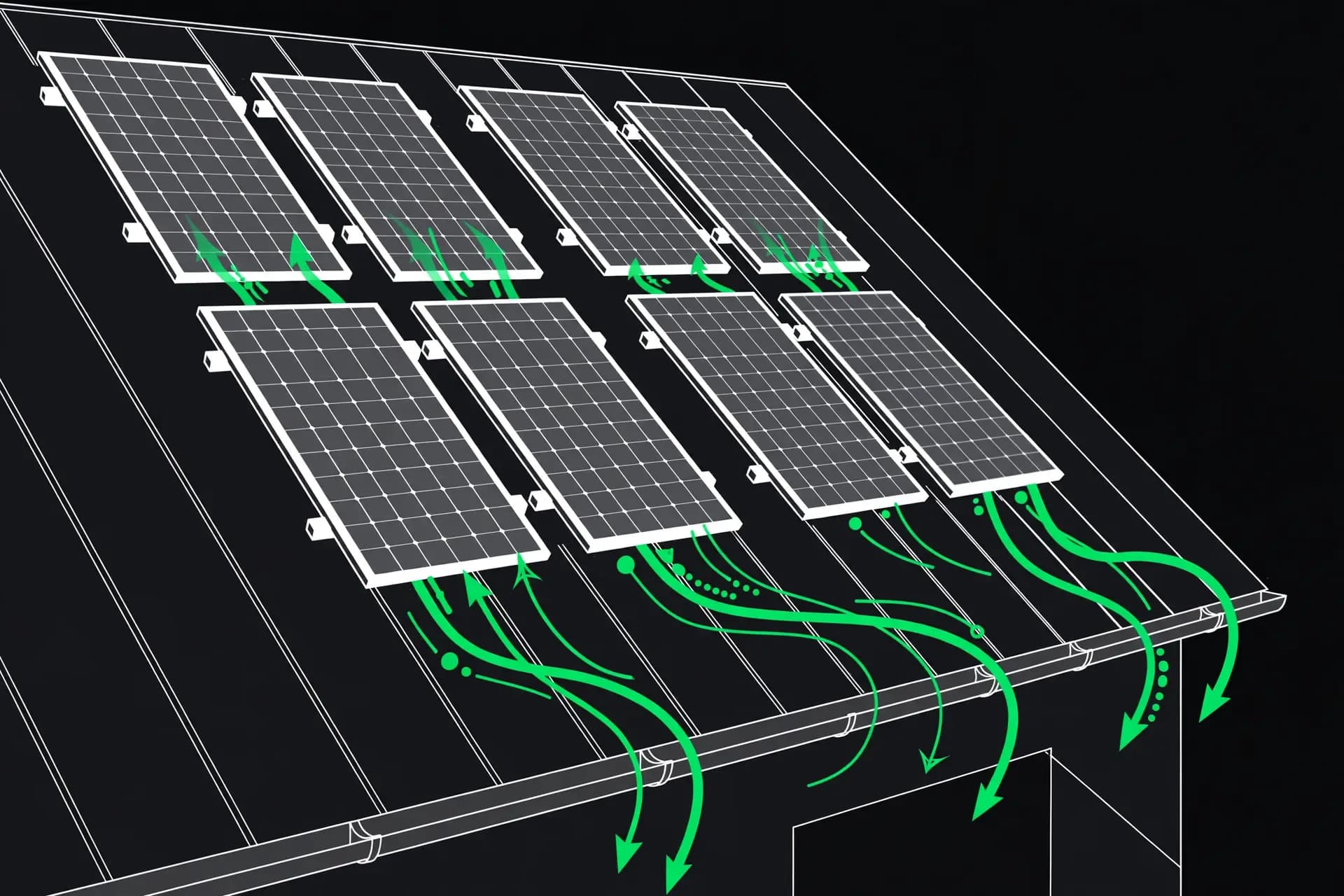
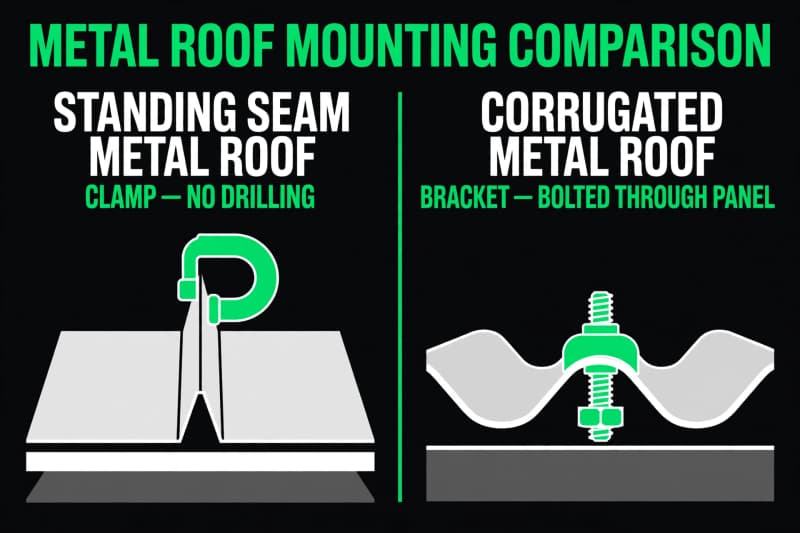
- Standing seam roofs accept non-penetrating clamps, so solar panels mount without a single hole in the roof.
- Corrugated roofs need penetrating brackets, and their exposed fasteners begin failing after 10 to 15 years.
- A standing seam roof lasts 40 to 70 years and outlives solar panels rated for 25 to 30 years, while corrugated roofs last 25 to 40 years.
Solar panels on a metal roof: a photovoltaic array fixed to a metal roofing system, usually with clamps that grip raised seams or brackets screwed through the metal. The roof profile decides whether the mounting penetrates the roof, and that choice shapes leak risk, cost, and how long the roof lasts.
The first question a homeowner weighing solar panels on a metal roof should settle is not which panel to buy. It is which roof profile sits underneath the array, because the profile decides the mounting method, and the mounting method decides where water can get in. A standing seam roof lets an installer clamp the racking to raised seams without drilling. A corrugated roof forces brackets through the metal, and every penetration becomes a seal that must hold for decades. That single difference drives the cost gap, the maintenance schedule, and the risk that a leak appears years after the installer has gone.
Leak risk tops the list of owner fears for a reason. A roof leak rarely announces itself at the point of entry. Water travels along decking and framing before it stains a ceiling, so a small failed seal can cause damage far from the bracket that let it in. Metal roofs earn their reputation for durability from concealed fasteners and long panel runs, and the mounting method either preserves that advantage or gives it away. Clamps that grip a seam leave the weather surface untouched. Screws through a corrugated sheet punch holes that depend on rubber washers and sealant to stay dry, and those washers age faster than the roof around them.
How solar panels on a metal roof attach to standing seam
Standing seam roofing uses long metal panels joined by raised seams, with the fasteners hidden beneath the seam. The S-5! clamp system was designed for exactly this profile. A clamp body sits over the seam and setscrews press into the seam fold, dimpling the metal to hold the clamp in place without penetrating it. The racking then bolts to the clamp. Because nothing pierces the roof surface, the weather barrier stays intact, and the array can be removed later without leaving holes behind.
The clamp must match the seam profile. Standing seam profiles vary in height, width, and fold shape, and a clamp made for one profile will not grip another correctly. Installers check the profile before ordering hardware, and manufacturers publish compatibility charts for their clamps. A mismatched clamp can slip under wind load or crush the seam, so profile matching is a design step rather than a detail to sort out on the roof.
Rail-less mounting is the second advantage of the standing seam profile. With clamps placed at the right spacing, panels can bolt directly to the clamps with no rails between them. RoofPitch reports that rail-less mounting on standing seam can cut material cost, freight, and install time by up to 50 percent. Fewer parts also means fewer connections to inspect over the life of the array, and a lower profile that sits closer to the roof surface.
Certification backs the clamp approach. S-5! clamps carry UL 2703 certification, the mounting-system standard that covers electrical bonding, fire performance, and mechanical load including wind uplift. They also hold ICC-ES ESR-3869 and Florida Product Approval FL46688, which matters in a state where building officials check product approvals closely. A Los Angeles County research bulletin, RB12, qualified S-5! clamps as mechanical anchors under ASCE 7-16, the structural loading standard, with anchor capacities calculated using a safety factor of 4 on ultimate load and a maximum roof slope of 12:12. That safety factor means the rated capacity is one quarter of the load at which the anchor actually fails in testing.
Corrugated roofs and the penetrating bracket problem
Corrugated and other exposed-fastener roofs have no raised seam to grip, so mounting brackets must be screwed through the metal and into the structure below. Each bracket needs a seal, usually a rubber washer under the fastener head plus sealant, and the seal is only as durable as its weakest part. The metal sheet itself can last decades. The washers cannot. RoofPitch notes that fasteners on exposed-fastener roofs begin failing after 10 to 15 years, and washer replacement is expected at 10 to 20 years. A solar array sitting on top of those fasteners makes the replacement work harder, because panels must be lifted or worked around to reach the fasteners beneath them.
Slope rules add another constraint. The International Residential Code, section R905.10, sets a minimum slope of 0.25:12 for standing seam roofs and 3:12 for corrugated roofs. A low-slope corrugated roof sheds water slowly, which gives any failed seal more time to leak. Standing seam tolerates near-flat pitches because its concealed fasteners and raised seams keep water out of the joints.
Wind uplift ratings show the same gap. UL 580 assigns uplift classes of 30, 60, and 90 pounds per square foot, and standing seam typically outperforms exposed-fastener roofing by about 20 to 40 mph in wind resistance. Hail performance follows a similar pattern. UL 2218 Class 4 is the highest hail impact rating, and standing seam in 24-gauge steel typically carries it, while thinner corrugated profiles are less likely to. The panel and the roof can both survive the hail while a cracked washer lets water in afterwards.
None of this makes corrugated roofs unsuitable for solar. Roofrite, an Australian roofing company, lists metal roofs, especially Colorbond steel, among the best roof types for solar panels. The point is narrower. A corrugated roof can carry solar panels, and many do, but the owner accepts penetrating mounts and a maintenance cycle that a standing seam roof avoids. That trade has to be priced honestly before the array goes up, because the cost of lifting panels to replace washers is far higher than the cost of replacing washers on a bare roof.
| Feature | Standing seam | Corrugated / exposed-fastener |
|---|---|---|
| Mounting method | Non-penetrating seam clamps | Penetrating brackets screwed through the metal |
| Roof penetrations for solar | None | One or more per bracket |
| Installed roof cost per square foot | US$10 to US$16 | US$7 to US$12 |
| Roof lifespan | 40 to 70 years | 25 to 40 years |
| Minimum slope (IRC R905.10) | 0.25:12 | 3:12 |
| Wind uplift vs the other type | Higher by about 20 to 40 mph | Lower by about 20 to 40 mph |
| Fastener maintenance | Concealed fasteners, no washer cycle | Fasteners begin failing after 10 to 15 years; washer replacement at 10 to 20 years |
| Hail rating | UL 2218 Class 4 available | UL 2218 Class 4 available |
Metal roof lifespan against solar panel lifespan
The lifespan match is the strongest argument for pairing solar with a standing seam roof. Solar panels typically last 25 to 30 years, with a 25-year performance warranty, according to NREL data. A standing seam roof lasts 40 to 70 years. Put the two together and the roof outlives the first set of panels and still has decades left when the second set goes on. The owner replaces panels once and never touches the roof.
Corrugated roofing tells a different story. At 25 to 40 years, its lifespan overlaps the panel lifespan rather than exceeding it. A corrugated roof installed at the same time as a solar array will likely need replacement around the same time as the panels, or even before them. Roof replacement under an existing array means removing the panels, storing them, replacing the roof, and reinstalling the array. The roofing cost is only part of that bill. The removal and reinstallation work, plus the weeks without generation while the array is down, is the part owners forget to budget.
This timing question should be settled before the first panel is ordered. If the roof has less than 25 years of life left, replacing it before the solar install is cheaper than replacing it under the array. A standing seam roof installed with the array removes the question entirely for most owners. The roof will still be there when the panels are retired, and the clamps that held the first array can hold the second one.
Panel lifespan also shapes the inverter and storage decisions that sit alongside the roof choice. Inverters wear out faster than panels, and the replacement schedule for the whole system is worth mapping at the same time as the roof decision. Our guide to how long solar inverters last covers the component most owners replace first, and how solar panels work explains the cell and wiring layout that the mounting system has to protect. Owners adding storage should also read our breakdown of home battery storage cost per kilowatt-hour, since battery pricing moves the payback math for the whole system.
What two roof replacements cost over 50 years on a 2,000-square-foot roof
The headline prices hide the real comparison. RoofPitch lists installed costs of US$10 to US$16 per square foot for standing seam and US$7 to US$12 per square foot for corrugated roofing. On a 2,000-square-foot roof, that is US$20,000 to US$32,000 for standing seam and US$14,000 to US$24,000 for corrugated. The corrugated roof looks US$6,000 to US$8,000 cheaper on day one. Over 50 years, the order reverses.
A corrugated roof lasts 25 to 40 years, so a 50-year ownership horizon includes one full replacement at around year 30, costing another US$14,000 to US$24,000 at the same per-square-foot rates. Washer replacement cycles fall due at 10 to 20 years and again before the roof is replaced, adding recurring maintenance that a standing seam roof never needs. The 50-year roofing total for corrugated therefore runs to US$28,000 to US$48,000 before washer work, against US$20,000 to US$32,000 for standing seam. The cheaper roof ends up costing US$8,000 to US$16,000 more over 50 years, and that gap excludes the cost of removing and reinstalling the solar array for the mid-life roof replacement.
| Cost over 50 years, 2,000 sq ft roof | Standing seam | Corrugated / exposed-fastener |
|---|---|---|
| Initial roof, installed | US$20,000 to US$32,000 | US$14,000 to US$24,000 |
| Washer and fastener cycles | None; concealed fasteners | Washer replacement at year 10 to 20, then again before replacement |
| Full roof replacement around year 30 | None; roof lasts 40 to 70 years | US$14,000 to US$24,000 |
| Panel removal and reinstallation for roof work | None | Required once; cost varies by installer |
| 50-year roofing total | US$20,000 to US$32,000 | US$28,000 to US$48,000, plus washer work |
The arithmetic uses only the installed costs and lifespans published by RoofPitch, combined with the fastener and washer failure intervals from the same source. It assumes the per-square-foot rates hold for the replacement roof, which understates the corrugated total if roofing prices rise over 30 years. It also leaves out the panel removal and reinstallation cost, which varies too much by installer and region to put a number on. Both omissions cut in the same direction. They make the corrugated case look better than it is.
There is one honest caveat. The 50-year comparison favors standing seam only if the owner stays in the house long enough to reach the replacement cycle. An owner who plans to sell within 10 years may never pay for a washer cycle or a roof replacement, and the lower upfront cost of corrugated roofing is real money in that window. The standing seam roof still adds resale value, since a buyer inherits a roof with decades left and a solar-ready mounting surface, but that value is harder to put a number on than the installation invoice.
What to ask an installer before signing
Five questions separate a careful installer from one who treats every roof the same. First, which clamp model matches this exact seam profile, and is it UL 2703 certified. The answer should name a clamp and a profile, and the certification should be checkable against the UL listing. Second, how many penetrations will the mounting system make, and where. On a standing seam roof the answer should be zero. On a corrugated roof the answer should come with a count and a sealing method for each one.
Third, who handles fastener and washer maintenance, and at what interval. On an exposed-fastener roof, the contract should state who lifts panels to reach fasteners and who pays for it. Fourth, what wind uplift rating does the installed assembly carry, and does the local building department require a specific UL 580 class. Fifth, what happens at panel replacement time. The installer should be able to say whether the clamps can be reused for a second generation of panels and whether the roof warranty survives the solar installation. Get the answers in writing. A roof that lasts 40 to 70 years deserves a mounting decision made with the same horizon in mind.
Frequently asked questions
Can solar panels go on any metal roof?
Yes, with the right mounting method. Standing seam roofs take non-penetrating clamps, while corrugated and exposed-fastener roofs need penetrating brackets with sealed fasteners. The roof profile decides the hardware, and an installer should confirm the profile and the clamp or bracket match before quoting.
Do solar panels cause leaks on a metal roof?
Panels themselves do not cause leaks. Leaks come from mounting penetrations, which is why standing seam clamps that never pierce the roof carry the lowest leak risk. On corrugated roofs, the risk sits with the bracket seals, and exposed fasteners begin failing after 10 to 15 years, so washer maintenance matters more than the panels do.
How long does a metal roof last under solar panels?
A standing seam roof lasts 40 to 70 years, which outlives solar panels rated for 25 to 30 years. A corrugated roof lasts 25 to 40 years, so it will likely need replacement during the life of the array, and that replacement means removing and reinstalling the panels.
Are standing seam clamps strong enough in high wind?
Yes, when the clamp matches the seam profile. S-5! clamps carry UL 2703 certification for mechanical load including wind uplift, and LA County bulletin RB12 qualified them as mechanical anchors under ASCE 7-16 with a safety factor of 4 on ultimate load. Standing seam roofing also typically outperforms exposed-fastener roofing by about 20 to 40 mph in wind resistance.
Should I replace my roof before installing solar panels?
If the roof has less than 25 years of life left, replace it first. Replacing a roof under an existing array means removing and reinstalling the panels, which costs more than doing the roof before the solar install. A new standing seam roof removes the question for decades, since it outlives the panels.
Sources
- RoofPitch, Standing Seam vs Corrugated Metal Roof: installed costs, lifespans, fastener failure intervals, slope minimums, UL 580 uplift classes, and rail-less mounting savings.
- AltE Store, S-5! S-5-E clamp for double-folded standing seam roof profiles: UL 2703 certification, ICC-ES ESR-3869, and Florida Product Approval FL46688.
- CladdingMate, Are S-5 clamps MCS certified: clamp certification details and the non-penetrating setscrew design.
- Los Angeles County Research Bulletin RB12, S-5! clamps qualified as mechanical anchors under ASCE 7-16, safety factor of 4 on ultimate load, maximum roof slope 12:12.
- Roofrite, Is Metal Roofing Suitable for Solar Panels: metal roofs, especially Colorbond steel, among the best roof types for solar.
- Helios Energy Global, Best Roof Material for Solar Panels: panel lifespan of 25 to 30 years with a 25-year performance warranty, per NREL data.