
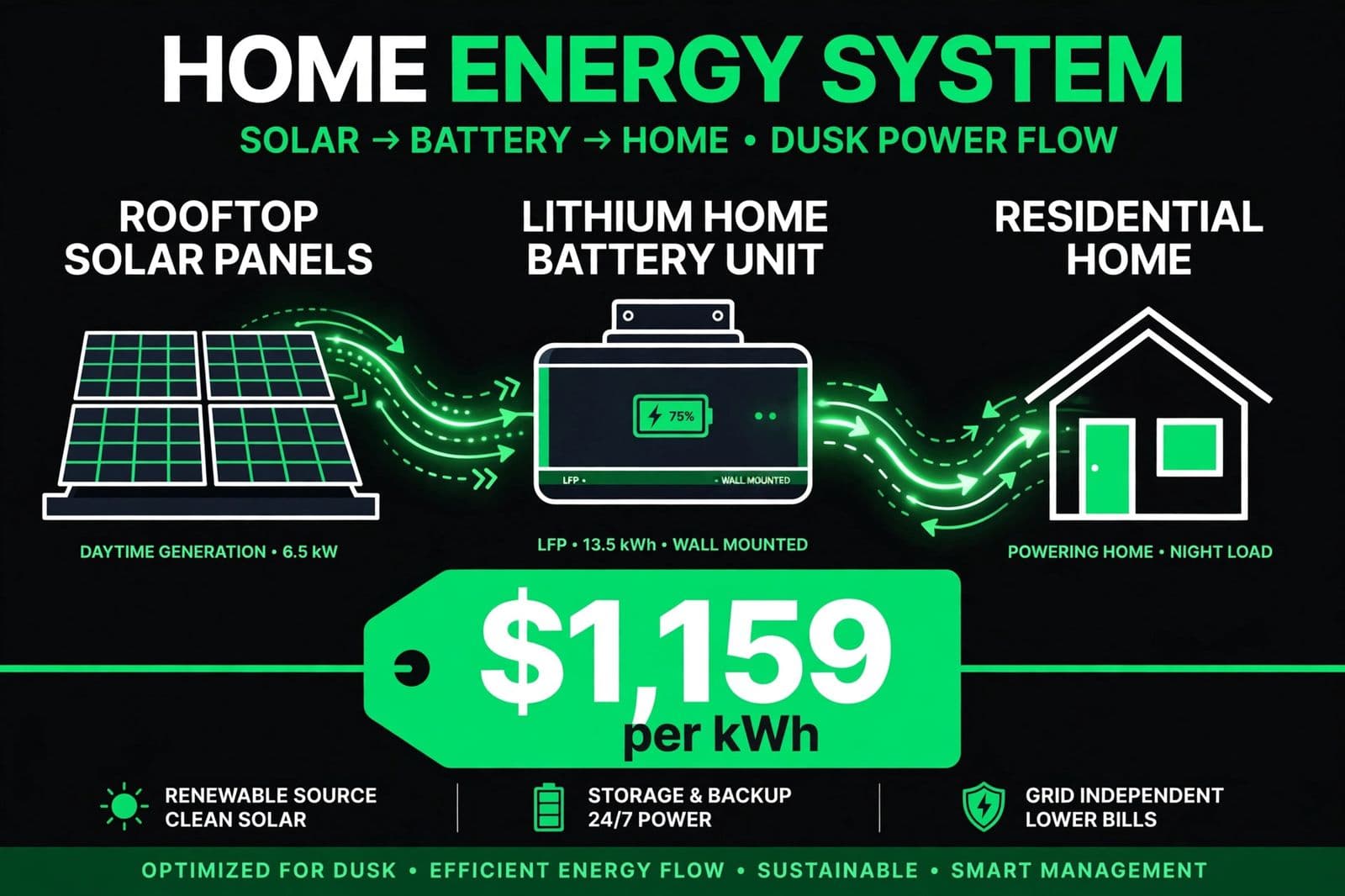
- A typical 13.5 kWh home battery costs about US$15,647 installed in 2026, or US$1,159 per kWh, according to EnergySage marketplace data.
- Tesla’s Powerwall 3 is the cheapest of the three leading batteries per kWh at about US$967, while Enphase’s IQ Battery 5P is the priciest at about US$2,130 per kWh installed with solar.
- The 30% federal Residential Clean Energy Credit expired for systems placed in service after 31 December 2025, so 2026 buyers pay the full installed price unless they lease.
Home battery storage cost per kWh: the installed price of a residential battery divided by its usable capacity in kilowatt-hours. It is the figure that lets buyers compare batteries of different sizes on equal terms, and the number that decides whether the system earns its place on the wall.
The price that matters most for a home battery in 2026 is not the sticker on the box. It is the installed cost per kilowatt-hour, and that number moved in two directions at once this year. Marketplace averages fell, yet the 30% federal credit that used to cut a third off the bill disappeared on 31 December 2025, so the same hardware costs a buyer substantially more this year than last. The gap between the cheapest and priciest leading batteries is now more than two to one per kilowatt-hour, which makes the brand choice worth more than the haggling. This guide works through the current per-kWh prices for the three batteries most United States homeowners actually buy, what the quoted price includes, and how long the numbers take to pay back at today’s electricity prices.
What home battery storage costs per kWh in 2026
EnergySage, which collects installer quotes across the United States, puts the 2026 average at US$1,159 per kWh of stored energy, or US$15,647 installed for a 13.5 kWh battery, the capacity of a Tesla Powerwall 3. The figure comes from thousands of quotes gathered through its marketplace and was updated on 26 August 2026. A separate Owner Handbook analysis of first-half 2026 quotes found a similar average of US$1,130 per kWh across all brands, with the ten most-quoted batteries ranging from about US$967 to US$1,429 per kWh.
Berkeley Lab data points the same way. Among cash buyers, a solar-plus-battery system cost a median of US$2.10 per watt of solar more than a solar-only system, which works out to roughly US$16,200 for the battery and associated equipment on a median 7.7 kW residential solar installation. Most of the Berkeley Lab battery data comes from California, where installation costs run higher than the national average, so the EnergySage figure is the better national benchmark.
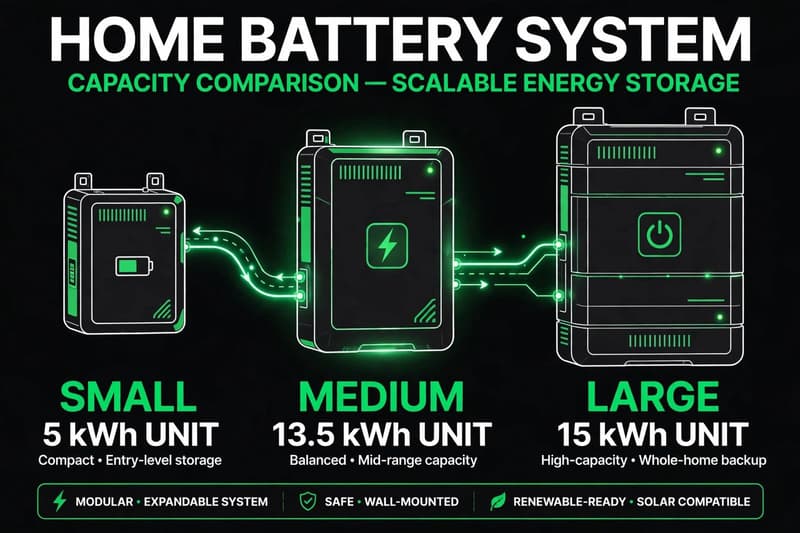
At the US$1,130 per kWh average, the installed cost scales almost linearly with size. A 5 kWh battery runs about US$5,700, a 10 kWh unit about US$11,300, a 13.5 kWh system about US$15,300, and a 27 kWh system about US$30,500. Those are Owner Handbook’s own estimates from the same quote data, and they assume a standard installation with no unusual electrical work.
| Battery size (usable) | Typical installed cost at US$1,130/kWh | What it covers |
|---|---|---|
| 5 kWh | About US$5,700 | Evening essentials for a few hours, or a small solar array’s overnight output |
| 10 kWh | About US$11,300 | Most of an average home’s evening use, or a full day of essentials during an outage |
| 13.5 kWh | About US$15,300 | The most common single-battery size; a full day of average household electricity |
| 27 kWh | About US$30,500 | Two large batteries; multi-day backup or a large solar array’s full daily output |
The per-kWh figure is only comparable when the basis matches. A quote that includes a new solar array shares labour, permitting and electrical work between the panels and the battery, so the battery looks cheaper than a standalone retrofit. A battery added to existing solar carries the full cost of the visit. The figures in this guide name their basis wherever sources report it.
Tesla Powerwall 3, Enphase 5P and FranklinWH aPower 2 cost per kWh compared
Three batteries dominate United States residential quotes in 2026, and their per-kWh prices spread wide. Tesla’s Powerwall 3 is the cheapest per kWh, FranklinWH’s aPower 2 sits near the market average, and Enphase’s IQ Battery 5P costs the most per kWh because it is sold in small 5 kWh units with backup hardware priced in.
| Battery | Usable capacity | Installed cost (2026) | Cost per kWh | Warranty |
|---|---|---|---|---|
| Tesla Powerwall 3 | 13.5 kWh | US$13,000–16,200 | About US$967–1,110 | 10 years, 70% capacity retention |
| FranklinWH aPower 2 | 15 kWh | About US$17,250 with new solar | About US$1,150 | 15 years or 60 MWh throughput |
| Enphase IQ Battery 5P | 5 kWh per unit | About US$10,650 with solar | About US$2,130 | 15 years, 6,000 cycles |
The Powerwall 3 stores 13.5 kWh, delivers 11.5 kW of continuous power according to Tesla’s datasheet, and carries a 10-year warranty that guarantees at least 70% of its capacity, or 9.45 kWh, after a decade. NuWatt’s review, citing EnergySage, puts the average installed cost at about US$13,473, with a typical range of US$12,000 to US$16,200. Solar.com’s marketplace median is about US$15,000 installed with new solar. A second unit adds 13.5 kWh for about US$5,900 as an expansion, which brings a 27 kWh pair to roughly US$20,000 to US$26,000.
FranklinWH’s aPower 2 is the largest single unit of the three at 15 kWh, with 10 kW of continuous output and about 90% round-trip efficiency. Solar.com’s median installed price is about US$17,250 with new solar, or about US$1,150 per kWh, and about US$19,000 when added to existing solar. A second battery costs about US$12,000, so a 30 kWh pair runs about US$28,000, or roughly US$930 per kWh. Every system needs FranklinWH’s aGate controller, which accounts for roughly US$3,000 to US$4,000 of the total, and one aGate supports up to 15 batteries.
Enphase’s IQ Battery 5P is a 5 kWh unit with 3.84 kW of continuous output, stackable to four units or 20 kWh, and backed by a 15-year warranty. Solar.com’s median is about US$10,650 installed with solar for a backup-capable unit, which works out to about US$2,130 per usable kWh, the highest of the three. A consumption-only version without backup hardware runs about US$6,125. The per-kWh figure looks harsh partly because a single small unit carries the full cost of its controller and backup hardware; a two-unit 10 kWh system medians about US$14,250, or roughly US$1,425 per kWh.
What the US$1,159 per kWh average buys
An installed price covers more than the battery. The hardware is the battery itself, an inverter or hybrid inverter where the battery does not include one, a backup panel or gateway that isolates the home during an outage, and the wiring and disconnects between them. Labour covers the electrician’s day, the permit, the inspection, and the utility interconnection application. On a typical 13.5 kWh job, the battery hardware is roughly two-thirds of the total and the rest is labour, permits and balance-of-system equipment.
Two details change the number more than any other. The first is whether the battery is installed with new solar, which shares the crew, the permit and the electrical panel work. The second is the home’s existing electrical panel: an older 100-amp panel that needs an upgrade to 200 amps can add US$2,000 to US$4,000 to the job, and that cost lands on the battery quote even though it has nothing to do with storage. Homeowners comparing quotes should ask for the battery line item separately from panel work.
Battery lifespan shapes the value of the price. EnergySage puts typical home battery life at 10 to 15 years, which matches the warranty terms of the leading units: 10 years for the Powerwall 3, 15 years for the Enphase 5P and the FranklinWH aPower 2. A battery bought in 2026 will usually need replacement in the late 2030s, well before the solar panels it pairs with, which carry 25-year performance warranties. That replacement cost belongs in any honest payback calculation.
The 30% federal credit is gone. What replaces it?
The Residential Clean Energy Credit, known as Section 25D, paid 30% of the cost of a home battery of at least 3 kWh installed between 2022 and the end of 2025. The Internal Revenue Service states it plainly: “The credit is not available for any property placed in service after December 31, 2025.” The One Big Beautiful Bill Act, signed on 4 July 2025, ended the credit, and paying for a system before the deadline did not preserve it if installation finished after that date, because the expenditure counts as made when installation is completed.
Nothing replaces the credit for a homeowner who buys a battery outright in 2026. The commercial credit under Section 48E survives, but only for systems owned by a business, which is why lease and power purchase agreement providers can still pass value through. Under a prepaid lease, the provider owns the system for five years, claims the business credit, and passes it on as an upfront discount, with ownership transferring to the homeowner after year five. Solar.com noted in October 2026 that FranklinWH batteries were not on its prepaid-lease partners’ approved lists, so the route is not open for every brand.
State and utility programs remain the main source of support. California’s Self-Generation Incentive Program offers up to about US$1,100 per kWh for eligible low-income customers, although residential funding was waitlisted during 2026. Massachusetts’ ConnectedSolutions program pays about US$275 per kW for summer performance, worth roughly US$1,200 a year for a typical participating home on National Grid. Both programs change funding levels regularly, so buyers should confirm current availability before counting on them.
How long a home battery pays for itself at 18 cents per kWh
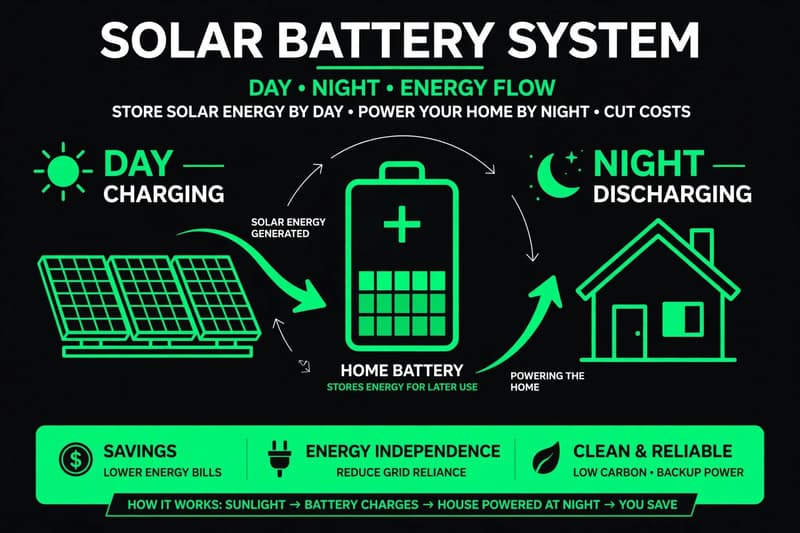
The United States Energy Information Administration projects an average residential electricity price of 18.2 cents per kWh for 2026, up from 17.3 cents in 2025. That price sets a hard ceiling on what arbitrage alone can earn. Charging a 13.5 kWh battery from solar and discharging it instead of buying grid power saves at most the retail price of the energy it delivers. One full cycle a day at the August 2026 national average of 18.16 cents per kWh is worth about US$2.45 a day, or roughly US$895 a year, by Joule Post’s own calculation from the EIA price. Against a US$15,647 system, pure arbitrage takes more than 17 years to pay back, longer than the battery’s 10 to 15 year life.
Real payback comes from three other sources. The first is self-consumption under low export rates: in California, where the net billing tariff pays about 5 to 8 cents per kWh for exported solar against a retail price above 35 cents, every kilowatt-hour the battery stores instead of exporting is worth roughly five times more than the export payment. The second is backup value during outages, which is real but hard to price: the average United States electricity customer experienced 11 hours of interruptions in 2024, nearly double the average a decade earlier, according to EIA data cited by EnergySage. The third is demand-response revenue, worth roughly US$1,125 to US$1,375 per summer for 5 kW of dispatchable capacity in Massachusetts and Rhode Island, and about US$300 per kW per year in Connecticut.
| Value source | Annual value for a 13.5 kWh battery | Notes |
|---|---|---|
| Arbitrage at 18.16 cents per kWh | About US$895 | Joule Post calculation; one full cycle a day, every day |
| Self-consumption under California net billing | US$1,500–2,500 | Export paid 5–8 cents vs retail above 35 cents per kWh |
| Demand response (Massachusetts/Rhode Island) | About US$1,125–1,375 per summer | 5 kW dispatchable, summer performance payments |
| Backup during outages | Not priced | 11 hours of interruptions per customer in 2024, EIA data |
The honest conclusion is that a battery bought for arbitrage alone does not pay for itself in 2026. A battery bought for backup, for self-consumption under a low export tariff, or for a home with high evening use and a time-of-use rate can. Buyers should run the numbers on their own tariff and their own export rate before signing, because the same battery that loses money in Nevada at 12.72 cents per kWh can pay back in Hawaii at 47.18 cents.
What the US$15,647 average means for a typical household
The 2026 market has split into two clear choices. The Powerwall 3 is the value pick for a homeowner who wants the most storage per dollar and accepts a 10-year warranty. The FranklinWH aPower 2 is the capacity pick, with the largest single unit and the longest warranty at a near-average price. The Enphase 5P is the modular pick, expensive per kWh as a single unit but flexible for homes that want to start small and add capacity later.
Budget shoppers will also see the EG4 PowerPro, a 14.3 kWh lithium iron phosphate battery sold as hardware for about US$3,125 to US$3,692, or about US$219 per kWh. That figure is hardware only and must never be compared with installed prices: a complete system needs a hybrid inverter of about US$4,886, plus labour, permits and balance-of-system parts, bringing a turnkey EG4-based system to roughly US$8,600 in hardware before installation. It is a legitimate budget route for a homeowner comfortable with a less mainstream brand, not a US$219 per kWh battery.
Three checks before buying: confirm the quote states installed cost and usable capacity separately, so the per-kWh figure is real; confirm the warranty’s capacity guarantee, not just its length, because 70% retention after 10 years is a different promise from 60%; and confirm whether the price assumes new solar or a retrofit, because the same battery can quote US$2,000 apart on that basis alone. With the federal credit gone, the per-kWh price is the number that decides whether the battery earns its place on the wall.
Frequently asked questions
How much does a home battery cost per kWh in 2026?
About US$1,159 per kWh installed on average, according to EnergySage marketplace data updated in August 2026. A typical 13.5 kWh system costs about US$15,647 before state or local incentives. Brand prices range from about US$967 per kWh for Tesla’s Powerwall 3 to about US$2,130 per kWh for a single Enphase IQ Battery 5P installed with solar.
How much does a Tesla Powerwall 3 cost installed?
Between US$13,000 and US$16,200 installed, with an average of about US$13,473 according to NuWatt’s review citing EnergySage. Solar.com’s marketplace median is about US$15,000 installed with new solar. The 13.5 kWh unit works out to roughly US$967 to US$1,110 per kWh depending on the source.
Is the 30% federal tax credit still available for home batteries?
No. The Residential Clean Energy Credit ended for property placed in service after 31 December 2025. Homeowners who buy a battery outright in 2026 get no federal credit. A lease or power purchase agreement can still pass through the commercial credit, and some state and utility programs offer separate incentives.
How long do home batteries last?
Most home batteries last 10 to 15 years, according to EnergySage. The Tesla Powerwall 3 carries a 10-year warranty with 70% capacity retention, while the Enphase IQ Battery 5P and FranklinWH aPower 2 both carry 15-year warranties. Solar panels last 25 years or more, so a battery will usually need replacing once during the panels’ life.
Is a home battery worth it in 2026?
For arbitrage alone, no: one full daily cycle at the national average price of about 18 cents per kWh saves at most about US$895 a year, which does not repay a US$15,647 system within its life. For backup power, for self-consumption where export rates are low, or for demand-response revenue, the numbers can work. The answer depends on the local tariff, the export rate, and how much the household values backup.
Sources
- EnergySage: Your Guide to Home Batteries in 2026, updated 26 August 2026
- Owner Handbook: Home Battery Storage Cost, published 24 October 2026
- Solar.com: Best Solar Batteries, updated 1 October 2026
- Solar.com: FranklinWH Battery Review, updated October 2026
- NuWatt Energy: Tesla Powerwall 3 Review, updated June 2026
- NuWatt Energy: Enphase IQ Battery 5P Review, April 2026
- Internal Revenue Service: Residential Clean Energy Credit
- Internal Revenue Service: FAQs on the One Big Beautiful Bill Act, 21 August 2025
- US Energy Information Administration: Short-Term Energy Outlook, October 2026
- Joule Post: Home Battery Cost 2026: Powerwall vs Competitors
- Joule Post: Tesla Megapack Costs $278 per kWh and Stores 5 MWh per Unit
- Joule Post: Bidirectional Charging Powers Homes for 3 Days From a 131 kWh EV Battery