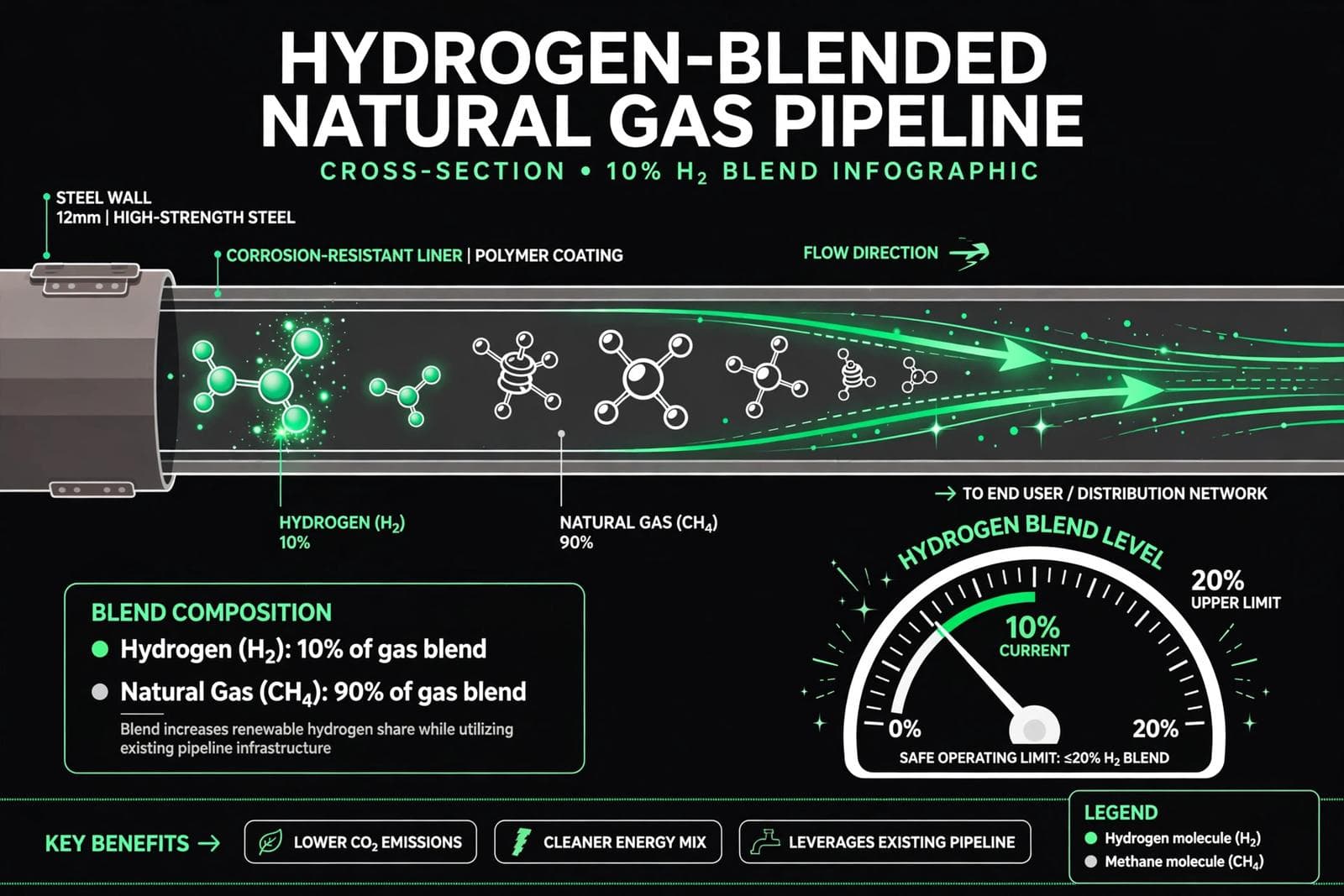
- Most existing gas pipelines can carry hydrogen blends of about 10% by volume with no major retrofit, and regulators generally treat 20% as the upper safe limit.
- A 20% blend cuts carbon dioxide by only about 7%, because hydrogen carries far less energy per unit of volume than natural gas.
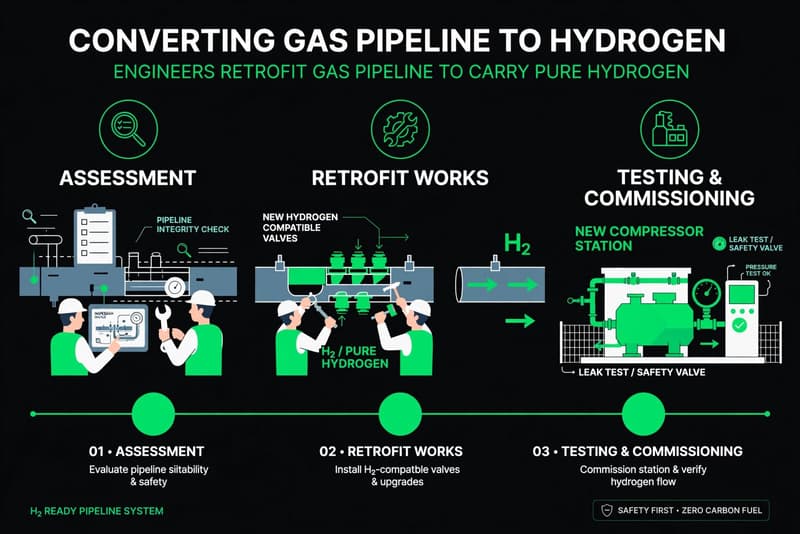
- Running a pipeline on 100% hydrogen is a different job: new compressors, converted steel, and two to three years per section in the German conversion programme.
Hydrogen blending in gas pipelines: mixing hydrogen into the natural gas that flows through existing pipelines, either as a small share of the gas or, after conversion work, as the full contents of the pipe. Blending lets a gas network carry some low-carbon fuel without building new pipelines, but the share is limited by steel embrittlement, compressor design, and the appliances at the end of the line.
Existing gas pipelines can carry hydrogen in small shares today, and the argument is about how large that share can grow before the network needs rebuilding. So can gas pipelines carry hydrogen at the scale climate plans assume? The evidence says yes up to a point, and that point arrives sooner than the headline percentages suggest. A paper from researchers at the German Jordanian University, published 4 November 2025, puts the practical line at about 10% hydrogen by volume for current pipeline technology with no major retrofitting. Most regulators and industry groups recognise 20% as the upper safe limit for existing pipelines without significant upgrades. Above that, the network stops being a gas network with some hydrogen in it and starts needing new equipment.
The first thing to understand is the gap between volume and energy. A 20% hydrogen blend means 20% of the gas by volume is hydrogen. Hydrogen carries roughly a third of the energy of natural gas in the same volume, so that 20% volume share delivers only about 7% of the energy. The same paper puts the carbon dioxide saving from a 20% blend at about 7%, and a 30% blend at about 11%. Anyone promising a 20% emissions cut from a 20% blend is confusing the two measures, and the confusion matters because it inflates the climate benefit by nearly three times.
A 20% hydrogen blend cuts emissions by about 7%
The volume trap explains why blending is a modest climate tool. A pipeline carrying a 20% blend still moves mostly natural gas, and the hydrogen in it displaces only a small share of the fossil fuel burned at the other end. At a 5% blend, the level India proposed for household gas in October 2026 and the level California is piloting, the emissions saving is smaller still, around 2%. Blending can shave emissions from a gas system. It cannot decarbonise one.
Cost is the second constraint. Green hydrogen is expected to cost about US$15 per million British thermal units (MMBtu) in 2030, against about US$4 per MMBtu for natural gas, according to the same 2025 paper. That is nearly four times the price for the same unit of energy. A Canadian study cited in the paper found that a 15% blend would need a carbon price of about US$300 per tonne of carbon dioxide to pay for itself. In Jordan, the figure was far higher, about US$1,835.8 per tonne, a Jordan-specific result that says more about local costs than about blending in general. The point that travels is the order of magnitude: blending only makes economic sense where carbon carries a high price or where hydrogen is unusually cheap.
What each part of the gas network can handle
The network is not one thing. Pipes, compressors, storage caverns, turbines, and household appliances each have their own limit, and the weakest component sets the limit for the whole system. The table below pulls together the limits reported in the German Jordanian University paper.
| Network component | Hydrogen share it can handle | What sets the limit |
|---|---|---|
| Long-distance transmission pipelines | About 10% by volume | Current pipeline steel and welds with no major retrofit |
| Distribution grids | Up to 20% by volume | Upper safe limit recognised by most regulators and industry groups |
| Compressors | About 10% by volume | Above 5% to 10%, compressor design must change |
| Static pipelines and storage | Up to 50% by volume | No moving parts, so higher tolerance |
| Gas turbines | Most commercial units below 70% | Combustion and materials limits; GE 7HA DLN 2.6e handles up to 50% with little or no modification |
| Carbon dioxide saving | 20% blend: about 7%; 30% blend: about 11% | Hydrogen carries about a third of the energy per unit volume |
Compressors deserve attention because they are the bottleneck most blending plans hit first. A pipeline compressor squeezes gas to keep it moving, and its seals, bearings, and rotors are tuned for the density and behaviour of natural gas. Hydrogen is lighter and leaks more easily, so above roughly 5% to 10% the compressor needs a new design. Static pipe and storage tolerate far more, up to 50%, because nothing inside them moves. That split explains why a distribution grid can accept a 20% blend while the transmission pipeline feeding it may already be at its limit.
Hydrogen embrittlement sets the limit on old steel
The reason old steel cannot simply take more hydrogen is embrittlement. Hydrogen molecules are small enough to slip into the crystal structure of steel, where they gather at grain boundaries and defects and make the metal less able to bend before it cracks. The effect grows with pressure, with the hydrogen share, and with time, which is why a pipeline that handles a 10% blend for a year may not handle a 30% blend for a decade. High-strength steels, the kind used in modern high-pressure transmission lines, are more vulnerable than the lower-strength steels in older, lower-pressure distribution pipes. Welds are a particular weak point, because welding changes the steel structure and leaves residual stress that hydrogen exploits.
Operators manage the risk in three ways. The first is to keep the blend low enough that embrittlement stays within the safety margin of the existing steel. The second is to inspect more often and to replace the most vulnerable sections, which is expensive and slow. The third is to convert the pipeline properly for hydrogen service, which means new compressors, new valves and seals, and in some cases relining or replacing pipe. Germany has chosen the third path for part of its network, and the work involved shows why conversion is measured in years rather than months.
Converting a pipeline to 100% hydrogen takes two to three years per section
Germany is converting parts of its low-calorific gas network, known as L-gas, to carry pure hydrogen. The work was studied section by section with the technical inspection association TUV, and each conversion takes two to three years. The pipes themselves are mostly suitable. The work sits in the equipment around them: compressors, metering, valves, and safety systems all need to change, and the pipeline must be cleaned and tested before hydrogen flows. German gas grid operators aim to have 5,100 kilometres of hydrogen network carrying about 70 terawatt hours by 2030, according to the Fraunhofer Institute for Integrated Circuits and the grid operator Open Grid Europe.
That timetable is the honest scale of repurposing. A country with one of the most developed gas grids in the world, working from a plan drawn up years ago, still needs most of this decade to convert a fraction of its network. The pipes are the cheap part. The conversion programme is the expensive part, and it is also the part that determines whether hydrogen actually flows. Pipelines are only one way to move the fuel: compressed gas, liquid hydrogen, and chemical carriers each suit different distances and volumes.
Moving hydrogen 1,000 km costs 10 to 20 euro cents per kilogram
Where pipelines win is moving large volumes of energy over long distances. A single pipeline one metre in diameter, running at 80 to 100 bar, can move about 24 gigawatts of energy, roughly eight times what a high-voltage power line carries, according to Fraunhofer IIS. The European Hydrogen Backbone study found that hydrogen could be moved 1,000 kilometres across Europe for 10 to 20 euro cents per kilogram. That is cheap against the cost of producing green hydrogen, and it is the strongest argument for repurposing gas pipelines rather than building new ones.
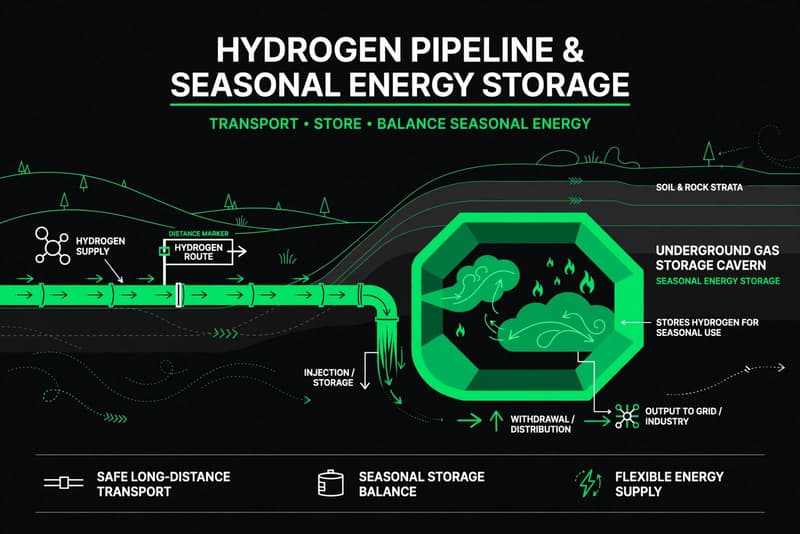
Storage is the second advantage. The German gas grid can store about three months of the country’s energy demand. The power grid, by comparison, stores about 30 minutes. That gap is why hydrogen in pipelines is discussed as seasonal storage, a way to hold summer solar energy for winter heating, rather than as a simple fuel swap. A battery stores hours. A gas grid stores seasons. For distances beyond pipeline range, shipping hydrogen as ammonia is the usual alternative.
| Figure | Value | Source |
|---|---|---|
| Green hydrogen cost, 2030 | About US$15 per MMBtu | German Jordanian University paper, 4 November 2025 |
| Natural gas cost | About US$4 per MMBtu | Same paper |
| Carbon price needed for a 15% blend | About US$300 per tonne of CO2 | Canadian study cited in the paper |
| Hydrogen transport, 1,000 km | 10 to 20 euro cents per kilogram | European Hydrogen Backbone study, via Fraunhofer IIS |
| Pipeline capacity, 1 m diameter at 80 to 100 bar | About 24 GW, about 8 times a high-voltage line | Fraunhofer IIS / Open Grid Europe |
| German hydrogen network target, 2030 | 5,100 km carrying about 70 TWh | Fraunhofer IIS / Open Grid Europe |
| German gas grid storage | About 3 months of energy demand | Fraunhofer IIS |
India proposes 5% hydrogen for household gas
India’s Petroleum and Natural Gas Regulatory Board floated draft guidelines in October 2026 to mix 5% hydrogen into piped natural gas for household consumers. The proposal is modest, and that is the point. At 5% by volume, the blend sits inside the range that existing distribution pipes and household appliances handle without modification, and the emissions saving is small, around 2%. India’s regulator is treating blending as a first step that tests the network, the metering, and the safety systems before anyone talks about higher shares.
The proposal also shows how regulators think about the appliance end of the system. Household stoves, water heaters, and boilers are designed for natural gas. Hydrogen burns hotter and faster, and its flame is invisible in daylight. At low blends, appliances cope. At higher blends, burners need adjustment or replacement, and the cost lands on households rather than on the gas company. A 5% proposal keeps that cost at zero, which is part of why regulators keep returning to it. The efficiency case against heating homes with hydrogen is a separate problem from the pipeline question, and it is a harder one for blending advocates.
California’s US$64 million Orange Cove pilot faces a fight over 5% blends
California shows what happens when blending moves from a regulator’s paper to a real town. Southern California Gas wants to run a demonstration in Orange Cove, a small city in Fresno County, blending hydrogen into the gas supply for about 2,000 customer meters and about 10,000 residents. The blend would start at 0.1% and rise to 5%, and the project would cost US$64 million over 18 months, according to a February 2026 opinion piece in the Los Angeles Times, republished by TechXplore. Residents pushed back, and the dispute has become a test case for whether blending is a climate measure or a way for gas utilities to keep selling gas.
The utilities’ own filings sharpen the argument. In February 2026, SoCalGas and two other California utilities petitioned the California Public Utilities Commission to skip pilot projects and allow a 5% hydrogen blend across the state without first demonstrating safety. The petition, filed with the commission on 3 February 2026, also asked to cancel the Orange Cove demonstration. The Los Angeles Times piece put the climate benefit bluntly: blending is a dead end that at best would reduce gas utility climate emissions by less than 7%. That figure matches the volume-to-energy arithmetic in the German Jordanian University paper, and it is the number blending advocates have to answer.
California is not the first place where a residential blending pilot has collapsed under local opposition. NW Natural withdrew its application for a hydrogen blending project in West Eugene, Oregon, in November 2022, after a coalition of community groups intervened and cited unanswered health and safety questions and a US$10 million price tag that ratepayers would have carried. In the Netherlands, the Hydrogen Hoogeveen project, which aimed to heat 100 new homes and about 10 existing homes with hydrogen, was cancelled in late October 2026 after seven years of development because the team could not make the gas odorisation equipment work reliably. Pure hydrogen has no smell, so an odorant must be added for leaks to be detectable, and the project partners, including the gas infrastructure company Gasunie, could not guarantee the system would work before homes were connected.
The US$300 per tonne carbon price that makes a 15% blend pay
The economics keep pointing the same way. Green hydrogen at about US$15 per MMBtu against natural gas at about US$4 per MMBtu means every unit of hydrogen energy costs nearly four times the gas it replaces. A 15% blend needs a carbon price of about US$300 per tonne of carbon dioxide to break even, according to the Canadian study. Few carbon prices in the world sit anywhere near that level, which is why blending projects lean on subsidies, pilot budgets, or regulatory mandates rather than on their own economics.
The Netherlands offers a wider warning. Four of seven subsidised Dutch green hydrogen projects, representing 550 megawatts of 1,150 megawatts planned, have been cancelled, according to parliamentary answers published 2 November 2026 and reported by CleanTechnica, and none of the original seven is operating. The Dutch government awarded 783.5 million euros in subsidies to the seven projects in 2022. Four years later, the projects have delivered no operating capacity, and the government cannot say when electrolytic hydrogen will become commercially viable without dedicated subsidies. Blending into a gas network is cheaper than building a hydrogen economy from scratch, and the Dutch record shows how far even subsidised hydrogen still has to go.
Blend now, convert deliberately
The evidence supports a narrow version of blending and a sceptical version of the hype around it. Blends up to 10% work in most existing pipelines with no major retrofit, and 20% is the recognised upper limit for distribution grids. Those blends cut emissions by a few percent, which is real but small, and they cost several times the gas they replace. Pipelines converted properly to 100% hydrogen can move enormous volumes of energy and store it for months, and Germany’s 5,100 kilometre target for 2030 shows the scale of that prize. Getting there takes two to three years per pipeline section, new compressors, and a carbon price or subsidy that closes a nearly fourfold cost gap.
For a gas network owner, the sequence that fits the evidence is to blend at 5% to 10% where the pipes and appliances already cope, to convert the highest-value routes to pure hydrogen with proper engineering, and to stop describing blending as decarbonisation. It is a first step that buys time and tests equipment. The decarbonisation comes from the conversion, and the conversion is a construction programme, not a blending ratio.
Frequently asked questions
Can existing gas pipelines carry hydrogen?
Yes, in small shares. Current pipeline technology handles about 10% hydrogen by volume with no major retrofit, and regulators generally treat 20% as the upper safe limit for existing pipelines without significant upgrades. Running a pipeline on 100% hydrogen needs conversion work, including new compressors and valves. The hydrogen in a blend can come from any production route, and the grey, blue, and green colour labels describe how it was made.
How much hydrogen can be blended into natural gas?
It depends on the part of the network. Long-distance transmission pipelines handle about 10%, distribution grids up to 20%, and static pipelines and storage up to 50%. Compressors are usually the first limit, at about 10%. Household appliances generally cope with blends up to 20%, though burners may need adjustment at higher shares.
What is hydrogen embrittlement?
Embrittlement is the weakening of steel when hydrogen atoms slip into its crystal structure and gather at grain boundaries, making the metal more likely to crack instead of bending. The effect grows with pressure, hydrogen share, and time, and high-strength steels and welds are the most vulnerable parts of a pipeline.
Can home appliances run on a hydrogen blend?
At low blends up to about 5%, most household appliances run without modification. At higher blends, burners may need adjustment because hydrogen burns hotter and faster than natural gas, and its flame is invisible in daylight. The cost of adjusting or replacing appliances is one reason regulators keep proposing low blends first.
Is hydrogen blending cheaper than building new pipelines?
Moving hydrogen through a repurposed pipeline is cheap: about 10 to 20 euro cents per kilogram over 1,000 kilometres, according to the European Hydrogen Backbone study. The hydrogen itself is the expensive part. Green hydrogen costs about US$15 per MMBtu against about US$4 per MMBtu for natural gas, so the fuel, not the pipeline, decides whether blending pays.
Sources
- Hydrogen blending in natural gas pipelines, MDPI, 4 November 2025
- Hydrogen in gas pipelines, Fraunhofer IIS / Open Grid Europe interview
- PNGRB suggests 5% hydrogen blending in piped gas for households, The Hindu BusinessLine, October 2026
- Blending hydrogen into gas pipelines could enrich utilities and harm Californians, Los Angeles Times via TechXplore, 18 February 2026
- Joint utilities proposal to modify decision D.22-12-057, California Public Utilities Commission, filed 3 February 2026
- NW Natural withdraws application for controversial hydrogen blending experiment, Sierra Club, November 2022
- Hydrogen heating pilot project cancelled in the Netherlands after seven years, SolarVision, 3 November 2026
- Four of seven Dutch green hydrogen projects cancelled, CleanTechnica, 12 November 2026