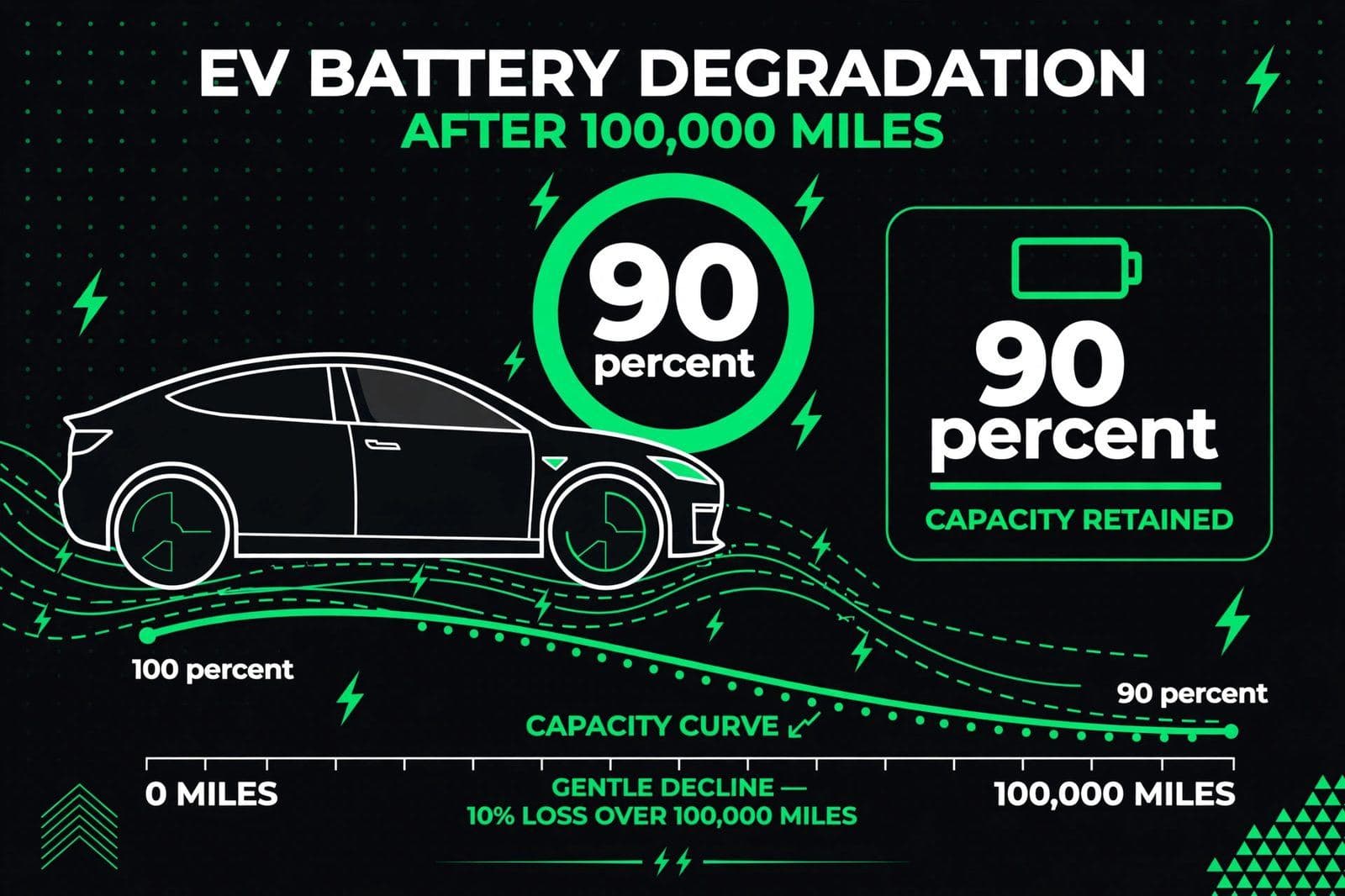
- Aviloo tested 500,000 EV batteries across 20 models. The median car kept 90 to 94 percent of its range after 150,000 km (93,205 miles).
- Geotab telematics from 22,700 EVs put average loss at 2.3 percent a year, projecting 81.6 percent capacity after eight years.
- Heavy DC fast charging roughly doubles the loss rate, while air-cooled packs in the Leaf and Zoe age fastest. Individual cars vary widely around every median.
EV battery degradation: the gradual loss of a battery pack’s usable capacity, measured as state of health, the percentage of original capacity still available. A car at 90 percent state of health returns about 90 percent of its original range on a full charge.
The fear that stops many used EV buyers is simple: a car with six figures on the odometer must be close to a dead battery. Two large datasets published in 2026 say the fear is overstated, and both agree on the number that matters. After roughly 100,000 miles, a typical liquid-cooled EV still holds about nine tenths of the range it had when new. The loss is real, it arrives early, and it slows down. What decides whether a particular car lands above or below the median is mostly how it was charged and where it lived.
Aviloo, an EV battery diagnostics company, compiled 500,000 health tests from 2022 to 2026 covering 20 popular models across North America, South America, Europe, Asia and Australia. For each model it calculated the median state of health at three milestones: 50,000 km, 100,000 km and 150,000 km. Geotab, a fleet telematics company, took a different route. It tracked 22,700 EVs across 21 models and measured how fast capacity falls per year of use. The two studies measure different things, mileage versus time, and their answers differ in ways that are worth understanding before trusting either number alone.
What 500,000 battery tests measured at three mileages
Aviloo’s headline finding is that after close to 100,000 miles, popular EVs tend to still have at least 90 percent of their battery capacity and range. The detail underneath is more useful than the headline. At 50,000 km (31,068 miles), every one of the 20 models held a median above 90 percent, and the Hyundai Ioniq 5 led at over 97 percent, with the Mercedes-Benz EQA second at 96.56 percent. At 100,000 km (62,137 miles), the Ioniq 5 still led at over 95 percent, followed by the EQA at 95 percent, the Hyundai Kona Electric at 94.3 percent, the BMW i4 at 94.3 percent and the Ford Mustang Mach-E at 93.45 percent. Excluding two outliers, every model stayed at or above 90 percent.
At the top milestone, 150,000 km (93,205 miles), the medians clustered between 90 and 94 percent for most models. The Ioniq 5 and EQA virtually tied at the top, 93.79 and 93.97 percent. The BMW i4 scored 93.62 percent, the Kona Electric 92.95 percent and the Volvo XC40 Recharge 92.79 percent. The two Teslas in the study landed in the middle to lower end of the pack: the Model Y showed 90.3 percent median health and the Model 3 88.94 percent after 150,000 km. The worst performers were the small air-cooled cars, the Nissan Leaf at 86.67 percent, the Renault Zoe at 87.33 percent and the Mini Cooper SE at 87.11 percent.
| Model | Median health at 50,000 km | Median health at 100,000 km | Median health at 150,000 km |
|---|---|---|---|
| Hyundai Ioniq 5 | Over 97% | Over 95% | 93.79% |
| Mercedes-Benz EQA | 96.56% | 95% | 93.97% |
| Hyundai Kona Electric | Not reported | 94.3% | 92.95% |
| BMW i4 | Not reported | 94.3% | 93.62% |
| Ford Mustang Mach-E | Not reported | 93.45% | Not reported |
| Tesla Model Y | Not reported | Not reported | 90.3% |
| Tesla Model 3 | Not reported | Not reported | 88.94% |
| Nissan Leaf | Not reported | Not reported | 86.67% |
The pattern across the three milestones is the first thing a buyer should take from the study. The Ioniq 5 lost roughly three to four points of capacity between 50,000 and 150,000 km, most of it in the first leg. That front-loaded shape shows up across the dataset and matches what Geotab found on the time axis: many EVs lose more in the first year or two before the rate levels out. A car that has already covered 60,000 miles has already absorbed the steepest part of its decline, which is why high-mileage EVs can be better value than their odometers suggest.
Why Geotab’s 2.3 percent a year gives a lower number
Geotab’s January 2026 analysis of more than 22,700 EVs across 21 models put average battery degradation at 2.3 percent a year, up from 1.8 percent in its 2024 analysis. Extended in a straight line, 2.3 percent a year leaves 81.6 percent of original capacity after eight years. That sounds worse than Aviloo’s 90-plus percent at 93,000 miles, and the gap needs explaining because both numbers are correct.
The two studies count different things. Aviloo reports medians by mileage for specific models, and its sample skews toward cars that were still on the road and healthy enough to be tested. Geotab reports an average across all vehicles by age, including the worst performers, and its straight-line projection assumes the loss rate never slows. Geotab itself notes the counterweight: eight of the 11 established models it has tracked since 2023 settled at 1.4 percent a year, which projects to about 89 percent after eight years. The average is pulled up by newer models in their fast early-loss phase and by heavy fast-charging fleets.
| Dataset | Sample | Headline figure | What it measures |
|---|---|---|---|
| Aviloo, Sep 2026 | 500,000 tests, 20 models | 90 to 94% median at 150,000 km | Capacity by mileage, per model |
| Geotab, Jan 2026 | 22,700 EVs, 21 models | 2.3% a year; 81.6% after 8 years | Average loss by age, all vehicles |
| Geotab established models | 8 of 11 tracked since 2023 | 1.4% a year | Loss rate once early decline settles |
| Recurrent, 2026 | 15,000+ vehicles | About 97% of expected range after 3 years; 95% after 5 | Range retention by age |
| Typical warranty floor | Most manufacturers | 70% at 8 years or 100,000 miles | Minimum guaranteed by the maker |
Recurrent’s 2026 market report, drawn from more than a billion miles of driving across 15,000 vehicles, adds a third angle: the average EV retains about 97 percent of its expected range after three years and 95 percent after five. Put together, the three datasets describe the same curve from different sides. Expect roughly 3 to 5 percent gone in the first years, then about 1 to 2 percent a year after that, with the exact slope set by the car and how it was used. For the warranty picture, see our guide to what EV battery warranties actually cover, and for the longer view, our explainer on how long EV batteries last.
Charging habits move a car off the median
Medians hide the spread, and Aviloo published the spread. For the Model Y after 150,000 km, the range covering 99 percent of examples ran from 82.9 to 94.9 percent. For the Model 3 it ran from 80.28 to 94.53 percent, for the Mustang Mach-E from 85.3 to 96.1 percent, and for the BMW i4 from 87.5 to 96.9 percent. Two cars of the same model and mileage can sit 12 to 14 points apart. That gap is larger than the difference between the best and worst models, which means habits matter more than badges.
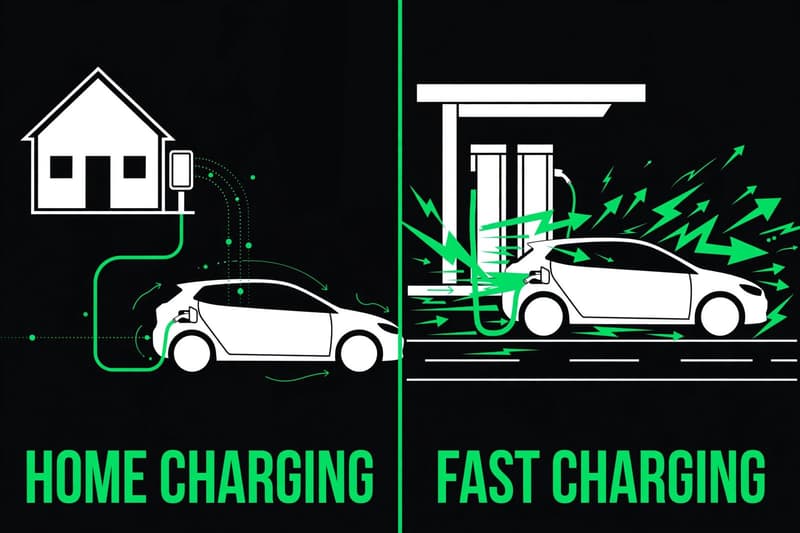
Geotab identified charging power and frequency as the strongest influence on degradation. Vehicles that relied heavily on DC fast charging above 100 kW degraded at up to 3.0 percent a year, roughly double the 1.5 percent rate of vehicles charged mainly on AC or lower-power charging. After eight years, the low-power group is projected at 88 percent of original capacity against 76 percent for the heavy fast-charging group. Vehicle class matters too: multi-purpose vehicles and SUVs averaged about 2.7 percent a year against about 2.0 percent for lighter cars.
Aviloo pointed to the same drivers. Hotter climates, frequent fast charging and keeping a car topped up at 100 percent for hours all widen the spread. Chemistry plays a part as well: manufacturers use different cell chemistries with different trade-offs, so identical charging habits can produce very different results across models. The cooling system is the clearest hardware split in the data. The Leaf and Zoe, two of the few EVs with air-cooled batteries, sit at the bottom of every Aviloo ranking, and Aviloo notes that smaller batteries also degrade faster because they need more charging cycles to cover the same distance.
One piece of common advice did not survive Geotab’s data. The study found that charging to 100 percent and then driving has minimal effect on long-term health. The damage comes from a car sitting at an extreme state of charge for more than 80 percent of its total time. A full charge before a road trip is fine. A car parked at 100 percent for weeks is the pattern to avoid.
What a 10 percent range loss costs on a 300-mile EV
A 10 percent capacity loss sounds abstract until it is converted into miles and minutes. A car rated at 300 miles of range delivers about 270 miles at 90 percent state of health. On a 600-mile day, that is one extra charging stop of roughly 20 to 30 minutes at a fast charger, assuming the driver charges in the usual 10 to 80 percent window. On a daily commute of 40 miles, the same loss is invisible: the car still covers the week on a single charge with range to spare.
The cost side is where the numbers get practical. A battery that has fallen below the 70 percent warranty floor is covered by the manufacturer for eight years or 100,000 miles under most warranties. Above that floor, degradation costs nothing directly. It costs time on long trips and it costs resale value, because buyers discount high-mileage EVs for the battery risk even when the data says the risk is small. That discount is the opportunity for a careful buyer: a 100,000-mile EV with a verified health report can cost thousands less than a low-mileage twin while delivering 90 percent of the range. Our guide to out-of-warranty replacement costs sets out what a genuinely failed pack costs, which is a different question from gradual degradation and a much rarer event.
The comparison that puts the whole picture in context is the warranty floor itself. Every manufacturer in the datasets guarantees at least 70 percent capacity at eight years or 100,000 miles. The Aviloo medians at 93,000 miles sit 17 to 24 points above that floor. The Geotab average projection of 81.6 percent after eight years sits nearly 12 points above it. Batteries are not failing at the warranty line. They are clearing it with room to spare, which is why the floor is a poor guide to what a used EV will actually deliver.
How to check a used EV before you buy
The single most useful step is a battery health report from the car itself. Aviloo, Recurrent and dealership diagnostic tools all read the battery management system’s own state-of-health estimate. Ask for the report before negotiating, and compare the number with the model medians in the table above. A car scoring well below its model’s median at the same mileage deserves a lower price or a walk-away, because the spread in the data means a low score reflects that individual car.
Charging history is the second check. A car that spent its life on home AC charging will generally sit higher in the range than one that lived on DC fast chargers, and Geotab’s numbers put the gap at roughly a full percentage point a year. Service records, charging app history and the previous owner’s pattern all help, and a car with a tow hitch and a roof box has probably worked harder than a garage-kept commuter. Climate matters too: a car from a hot climate will typically show more loss than the same model from a temperate one, so compare like with like.
Finally, check the warranty clock rather than the odometer alone. An eight-year warranty that started in 2022 still covers the battery until 2030, and a car at 95,000 miles with a year of warranty left is a different purchase from the same car a year later. The warranty covers capacity below 70 percent, so a health report in the high 80s with warranty remaining is a low-risk buy. Pair that with a check of the charging network where you live: our field-test report on California public charger reliability shows what the fast-charging experience looks like in practice, including the payment failures that cause more trouble than the chargers themselves.
Frequently asked questions
How much range does an EV lose after 100,000 miles?
About 10 percent on a typical liquid-cooled model. Aviloo’s 500,000-test study found median state of health of 90 to 94 percent at 150,000 km (93,205 miles) for most models, with the Hyundai Ioniq 5 and Mercedes-Benz EQA above 93 percent and the Tesla Model Y at 90.3 percent. Air-cooled models such as the Nissan Leaf scored lower, around 87 percent.
Does fast charging damage an EV battery?
Heavy DC fast charging roughly doubles the degradation rate. Geotab found vehicles using high-power DC fast charging for more than 12 percent of sessions degraded at up to 3.0 percent a year, against 1.5 percent for cars charged mainly on AC power. Occasional fast charging on road trips has a small effect. Daily fast charging is the pattern that shows up in the data.
Is it bad to charge an EV to 100 percent?
Charging to 100 percent and then driving is fine, according to Geotab’s analysis of 22,700 EVs. The problem is leaving the car sitting at 100 percent, or near empty, for long periods. Geotab found harm only when a vehicle spends more than 80 percent of its time at an extreme state of charge.
Do EV batteries degrade faster in hot climates?
Yes. Aviloo lists hotter climates among the main explanations for the wide spread within a single model, alongside frequent fast charging and long spells at full charge. Heat accelerates the chemical aging of lithium-ion cells, which is one reason liquid cooling, standard on most modern EVs, shows up as a clear advantage over the air-cooled packs in the Leaf and Zoe.
Should I worry about buying a used EV with 100,000 miles?
Get a battery health report first, and the worry mostly disappears. A median car at that mileage keeps about 90 percent of its range, and the warranty floor of 70 percent still leaves a large margin. Compare the car’s state of health with its model median, check the charging history, and confirm how much warranty remains. A car well below its model median is the one to avoid. High mileage alone is not the problem.
Sources
- This Study Covered 500,000 EV Batteries. Some Models Aged Much Better Than Others, InsideEVs, 2 September 2026 (Aviloo data)
- EV Battery Health: Key Findings from 22,700 Vehicle Data Analysis, Geotab, January 2026 update
- Geotab study finds EV batteries remain robust despite rise in fast charging, FreightWaves, 4 February 2026
- EV battery degradation: what 22,700 real cars show (2026), EV Model Compare, 2026 (Recurrent 2026 market report figures)