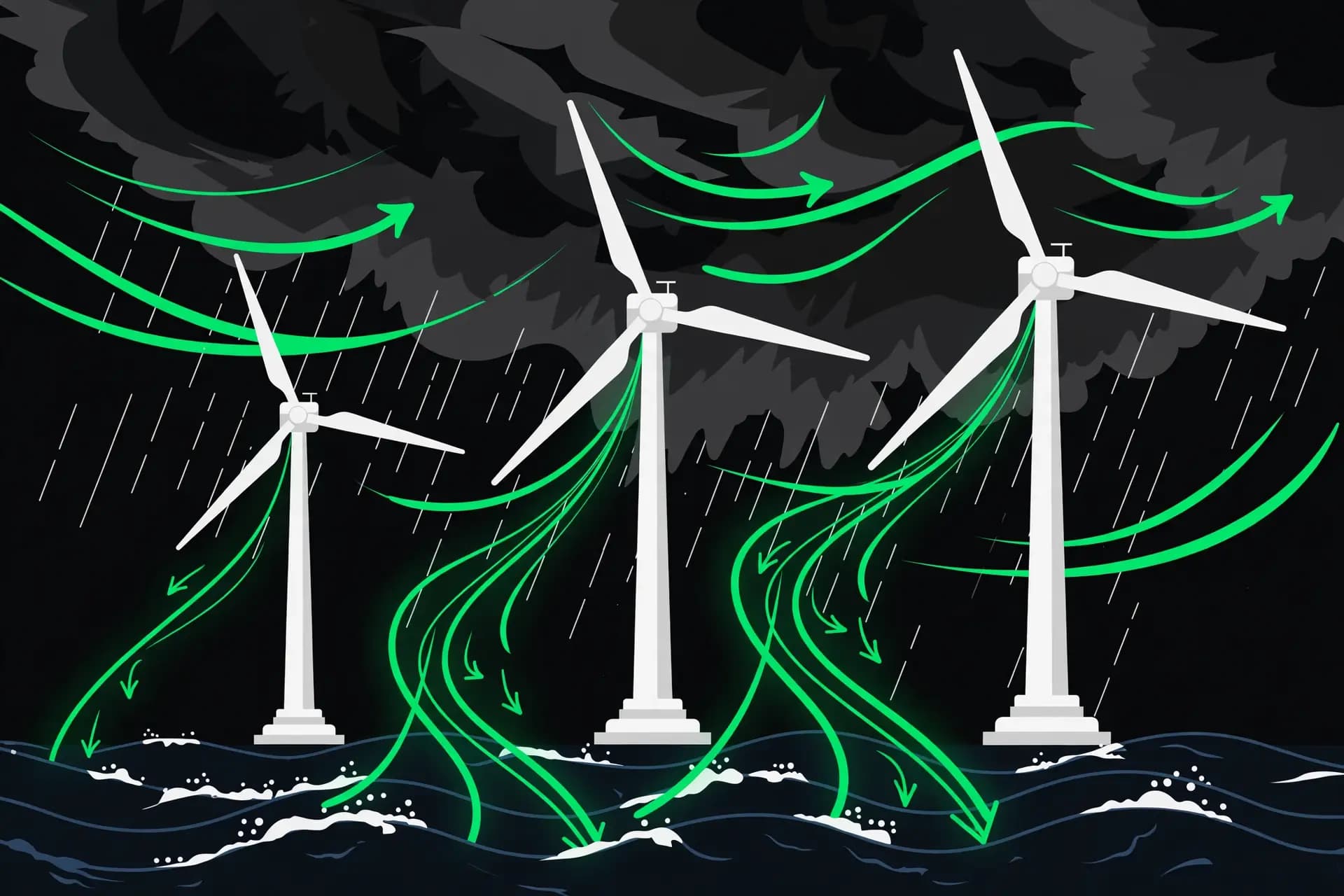
- Turbines shut down automatically near 55 mph, long before their design limits are reached.
- Feathered blades and yaw control cut the load the tower must carry while the storm passes.
- Typhoon Saomai in 2006 showed that grid loss can kill yaw control, so modern turbines carry backup batteries.
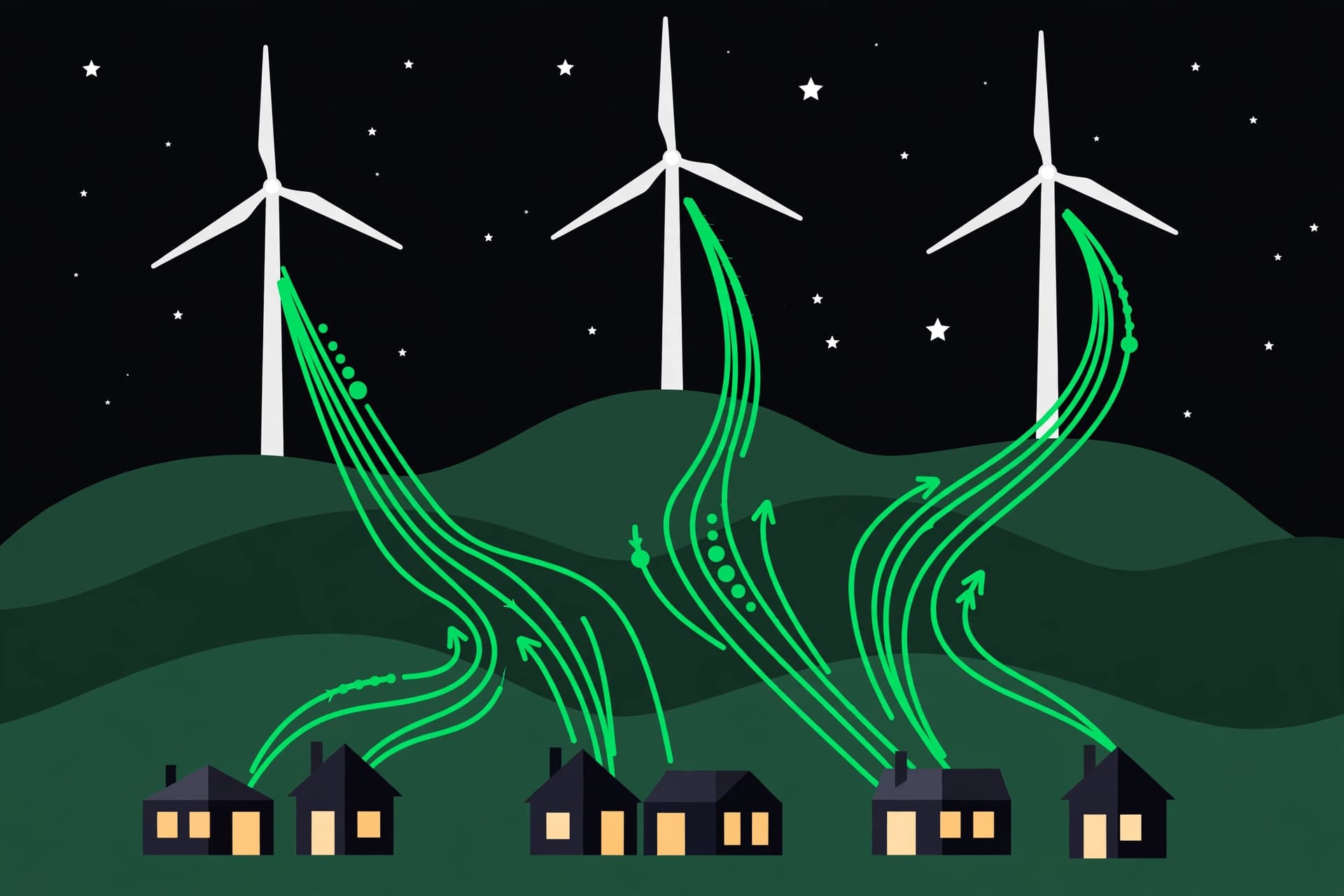
Wind turbines survive hurricanes: a turbine built to IEC 61400-01 limits that detects rising wind, stops its rotor, feathers its blades edge-on, and turns its nacelle to face the storm, so the structure takes the lowest possible load while the storm passes.
How wind turbines survive hurricanes comes down to a sensor on the nacelle. An anemometer on the nacelle measures wind speed continuously, and when the wind reaches the cut-out threshold the controller orders a shutdown. The blades pitch until they sit edge-on to the wind, a position called feathering, and the yaw drive rotates the nacelle so the rotor faces directly into the wind. A parked turbine with feathered blades presents a fraction of the surface area of a spinning one, and that reduction in exposed area is what keeps the tower and foundation loads inside their design envelope.
The part most people miss is that the turbine is not fighting the storm. It is getting out of the way. A spinning rotor extracts energy from the wind, and the loads on the blades, hub, and tower grow with the square of wind speed. Stopping the rotor removes the rotational loads and the thrust of a working rotor. Feathering then cuts the aerodynamic drag of the parked blades. Yaw control keeps the rotor pointed into the wind so gusts strike the narrow edge of the blades rather than the broad face. Each step lowers the load, and the steps happen in seconds once the controller acts.
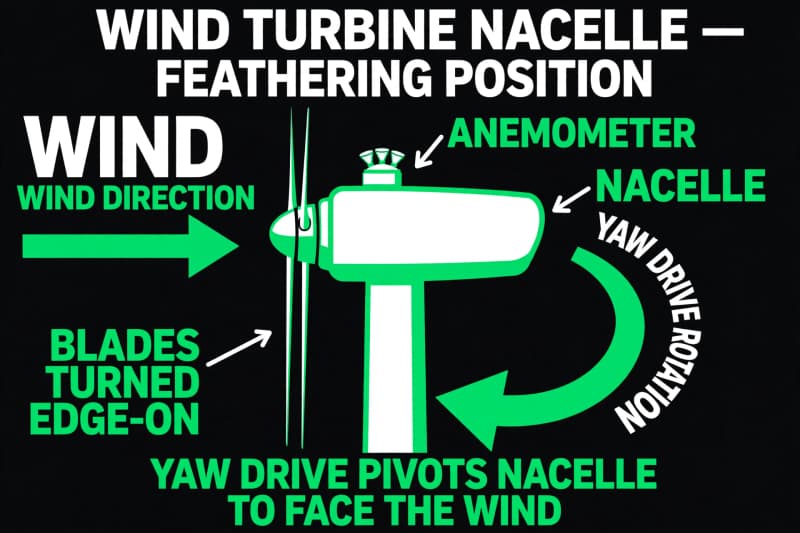
How wind turbines survive hurricanes: the shutdown sequence
The sequence runs on a fixed order. First the anemometer reads wind speed and the controller compares it with the cut-out speed, which the US Department of Energy puts at about 55 mph for most turbines. At that point the controller pitches the blades toward feather and applies the brake, bringing the rotor to a stop. The yaw drive then keeps the nacelle facing into the wind as the storm direction shifts. The turbine stays parked until the wind drops back below the cut-out speed, and the DOE notes that turbines typically resume operation within minutes once conditions ease.
Block Island gave the sequence a real-world test in March 2017. Winter Storm Stella pushed sustained winds above 70 mph across the five-turbine, 30 MW offshore wind farm off Rhode Island. The turbines shut down for several hours while winds stayed above 55 mph, then powered back up after the storm passed. Nothing broke. The shutdown was the protection working as designed, and the farm returned to service without repair work.
The yaw drive deserves attention because it keeps working through the whole storm. A parked turbine that cannot yaw will eventually face the wind from the side, and side winds load the blades and tower in ways the structure was not designed for. The yaw motors draw power from the grid, which is why the grid connection matters as much as the steel. If the grid fails during the storm, the turbine needs another way to keep turning its nacelle into the wind, and that lesson was written in 2006.
IEC 61400-01 and the 156 mph design limit
The international design standard for wind turbines is IEC 61400-01. Most turbines are built to withstand sustained winds of 112 mph and peak three-second gusts of 156 mph. Those numbers describe the extreme wind the structure must survive in its parked, feathered position, not the wind it can operate in. The gap between the 55 mph cut-out speed and the 156 mph gust rating is the safety margin. The turbine stops generating long before the wind approaches anything the tower cannot handle.
The standard also defines a Typhoon Class, added in 2019 for sites exposed to tropical cyclones. Typhoon Class turbines are designed for sustained winds of about 128 mph and gusts of about 179 mph at turbine height. The class exists because standard-class ratings, generous as they are, do not cover the strongest tropical cyclones, and developers building in typhoon regions needed a certified rating to match. A turbine built to Typhoon Class is built heavier, often with a smaller rotor and more steel, and it costs more. The choice between standard and Typhoon Class is a site decision made before the first foundation is poured.
The numbers only make sense against the wind speeds turbines actually face. A Category 5 hurricane can produce gusts above 156 mph, which is why siting matters as much as design. Turbines in the open ocean or on exposed ridges face higher winds than turbines behind hills or far inland. Developers model the site wind climate over decades and pick the turbine class that covers the worst storm the site is likely to see over the turbine’s design life. The standard gives them the rating. The site study tells them which rating to buy.
What Typhoon Saomai taught the industry in 2006
Super Typhoon Saomai struck Zhejiang province in China in August 2006 with gusts that topped 179 mph. The storm knocked out the electricity grid, and with the grid went the power to the yaw drives of the turbines in its path. Unable to keep their nacelles facing the wind, the turbines were caught side-on by gusts above their design rating. Five steel towers collapsed and 27 of the 28 turbines at the site were knocked out. The towers did not fail because the steel was too weak. They failed because the control system lost power and the parked position was lost with it.
The fix was straightforward and cheap relative to the cost of a turbine. Backup batteries were added to keep the yaw system turning on grid loss, so a turbine can hold its heading into the wind through a blackout. A 2012 Carnegie Mellon study put the cost of the backup system at US$30,000 to US$40,000 per turbine. Against the cost of a multi-megawatt turbine and its foundation, that is a small price for keeping the survival sequence running when the grid is gone. The battery backup is now standard practice for turbines in cyclone regions, and the Saomai failure mode is a case study in turbine engineering courses.
Saomai also changed how the industry thinks about the grid connection. A wind farm is not an island. Its survival systems assume power is available, and the grid is the normal source of that power. Battery backup covers the gap, but only for as long as the batteries last, and a storm that knocks out the grid for days tests that limit. Developers in cyclone regions now treat backup power as part of the structural design, and insurers ask about it before writing coverage.
Ragasa 2025 and Harvey 2017: the proof in the field
Super Typhoon Ragasa in 2025 gave Typhoon Class turbines their hardest test. The storm reached Category 5 strength, and winds above 47 metres per second, about 105 mph, were recorded at turbine sites in its path. Turbines built by Envision and Mingyang survived standing. The 105 mph figure sits well below the Typhoon Class gust rating of about 179 mph, which explains the outcome. The turbines shut down, feathered, yawed into the wind, and waited. When the storm passed, they were still standing, and the survival followed from the design margins.
Hurricane Harvey in 2017 told a similar story on the Texas coast. Harvey made landfall as a Category 4 hurricane, and no onshore turbines were destroyed. The Papalote Creek wind farm, a 196-turbine site near Corpus Christi, was back online within days. The turbines survived. The grid failed, and the farm could not export power until the grid was repaired. That distinction matters. A wind farm that survives a hurricane but cannot sell electricity until the transmission system is fixed faces a grid problem, and the recovery time is set by the grid operator.
The two storms bracket the modern record. Ragasa showed that turbines built to the right class survive a Category 5 typhoon. Harvey showed that a large onshore fleet survives a Category 4 hurricane with no turbine losses. Neither storm proves that every turbine survives every storm. A turbine built to standard class and hit by gusts above 156 mph is outside its rating, and Saomai showed what happens when the survival sequence loses power. The record supports a narrower claim. Turbines built to the right class, with working shutdown and yaw systems, survive the storms their class covers.
| Storm | Wind at the turbines | Design limit that applied | What happened |
|---|---|---|---|
| Cyclone Akvan, forecast landfall 20 Nov 2026 | Gusts to 145 km/h (90 mph) | IEC standard class gust rating 156 mph | Forecast: turbines in the path should shut down above 55 mph and ride out the storm with a 66 mph margin |
| Super Typhoon Ragasa, 2025 | Winds above 47 m/s (105 mph) at turbine sites | Typhoon Class gust rating about 179 mph | Envision and Mingyang turbines survived standing |
| Super Typhoon Saomai, Aug 2006 | Gusts topped 179 mph | Standard class gust rating 156 mph, exceeded; grid loss killed yaw control | 5 steel towers collapsed; 27 of 28 turbines knocked out |
| Winter Storm Stella, Block Island, Mar 2017 | Sustained winds above 70 mph | Cut-out speed about 55 mph | 5 turbines, 30 MW, shut down for several hours, then powered back up |
| Hurricane Harvey, Texas coast, 2017 | Category 4 landfall | IEC standard class gust rating 156 mph | No onshore turbines destroyed; Papalote Creek, 196 turbines, back online within days |
What a 66 mph margin means for Cyclone Akvan
Cyclone Akvan gives the comparison table a live test case. The India Meteorological Department forecasts landfall on the Andhra Pradesh and Yanam coast between Nellore and Tuni around noon on Friday 20 November 2026, with sustained winds of 120 to 130 km/h, about 75 to 81 mph, and gusts to 145 km/h, about 90 mph. The storm is rated a very severe cyclonic storm, with heavy rain expected across the coastal districts around landfall. Against the IEC standard class gust rating of 156 mph, the forecast gusts of 90 mph leave a margin of 66 mph. That is a wide margin, and it is the reason turbines in the storm’s path are expected to ride it out.
The margin is not the whole story. The forecast sustained winds of 75 to 81 mph sit above the 55 mph cut-out speed, so turbines in the path will shut down well before the strongest winds arrive and stay parked through the storm. The shutdown is the protection. A turbine spinning at 80 mph would face loads far beyond its operating envelope, while a parked and feathered turbine at the same wind speed faces a fraction of that load. The 66 mph margin describes the parked structure. The shutdown is what gets the turbine into the parked position in time.
Two risks still apply to Akvan. The first is grid loss, the Saomai failure mode. If the storm knocks out power to the wind farms in its path, the turbines need their battery backup to keep yawing into the wind. Modern turbines in cyclone regions carry that backup, and the Carnegie Mellon study priced it at US$30,000 to US$40,000 per turbine, but older installations may lack it. The second risk is flooding and debris. A tower can survive the wind and still be damaged by storm surge or flying debris, and those hazards sit outside the IEC wind ratings entirely. The wind numbers say the turbines should stand. The grid and the flooding decide whether the farms come back online quickly.
For readers who want the mechanics behind the shutdown sequence, our explainer on how wind turbines work covers the rotor, gearbox, and generator layout that the feathering and yaw systems protect. The wildlife question comes up in every wind discussion, and our review of wind turbines and bird deaths puts the research numbers in context. Wind power also feeds the clean hydrogen economy, and our country-by-country breakdown of green hydrogen prices shows where cheap wind electricity is already cutting the cost of electrolysis.
What happens after the storm passes
Restart is fast when the structure survives. The controller watches the anemometer, and once the wind drops below the cut-out speed the turbine pitches its blades back into the wind and resumes generation. The DOE notes that turbines typically resume within minutes of the wind easing. Block Island demonstrated it in 2017, powering back up after several hours parked above 55 mph. Papalote Creek demonstrated it at fleet scale after Harvey, with 196 turbines back online within days, limited by grid repairs rather than turbine damage.
Inspection follows restart, and it is not optional. Operators check blade surfaces for impact damage, inspect the tower base and foundation bolts, and review the controller logs for the loads recorded during the storm. A turbine that survived a storm near its design limit may carry damage that is invisible from the ground, and the inspection is what catches it before the next storm. Insurance and warranty terms usually require the inspection, and the data feeds back into the site wind model for the next turbine class decision.
The inspection habit is part of why the survival record keeps improving. Each storm that turbines survive adds data to the design standards, and each failure, Saomai above all, adds a fix to the next generation. IEC 61400-01 gained its Typhoon Class in 2019 because the industry needed a certified rating for the strongest storms. Battery backup for yaw became standard because Saomai showed the cost of losing it. The turbines standing after Ragasa in 2025 are the direct result of a failure in 2006.
Frequently asked questions
Can wind turbines withstand hurricanes?
Yes, when they are built to the right class and their shutdown systems work. Most turbines are designed to IEC 61400-01 limits of 112 mph sustained winds and 156 mph gusts, and Typhoon Class turbines are rated for gusts of about 179 mph. Turbines survived Hurricane Harvey in 2017 and Super Typhoon Ragasa in 2025. A turbine hit by winds above its class rating, or one that loses yaw control, is at risk, as Saomai showed in 2006.
Why do wind turbines shut down at 55 mph?
The cut-out speed of about 55 mph is the point where the loads on a spinning rotor grow too large for safe operation. The turbine stops the rotor, feathers the blades edge-on, and yaws into the wind, which cuts the aerodynamic load to a fraction of the operating load. The parked turbine is then rated to survive gusts of 156 mph, far above the speed at which it stopped generating.
What wind speed destroys a wind turbine?
There is no single number. A standard-class turbine is rated for gusts to 156 mph, and a Typhoon Class turbine for gusts to about 179 mph, both in the parked and feathered position. Saomai in 2006 produced gusts above 179 mph and knocked out 27 of 28 turbines at one site, but the grid failure that killed yaw control was as important as the wind speed itself.
Did any wind turbines survive Hurricane Harvey?
Yes. No onshore turbines were destroyed by Harvey, and the 196-turbine Papalote Creek wind farm near Corpus Christi was back online within days. The turbines survived the Category 4 landfall. The grid failed, which delayed the return to service, but the turbines themselves needed no major repair.
What is a typhoon class wind turbine?
A Typhoon Class turbine is built to an IEC 61400-01 class added in 2019 for sites exposed to tropical cyclones. It is designed for sustained winds of about 128 mph and gusts of about 179 mph at turbine height, with stronger towers, foundations, and control systems than a standard-class turbine. Developers choose it for sites where the strongest expected storm exceeds the standard-class rating.
Sources
- US Department of Energy, How Do Wind Turbines Survive Severe Weather and Storms, updated 24 September 2026: IEC 61400-01 limits, 55 mph cut-out, feathering and yaw sequence, and the Block Island winter storm Stella shutdown.
- Southeast Wind Coalition, Weathering the Storm, 23 October 2026: Typhoon Class ratings, Super Typhoon Saomai in 2006, Super Typhoon Ragasa in 2025, Hurricane Harvey in 2017, and the Carnegie Mellon backup battery study.
- Watchers News, Cyclone Akvan landfall forecast, 16 November 2026: landfall between Nellore and Tuni around noon on Friday 20 November 2026, sustained winds 120 to 130 km/h, gusts to 145 km/h.
- Dainik News Live, Cyclone Akvan intensifies over Bay of Bengal: storm intensity, very severe cyclonic storm rating, and heavy rain on coastal Andhra Pradesh from 18 November 2026.