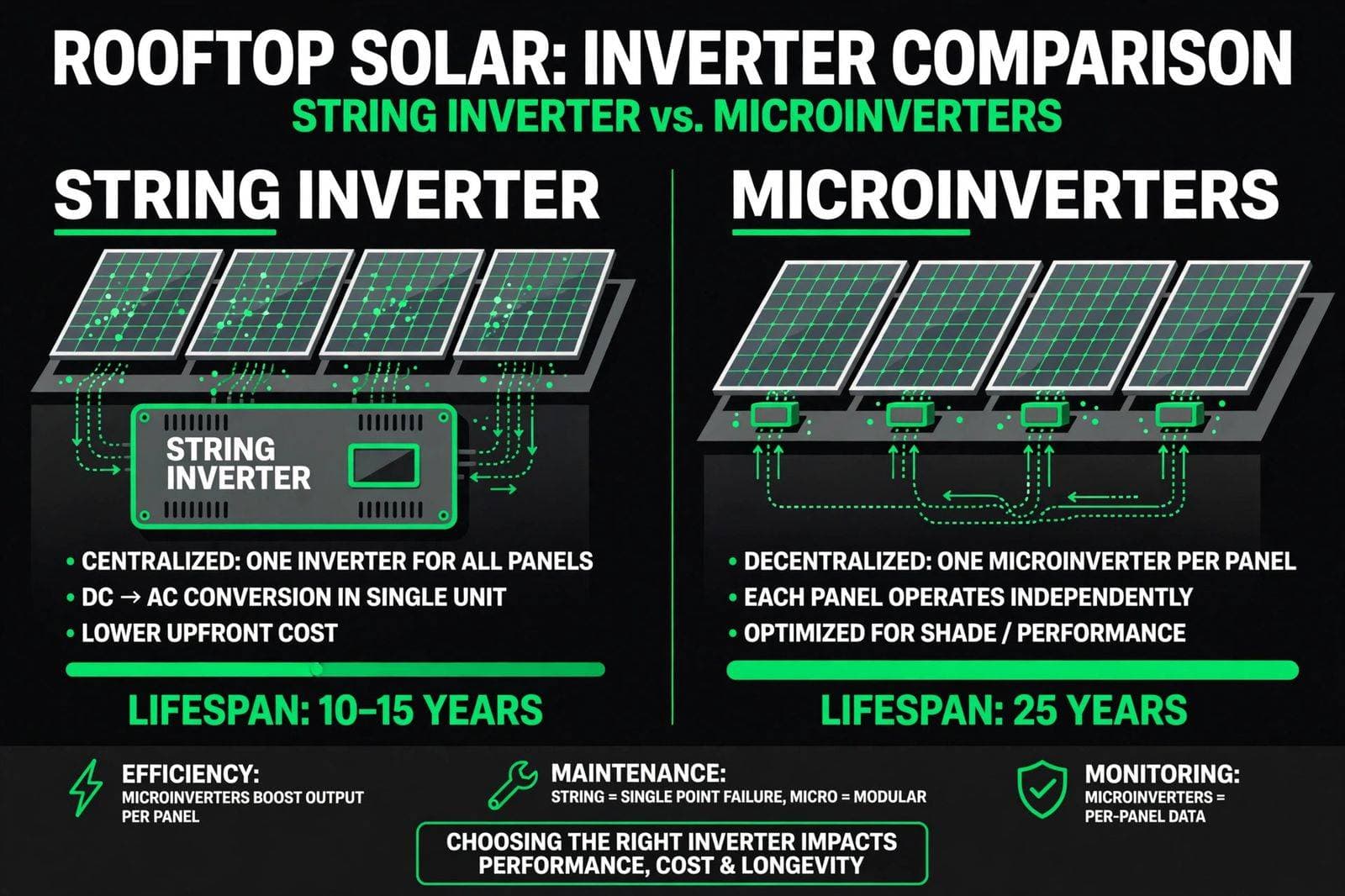
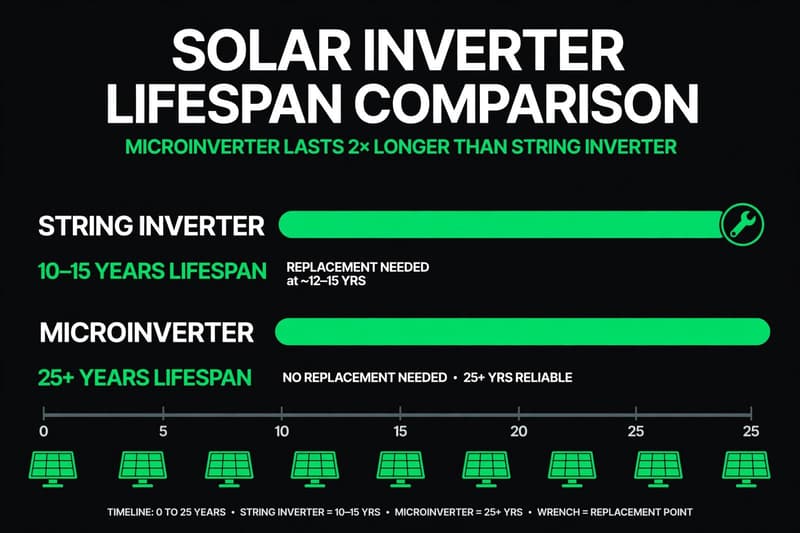
- String inverters typically last 10 to 15 years, while microinverters are designed for 20 to 25 years, matching the life of the solar panels they serve.
- Enphase microinverters carry a 25-year warranty, SolarEdge string inverters carry 12 years extendable to 25, and Fronius and SMA string inverters carry 10 years.
- A like-for-like string inverter replacement costs about US$1,000 to US$2,500 installed, and there is no federal tax credit for a residential inverter replacement bought in 2026.
How long do solar inverters last: a string inverter, the single box that converts a whole array’s power, wears out well before the panels it serves, while a microinverter fitted to one panel is built to last as long as the panel itself. The difference decides whether an owner faces a mid-life replacement bill.
Every solar array has a part that wears out first. The inverter, the box that turns the direct current from the panels into the alternating current a home uses, works in heat, switches thousands of times a day, and carries the full electrical load of the array. Heat is what ages it: the capacitors that smooth power flow inside the box degrade with temperature and time, and that wear is the most common true hardware failure on units older than a decade. The choice of inverter type decides whether that wear shows up as one mid-life bill or as a slow trickle of small ones.
How long do solar inverters last by type
The answer depends on which inverter the system uses. A string inverter is one central unit that serves the whole array, so it handles the full power of every panel and runs hot. A microinverter sits under a single panel and handles only that panel’s output, so each unit works less hard and lasts longer. A hybrid inverter, which manages both solar panels and a battery, has an inverter section that lasts about as long as a string inverter, 10 to 15 years.
Modern quality inverters convert 97 to 99% of the power that passes through them, so efficiency is rarely the reason to replace one. Age and heat are. Capacitors, the components that smooth the power flow inside the inverter, degrade with heat and time, and capacitor wear is the most common true hardware failure on string inverters older than 10 years. A capacitor repair can cost US$200 to US$500, against US$1,000 to US$2,500 for a full replacement, so a repair is worth pricing first.
| Inverter type | Typical lifespan | Typical warranty | Failure takes down |
|---|---|---|---|
| String inverter | 10 to 15 years | 10 to 12 years, extendable | The whole array |
| Microinverter | 20 to 25 years | 25 years | One panel only |
| Hybrid inverter | 10 to 15 years (inverter section) | 10 to 12 years, extendable | The whole array and the battery |
| Power optimizer (with string inverter) | 25 years | 25 years | One panel only |
The failure shape matters as much as the lifespan. When a string inverter fails, the entire array stops producing until it is repaired or replaced. When one microinverter fails, only its panel goes dark and the rest keep working. The same split applies to SolarEdge systems: a failed power optimizer takes down one panel, but a failed central SolarEdge inverter takes down the whole array, even though the optimizers themselves carry a 25-year warranty.
What the warranties promise
A warranty guarantees against defects for a stated term. It says nothing about the day the unit stops working. String inverters typically outlive a 10 to 12 year warranty by a few years, reaching 10 to 15 years of service. Microinverters are designed for 25 years and warranted for 25 years, so the two numbers coincide.
| Manufacturer | Product | Standard warranty | Extension |
|---|---|---|---|
| Enphase | IQ8 microinverters | 25 years | None needed |
| SolarEdge | Home Hub string inverter | 12 years | 20 or 25 years for a one-time fee, bought within 24 months of shipment |
| SolarEdge | Power optimizers | 25 years | None needed |
| Fronius | Primo GEN24 string inverter | Up to 10 years on registration | Paid extension within the first 6 months of the warranty |
| SMA | Sunny Boy string inverter | 10 years on registration | 20 years at purchase |
Enphase states the contrast directly in its own FAQ: “Enphase offers one of the longest warranties in the market: 25 years on the microinverters, 15 years on the IQ Battery, and 5 years on the EV Charger.” SolarEdge describes its Home Hub inverter as “Built to last and backed with a standard 12 year warranty, extendable to 25 years.” Its 10-K filing for the year ended 31 December 2025 confirms the structure: most inverters sell with a 12-year warranty extendable to 20 or 25 years for an additional cost, power optimizers carry 25 years, and residential batteries carry 10 years.
Fronius offers up to 10 years when the inverter is registered, built as 5 years of standard cover plus a further 5 years covering material costs. SMA’s Sunny Boy carries a 10-year standard warranty after registration within 12 months of commissioning, extendable to 20 years at purchase. Buyers should register the inverter promptly: several manufacturers tie the full warranty term to registration within a set window after installation.
How much a solar inverter replacement costs in 2026
SolarReviews puts the average installed cost of a replacement string inverter at about US$1,500 to US$3,000. Helios, an installer guide for Southern California updated in September 2026, breaks the cost down further: a like-for-like string inverter of 6 to 10 kW costs US$1,000 to US$2,500 fully installed, with hardware of US$800 to US$1,800 and labour plus permit of US$400 to US$800. A hybrid or battery-ready inverter of the same size costs US$3,000 to US$6,000 installed. A permit typically adds US$100 to US$500 in Southern California, and other states vary.
Microinverter replacement is priced per unit, and labour can exceed hardware on a single swap. One Enphase IQ8 microinverter costs US$150 to US$350 installed, with hardware of US$100 to US$200 and a labour charge of US$250 to US$500 per visit. Replacing all the microinverters on a standard 20-panel system costs US$3,000 to US$6,000. A single SolarEdge power optimizer costs US$400 to US$600 installed, against hardware of about US$100 to US$110, so the visit dominates the bill there too. The practical lesson is to replace a failed microinverter or optimizer during a visit that is already scheduled, or to wait until two have failed, rather than paying a call-out fee for one small part.
| Replacement job | Typical installed cost (2026) | Notes |
|---|---|---|
| String inverter, 6 to 10 kW, like for like | US$1,000–2,500 | Most common residential replacement |
| Hybrid or battery-ready inverter, 6 to 10 kW | US$3,000–6,000 | Needed when adding a battery |
| Single Enphase IQ8 microinverter | US$150–350 | Labour per visit can exceed the hardware cost |
| Full 20-panel microinverter swap | US$3,000–6,000 | Rare; units usually fail one at a time |
| Single SolarEdge power optimizer | US$400–600 | Hardware is only about US$100 |
| Capacitor repair on an old string inverter | US$200–500 | Worth pricing before replacing |
There is no federal tax credit for a residential inverter replacement bought in 2026, whether the new unit is a like-for-like swap or an upgrade to a hybrid. The Residential Clean Energy Credit ended for property placed in service after 31 December 2025, and Helios confirms the consequence directly: “There is no federal tax credit for a residential inverter replacement purchased in 2026, whether you’re replacing like-for-like or upgrading to a hybrid.” A replacement bought alongside new solar panels may qualify differently, so homeowners planning both should check with their installer before splitting the jobs.
Five signs a solar inverter is failing
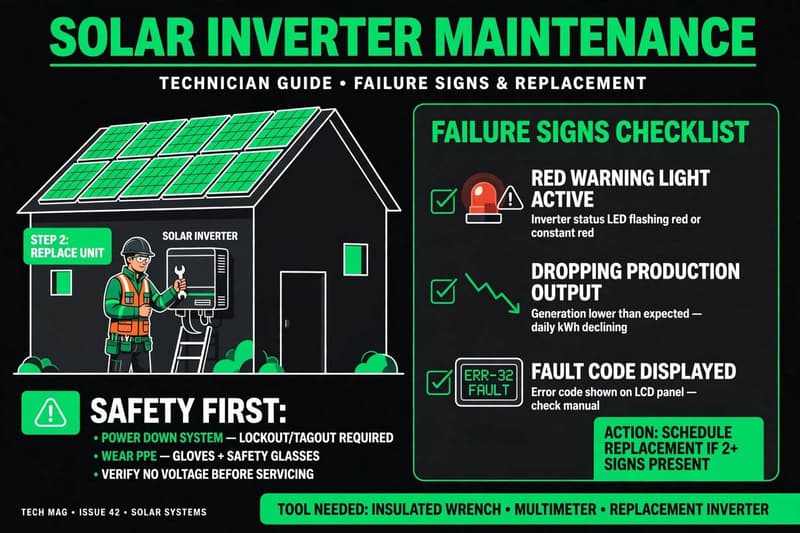
Most inverter trouble announces itself in the monitoring app before it shows up on the electricity bill. The clearest sign is a sudden or significant drop in energy production compared with normal output in similar weather. A single cloudy week explains a dip; a sunny week at half the usual output does not. Error messages, fault codes or red and amber warning lights on the display or in the app are the second sign, and frequent shutdowns and restarts are the third. A persistent buzzing or humming sound, a burning odour, or breakers that keep tripping are the fourth and fifth, and all three call for an electrician rather than a software reset.
Not every fault code means the inverter is dying. Grid frequency and voltage disturbances usually mean the inverter correctly disconnected itself from the grid and will reconnect when the grid steadies. Codes for IGBT faults, DC bus overvoltage, persistent isolation faults or critical internal temperature usually indicate real hardware trouble. A monitoring app that stops updating does not by itself prove the panels stopped generating; the communications link fails more often than the inverter does, and most failures in the first 10 years are communication or firmware issues rather than hardware.
Replace rather than repair when the unit is past warranty and throwing recurring AC fault codes, when the repair quote exceeds 40 to 50% of the replacement cost, when parts are no longer available, or when the household is adding a battery and needs a hybrid inverter anyway. Repair first when the fault is a single capacitor, when the unit is still under warranty, or when the problem is a firmware or communications fault that a software update fixes.
What a US$1,500 replacement means for a 25-year solar system
Solar panels are warrantied for 25 years of performance and typically last 25 to 30 years or more. A string inverter at 10 to 15 years means most string-inverter owners face at least one inverter replacement during the panels’ life, at roughly US$1,500 to US$2,500 installed. Spread over a 25-year system life, that is about US$60 to US$100 a year, a small share of the system’s total cost but a real bill that should be budgeted from the start, not discovered in year 12.
Microinverters change the arithmetic by removing the mid-life replacement entirely. Their 25-year warranty matches the panels, and their per-panel failure shape means a single failure costs a few hundred dollars and loses one panel’s output, not the array’s. The trade-off is upfront cost: microinverter systems run US$0.25 to US$0.45 per watt more than string systems, which is US$1,500 to US$2,700 on a typical 6 kW array. That premium is roughly the price of the one string-inverter replacement it avoids, so the choice turns on when the money is spent and how much downtime the household tolerates.
Homeowners choosing a system today should weigh three things: the warranty length against the expected 25-year panel life, the failure shape of one central unit against many small ones, and whether a battery is planned, since a hybrid inverter costs more to replace later than to install now. The inverter is the shortest-lived part of a solar system. Buying with its replacement in mind is the cheapest way to own one.
Frequently asked questions
How long does a solar inverter last?
A string inverter typically lasts 10 to 15 years. A microinverter typically lasts 20 to 25 years, matching the life of the solar panels. A hybrid inverter’s inverter section lasts about 10 to 15 years, similar to a string inverter.
When should I replace my solar inverter?
Replace it when production drops sharply in normal weather, when fault codes or warning lights persist after a reset, when the unit cycles on and off repeatedly, or when a repair quote exceeds 40 to 50% of the replacement cost. A unit past warranty with recurring hardware fault codes should be replaced rather than repaired.
How does solar inverter lifespan compare between string and microinverters?
String inverters last 10 to 15 years with a 10 to 12 year warranty, while microinverters last 20 to 25 years with a 25-year warranty. A failed string inverter takes the whole array offline; a failed microinverter takes down one panel only. Microinverter systems cost US$0.25 to US$0.45 per watt more upfront.
How much does it cost to replace a solar inverter?
A like-for-like string inverter of 6 to 10 kW costs US$1,000 to US$2,500 installed. A hybrid inverter costs US$3,000 to US$6,000 installed. A single microinverter costs US$150 to US$350 installed, and a single power optimizer costs US$400 to US$600 installed.
Does the warranty cover a solar inverter replacement?
A warranty covers defects within its term: 25 years for Enphase microinverters, 12 years extendable to 25 for SolarEdge string inverters, and 10 years for Fronius and SMA string inverters. Wear after the warranty expires is the owner’s cost, and there is no federal tax credit for a replacement bought in 2026.
Sources
- SolarReviews: Solar Inverter Cost 2026 Price Guide for US Homeowners, updated 29 September 2026
- Helios Energy Global: Solar Inverter Replacement Cost in California, September 2026
- SolarEdge: SolarEdge Home Hub Universal 3-Phase Inverter
- SolarEdge: Warranty Questions for System Owners
- Fronius: Up to 10 Years Warranty, Five Plus Five
- BSL Battery: Solar Inverter Lifespan and How to Extend It, 9 December 2025
- Joule Post: Enphase vs SolarEdge: The $2,000 Decision Hiding Inside Your 2026 Solar System
- Joule Post: Home Battery Cost 2026: Powerwall vs Competitors
- Joule Post: What a Solar Installer Bankruptcy Does to Your Warranty and Who Pays Next