- Most of a wind turbine recycles easily: 85% to 90% of its mass is steel and other metals. The blades are the exception, because fibreglass set in epoxy resin cannot be melted down and remoulded.
- About 3,000 to 9,000 blades come down in the United States each year, a flow the Department of Energy expects to reach 10,000 to 20,000 a year by 2040.
- Europe’s wind industry stopped sending blades to landfill on 1 January 2026 under a voluntary commitment, and a November 2026 lab result turns blade waste into graphene and silicon carbide.
Wind turbine blade retirement: what happens to the 40 to 80 metre blades of a wind turbine when the machine reaches the end of its working life, usually after about 20 years. The tower and nacelle are mostly steel and recycle like any scrap metal. The blades are made of fibreglass or carbon fibre set in epoxy resin, a thermoset composite that cannot be melted and reshaped, so they need a different route: reuse, cutting and grinding, heat treatment, chemical recovery, cement kiln co-processing, or burial.
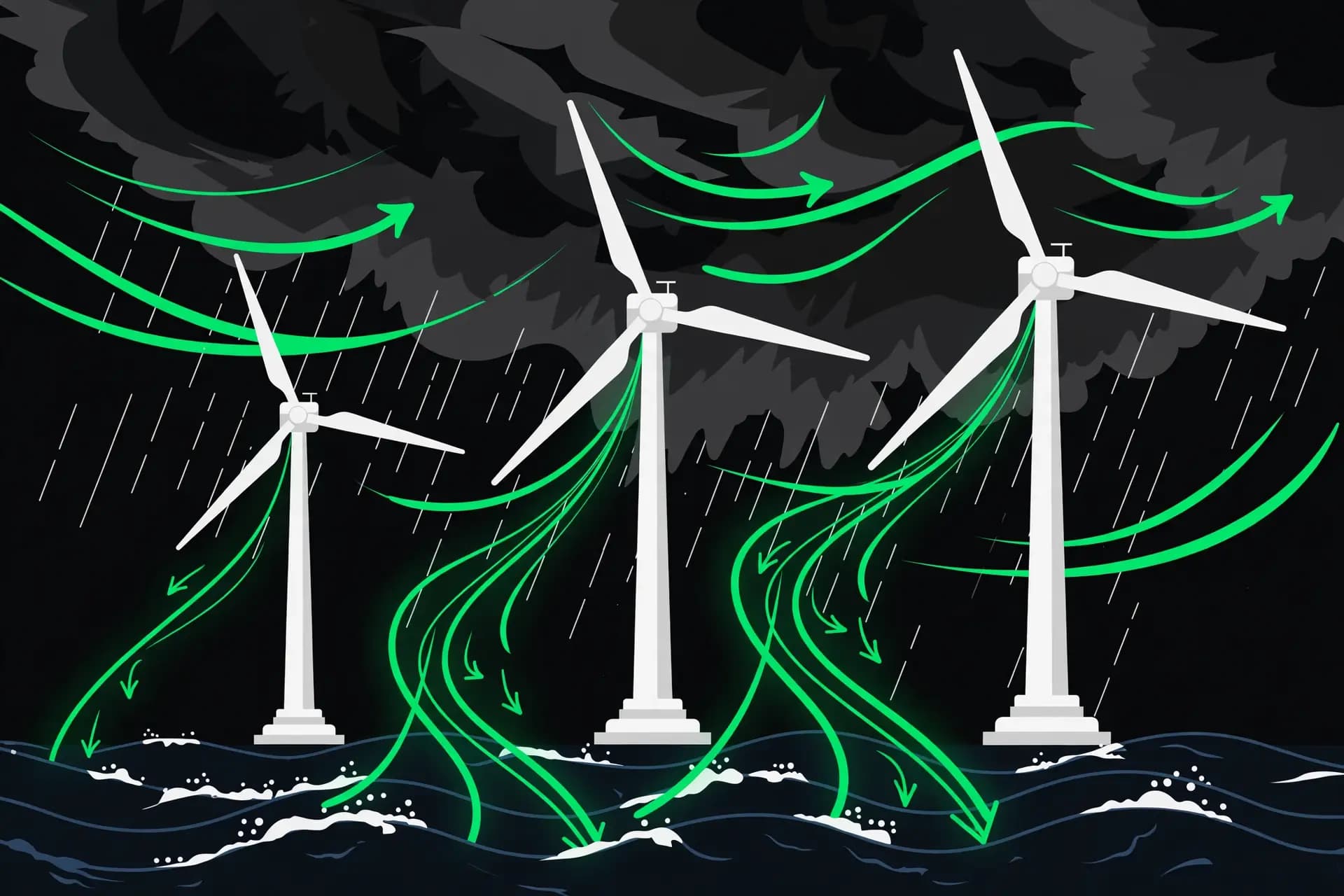
Engineers designed the modern wind turbine blade to survive two decades of flexing in storms, and they succeeded so well that the blade now resists the very processes meant to take it apart. The resin binding the fibres is a thermoset: it hardens permanently when it cures, and reheating it does not soften it the way a thermoplastic softens. Cutting a blade means cutting through glass fibre and carbon fibre that were laid up to carry tonnes of load. Grinding it means destroying fibres that cost a great deal of energy to make. Every disposal route starts from that trade-off between a structure built to last and a material built to be taken apart.
The scale is what turns a materials problem into a waste stream. A modern turbine is about 85% to 90% recyclable by mass, counting the steel tower, the copper wiring, and the metals in the nacelle, according to the US Department of Energy, and the blades make up only 6% to 14% of that mass. The Department of Energy counts 3,000 to 9,000 blades coming down in the United States each year in the 2021 to 2026 period, and projects 10,000 to 20,000 a year by 2040 as the first big build-out of wind farms reaches retirement age. In Europe, about 20,000 tonnes of blade material was retired in 2025, rising to about 55,000 tonnes a year by 2030, according to WindEurope. About 80 gigawatts of European capacity reaches its theoretical lifetime by 2030, against about 290 gigawatts installed. Decommissioning a turbine takes 6 to 24 months, and the US Department of Energy put the cost at US$114,000 to US$195,000 gross per turbine, or US$67,000 to US$150,000 net after scrap value, in 2019 to 2021 estimates.
Why blades are the hard part of a turbine
A blade is a sandwich of materials chosen to be strong and light, with no thought given to taking them apart. Glass fibre or carbon fibre carries the load. Epoxy resin binds the fibres and holds the shape. Foam cores, balsa wood, and coatings add stiffness and weather protection. The result is a structure that weighs several tonnes, spans the length of a city block, and resists exactly the forces a recycling process applies: heat, cutting, and chemical attack. Grinding a blade is possible, and the ground composite can be used as filler in concrete or plastic, but the fibres come out short and damaged, and the recovered material is worth far less than the virgin fibre it replaces.
That is the difference between the blade and the rest of the turbine. Steel melts and becomes steel again. Copper is copper. A blade ground into filler is a blade used once more at a fraction of its original value, and the industry calls that downcycling for a reason. The routes that recover full-length fibres or rebuild the material into something valuable all cost more energy, more chemistry, or more handling, and the economics of each route decide where a retired blade actually goes.
Where retired blades go today
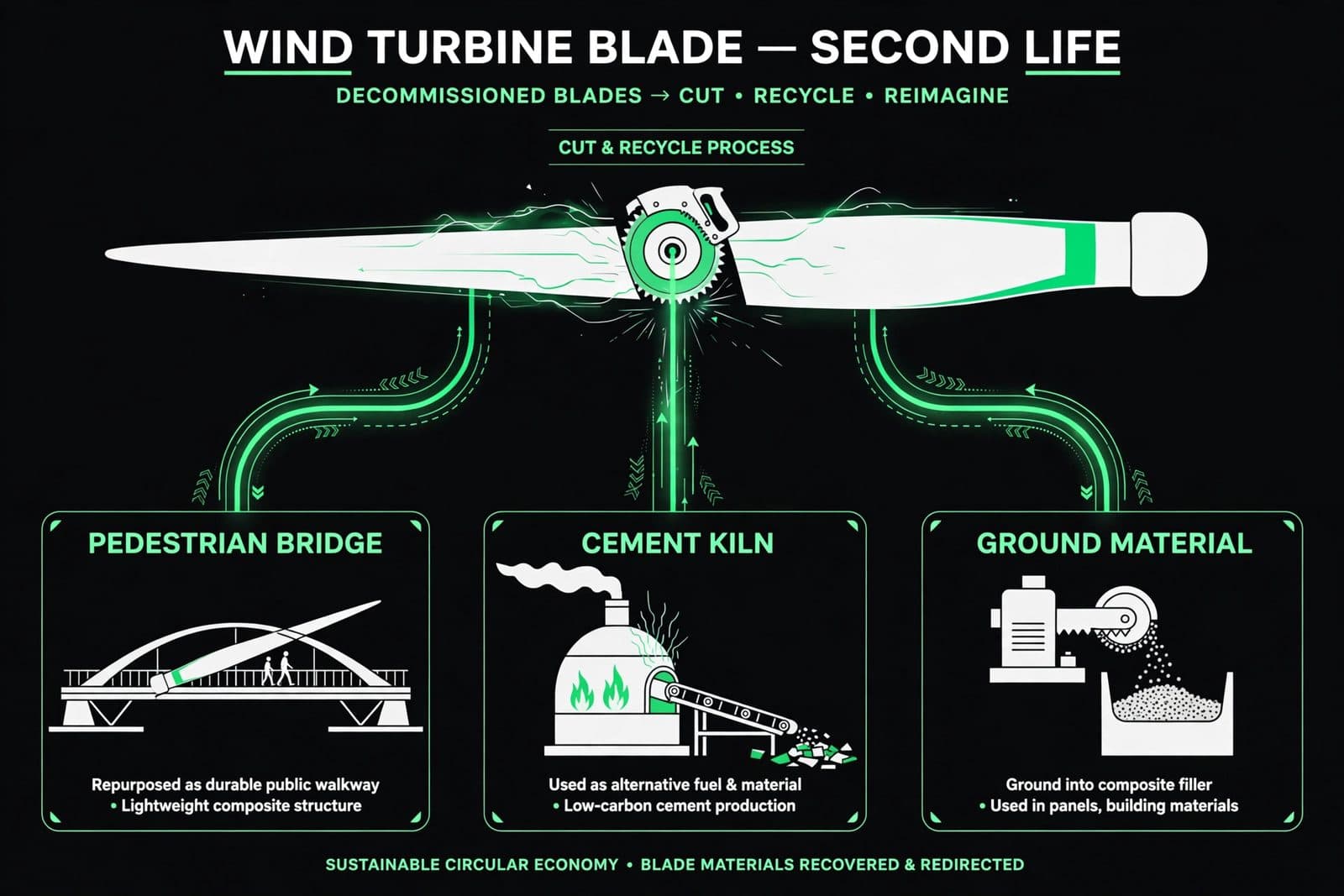
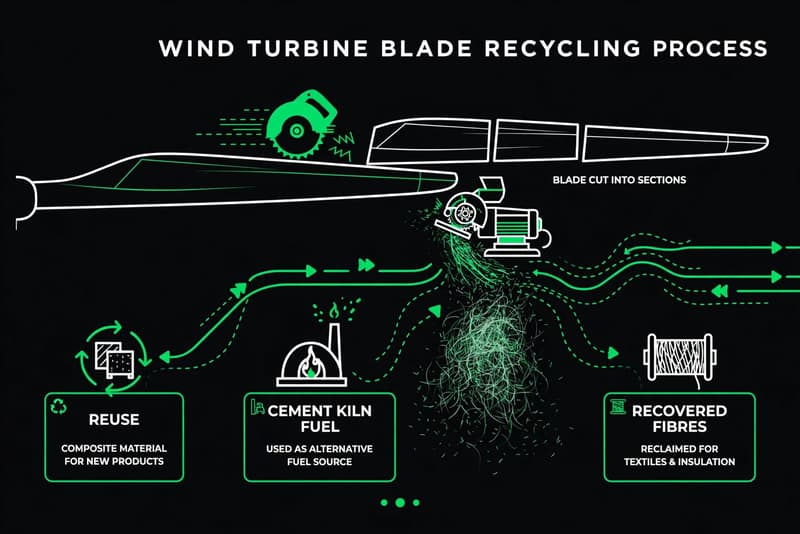
There are six routes, and they sit on a ladder from most to least circular. Reuse tops the list: a blade with life left in it can be fitted to another turbine, though matching a used blade to a different machine is rare. Repurposing is more common and more visible: blades cut into sections become bridges, playground structures, noise barriers, and bike shelters. Mechanical processing grinds blades into filler for construction materials. Thermal treatment, or pyrolysis, heats the composite without oxygen to recover fibres and oils. Solvolysis dissolves the resin in solvents to free the fibres. Cement kiln co-processing burns the resin as fuel and uses the glass fibre as a raw material in cement. Incineration and landfill sit at the bottom.
| Route | What happens to the blade | What comes out |
|---|---|---|
| Reuse and repurposing | Whole blade or large section used again | Second-life structure: bridge, shelter, barrier |
| Mechanical processing | Blade cut and ground | Short fibres and filler for concrete and plastics |
| Pyrolysis | Heated without oxygen | Recovered fibres, oils, and gas |
| Solvolysis | Resin dissolved in solvents | Long fibres at 50% to 60% of original quality |
| Cement kiln co-processing | Burned as fuel in a cement kiln | Heat plus glass fibre as cement raw material |
| Incineration and landfill | Burned for energy or buried | Energy, or nothing |
Cement kiln co-processing deserves a closer look because it handles the largest volumes today. The resin burns and replaces coal or gas as kiln fuel, while the glass fibre becomes part of the cement clinker. Nothing is wasted in the narrow sense, and the kiln runs at temperatures that destroy the resin completely. The trade-off is that the fibre never comes back as fibre. It becomes cement, which is a one-way trip for a material that cost a great deal of energy to make. Co-processing is a practical answer to a waste problem, and calling it circular would overstate what it does.
The Casper landfill photo and what came after
The image most people associate with blade waste is the Casper landfill in Wyoming, where photographs of blades stacked in a pit circulated widely in 2019 and 2020. The landfill took 1,124 blades between 2019 and 2020, according to the wind industry publication Live in the Future, and none have arrived since mid-2021. The photographs were real, and the number was large, but the landfill stopped taking blades, and the story moved on while the image kept circulating. A reader who judges the industry by that photo is judging it by a practice that ended years ago in that location.
The United States has built recycling capacity since. Capacity stood above 3,000 blades a year as of 2022, according to Department of Energy figures reported by UMA Technology. Capacity and throughput are different things: a plant that can process 3,000 blades a year may process fewer, and the gap between what the system can handle and what it does handle is where blades still slip through to landfill. The honest measure of progress is how many blades actually reach a recycling route, and that number is not published consistently enough to quote with confidence.
Europe stopped sending blades to landfill on 1 January 2026
Europe changed the default at the start of 2026. The European wind industry adopted a voluntary commitment not to send blades to landfill, effective 1 January 2026, coordinated through WindEurope. The commitment is self-imposed. It carries no force of EU law, and WindEurope is pressing the European Commission to turn it into binding legislation. Austria, Finland, Germany, and the Netherlands already had landfill restrictions in place before the industry-wide pledge. Other markets, including major buyers outside Europe, have not adopted equivalent rules.
The timing matters because the waste stream is about to grow steeply. WindEurope estimates that annual decommissioned blade material in Europe will rise from about 20,000 tonnes in 2025 to 55,000 tonnes a year by 2030, as first-generation fleets retire. About 80 gigawatts of European capacity reaches its theoretical lifetime by 2030. The ban forces operators to find a route for every blade, and the routes available today are the ones in the table above: repurposing for the best blades, cement kilns for the bulk, and newer chemical and thermal processes for the rest. The industry’s own circularity hub, set up by WindEurope, showcases the methods that already exist, and the gap between what exists and what the 2030 volumes need is the work of the next five years.
A 2,000-degree flash turns blades into graphene and silicon carbide
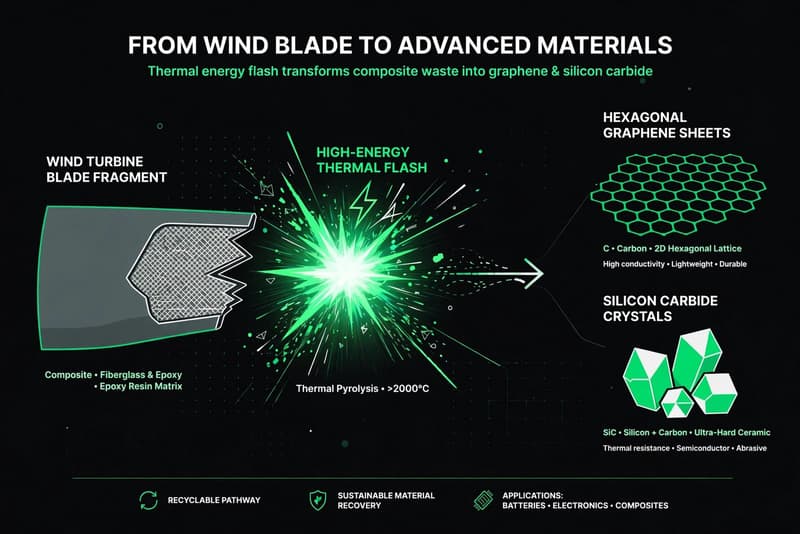
The most striking blade result of 2026 came from a laboratory in Beijing. Researchers at Tsinghua University reported on 6 November 2026 in the Cell Press journal Chem Circularity that flash Joule heating can turn discarded blade material into silicon carbide and graphene, two valuable manufacturing materials. The method heats pulverised blade waste to about 2,000 degrees Celsius in seconds, using a brief burst of electric current. At that temperature, carbon from the resin reacts with silica from the fibreglass to form silicon carbide, a hard, heat-resistant compound, while the remaining carbon reorganises into graphene.
The numbers are the reason the result travelled. A typical experiment converted about 56% of the mixture into a silicon carbide and graphene composite, made up of 34% silicon carbide and 66% graphene. Adding just 0.3% of the recovered material by weight to fresh resin made it stiffer and stronger, improving its resistance to deformation by 27% under tension and 9% when bent. At 0.1% by weight, the resin’s thermal diffusivity, a measure of how quickly heat spreads through it, rose by 41%. The recovered material could go back into new blades and make them stronger, which is the closed loop the industry has been looking for.
The economics, on paper, invert the usual recycling problem. The researchers estimate the process could turn a profit of about US$80 per tonne of blade material, because silicon carbide and graphene are valuable, while pyrolysis costs about US$460 per tonne and chemical dissolution about US$1,800 per tonne. Greenhouse gas emissions fall by about 83% compared with pyrolysis and about 92% compared with chemical dissolution. Both figures come from preliminary laboratory-scale assessments, and the caveat is a large one: the largest batch tested so far was 10 grams. Scaling from grams to tonnes is the whole challenge, and the researchers say they are working on it.
Solvolysis recovers the most material and uses the most energy
Solvolysis is the route that recovers the longest fibres. Solvents dissolve the epoxy resin and free the glass or carbon fibres largely intact, at 50% to 60% of their original quality, with 90% to 100% of the material recovered. A European Commission modelled comparison gave solvolysis a circularity indicator of 0.77, the highest of the routes compared. The same comparison found it the most energy-intensive route. That is the trade that defines blade recycling: the better the recovery, the more energy and chemistry it takes, and the more the recovered fibre has to be worth to justify the process.
Pyrolysis sits in the middle. Heating the composite without oxygen recovers fibres and produces oils and gas, at a cost of about US$460 per tonne, according to the Tsinghua comparison. The fibres come back shorter and weaker than solvolysis fibres, and the process needs careful control of emissions. Mechanical grinding is the cheapest route and the least circular: the blade becomes filler, the fibres are destroyed as fibres, and the value recovered is a small fraction of the original material cost.
REWIND recovers whole blade sections for new products
Not every answer is chemical. The European REWIND project, funded by the EU Horizon Europe programme under grant agreement 101147226 and coordinated by the plastics technology centre AIMPLAS, takes a different approach: recover large sections of blade intact and validate them as material for new products. The project has recovered blade sections of more than 20 square metres for validation in electric vehicle parts and insulation, and built a predictive model of blade condition with 90% accuracy. The idea is that a blade is not waste at all until it is cut up. Kept whole, a section of blade is a curved, stiff, weatherproof composite panel, and panels like that have uses.
The project matters because it attacks the handling problem rather than the chemistry problem. A blade is 40 to 80 metres long, and moving it, cutting it, and feeding it into a process is most of the cost of any recycling route. Recovering large sections avoids the shredder entirely, and the model that predicts which sections are worth recovering saves the labour of inspecting every blade by hand. REWIND is a research project, not a waste company, and its results need a commercial operator to scale them. Its contribution is to show that the cheapest route through a retired blade may be to keep it as large as possible for as long as possible.
What a blade is worth at the end of its life
The money decides. Decommissioning costs US$114,000 to US$195,000 gross per turbine, or US$67,000 to US$150,000 net after the scrap value of the steel and copper, in 2019 to 2021 estimates from the Department of Energy. The blades are a cost inside that figure, not a revenue line, because every current route costs money to run. Cement kiln co-processing is close to break-even because the kiln operator values the fuel and the raw material. Mechanical grinding is cheap but produces low-value filler. Solvolysis and pyrolysis recover more value and cost more to run. Flash Joule heating is the first route that claims to make money, about US$80 per tonne, and the claim rests on a 10-gram experiment.
The table below puts the routes side by side on the measures that matter to an operator choosing what to do with a retired blade.
| Route | Cost per tonne | Material recovered | Status in 2026 |
|---|---|---|---|
| Mechanical grinding | Lowest of the routes | Short fibres and filler | Operating at scale |
| Cement kiln co-processing | Near break-even | Fuel value plus cement raw material | Operating at scale, largest volumes |
| Pyrolysis | About US$460 | Fibres, oils, and gas | Operating, limited scale |
| Solvolysis | Higher than pyrolysis | Long fibres at 50% to 60% quality, 90% to 100% recovery | Operating, limited scale |
| Chemical dissolution | About US$1,800 | Fibres and chemicals | Operating, limited scale |
| Flash Joule heating | About US$80 profit claimed | Silicon carbide and graphene | Laboratory scale, 10-gram batches |
The pattern is clear. The routes that work at scale today recover the least value, and the routes that recover the most value do not yet work at scale. Europe’s landfill ban and the rising waste volumes will force the gap to close, because operators can no longer choose the cheapest option, which was burial. The next five years will show whether the chemical routes scale, whether flash heating survives contact with tonnes rather than grams, and whether a retired blade becomes a resource or stays a cost.
Frequently asked questions
What happens to old wind turbine blades?
Most retired blades are cut up and ground into filler, burned as fuel in cement kilns, or, where still allowed, landfilled. Newer routes recover fibres through heat or solvents, and a 2026 laboratory result turns blade waste into silicon carbide and graphene. About 85% to 90% of the rest of the turbine is steel and other metals that recycle normally.
Can wind turbine blades be recycled?
Yes, but not by melting them down. The epoxy resin is a thermoset that hardens permanently, so blades are ground, heated without oxygen, dissolved in solvents, or burned in cement kilns. Solvolysis recovers 90% to 100% of the material at 50% to 60% of the original fibre quality. Full recycling at scale is still developing.
Where do wind turbine blades go when they are decommissioned?
In Europe, landfill stopped being an option on 1 January 2026 under a voluntary industry commitment coordinated by WindEurope. In the United States, blades go to recycling plants, cement kilns, or landfill depending on the state and the operator. The Casper landfill in Wyoming took 1,124 blades in 2019 and 2020 and none since mid-2021.
How long do wind turbine blades last?
About 20 years in normal service, with some turbines running longer after inspection and maintenance. Offshore turbines face the same retirement question, with harsher conditions and higher decommissioning costs, while turbines are designed to survive gusts far above their operating limit by shutting down.
Why are wind turbine blades hard to recycle?
Blades are made of fibreglass or carbon fibre set in epoxy resin, a composite designed to survive 20 years of flexing in storms. The resin cannot be melted and reshaped, so recovering the fibres needs grinding, high-temperature treatment, or chemical solvents, and each route trades cost against the quality of the material recovered. How a turbine turns wind into electricity explains why the blade shape matters so much, and old solar panels face a similar end-of-life question with different answers.
Sources
- What happens to wind turbine blades at the end of their life?, UMA Technology
- Wind blade end-of-life marketplace, Live in the Future
- Where do wind turbine blades go when they are decommissioned?, WindEurope, 14 November 2025
- Scientists found a clever second life for dead wind turbine blades, Gizmodo, 6 November 2026
- Scientists give hard-to-recycle wind turbine blades a second life, Brightsurf, 6 November 2026
- REWIND demonstrates the potential of decommissioned wind turbine blades as new industrial resources, AZoCleantech