- Understanding how wind turbines work starts with the cube law: a single 15 MW offshore turbine can generate 80 GWh a year — enough for about 20,000 European homes — because the power in wind rises with the cube of wind speed.
- Every modern turbine shares the same basic anatomy: blades that fly on lift like an aircraft wing, a drivetrain that turns slow rotation into grid-ready electricity, and yaw and pitch systems that aim the rotor and feather the blades in storms.
- Onshore wind is among the cheapest sources of new electricity in the US ($37–$99/MWh), offshore machines deliver steadier output at higher cost, and floating turbines are opening deep-water sites that fixed foundations cannot reach.
Wind turbine: A wind turbine is a machine that converts the kinetic energy of moving air into electricity. Wind flowing over its blades creates lift, spinning a rotor connected through a drivetrain to a generator. Onshore machines in the US now average 3.4 MW; the largest offshore turbines reach 15 MW, each able to power tens of thousands of homes.
Contents:
- How wind becomes electricity: it is lift, not drag
- Anatomy of a modern wind turbine: every part explained
- Onshore vs offshore vs floating: three ways to harvest the wind
- Why wind turbine capacity factor is the number that really matters
- How wind got cheap: the cost curve that changed everything
- How wind turbines work with the grid: taming variability
- The honest environmental ledger: birds, noise, and old blades
- What is next: bigger rotors, floating fleets, recyclable blades
- Why it matters
- Frequently asked questions
Understanding how wind turbines work starts with a surprise: the blades are not pushed by the wind so much as pulled by it. A modern turbine is closer to a flying aircraft wing mounted on a tower than to the windmills of old. That single insight — lift, not brute force — explains why a machine standing in a field in Texas or 130 kilometres off the Yorkshire coast can now generate electricity more cheaply than almost any other new power source. Wind supplied about 10% of US electricity in 2023, and the machines keep getting larger, quieter, and more productive.
This guide walks through the physics, the parts, the economics, and the trade-offs, using real machines and verified numbers throughout.
How wind becomes electricity: it is lift, not drag
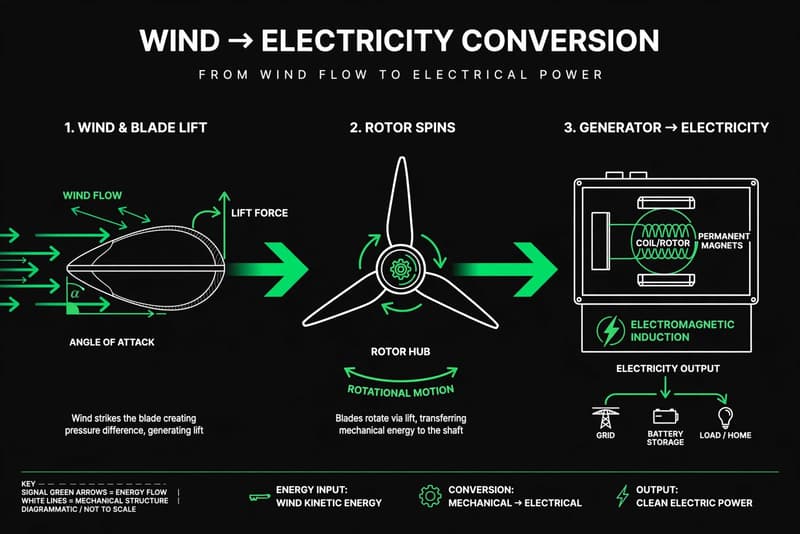
A turbine blade is shaped like an aeroplane wing: curved on one side, flatter on the other. When wind flows across it, air moves faster over the curved surface, creating lower pressure above the blade and higher pressure below. The resulting force — lift — pulls the blade sideways, and because the blades are fixed to a hub, that sideways pull becomes rotation. Each blade is also set at a slight angle of attack to the wind, the same principle that keeps a plane aloft.
Three facts govern everything a turbine does. First, the power available in wind rises with the cube of wind speed: double the wind speed and the energy passing through the rotor increases eightfold. A wind of 9 metres per second carries about 42% more power than one of 8 m/s. This is why developers obsess over windy sites and tall towers, and why offshore locations — where winds are stronger and steadier — are so attractive.
Second, no turbine can capture all of that energy. Physics sets a hard ceiling, the Betz limit, of about 59.3% of the wind’s kinetic energy. Real machines capture roughly half of the energy passing through the rotor disc — the rest must keep moving so the air can flow away downstream.
Third, turbines only operate within a wind window. The largest machines start generating at a gentle breeze of about 3 m/s (cut-in), reach full rated power at roughly 12–14 m/s, and shut down in storms — Vestas’ V236-15.0 MW, for example, cuts out at 31 m/s, while GE’s Haliade-X rides through to 34 m/s. Between cut-in and rated speed, output climbs steeply; above rated speed, the control system holds output flat at the maximum until the storm shutdown.
Anatomy of a modern wind turbine: every part explained
Here are the wind turbine parts explained in the order energy flows through them, from the sky to the socket.
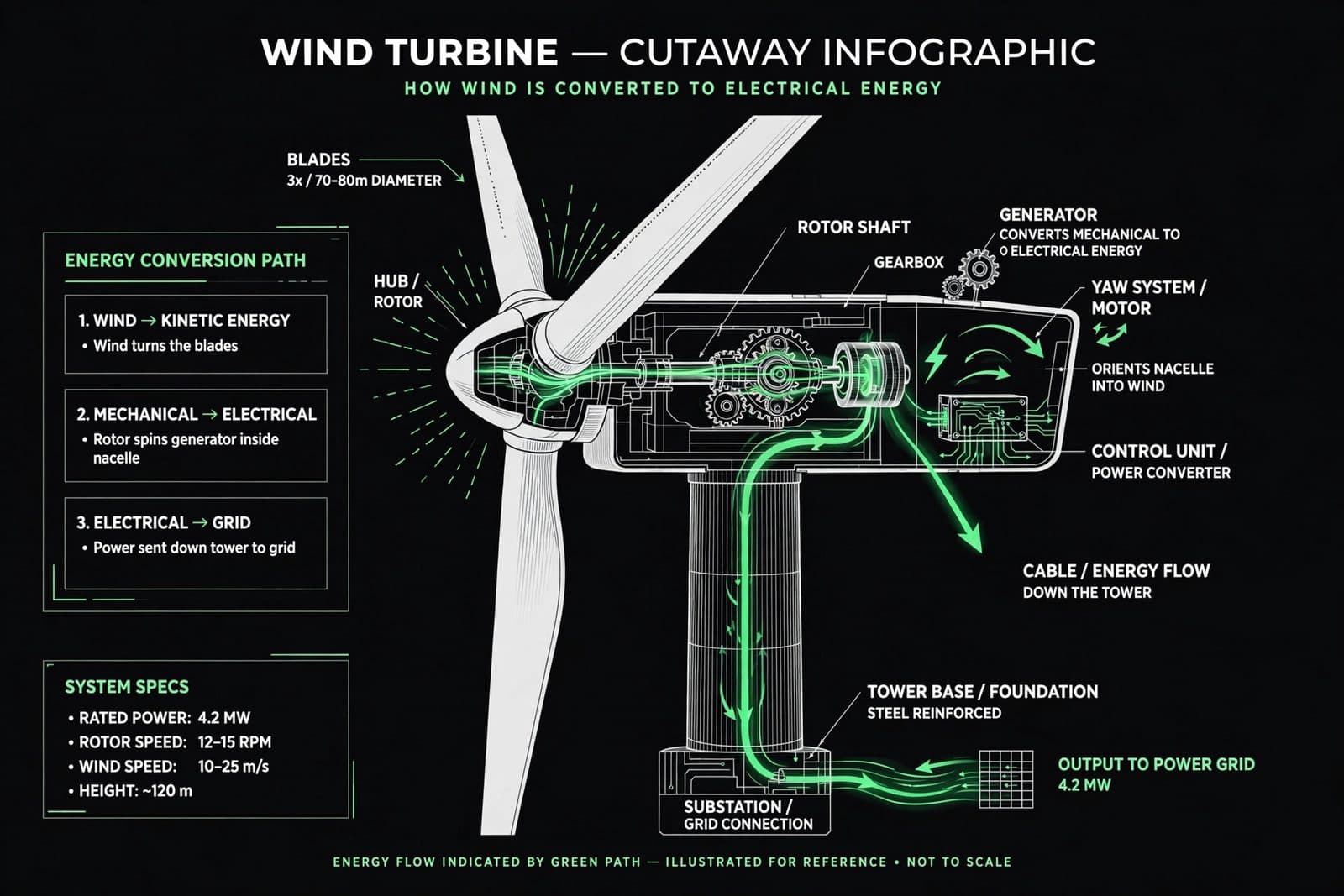
Blades. The three blades are the engine of the machine. Offshore blades are now longer than a football pitch: 115.5 metres on the Vestas V236-15.0 MW, 107 metres on GE’s Haliade-X, 115 metres on the Siemens Gamesa SG 14-236 DD. They are built from glass- and carbon-fibre composites, twisted along their length so each section meets the wind at the ideal angle, and they flex deliberately in gusts to shed loads. Three blades, rather than two or four, proved the best compromise between efficiency, balance, and noise.
Hub and pitch system. The blades meet at the hub, which carries a pitch mechanism — hydraulic or electric motors that rotate each blade around its own long axis. Pitching the blades fine-tunes power capture in normal winds and feathers them (turning them edge-on) to brake the rotor in storms. It is the turbine’s throttle and its emergency brake in one.
Nacelle. The bus-sized housing atop the tower contains the drivetrain. In a V236 it sits roughly 150 metres above the sea; technicians climb or lift inside to service components that weigh tens of tonnes.
Drivetrain: gearbox vs direct drive. The rotor turns slowly — the Haliade-X spins at under 8 revolutions per minute — but generators want speed. Two philosophies compete. Vestas’ V236 uses a medium-speed gearbox to step rotation up before a conventional generator. GE’s Haliade-X and Siemens Gamesa’s SG 14-236 DD skip the gearbox entirely: a huge direct-drive permanent-magnet generator turns at rotor speed, trading mechanical complexity for a larger, heavier generator. Fewer moving parts means fewer failures offshore, where a service visit needs a specialised vessel.
Converter and electrics. A full-scale power converter takes the generator’s variable-frequency output and conditions it into grid-synchronous AC at exactly 50 or 60 Hz. Transformers step the voltage up for export through array cables to an offshore substation or onshore grid connection.
Tower and yaw system. The tower lifts the rotor into stronger, less turbulent air — average hub heights for new US onshore turbines reached 103.4 metres in 2023. A yaw drive at the tower top rotates the whole nacelle to face the wind, guided by anemometers and wind vanes on the nacelle roof.
Put it together and the scale is startling. A single Vestas V236-15.0 MW — 15 MW rated, a 236-metre rotor sweeping 43,742 square metres, 280 metres from sea to blade tip — can produce 80 GWh in a year at a good site, according to Vestas’ published V236-15.0 MW specifications. GE’s Haliade-X 14 MW counters with a 220-metre rotor, 38,000 square metres of swept area, and a direct-drive generator, per Dogger Bank’s published Haliade-X figures — machines of this class are now being installed at Dogger Bank in the North Sea, set to become the world’s largest offshore wind farm. Siemens Gamesa’s SG 14-236 DD, with its 236-metre rotor and optional recyclable blades, can be boosted to 15 MW, and its prototype once delivered 359 MWh in a single day — then a world record for one turbine.
Onshore vs offshore vs floating: three ways to harvest the wind
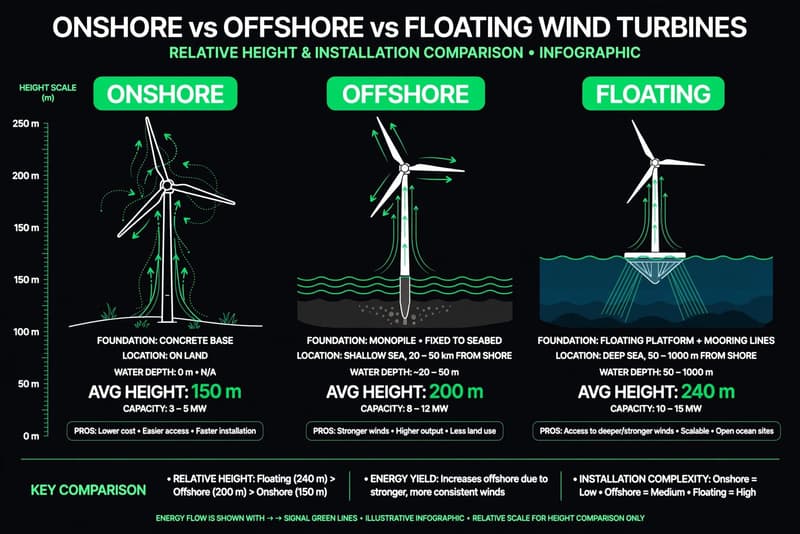
Not all wind turbines live in the same world. Onshore machines stand on farmland, ridgelines, and plains. Fixed-bottom offshore turbines are mounted on monopiles or jackets driven into the seabed, typically in water less than 60 metres deep. Floating turbines — the newest family — sit on buoyant platforms tethered to the seabed, unlocking deep-water zones where most of the ocean’s wind resource lies. Norway’s Hywind Tampen, the world’s largest floating wind farm at 88 MW from 11 turbines, powers offshore oil and gas platforms 140 kilometres from shore and began full operation in 2023.
| Onshore | Offshore (fixed-bottom) | Floating | |
|---|---|---|---|
| Typical new turbine size | ~3–5 MW (US 2023 average: 3.4 MW) | 13–15 MW | 8–15 MW (Hywind Tampen uses 8.6 MW machines) |
| Capacity factor | 9–53%, averaging ~37% in the US | 45–47% | Comparable to fixed-bottom; deep-water sites see the strongest, steadiest winds |
| Levelised cost (Lazard, unsubsidised US) | $37–$99/MWh | $105–$167/MWh (offshore overall) | Above fixed-bottom today; expected to fall with scale |
| Main constraints | Land availability, local acceptance, grid connection | Water depth, ports, installation vessels, export cables | Cost, mooring technology, port infrastructure |
The contrast in scale is instructive. The average new onshore turbine installed in the United States in 2023 was rated at 3.4 MW, with a 133.8-metre rotor and a 103.4-metre hub height, according to the US Department of Energy’s 2024 land-based wind market report — up 375% in capacity since 1998. Offshore, the economics favour giants: fewer foundations, fewer cables, fewer service visits per megawatt. And floating wind, with only about 245 MW operating worldwide as of late 2024 but a project pipeline measured in the hundreds of gigawatts, is where the industry’s growth frontier now lies.
Onshore remains the workhorse: the US added 6,474 MW of land-based wind in 2023, reaching nearly 150.5 GW across 42 states, and markets like India are lining up multi-gigawatt onshore pipelines. Offshore is the growth engine near coastal demand centres, with India’s first offshore steps, including the Thoothukudi prototype tender, showing how the technology is spreading beyond the North Sea.
Why wind turbine capacity factor is the number that really matters
A turbine’s nameplate rating — 15 MW, 3.4 MW — is its output at full tilt. But the wind does not blow at full tilt all year, so the industry judges machines by capacity factor: actual annual output divided by the theoretical maximum. A 15 MW turbine running at full power every hour of the year would produce 131,400 MWh; in practice it produces a fraction of that. (For the full explainer, see our guide to capacity factor.)
US onshore wind averages about 37%, ranging from 9% at poor sites to 53% at exceptional ones. Offshore machines reach 45–47%, and new projects are expected to push toward 60% by 2050 as rotors grow relative to generators. That gap is the economic heart of offshore wind: a costlier machine that works far more of the time.
Here is what that means in practice. Take a hypothetical 500 MW offshore wind farm operating at a 45% capacity factor:
- Maximum possible output: 500 MW × 8,760 hours = 4,380,000 MWh per year
- Actual expected output: 4,380,000 × 0.45 = 1,971,000 MWh — just under 2 terawatt-hours a year
- At about 4 MWh per European household per year (Vestas’ own benchmark: 80 GWh powers ~20,000 homes), that is electricity for roughly 490,000 homes
- At 38,000 tonnes of CO₂ avoided per 80 GWh (again Vestas’ figure), the farm avoids around 940,000 tonnes of CO₂ a year — comparable to taking about 615,000 petrol cars off the road
A single average new US onshore turbine tells the smaller-scale story: 3.4 MW × 8,760 hours × 37% ≈ 11,000 MWh a year. The records show what strong sites can do: Siemens Gamesa’s SG 14-222 DD prototype once generated 359 MWh in 24 hours, and GE’s Haliade-X prototype earlier set a record of 288 MWh in a single day, enough for about 30,000 homes in Rotterdam, according to POWER magazine’s offshore wind notebook.
How wind got cheap: the cost curve that changed everything
Wind’s journey from expensive alternative to mainstream power is one of the energy transition’s central stories. Lazard’s latest levelised cost of energy analysis puts unsubsidised US onshore wind at $37–$99/MWh and offshore wind at $105–$167/MWh — still below new gas peaking plants ($144–$276/MWh) and new nuclear ($175–$255/MWh), according to Utility Dive’s coverage of the Lazard report. Onshore wind’s low end, $37/MWh, remains the cheapest new-build electricity available in the American market.
The long arc is dramatic: two decades of bigger rotors, taller towers, and industrialised manufacturing collapsed costs. But the honest 2026 picture includes a wrinkle — inflation, higher interest rates, and supply-chain strain pushed wind costs back up in recent editions of the Lazard analysis, with offshore hit particularly hard. The industry’s answer has been scale: ever-larger turbines that spread fixed costs — foundations, cables, vessels — across more megawatt-hours. That is the economic logic behind the 15 MW class.
Cost is also why onshore wind keeps growing in emerging markets even as rich countries chase offshore giants: the machine is proven, the supply chain is mature, and the fuel is free. For the solar side of the same cheap-electricity story, see our complete guide to how solar panels work.
How wind turbines work with the grid: taming variability
The most common objection to wind power — what happens when the wind stops — has a serious engineering answer, not a slogan. Grid operators manage variability four ways.
Forecasting. Modern wind forecasting, blending weather models with machine learning, predicts farm output hours to days ahead with steadily improving accuracy, letting operators schedule other plants around expected wind.
Geographic spread. Wind is local; weather systems are continental. A portfolio of farms across a wide area rarely goes calm all at once, which is why transmission and interconnection matter as much as the turbines themselves.
Storage pairing. Batteries absorb midday or overnight surpluses and discharge at evening peaks. Lazard’s analysis prices onshore wind-plus-storage at roughly $49–$140/MWh — still competitive with gas peaking.
Curtailment and flexibility. When supply exceeds demand or transmission, operators deliberately spill some wind. US wind curtailment averaged 5.3% in 2022, down from over 11% in 2009 — a sign grids are learning to absorb the resource, though the figure has ticked up from its 2016 low as deployment outran transmission in some regions.
The deeper point: variability is a cost to manage, not a veto. Grids in Iowa, South Dakota, Kansas, and Oklahoma already draw more than 40% of their electricity from wind, and Denmark and parts of Germany regularly exceed that.
The honest environmental ledger: birds, noise, and old blades
No energy source is impact-free, and wind’s impacts deserve specifics rather than slogans.
Birds and bats. The US Fish and Wildlife Service’s most comprehensive estimates put turbine-related bird deaths at 140,000 to 500,000 birds a year in the United States. Advocacy estimates run higher — the American Bird Conservancy estimated about 1.17 million in 2021 — while a peer-reviewed 2014 study of North American wind farms estimated 214,000 to 368,000 annually. For perspective, domestic cats kill an estimated 1.4 to 3.7 billion birds a year, and building collisions kill hundreds of millions more, according to the Society of Environmental Journalists’ reporting on the research. The genuine concern is not the total but which birds: slow-breeding raptors and seabirds whose populations recover slowly, and bats — one widely cited estimate puts US bat deaths near 888,000 a year. Mitigation is advancing: careful siting away from migration corridors, radar-triggered shutdowns, and even painting one blade black, which Norwegian trials found cut bird strikes substantially.
Noise. Turbines are audible — a rhythmic whoosh as blades pass the tower. Manufacturers publish rated sound power levels (Vestas lists a maximum of 115.3 dB(A) for the V236) and offer sound-optimised operating modes that trade a little output for quieter running. Setback rules, which vary by jurisdiction, keep homes at distances where sound fades into background levels. Noise remains the most common local complaint, which is why community engagement and honest sound modelling matter more than any specification sheet.
End of life. A modern turbine is 85–90% recyclable by mass — steel, copper, concrete all have established recycling streams. The exception has been the blades: epoxy-resin composites were long considered unrecyclable, and early decommissioned blades went to landfill. That is changing. Vestas’ CETEC initiative developed a chemical process that breaks epoxy resin down into virgin-grade raw materials, even from blades already in landfill, without redesigning the blade. As Mie Elholm Birkbak of Vestas put it, epoxy-based blades “whether in operation or sitting in landfill, can be turned into a source of raw material to potentially build new turbine blades.” Siemens Gamesa offers its RecyclableBlade option on the SG 14-236 DD, and with WindEurope expecting some 25,000 tonnes of blades to reach end of life each year, the industry is racing to scale these processes. The other strategy is simply to run machines longer: the life extension of Germany’s pioneering Alpha Ventus offshore wind farm shows 20-plus-year assets earning second lives.
What is next: bigger rotors, floating fleets, recyclable blades
Three trends will define the next decade. First, rotors keep growing relative to generators — the “low specific power” trend — because a bigger rotor harvests more energy at modest wind speeds, raising capacity factors at ever more sites. The 15 MW class is now commercial; the race beyond it has begun.
Second, floating wind moves from demonstration to industry. With about 245 MW operating worldwide and a global pipeline in the hundreds of gigawatts, floating platforms will open deep-water markets — the US Pacific coast, Japan, much of the Mediterranean — where fixed foundations are impossible. Costs are high today; standardisation and serial production are the path down.
Third, circularity becomes a licence to operate. Vestas has set an ambition of zero-waste turbines by 2040, and chemical recycling of blades is scaling from laboratory to industrial pilots. The turbine of 2035 may be fully recyclable by design.
Underpinning all three is deployment momentum: the US Energy Information Administration expects American wind capacity to reach roughly 159 GW in 2025 and 169 GW in 2026, while global land-based wind passed 1,000 GW of cumulative capacity at the end of 2023, per the DOE’s 2024 wind market reports.
Why it matters
Step back from the specifications and the story of the wind turbine is really a story about industrial learning. In 1998, the average new US turbine was rated under 1 MW with a rotor barely 50 metres across. By 2023 the average new machine was 3.4 MW with a 134-metre rotor — a 375% capacity increase driven not by subsidies alone but by relentless engineering: longer blades, taller towers, better controls, smarter siting. The result is a machine that now undercuts fossil fuels on cost in many of the world’s best wind regions while producing zero emissions in operation.
That matters for three reasons that go beyond any single project. First, wind has become the grid’s cheapest scalable source of new electrons in windy regions, which changes the politics of the energy transition: it is no longer a premium product but the default economic choice. Second, the technology is still early on its learning curve — floating platforms and recyclable blades are where onshore turbines were fifteen years ago, meaning the next cost declines are already visible. Third, wind’s variability forced grids to become smarter: better forecasting, more storage, stronger interconnections. The grid that accommodates 40%-plus wind in Iowa is a more capable grid for everything else.
The honest caveats remain — siting conflicts, wildlife impacts, supply-chain strain, and the sheer industrial effort of building at terawatt scale. But the direction is set: the wind turbine has grown from a countryside curiosity into one of the largest moving machines humanity builds, and it now does some of the heaviest lifting in decarbonising electricity.
Frequently asked questions
How much electricity does one wind turbine produce?
It depends on size and site. An average new US onshore turbine (3.4 MW) at a typical 37% capacity factor produces about 11,000 MWh a year. A single Vestas V236-15.0 MW offshore turbine at a good site can generate 80 GWh a year — enough for roughly 20,000 European homes.
Do wind turbines work when there is no wind?
No — turbines need wind above about 3 m/s to start generating, and they produce nothing in a dead calm. Grids handle this with forecasting, geographic diversity (it is rarely calm everywhere), energy storage, and backup from other sources. That is why capacity factor and grid planning matter more than any single turbine’s output.
How long do wind turbines last?
The design life of a modern turbine is typically 20–30 years — Vestas engineers the V236 for 30 years — and many machines run longer with maintenance and component upgrades. Life extension is increasingly common: operators assess foundations and drivetrains and keep profitable farms running well past their original design life rather than decommissioning them.
Are wind turbines noisy?
They produce a characteristic whooshing sound as blades pass the tower. Modern machines are far quieter than early designs, manufacturers offer sound-optimised operating modes, and planning rules set minimum distances from homes. Noise is the most frequent local complaint, so reputable developers model sound levels and consult communities before building.
What happens to wind turbine blades when they wear out?
Historically, epoxy-composite blades were hard to recycle and some ended in landfill. New chemical recycling processes — such as Vestas’ CETEC technology, which breaks epoxy back into virgin-grade raw materials — are now scaling toward commercial use, and manufacturers increasingly offer recyclable blade options. Around 85–90% of the rest of the turbine was already recyclable.
Wind power rewards those who understand its physics: site it where the wind blows strong and steady, build the rotor large, and the economics follow. The machines will keep growing — and the electricity they make will keep getting cheaper. The next time you see blades turning on a distant ridge or on the horizon at sea, you will know exactly what is happening inside.