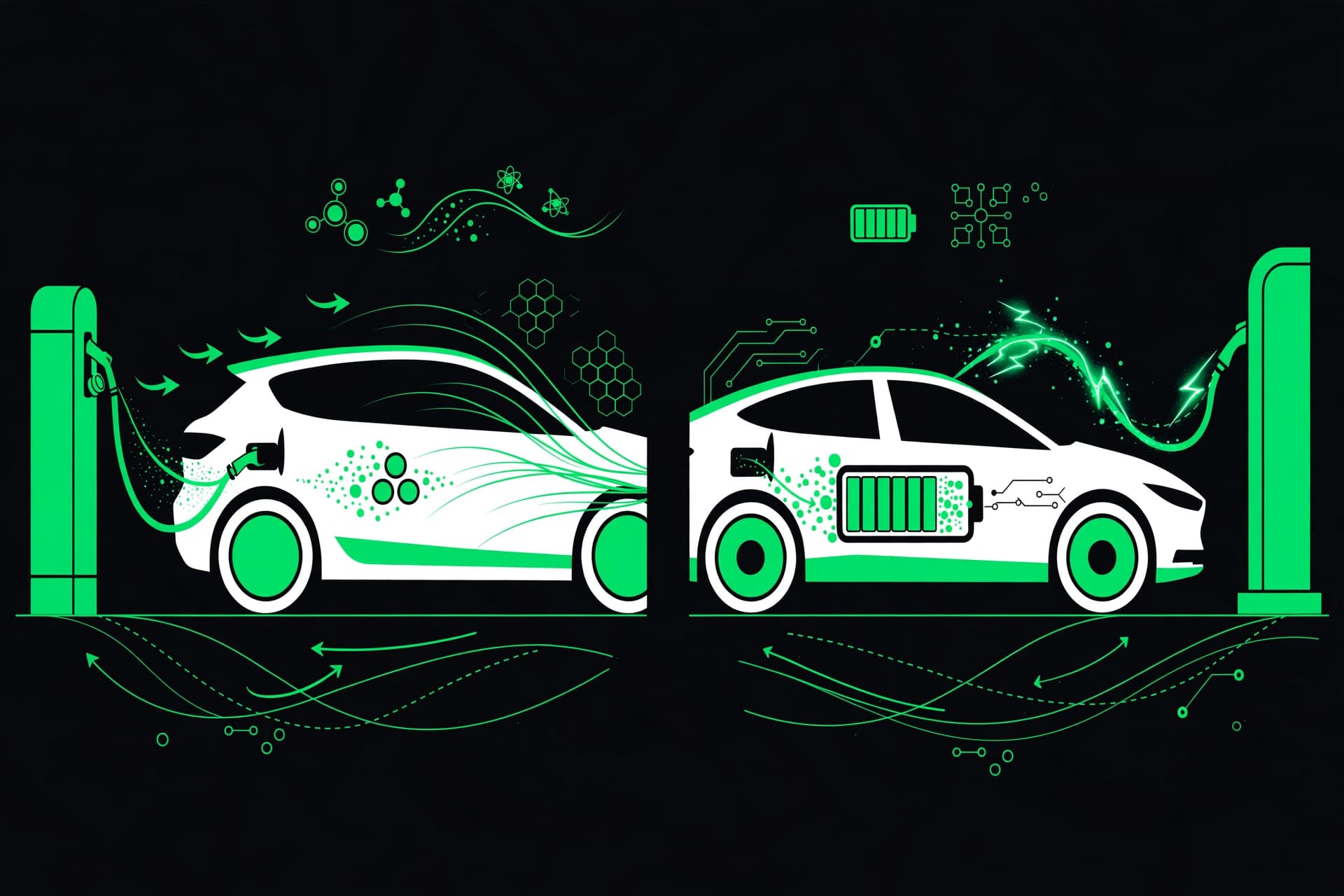
- California had 42 open retail hydrogen stations in September 2026, with 87 percent network availability, against 83,667 electric charging locations and 263,141 ports counted by the US Alternative Fuels Data Center on 2 November 2026.
- A fuel cell stack can exceed 60 percent conversion efficiency on the US Department of Energy definition, while a typical electric vehicle returns 87 to 91 percent of stored energy to the wheels on a different Department of Energy measure. The two figures describe different stages, so they cannot be ranked directly.
- Just over 19,000 fuel cell vehicles have been sold or leased in the United States since 2012, including 233 through August 2026, according to the Hydrogen Fuel Cell Partnership.
Hydrogen car: An electric car that carries hydrogen in a tank and uses a fuel cell to turn that hydrogen into electricity on board, instead of drawing stored electricity from a large battery charged from the grid.
The conversion chain decides the running cost before any showroom comparison begins. Hydrogen made from natural gas loses energy at production, loses energy again when it is compressed or liquefied for transport, and loses energy a third time inside the fuel cell. Electricity for a battery car loses energy in generation and transmission, then travels a shorter path from the charger to the motor. The US Department of Energy puts fuel cell conversion efficiency above 60 percent for the stack itself, and it puts a typical electric vehicle at 87 to 91 percent for stored energy delivered to the wheels after regenerative braking. Those definitions cover different stages of two different chains. A fair comparison needs the hydrogen production route and the local grid mix stated beside each number, and neither figure on its own settles the argument.
That distinction matters because almost all hydrogen sold today comes from fossil fuels. The International Energy Agency reported hydrogen production of 97 million tonnes in 2023, with less than 1 percent from low-emission sources, and it described renewable hydrogen as generally one and a half to six times more costly than unabated fossil-based production. The Alternative Fuels Data Center states that steam reforming of natural gas accounts for the majority of hydrogen produced in the United States, and that electrolysis uses more energy but can run on renewable electricity. A hydrogen car filled with hydrogen from natural gas and a battery car charged on a coal-heavy grid both carry upstream emissions that the tailpipe hides. The vehicle comparison below therefore separates the car, the fuel, and the network, because each part points in a different direction.
Why 42 hydrogen stations change the hydrogen car vs electric car math
The station count is the sharpest fact in the comparison, and the definitions behind it need care. The Hydrogen Fuel Cell Partnership reported 42 open retail hydrogen stations in California, with 87 percent network availability in September 2026. Availability had been near 60 percent in 2024 into 2025 and reached 90 to 95 percent by the end of 2025 after equipment upgrades and on-site staff, before a February 2026 gaseous supply disruption took 21 stations offline. Twelve stations returned through a secondary supply, and 13 remained unavailable, nine of them because of the disruption. Air Products closed its Diamond Bar and Torrance stations in 2026. The California Air Resources Board counted 61 hydrogen fueling stations in California as of 29 August 2025, a total-station count on an earlier date with a different definition. The Alternative Fuels Data Center counted 44 hydrogen stations in the United States on 2 November 2026, with 42 of them in California, split between 38 retail and six non-retail stations. Readers should attach the date and the definition to every station figure, because the counts move and the categories differ.
Electric charging sits on a different scale and a different unit. The Alternative Fuels Data Center counted 83,667 electric charging station locations in the United States on the same date, with 263,141 charging ports, including 79,562 DC fast ports. California alone had 20,397 locations and 69,652 ports. A port is a single plug, while a hydrogen station is a whole site, so the totals are not like-for-like counts. The practical point survives the caveat. A battery car driver in most of the United States can plan a trip around charging that exists today. A hydrogen car driver plans a trip around a network concentrated in California, where the Hydrogen Fuel Cell Partnership says a little over 19,000 fuel cell vehicles have been sold or leased in the United States since 2012. For buyers outside California, the hydrogen car vs electric car question is settled by geography before price or range enters the discussion.
| Measure | Hydrogen fuel cell car | Battery electric car |
|---|---|---|
| Refuelling or charging sites, United States | 44 hydrogen stations on 2 November 2026 (Alternative Fuels Data Center) | 83,667 charging locations, 263,141 ports (Alternative Fuels Data Center) |
| California retail hydrogen availability, September 2026 | 87 percent across 42 open retail stations (Hydrogen Fuel Cell Partnership) | 20,397 charging locations in California (Alternative Fuels Data Center) |
| Typical fill or fast-charge time | About 5 minutes (Alternative Fuels Data Center) | Paid DC fast-charging sessions averaged 42 minutes in Department of Energy data for mid-2020 to mid-2023, excluding Tesla Superchargers |
| Efficiency figure, with definition | Fuel cell stack capable of exceeding 60 percent (US Department of Energy) | 87 to 91 percent stored-energy-to-wheels after regenerative braking (US Department of Energy) |
| Vehicles sold or leased in the United States | A little over 19,000 since 2012, including 233 through August 2026 (Hydrogen Fuel Cell Partnership) | About 746,000 battery-electric registrations in the first nine months of 2026 (PwC Autofacts, reported 29 October 2026) |
Fuel price decides the monthly bill, and California has no single 2026 average
No statewide average retail hydrogen price for 2026 was verified for this comparison, and a single figure should be treated with suspicion. The Hydrogen Fuel Cell Partnership reported that FirstElement Fuel cut prices at its True Zero stations from 36 dollars per kilogram to 25.99 dollars at liquid-supplied stations and 29.99 dollars at gaseous stations, a move its industry affairs director linked to Toyota taking a management stake in FirstElement Fuel. That is one operator, at its own stations, in one state. An older monthly average from S and P Global Commodity Insights put the California light-duty pump price at 34.55 dollars per kilogram on 1 October 2024. The older figure cannot be presented as a 2026 price. Buyers need the price at the stations they will actually use, on the week they buy, because hydrogen prices vary by station and supply route.
Toyota softens the fuel bill for early buyers with a large credit. The 2026 Toyota Mirai carries an EPA-estimated range of 402 miles and a starting price of 51,795 dollars before a 1,195 dollar dealer processing charge, according to Toyota. Purchases include 15,000 dollars of complimentary fuel or six years of fuel, whichever comes first, and leases include three years. The credit changes the first years of ownership a lot, and it also shows why the sticker fuel price alone misleads. A buyer who uses the credit, then pays the pump price in full, faces a step change in running costs when the credit ends. Hyundai took a different route with the all-new Nexo, projecting 826 kilometres of WLTP range from a five-minute refill, with 6.69 kilograms of hydrogen storage. That range is a European WLTP projection, and the release does not confirm United States availability, pricing, or an EPA range. Converting a WLTP projection into an EPA figure would invent a number, so this comparison leaves the two range figures in their own test cycles.
Automakers split on hydrogen while battery production keeps scaling
Stellantis ended its hydrogen fuel cell development programme on 16 July 2025 and cancelled the planned Pro One hydrogen van range, citing limited refuelling infrastructure, high capital requirements, and the need for stronger consumer incentives. General Motors said on 10 October 2025 that it would stop work on next-generation hydrogen fuel cell development under its Hydrotec brand and end production of hydrogen fuel cells for data centres and power generation through its joint venture with Honda, concentrating research and capital on batteries, charging, and electric vehicles. Honda then said on 20 January 2026 that it would discontinue production before the end of 2026 of the current fuel cell system built at the joint venture plant, while continuing with a next-generation system developed independently by Honda. Honda did not exit hydrogen. The three announcements together narrow the passenger hydrogen field to a small number of committed makers, led by Toyota and Hyundai, while the battery field keeps adding models, chargers, and factory capacity.
The retreat also has a freight dimension that buyers sometimes miss. Stellantis said it did not anticipate hydrogen adoption for light commercial vehicles before the end of the decade. That matters for the argument that cars will follow trucks, or trucks will follow cars, into hydrogen. Each segment needs its own stations, its own vehicle volumes, and its own fuel contracts. A hydrogen station built for cars serves a small fleet, and a station built for trucks needs a different location and throughput. The shared lesson from the three announcements is that infrastructure, capital cost, and incentives decided the outcome, and the technology readiness of the fuel cell itself was a smaller part of the story. Readers who want the colour system behind hydrogen claims can read the guide to grey, blue and green hydrogen colours, which separates production routes that the pump price hides.
What 233 fuel cell sales through August 2026 say about hydrogen cars
The sales figure puts the whole comparison in proportion. A little over 19,000 fuel cell vehicles sold or leased since 2012, with 233 added through August 2026, is a rounding error beside battery-electric registrations counted in the hundreds of thousands in a single quarter. Battery longevity data from 22,700 cars, covered in the analysis of how long EV batteries last, gives battery buyers a large real-world sample. Hydrogen buyers have a small sample, a concentrated network, and a fuel price that depends on a handful of stations and suppliers. The technology case for hydrogen stays open in niches where a five-minute fill and long range matter more than fuel cost, and where a station sits on a fixed route. The mass-market case in 2026 rests on a network build-out, a production shift toward low-emission hydrogen, and a fuel price that stays affordable after introductory credits expire. Until those three move together, the sensible default for most buyers is a battery car charged at home, with costs covered in the guide to Level 2 home charger installation cost, and a hydrogen car treated as a specialist choice for drivers who live near reliable stations and value the refill time above the fuel bill.
Sources: Alternative Fuels Data Center station counts; Hydrogen Fuel Cell Partnership webinar recap, October 2026; US Department of Energy fuel cells page; US Department of Energy Fact of the Week 1360; International Energy Agency Global Hydrogen Review 2024; Toyota 2026 Mirai release; Hyundai Motor Group Nexo release; Stellantis release, 16 July 2025; General Motors release, 10 October 2025; Honda release, 20 January 2026; California Air Resources Board annual hydrogen evaluation.
Frequently asked questions
Is a hydrogen car an electric car?
Yes, in the sense that an electric motor drives the wheels. The difference is the source of the electricity. A hydrogen car makes electricity on board in a fuel cell, while a battery car stores electricity in a battery charged from the grid.
How long does it take to refuel a hydrogen car?
The Alternative Fuels Data Center puts refuelling at about 5 minutes, with retail dispensers filling light-duty tanks in 3 to 5 minutes. The time at a specific station depends on pressure, temperature, and the remaining fuel level.
How many hydrogen stations are there in the United States?
The Alternative Fuels Data Center counted 44 hydrogen stations on 2 November 2026, with 42 in California. The Hydrogen Fuel Cell Partnership counted 42 open retail stations in California in September 2026. The counts differ by date and definition, so both figures need their date attached.
How much does hydrogen fuel cost?
There is no verified statewide average for 2026. FirstElement Fuel cut True Zero prices to 25.99 dollars per kilogram at liquid-supplied stations and 29.99 dollars at gaseous stations, according to the Hydrogen Fuel Cell Partnership. Buyers should check the price at the stations they will use.
Should I buy a hydrogen car or a battery electric car in 2026?
Most buyers should choose a battery car, because charging exists across the country and the running cost is easier to predict. A hydrogen car suits drivers who live near reliable California stations, drive long distances on fixed routes, and value a five-minute fill above the fuel bill.